AI News6 min readBy JH Akash
ChatGPT Wallet: AI Agents Buy, Face ID Approves
OpenAI's ChatGPT Wallet, launched Nov 13, lets dots agents check out for you without ever seeing your card number. Every purchase still needs your Face ID. Here is how it works, who can use it, and what it costs.
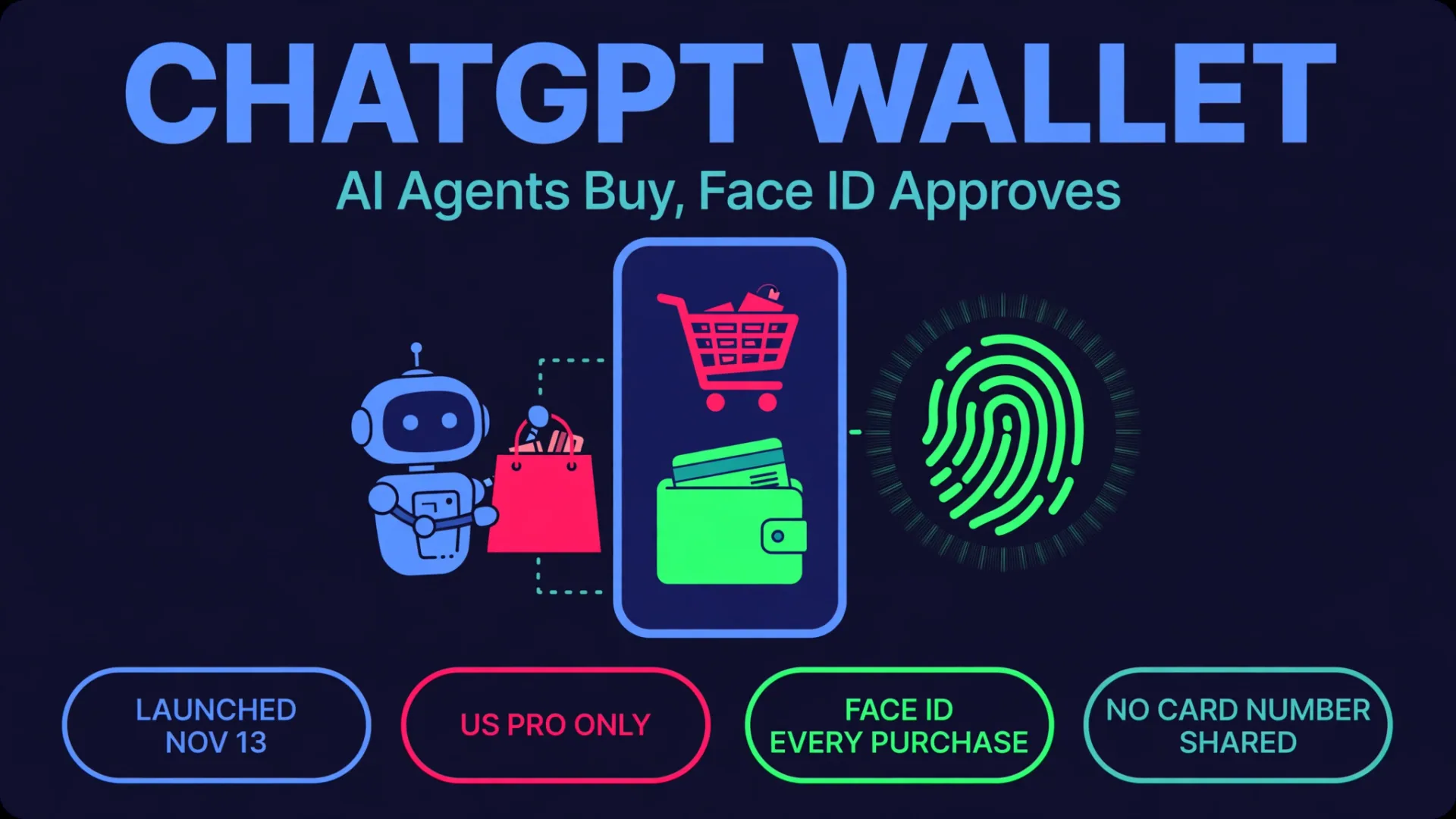
OpenAI just gave its AI agents a way to spend your money. ChatGPT Wallet, announced on November 13, 2026, lets the always-on dots agents inside ChatGPT find something, buy it, and check out for you. The catch that makes it interesting: your agent never sees your real card number, and nothing gets bought until you approve it with Face ID or a fingerprint.
This is the first time a major chatbot has put a payment rail directly inside an agent. It is also the clearest sign yet that agentic commerce is moving from demos to real checkouts.
Quick verdict
| Question | Answer |
|---|---|
| What is it? | A wallet inside ChatGPT that lets dots agents pay for things on your behalf |
| Launched | November 13, 2026 |
| Who can use it | US ChatGPT Pro subscribers, 18 and older, with an eligible US-issued card |
| How approval works | You review the items, total, and card, then approve every purchase with Face ID or a fingerprint |
| What the agent sees | A one-time payment token from the card network, never your real card number |
| Extra fee | None at launch, OpenAI takes no cut of transactions |
| Preapproved auto-buying | Planned, with spending limits, but no date given |
How ChatGPT Wallet works
Wallet runs inside dots, the always-on agents OpenAI introduced on September 29 at DevDay. A dot has its own cloud computer and browser, connects to more than 4,000 apps, and can now carry a purchase all the way through checkout.
The flow has four steps:
- Save a card once. You add an eligible Visa, Mastercard, or American Express card to ChatGPT Wallet. The wallet was built with all three networks.
- Ask your dot to buy something. Your dot finds the item and prepares the checkout on the merchant's normal checkout page. No special Wallet integration is needed on the merchant side.
- Review and approve. The dot shows you the items, the total, and the card it will use. You approve with a security check such as Face ID or a fingerprint scan. Every purchase needs this approval.
- Tokenized payment. After approval, the card network issues a payment token, a substitute containing a card number, security code, and expiration date. The merchant and the agent are charged through the token, so neither ever receives your actual card details.
Each approval creates a record of what you authorized the agent to buy. That paper trail matters, because the agent is making the choice and you are only confirming it.
What it costs
Wallet itself costs nothing extra, and OpenAI says it takes no share of transactions at launch. The real cost is the subscription, because Wallet only works through dots, and dots is a Pro feature.
| ChatGPT plan | Monthly price | ChatGPT Wallet |
|---|---|---|
| Free | $0 | No |
| Go | $8 | No |
| Plus | $20 | No |
| Pro 100 | $100 | Yes, via dots |
| Pro 200 | $200 | Yes, via dots |
| Pro 500 | $500 | Yes, via dots |
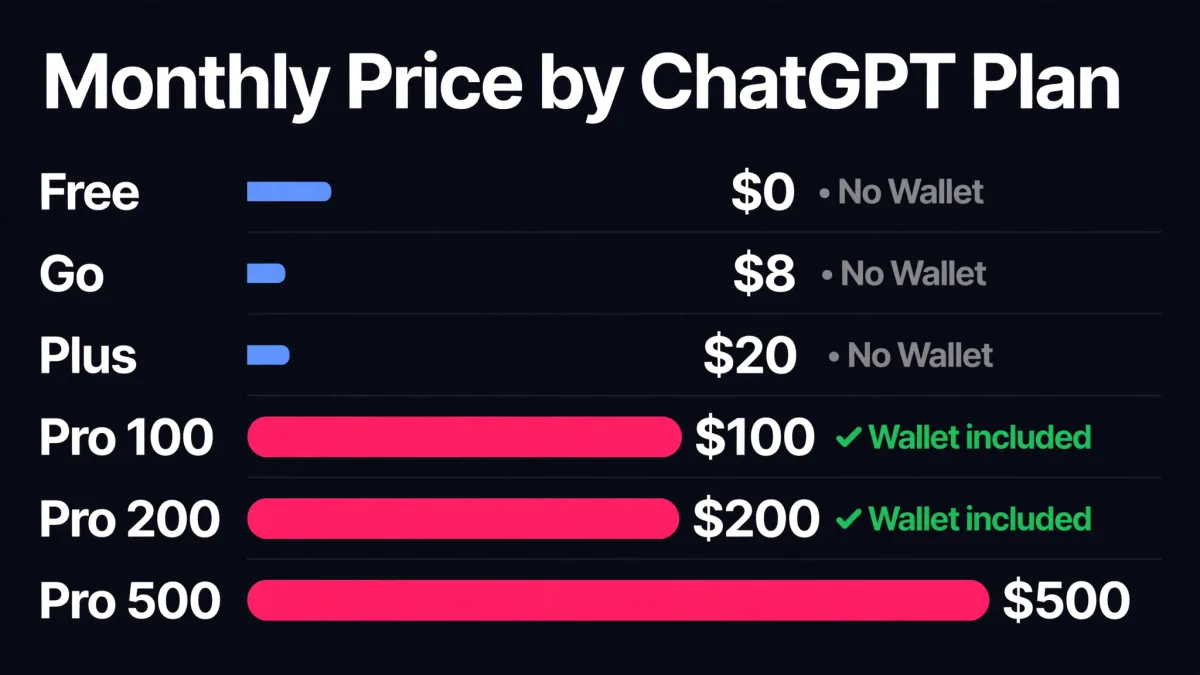
So the cheapest way into Wallet is Pro 100 at $100 a month. Plus subscribers at $20 a month get nothing here, and OpenAI has given no timeline for bringing Wallet to Plus, free users, or customers outside the US.
ChatGPT Wallet vs Amazon Buy for Me
OpenAI is not the first to let an AI agent buy things. Amazon launched Buy for Me in April 2025, and the two approaches show how differently the same idea can be built.
| ChatGPT Wallet | Amazon Buy for Me | |
|---|---|---|
| Launched | November 13, 2026 | April 2025 |
| Agent | OpenAI dots | Amazon agentic AI on Bedrock, using Nova and Claude |
| Where it shops | Any merchant checkout page, through dots | 400,000+ brand sites, from inside the Amazon app |
| Who can use it | US ChatGPT Pro subscribers, 18+ | A subset of US Amazon app users |
| Per-purchase approval | Required every time, Face ID or fingerprint | Confirm at Amazon checkout; auto-buy at a price target is also possible |
| Card handling | Network token, real card number never shared | Encrypted payment details sent to the brand site |
| Fee | None at launch | No commission during beta |
| Returns | Merchant's own policy | Amazon returns policy and A-to-Z guarantee do not apply |
| Limits | One approval per purchase, for now | One item per order, no promo codes |
The biggest difference is control. Wallet makes your biometric approval the single checkpoint on every purchase. Amazon's model leans on its own checkout confirmation and can even auto-buy when a price target is hit. Wallet is also open-ended, it works on any merchant's existing checkout, while Buy for Me keeps you inside the Amazon app.
What Wallet cannot do yet
- No hands-free buying. Preapproved purchases within spending limits, product categories, or time windows are planned, but OpenAI has given no date. Today, every single purchase needs your tap.
- No international rollout. US only, Pro only, 18 and older, US-issued card with a US billing address.
- Some merchants block it. OpenAI says some merchants are blocking agent purchases, and websites need to make sure agents are not inadvertently blocked.
- Disputes are untested. Chargeflow found no CFPB guidance covering agent purchases, so federal dispute rules have not clearly been applied to what happens when an approved agent purchase goes wrong.
- Approval is not a guarantee. Approving a transaction does not automatically mean the order was placed. You still need confirmation from the merchant.
OpenAI is working with fraud-prevention partners Forter, Riskified, Sardine, and Signifyd, plus payment providers Adyen, Checkout.com, and Stripe, to make agent checkouts trustworthy for merchants.
Which one should you pick?
Pick ChatGPT Wallet if you already pay for ChatGPT Pro, you want an agent that can shop anywhere on the web, and you like the idea that a Face ID tap stands between the agent and your money.
Pick Amazon Buy for Me if you mostly shop inside the Amazon app, you want an agent that finds products Amazon itself does not sell, and you are fine with the brand handling fulfillment and returns.
Pick neither yet if you are on ChatGPT Plus or Free, or you live outside the US. Wallet is not available to you, and there is no date for when that changes.
The deeper story is not the wallet itself. It is that OpenAI, Amazon, and Google are all racing to own the moment an AI agent pays. Whoever controls that checkout controls the commission, the data, and the customer relationship. Wallet is OpenAI's opening move, and the Face ID approval is its answer to the obvious question: who is responsible when an agent buys the wrong thing?
For now, the answer is you, one fingerprint at a time.
Read next
- Claude Fable 5.2: #1 at 65, 20% Cheaper, 30% Faster
- How to Build an AI Agent: 8 Steps, $15K-$350K
- Gemini 4 Carbon vs Claude Fable 5.2: $2 vs $8
- Qwen4-Max Preview: 14 Days Live, 1M Context, No Price
Is ChatGPT Wallet free to use?
Yes, Wallet itself has no extra fee and OpenAI takes no cut of transactions at launch. But it only works through dots, which is a Pro feature, so the cheapest access is Pro 100 at $100 a month.
Does the AI agent see my credit card number?
No. After you approve a purchase with Face ID or a fingerprint, the card network issues a one-time payment token. The agent and the merchant only ever see the token, never your real card number, security code, or expiration date.
Can ChatGPT Wallet buy things without my approval?
Not today. Every purchase requires your review and a biometric approval. OpenAI plans to allow preapproved purchases within spending limits later, but has given no date for that.
Who can use ChatGPT Wallet?
Only a limited number of US ChatGPT Pro subscribers aged 18 and older with an eligible US-issued Visa, Mastercard, or American Express card and a US billing address. Plus and free users cannot use it yet, and there is no timeline for other countries.
What happens if an agent buys the wrong item?
You approve every purchase before it is charged, and each approval creates a record. But dispute rules for agent purchases are untested: there is no clear CFPB guidance yet on who is liable when an approved agent purchase goes wrong. Returns follow the merchant's own policy.
Sources
- TechCrunch, "ChatGPT's new Wallet lets AI agents shop and check out for you", November 13, 2026
- OpenAI, "Introducing ChatGPT Wallet", November 13, 2026
- Unite.ai, "OpenAI Launches ChatGPT Wallet for Agent-Assisted Purchases", November 13, 2026
- AI Affairs, "OpenAI launches ChatGPT Wallet for purchases made by its dots agents", November 13, 2026
- ChatGPT Wallet
- OpenAI
- AI agents
- agentic commerce
- dots