AI6 min readBy JH Akash
Custom AI vs Off-the-Shelf AI: 76% Buy First
Off-the-shelf AI starts at $50 a month and goes live in weeks. Custom AI costs $100K or more and takes months. Here is how to choose, with 2025 numbers.
Buy off-the-shelf AI when a ready tool already solves the problem. Build custom AI when the work touches your own data, your own rules, or a process no vendor understands. Most companies should do both: buy the commodity parts, and build only what makes them different.
The build vs buy question is not about which is better. It is about which part of your business is generic, and which part is yours alone.
Custom AI vs Off-the-Shelf AI at a Glance
| Off-the-shelf AI | Custom AI | |
|---|---|---|
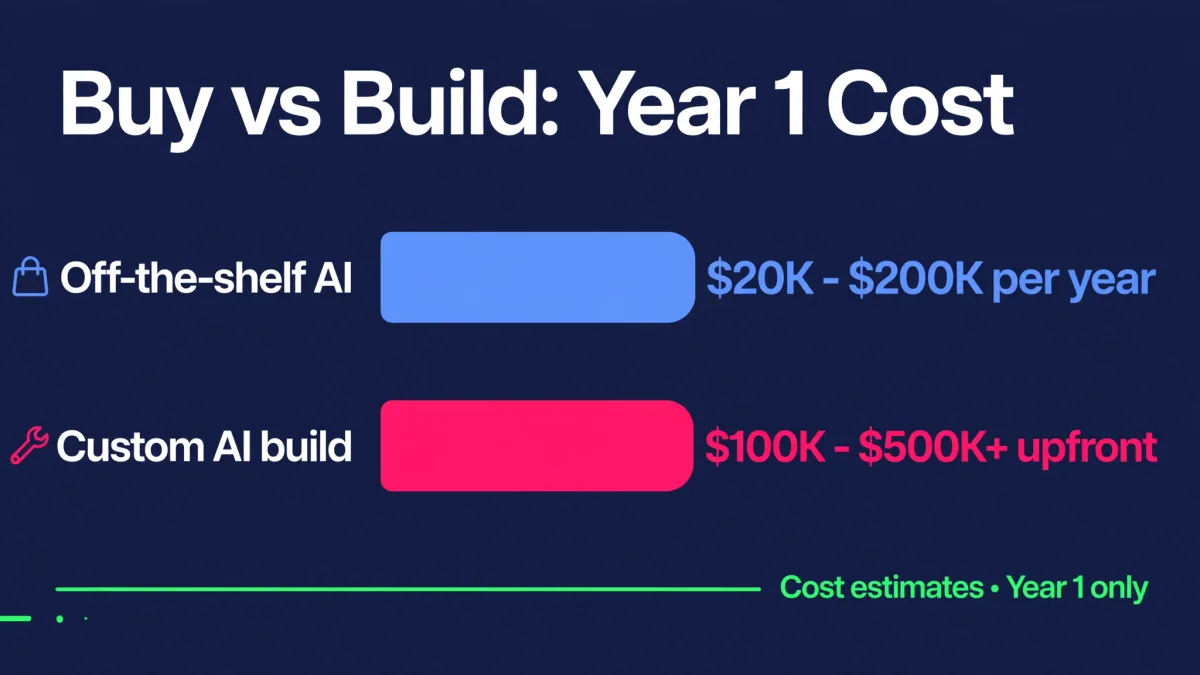
| Upfront cost | $0 to $5K setup | $100K to $500K+ |
| Monthly cost | $50 to $300 per tool, up to $1,500 for platforms | $500 to $2,000 maintenance |
| Time to value | Days to weeks | 6 to 12 months |
| Control over data and rules | Limited, vendor decides | Full, you decide |
| Fit to your workflow | You adapt to the tool | The tool adapts to you |
| Vendor lock-in | High | None |
| Best for | Standard tasks: support, drafting, scheduling | Core processes that set you apart |
What the 2025 Data Actually Says
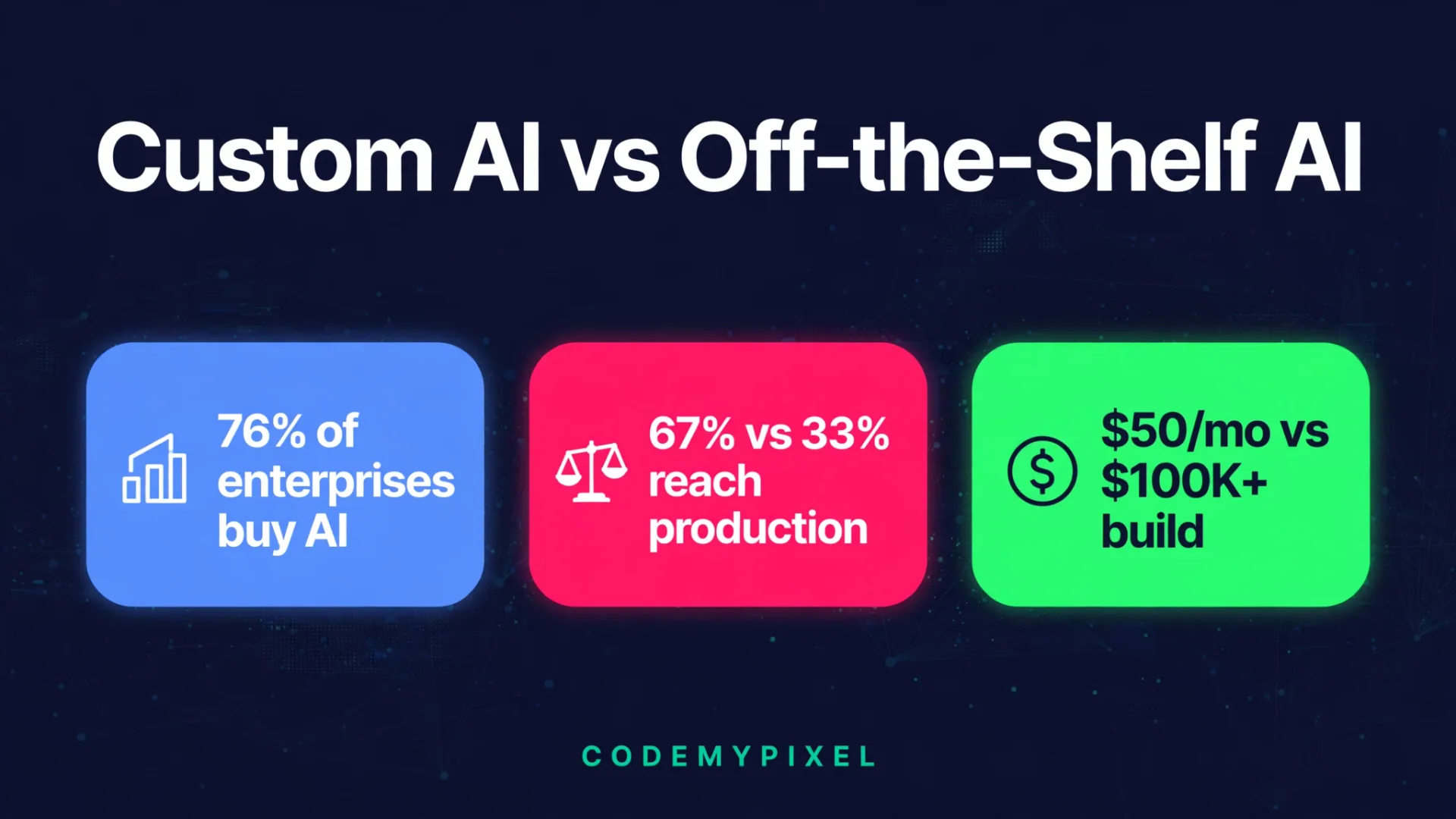
The market has already voted, and the vote is not close. Menlo Ventures surveyed 495 enterprise decision-makers in 2025 and found 76% of enterprise AI use cases were bought, not built, up from 53% a year earlier. Buying overtook building in a single year.
The success gap is just as wide. MIT's NANDA research from 2025 found that vendor or partner-led deployments reached production about 67% of the time, versus about 33% for purely internal builds. And McKinsey's State of AI 2025 survey found 88% of organizations now use AI in at least one business function, but only 39% report any EBIT impact, and only 6% qualify as high performers with 5% or more EBIT impact from AI.
Gartner added a warning in June 2025: it predicted over 40% of agentic AI projects will be cancelled by the end of 2027, mostly over unclear value and rising costs. The lesson is not that AI fails. It is that picking the wrong path for the wrong job is what fails.
When to Buy Off-the-Shelf AI
Buy when the task looks the same in every company. Customer support replies, meeting notes, drafting, scheduling, basic analytics: thousands of businesses need these, so vendors have already solved them well.
Buy when you need value this month, not next quarter. An off-the-shelf tool can be running in days. Buy when your team is small and nobody owns maintenance, because the vendor handles updates, security, and model improvements for you. And buy when a tool already covers 80% or more of the need. The last 20% is rarely worth a six-figure build.
When to Build Custom AI
Build when the process is your edge. Pricing, underwriting, quoting, triage, anything with rules that exist only in your business: a generic tool will keep forcing your business into someone else's shape. Our guide on what custom AI development is covers how that kind of build works.
Build when the AI must read and write across your CRM, ERP, and databases instead of living inside one app. An AI agent that cannot touch your real systems is a demo, not a product. Our guide on how to build an AI agent walks through what that integration looks like.
Build when data privacy or compliance rules mean customer data cannot leave your systems, and when off-the-shelf tools keep failing on your edge cases. If your team spends more time working around the tool than the tool saves, the tool is the wrong one.
The Hidden Costs Both Sides Forget
The sticker price is never the real price. A three-year total cost of ownership on a custom build commonly runs 1.5x to 2x the initial price once retraining, integration, and maintenance are counted. On the buying side, AI vendor pricing rises 20% to 37% a year, two to four times the rate of traditional software, so a $500 a month platform becomes roughly $685 in year two. Spend on AI-native applications averaged $1.2 million a year per organization, up 108% year over year, according to Zylo's 2026 SaaS Management Index, and 78% of IT leaders reported unexpected charges tied to consumption-based AI pricing.
One cost hits both paths equally: data preparation typically consumes 40% to 60% of total project effort, whether you buy or build. Bad data breaks a bought tool and a custom model the same way. See the full cost breakdown in our AI development cost guide and the payback math in our AI ROI guide.
The Hybrid Answer Most Companies Land On
The smartest answer in 2026 is rarely pure buy or pure build. KPMG found 57% of organizations favour a blend of building and buying AI agents, and 65% of successful AI products use a hybrid approach: buy commodity AI capabilities, build only the components that create competitive advantage.
Gartner's 2025 analysis backs the blend: companies that matched build vs buy decisions to their competitive strategy delivered AI products 2.5x faster and at 40% lower total cost than companies that defaulted to building everything or buying everything.
The rule is simple. Buy the commodity, build the differentiator. Buy first to prove the value, then build the custom layer where the bought tool stops fitting.
A 5-Question Decision Checklist
1. Is this task the same in every company, or specific to ours? Same everywhere means buy. Specific to us means build.
2. Does it need our data and systems to work, or is generic knowledge enough? Our data and systems mean build.
3. Do we need it live in weeks, or can we wait months? Weeks mean buy. Months of runway mean build is possible.
4. Who maintains it in year two? No owner means buy, because the vendor maintains it. A named owner means build is viable.
5. What happens if the vendor doubles the price or shuts down? If the answer is painful, that risk alone can justify building.
FAQ
Is custom AI always more expensive than off-the-shelf AI?
Upfront, yes. A single custom workflow runs $5,000 to $25,000, and a full custom build runs $100,000 to $500,000 or more. Off-the-shelf tools start at $50 to $300 a month. Over three years the gap shrinks, because subscriptions rise 20% to 37% a year while a custom build flattens after 18 to 24 months.
How long does each option take to go live?
Off-the-shelf AI goes live in days to weeks. Custom AI takes 6 to 12 months to build and deploy. If the need is urgent, buy first and build later.
Which option is more likely to reach production?
Vendor or partner-led deployments reach production about 67% of the time, versus about 33% for purely internal builds, according to MIT NANDA 2025. Buying first is the lower-risk start for most teams.
Can I combine custom AI and off-the-shelf AI?
Yes, and most successful teams do. Buy tools for standard work, then build a custom layer on top for the parts that make your business different. 57% of organizations favour this blend, according to KPMG 2026.
When is custom AI the right choice?
When the AI must follow your own rules, use your own data, and connect to your own systems. If the process is your competitive edge, a generic tool will keep forcing your business into someone else's shape.
- custom ai vs off the shelf ai
- custom ai
- off-the-shelf ai
- build vs buy ai
- ai agents