AI7 min readBy JH Akash
What Is Custom AI Development? $10K to $500K Reality
Custom AI development builds AI around your own data, workflows and goals instead of forcing your business into a generic tool. Here is what it is, what it costs, and when it is worth it.
Custom AI development is the process of building an artificial intelligence system around one specific business: its data, its workflows, its rules and its goals, instead of buying a generic tool and adapting the business to fit it.
That one sentence is the whole idea. A generic tool is built for the average of many customers. Custom AI is built for the specifics of one. The model learns from your data, plugs into the systems you already run, and follows your rules, not a vendor's defaults.
Custom AI is not a fancier chatbot. It is your business knowledge, turned into software that works while you sleep.
What Custom AI Development Actually Means
Three things have to be true for a system to count as custom AI:
1. A model targeted at your problem. It is built from scratch, fine-tuned from a foundation model, or assembled from components, but it is trained or grounded on data specific to you. Keeper Tax, for example, raised its AI accuracy from 85% to 93% by fine-tuning GPT-3 with just 500 new training examples each week. Sana Labs saw a 60% improvement in output quality after customizing GPT-3 with its own data.
2. Integration into your systems. The model reads from and writes to your CRM, ERP, databases and workflows, instead of living in an isolated tool. An AI agent that cannot touch your real systems is a demo, not a product. Our guide on how to build an AI agent walks through what that integration looks like in practice.
3. Production operation. It runs reliably, is monitored for accuracy, and is governed for security and compliance. A pilot that works once in a notebook is not custom AI development. A system your team trusts every day is.
Why Businesses Are Investing Now
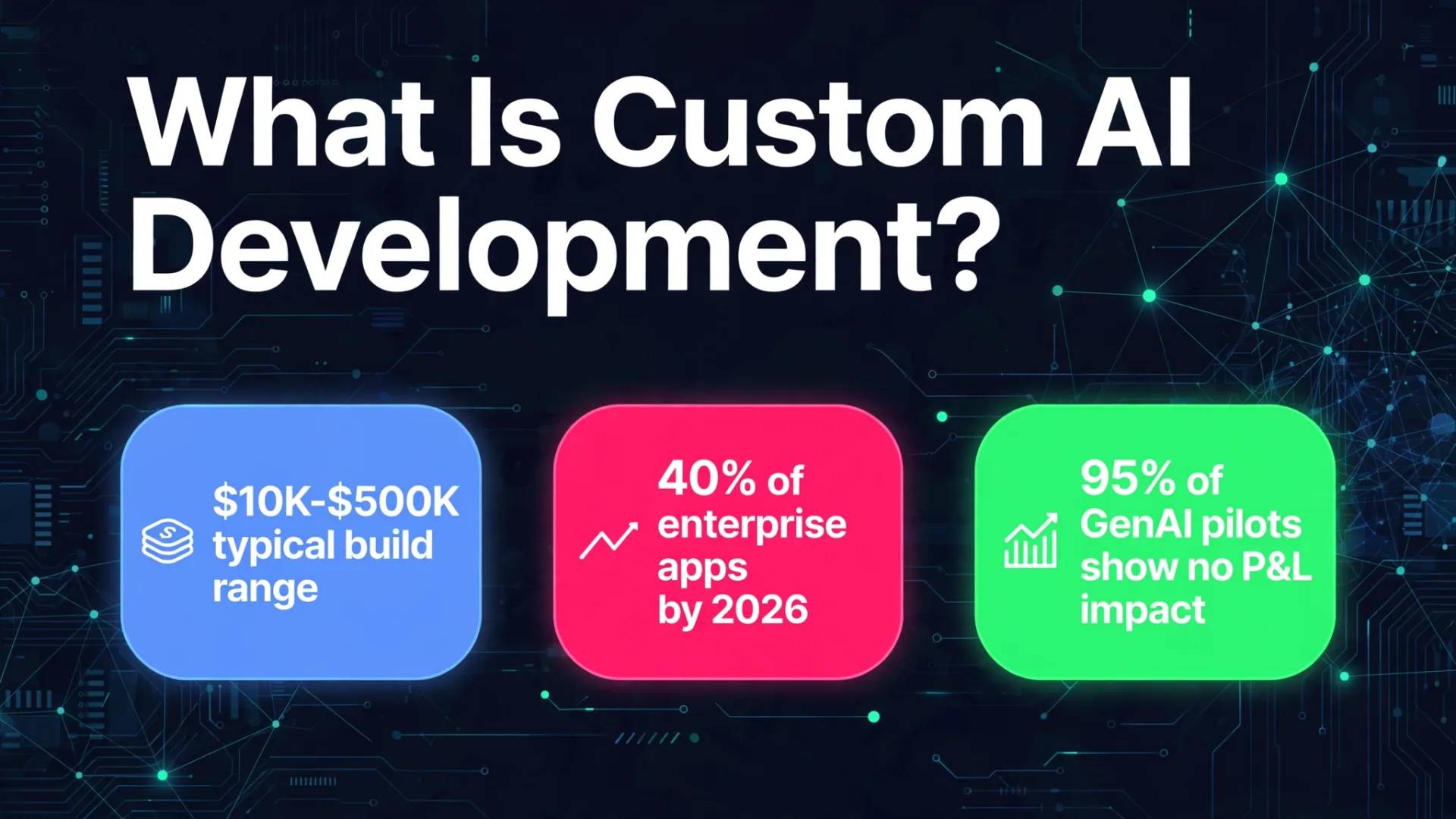
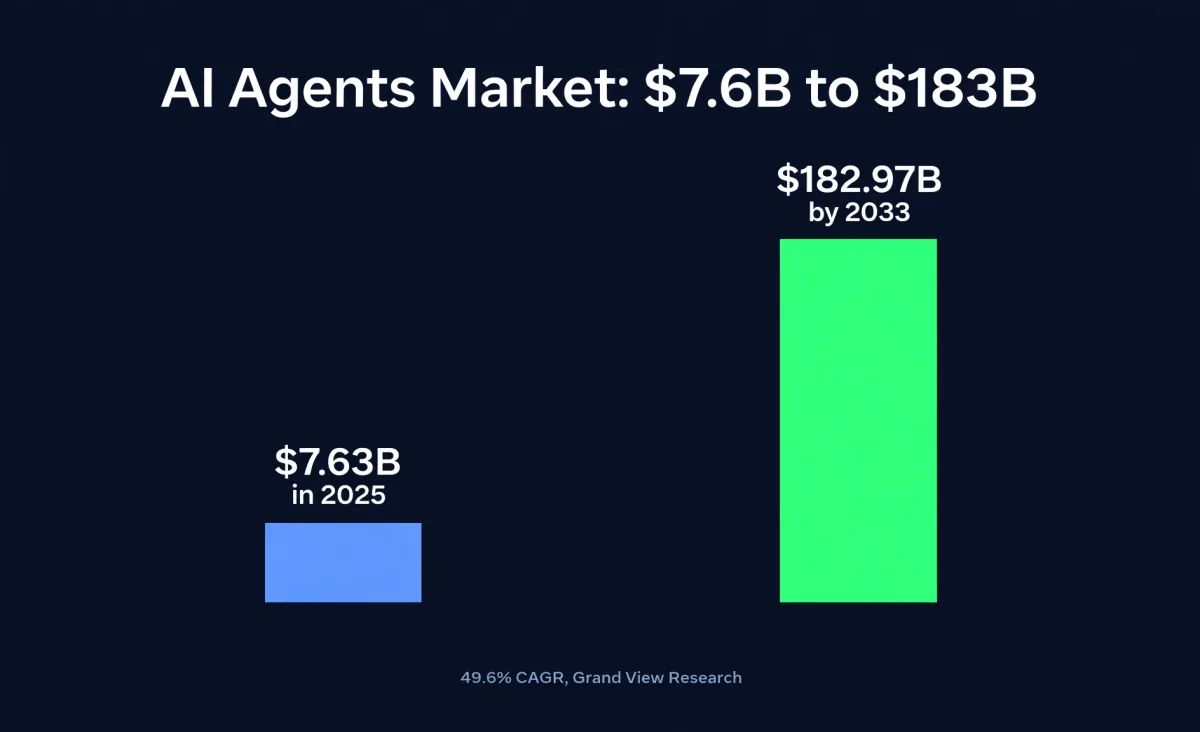
The market is moving fast. Gartner expects 40% of enterprise applications to feature task-specific AI agents by the end of 2026, up from under 5% in 2025. Grand View Research puts the global AI agents market at $7.63 billion in 2025, growing to a projected $182.97 billion by 2033, a 49.6% compound annual growth rate. And McKinsey's 2023 research found current generative AI technology can automate tasks that take up to 70% of employees' time.
That is the opportunity. The catch is that most of it is being captured by systems built around real workflows, not by generic tools. Custom development is how a business turns its own data into an advantage competitors cannot copy by buying the same subscription.
Custom AI vs Off-the-Shelf AI
| Custom AI | Off-the-shelf AI | |
|---|---|---|
| Built for | Your data, workflows and rules | The average customer |
| Accuracy on your tasks | Higher, improves with your feedback | Fixed, generic |
| Data control | Full, stays in your systems | Vendor's cloud, vendor's terms |
| Integration | Deep, into CRM, ERP and tools | Limited to what the vendor supports |
| Upfront cost | $10K to $500K+ | $5 to $50 per user per month |
| Time to value | Weeks to months | Days |
| Competitive edge | Proprietary, hard to copy | Same tool your competitors buy |
Neither side wins by default. The right choice depends on whether the problem is central to your advantage or just a commodity task. Our comparison of custom AI vs off-the-shelf AI thinking applies here too: buy what is standard, build what makes you different.
What Custom AI Is Used For
Process automation at scale. Document classification, invoice processing, onboarding and compliance checks, automated against your own rules and formats. A logistics operator can forecast delivery delays from its own history of weather, traffic and route data, which no generic tool can model.
Predictive analytics. Generic dashboards report what happened. A model trained on your history predicts what will happen: churn, demand, early signs of equipment failure.
Personalized customer experience. Recommendations, dynamic pricing and support that adapt to your specific customer segments and behaviour.
AI agents that do real work. Agents that read your inbox, update your CRM, draft replies and escalate the tricky cases to a human. At CodeMyPixel, this is our core work: AI agents that automate business tasks, built around the way a team already works.
Domain-specific intelligence. The problems too specialised for any product to address: a bank's fraud engine on its own transaction data, a clinic predicting IVF outcomes from embryo data, a retailer running dynamic pricing on supply and demand.
How Much Does Custom AI Development Cost in 2026
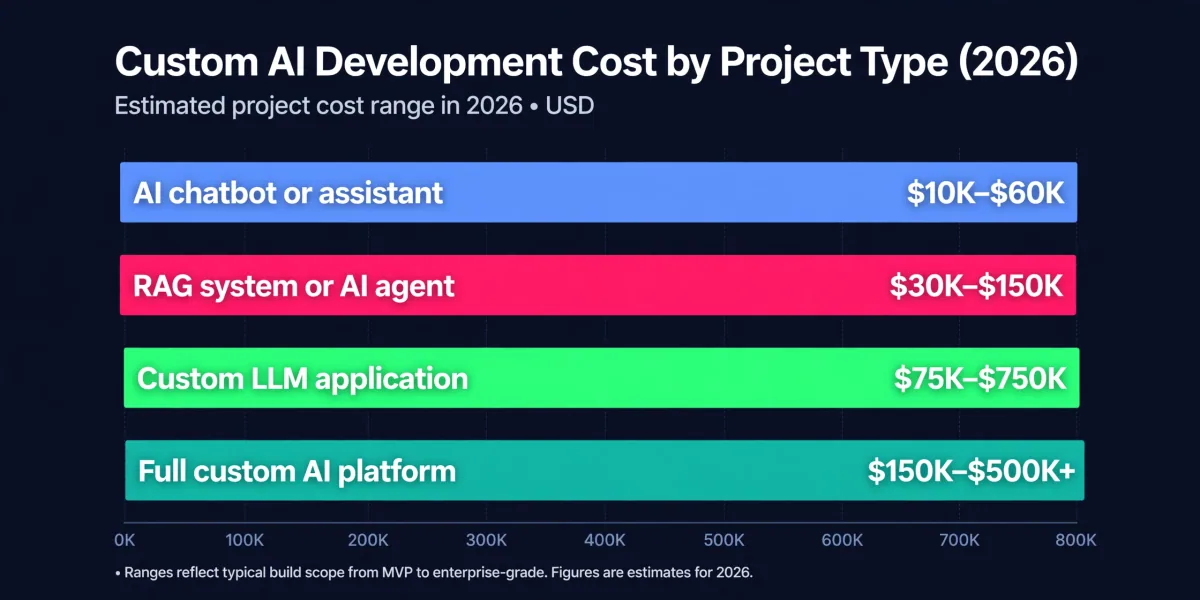
| Project type | Typical cost (2026) | Timeline |
|---|---|---|
| AI chatbot or assistant | $10,000 to $60,000 | 3 to 8 weeks |
| RAG system or AI agent | $30,000 to $150,000 | 6 to 12 weeks |
| Custom LLM application | $75,000 to $750,000 | 3 to 6 months |
| Full custom AI platform | $150,000 to $500,000+ | 4 to 12 months |
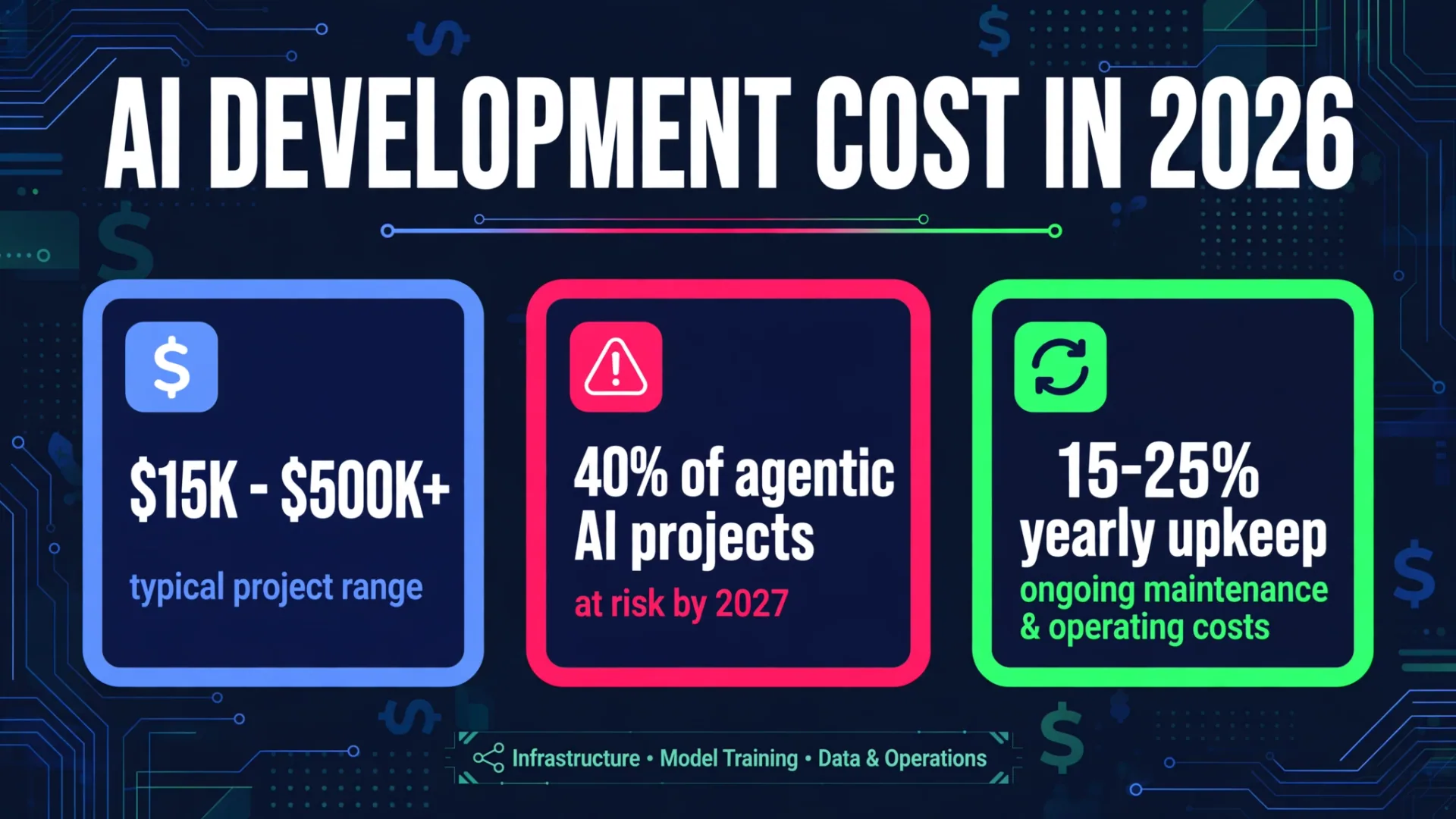
These are vendor-published planning ranges, not quotes. Data preparation usually takes 30% to 50% of the budget, and annual running costs add another 20% to 35% of the build cost for compute, updates and monitoring. For a full breakdown, see our AI development cost guide.
When Custom AI Is Worth It (and When It Is Not)
Build custom when:
- The use case is central to your competitive advantage
- Your data is proprietary, sensitive or regulated
- Generic tools underperform on your niche tasks
- The cost per use of a vendor tool exceeds the cost of running your own system at scale
Buy off-the-shelf when:
- The task is standard: scheduling, transcription, generic support
- You need value this week, not this quarter
- Your data gives you no special edge on this problem
- The vendor tool already does 90% of what you need
A useful rule: buy what is standard, build what makes you different.
How a Custom AI Project Works
- Define the outcome. One measurable result, such as cutting support response time by half, not "add AI".
- Audit the data. What data exists, where it lives, and whether it is clean enough to train on. This is where most projects are won or lost.
- Build a small pilot. One workflow, one integration, real users, real data. Prove value before scaling.
- Measure against the baseline. Compare the pilot to how the work is done today. Our AI ROI guide shows how to run that math honestly.
- Ship, monitor, improve. Accuracy drifts, data changes, users find edge cases. A custom system needs an owner and a feedback loop, or it quietly decays.
The Risks Nobody Mentions
Custom AI fails more often than vendors admit, and the numbers are worth knowing before you spend:
- MIT research from 2025 found about 95% of enterprise generative AI pilots produced no measurable profit impact.
- Gartner predicts over 40% of agentic AI projects will be canceled by the end of 2027, citing escalating costs, unclear business value and weak risk controls.
- Vendor-led AI projects report around 67% success rates, while purely internal builds sit near 33%.
The pattern behind the failures is consistent: vague goals, messy data, no owner after launch, and pilots that never connect to real workflows. Custom AI development done well is the opposite of all four.
FAQ
What is custom AI development in simple terms?
Custom AI development means building an AI system for your specific business, trained on your data and wired into your tools, instead of using a generic product built for everyone.
How much does custom AI development cost?
Most projects cost $10,000 to $150,000 to build. Simple chatbots start around $10,000, RAG systems and AI agents run $30,000 to $150,000, and full custom platforms can exceed $500,000. Annual running costs add 20% to 35% of the build cost.
How long does it take to build custom AI?
A focused pilot takes 3 to 8 weeks. A production AI agent typically takes 6 to 12 weeks. A full custom platform takes 4 to 12 months, depending on integrations and compliance needs.
Is custom AI better than off-the-shelf AI?
It is better when the task is core to your business, your data is unique, or generic tools miss your requirements. It is worse when the task is standard and a vendor tool already does it well, because you pay more and wait longer for the same result.
What is the difference between custom AI and an AI agent?
Custom AI is the broader idea: any AI built for your business. An AI agent is one type of custom AI, a system that takes actions across your tools, like answering emails, updating records and following up, instead of just answering questions.
The Bottom Line
Custom AI development is building AI around your business instead of fitting your business around a product. It costs more upfront and takes longer than buying a tool, but it is the only way to turn your own data and workflows into an advantage nobody else can buy.
Start small, measure honestly, and build what makes you different. If the problem you want solved is the one your competitors cannot solve with a subscription, that is where custom AI earns its keep.
Want to see what custom AI could automate in your business? Talk to CodeMyPixel about an AI agent built around your workflows.
- custom ai
- ai development
- ai agents