AI News5 min readBy JH Akash
Claude Fable 5.2: #1 at 65, 20% Cheaper, 30% Faster
Anthropic launched Claude Fable 5.2 on Nov 9, 2026. It tops the Artificial Analysis Intelligence Index at 65, costs 20% less than Fable 5.1 at $8/$40 per 1M tokens, and runs up to 30% faster. Here are the benchmarks, the price, and the catch.
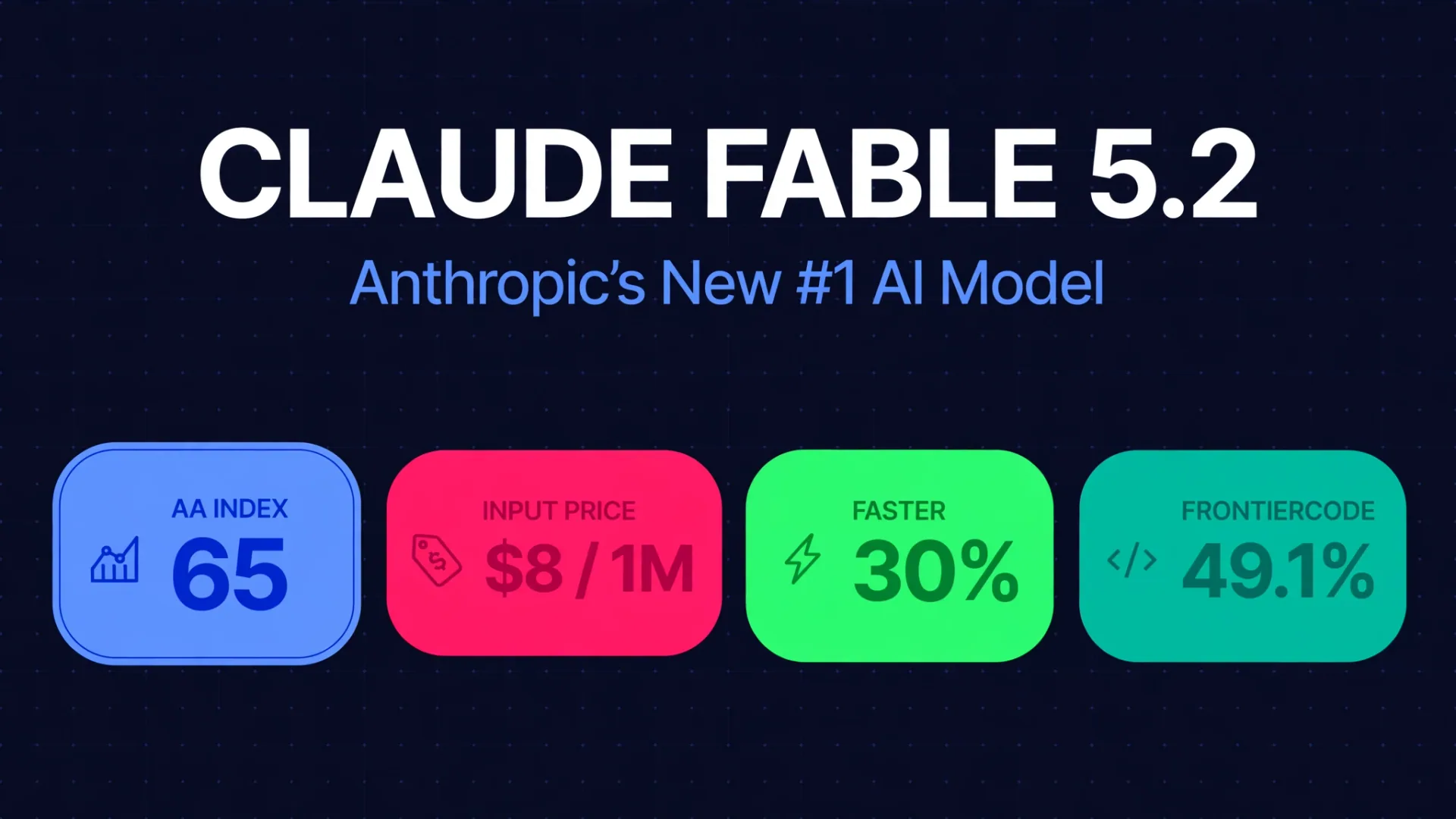
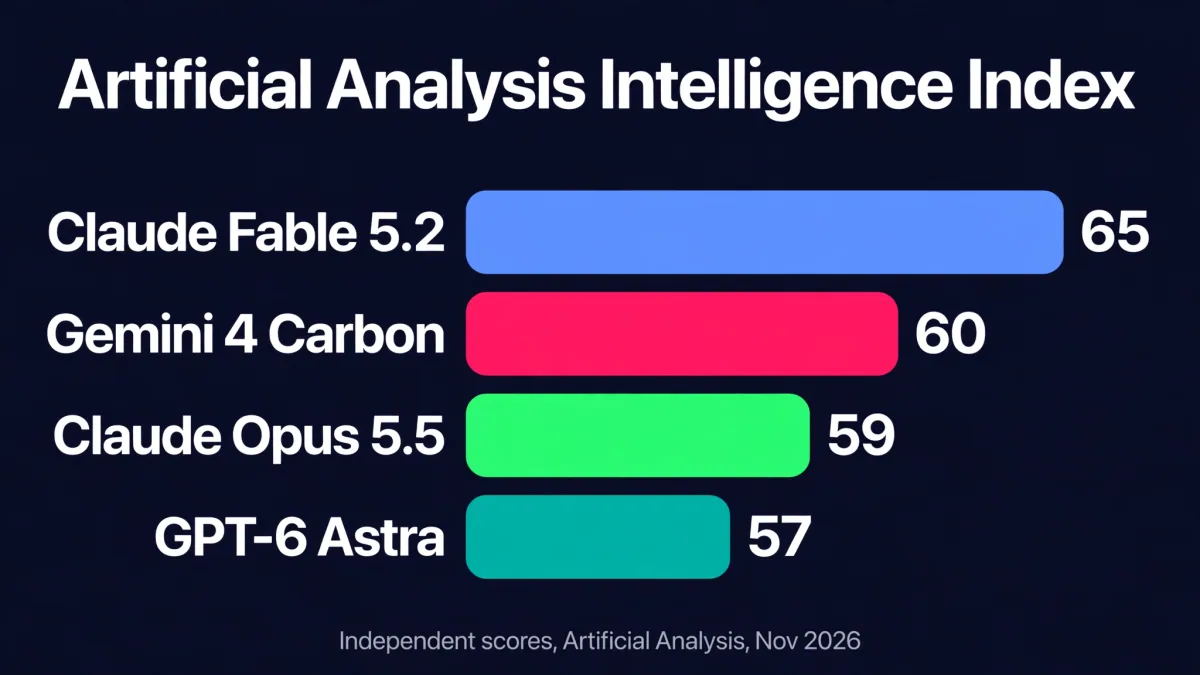
Anthropic shipped Claude Fable 5.2 on November 9, 2026, and it did something no Claude model has done before: it took the top spot on the Artificial Analysis Intelligence Index. The new model scores 65, ahead of Gemini 4 Carbon at 60, Claude Opus 5.5 at 59, and GPT-6 Astra at 57. It also costs 20% less than the model it replaces and runs up to 30% faster.
That combination, better scores and a lower price, is rare in AI launches. But the headline numbers hide a catch: at maximum effort, Fable 5.2 is one of the slowest and most expensive models per task. Here is what changed, what it costs, and who should actually use it.
Fable 5.2 at a glance
| Claude Fable 5.2 | |
|---|---|
| Launched | November 9, 2026 |
| Artificial Analysis Intelligence Index (independent) | 65, ranked 1st |
| Input price | $8 per 1M tokens |
| Output price | $40 per 1M tokens |
| Speed | Up to 30% faster than Fable 5.1 |
| Context window | 1M tokens |
| Knowledge cutoff | June 2026 |
| Model ID | claude-fable-5-2 |
| Available on | Claude paid plans, Claude Code, Claude Platform, AWS, Google Cloud, Azure |
What changed from Fable 5.1
The upgrade is three things at once: cheaper, faster, and stronger. Input price fell from $10 to $8 per million tokens and output from $50 to $40, a 20% cut on both. Output generation is up to 30% faster, and testers found the model communicates more clearly than the 5.1 version.
A new optional fast mode generates tokens up to 2.5 times faster for double the price, $16 input and $80 output per million tokens. Fable 5.1 is now a legacy model.
Anthropic also launched a restricted sibling the same day, Claude Mythos 5.2. It is the same underlying model without some cyber and biology safeguards, and it goes only to vetted organizations. Fable 5.2 is the version everyone else gets.
Price: what Fable 5.2 costs
| Model | Input per 1M tokens | Output per 1M tokens | Cache read per 1M tokens |
|---|---|---|---|
| Claude Fable 5.2 | $8 | $40 | $0.20 |
| Claude Fable 5.2, fast mode | $16 | $80 | - |
| Claude Fable 5.1 (legacy) | $10 | $50 | $0.25 |
| Claude Opus 5.5 | $4 | $20 | $0.20 |
| GPT-6 Astra | $10 | $50 | - |
Fable 5.2 now undercuts GPT-6 Astra by 20% at list price. But it still costs twice as much as Claude Opus 5.5, which is why Anthropic still recommends Opus 5.5 for everyday coding and knowledge work. Fable is for the most ambitious, open-ended technical work.
On the Claude plans, there is no free tier for Fable. Pro pays with usage credits, and Max and Ultra include it up to half the weekly limit during launch week.
Benchmarks: where Fable 5.2 leads
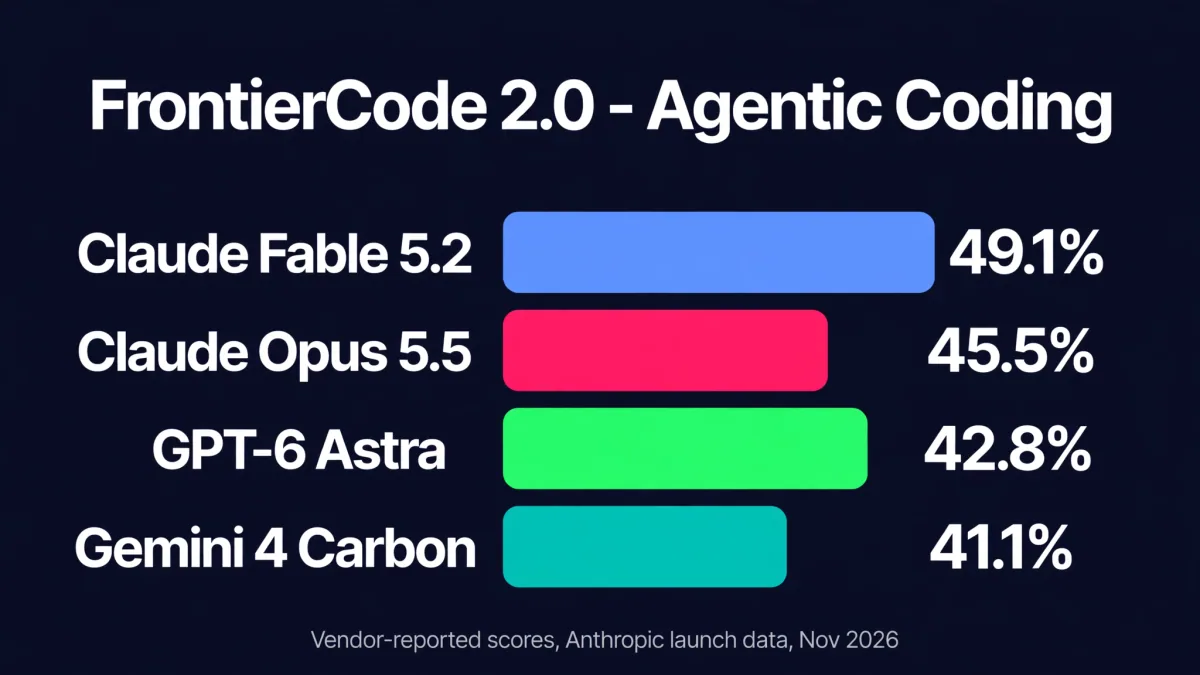
The scores below come from Anthropic's own launch table, so treat them as vendor-reported. Fable 5.2 leads every listed rival on agentic coding, and it leads Fable 5.1 on every benchmark Anthropic published.
| Benchmark (vendor-reported) | Fable 5.2 | Fable 5.1 | Opus 5.5 | GPT-6 Astra | Gemini 4 Carbon |
|---|---|---|---|---|---|
| FrontierCode 2.0 (agentic coding) | 49.1% | 32.4% | 45.5% | 42.8% | 41.1% |
| FrontierSWE v2 (agentic coding) | 69.9% | 56.3% | 62.3% | 65.5% | 61.2% |
| AutomationBench (business workflows) | 51.4% | 31.4% | 42.5% | 41.4% | 53.9% |
| WANDR (agentic search) | 82.1% | - | 72.3% | - | - |
Fable 5.2 does not win everything. Gemini 4 Carbon leads on AutomationBench, 53.9% against 51.4%, and Opus 5.5 keeps the higher AA-Briefcase Elo rating, 1800 against 1785. On Terminal-Bench 4.0, Fable 5.2 scored 60%, level with Opus 5.5 and behind Kimi K3.1 Pro, Gemini 4 Carbon, and Claude Sonnet 5.5.
Independent results back the ranking
Two outside testers published results on launch day. Artificial Analysis, which runs its evaluations independently, puts Fable 5.2 first on its Intelligence Index at 65 with maximum effort. Vals AI ranks it first of 36 models on the Vals Index at 71.31%.
But the independent data also shows the cost of the top score. At maximum effort, running the Artificial Analysis index cost an average of $26.54 per task, about 2.6 times as much as Opus 5.5, and at around 45 minutes per task, Artificial Analysis rates Fable 5.2 among the slowest models it tests. The same report notes Fable 5.2 at High effort scored about level with Opus 5.5 at Max effort on FrontierCode 2.0, 45.3% against 45.5%, for roughly half the cost per task. Effort level matters as much as the model name.
The catch: 30-day data retention
Unless Anthropic authorizes an exception, Fable 5.2 requires 30-day retention of prompts and completions. It is unavailable under zero data retention. Teams with strict data policies should check this before moving production workloads to Fable, even if the benchmarks look tempting.
Which model should you pick?
Pick Claude Fable 5.2 for the hardest work: long autonomous coding tasks, multi-step agent runs, and research-grade problems where accuracy beats cost. Run it at High effort first, since it roughly matches Opus 5.5 at Max effort for about half the cost per task.
Pick Claude Opus 5.5 for everyday coding and knowledge work. It is half the price per token, faster in practice, and still leads Fable 5.2 on the AA-Briefcase knowledge-work Elo. This is the default Anthropic itself recommends.
Pick GPT-6 Astra if your stack is already built on OpenAI, and Gemini 4 Carbon if business workflow automation is your main use case, since it leads AutomationBench. Read our GPT-6 Astra breakdown and our Gemini 4 Carbon coverage before deciding.
If you want a team to wire the right model into your business workflows instead of guessing, see our AI agent development services.
Sources
Anthropic's launch announcement and pricing page, Artificial Analysis Intelligence Index v5, Vals AI Vals Index v2.2, and Claude Platform documentation, all checked November 9-10, 2026. Vendor-reported benchmarks are marked as such above.
How much does Claude Fable 5.2 cost?
$8 per million input tokens and $40 per million output tokens on the API, down from $10 and $50 on Fable 5.1. An optional fast mode doubles that to $16 and $80 and generates tokens up to 2.5 times faster. Cache reads cost $0.20 per million tokens.
Is Claude Fable 5.2 better than GPT-6 Astra?
On the published benchmarks, yes for agentic coding: Fable 5.2 scores 49.1% on FrontierCode 2.0 against 42.8% for GPT-6 Astra, and 65 against 57 on the independent Artificial Analysis Intelligence Index. It also costs 20% less. Both sets of coding scores are vendor-reported by Anthropic.
Is Claude Fable 5.2 available for free?
No. There is no free tier for Fable. It is available on Claude Pro (usage credits), Max, and Ultra plans, in Claude Code, on the Claude Platform API, and through AWS, Google Cloud, and Azure.
What is Claude Mythos 5.2?
Mythos 5.2 is the same underlying model as Fable 5.2 without some cyber and biology safeguards. It is available only to vetted organizations, including members of Anthropic's Cyber and Life Sciences Verification Programs. Everyone else gets Fable 5.2.
Should I switch from Claude Opus 5.5 to Fable 5.2?
Only for your hardest tasks. Fable 5.2 beats Opus 5.5 on agentic coding benchmarks, but it costs twice as much per token and is slower at maximum effort. Anthropic still recommends Opus 5.5 as the everyday model. Use Fable where the extra capability is worth the price, and Opus everywhere else.
- Claude Fable 5.2
- Anthropic
- AI benchmarks
- GPT-6 Astra
- Gemini 4 Carbon