AI9 min readBy JH Akash
How Duolingo, TikTok and Tinder Hook You: 6 Steps
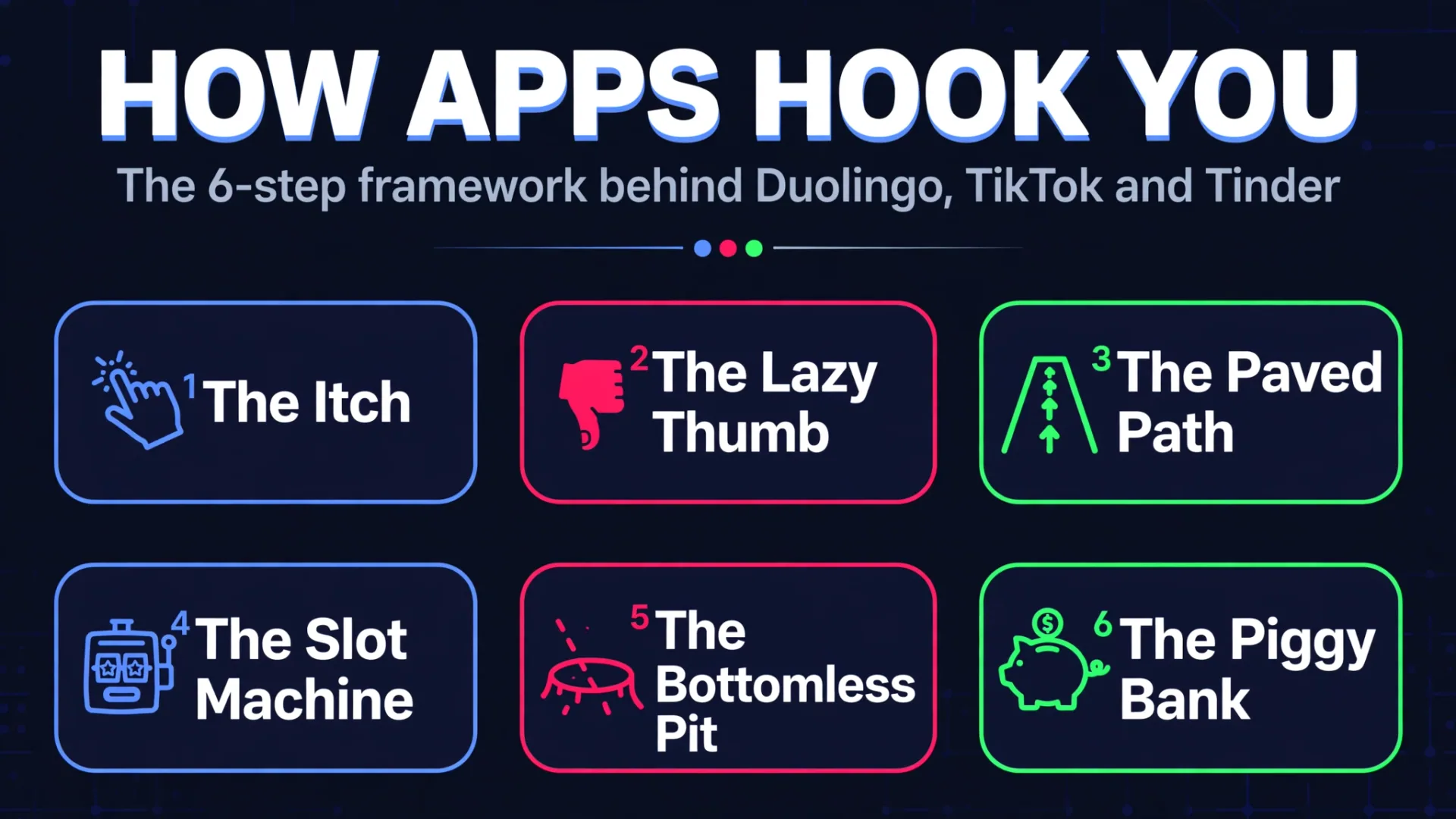
Duolingo, TikTok and Tinder run the same six-step playbook to keep you coming back every day. We break down the Itch, the Lazy Thumb, the Paved Path, the Slot Machine, the Bottomless Pit and the Piggy Bank, with the research behind each step.
The average person has 93 apps on their phone and opens about half of them in a typical month. The rest just sit there. Duolingo, TikTok and Tinder are not in the forgotten half. People open them every day, usually without a single notification, and stay far longer than they planned.
Why? In his video "How to design an app SO addictive people cant stop using it", App Breakdown argues it has almost nothing to do with how the app looks. The three apps run the same six-step psychological playbook, and each step is backed by research. This case study breaks down all six steps, the science behind them, and how to apply them to your own app, or any AI product.
Watch the original video here: https://youtu.be/NHIq3HnokOI
The six steps at a glance
| Step | What it does | The example that proves it |
|---|---|---|
| 1. The Itch | Turns a feeling into the reason to open the app | Boredom opens TikTok, no notification needed |
| 2. The Lazy Thumb | Makes the core action one easy tap | CalAI: photograph your plate, done |
| 3. The Paved Path | Picks the next step so the user never decides | TikTok autoplays, Duolingo lights up the next lesson |
| 4. The Slot Machine | Makes rewards unpredictable | Every TikTok swipe is a lever pull |
| 5. The Bottomless Pit | Removes every stopping cue | Infinite scroll, Netflix autoplay |
| 6. The Piggy Bank | Makes leaving feel like losing something | Netflix recommendations, your TikTok feed |
1. The Itch: boredom is the notification
Think about the last time you opened TikTok. It was probably not a notification. You were bored, you felt the urge, and before you thought about it your thumb was on the icon. That urge is the itch.
Nir Eyal's book Hooked splits the reasons people open apps in two. External triggers are notifications and red badges. Internal triggers are feelings: boredom, curiosity, feeling behind on your Spanish. Most of the time, internal triggers do the opening.
The failure mode is the meditation app you downloaded in January. Day one you meditated for 10 minutes and felt great. By day three you had forgotten the app existed. You did not stop feeling stressed. The app simply never associated itself with that feeling.
The best apps start with external triggers and, over time, attach themselves to a feeling. That is why you do not need a notification to open TikTok. Boredom is the notification.
Apply it: write down the feeling your app answers. Then write notifications that speak to that feeling, not corporate lines like "we miss you". Dating apps say "someone liked you". And time the reminder for when the feeling actually hits, for example a boredom app reminding you during the commute.
2. The Lazy Thumb: make the first action effortless
BJ Fogg runs the Behavior Design Lab at Stanford. His point is simple: your motivation goes up and down all day and you cannot control it. What you can control is how easy the action is. So do not wait for users to be highly motivated. Give them something easy enough to do even when motivation is low.
The video compares two calorie trackers that do the same job. In Yazu, logging lunch meant scrolling, opening a menu and typing. In CalAI, you photograph your plate and you are done. The easier one passed 15 million downloads in 2 years, according to the video. TikTok is one swipe. Tinder is one swipe. Duolingo is one giant tap on a button at the bottom of the screen.
And lower the bar for what counts as done. Duolingo used to count a streak only if you finished your full daily goal. When one lesson became enough, retention rose 3.3%, per the video.
Apply it: write down your core action, count the steps to do it, and cut it to one. Make its button the biggest thing on the screen, at the bottom where the thumb is. Half your users hold the phone one-handed.
3. The Paved Path: decide for the user
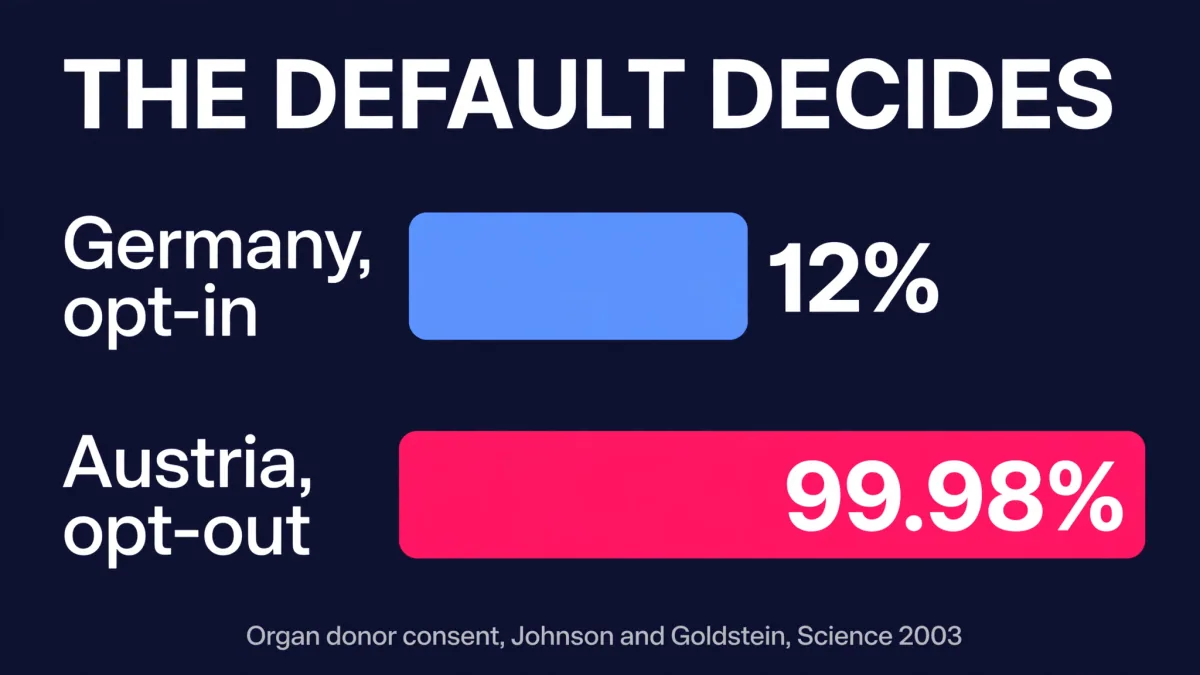
People like to think they want choice. Mostly they take whatever is already picked. The most famous proof is a 2003 study of organ donation in Europe by Eric Johnson and Daniel Goldstein, published in Science. In countries where you must opt in, effective consent ran from about 4% to 28%. In countries where you must opt out, it ran from about 86% to nearly 100%. The same decision, a gap of 60 points or more, moved only by the default. Germany sat at 12%, neighbouring Austria at 99.98%.
TikTok never asks what you want to watch. It is already playing. Duolingo does not offer a menu of lessons. It shows the next one, lit up. Tinder does not ask who you want to see next. It shows you someone. That is the paved path: pick the next option for the user and do not make them think.
Apply it: make the core action the first thing a user sees on open, not a menu. Then list every decision your app forces and give each one a default that serves both you and the user. Most people will take it.
4. The Slot Machine: vary the reward
Getting users in is half the battle. Keeping them hooked is the rest, and it starts with variable rewards.
In the 1950s, B.F. Skinner gave two groups of pigeons a button that delivered food. One group always got food. The other got it at random. When he stopped the food entirely, the first group quit fast. The second kept pecking for a long time, because it never knew when the food would come. Tinder's own co-founder has said this study inspired the swipe.
TikTok's internal documents, surfaced in Kentucky's 2024 lawsuit, give the pattern a name: the "habit moment". According to those documents, it arrives after a user watches 260 videos in their first week, which can take under 35 minutes. TikTok has said the quotes were outdated and taken out of context, and the claims remain allegations in an ongoing case, but the mechanism is visible either way. Every swipe is a lever pull, and you never know what comes next.
Compare that with the average workout app. First badge, exciting. Second badge, fine. By the tenth badge you know exactly what is coming, and your brain has stopped caring.
Apply it: find your app's real reward, then make it unpredictable in timing and size, but fairly frequent. Predictable rewards decay. Variable ones do not.
5. The Bottomless Pit: remove every exit
Unpredictable rewards only work if there is always another one coming. That is the job of the fifth step, and it belongs to Aza Raskin, the designer who invented the infinite scroll in 2006. He has since said he regrets it. His estimate is that infinite scrolling wastes over 200,000 human lifetimes every single day. (The video says 100,000 lives a day; the figure Raskin himself cites is 200,000-plus lifetimes a day.)
Most things in life come with stopping cues: the end of the day, the end of a video, the bottom of a page. Those are the moments your brain asks whether to keep going. Remove the cues and the user has to actively choose to leave, and as the paved path showed, people rarely choose.
Most apps, without realising it, are designed to make users stop. Every empty search screen, every dead end, every error state is a moment the brain asks "should I stop now?" Addictive apps never show you the way out. On Duolingo, the biggest button after a lesson starts another one. On TikTok, the feed has no end. On Tinder, the stack has no end. On Netflix, the next episode starts before you decided whether you wanted it.
Apply it: list every dead end in your app, the end of lists, empty search results, error screens, and make each one lead somewhere. Show something they might want next, but never tell them it is over.
6. The Piggy Bank: make leaving expensive
Netflix estimates that its recommendation system saves the company more than $1 billion a year. That figure comes from a 2015 paper by Netflix executives Carlos Gomez-Uribe and Neil Hunt: recommendations influence about 80% of hours streamed, and personalisation plus recommendations together save over $1 billion a year by reducing cancellations. It is Netflix's own estimate, not an audited figure, but the logic is the point. Every show you watch teaches Netflix what you like, so cancelling feels like starting over. You would have to explain your taste all over again.
Every addictive app works the same way. Each use leaves a little of you behind: your taste, your playlists, your connections, your friends. It is a piggy bank. Every session drops in another coin, and the more you have saved, the harder it is to walk away. Imagine starting TikTok over on a new account. Your feed learned from every video you watched. Starting over feels like leaving part of yourself behind.
Apply it: ask what a user loses if they uninstall today. If the answer is nothing, they will not come back. Track what users do, then give them something to build: progress, levels, an algorithm that gets better, something they know they lose if they never return.
What this means for AI products
The same six rules apply to AI agents and AI tools, and this is where CodeMyPixel's work meets the framework. An AI agent that needs ten steps to start a task loses to one that needs a single tap. An agent that asks you to choose between five options every time loses to one that picks the sensible default and shows its work. And an agent that remembers your business, your customers and your preferences becomes very hard to replace, because starting over means re-teaching it everything. The itch, the lazy thumb, the paved path, the slot machine, the bottomless pit and the piggy bank are not just app design tricks. They are the retention layer of every product people actually keep using, including the AI agents we build for businesses. If you are scoping one, the framework is a good checklist: read how to build an AI agent and what custom AI development really covers, then check the ROI math before you commit.
FAQ
Why do people open TikTok without a notification?
Because the app attached itself to an internal trigger, boredom, instead of relying on external triggers like notifications. Once the feeling itself becomes the cue, no push is needed. That is the itch, from Nir Eyal's Hooked framework.
What is TikTok's "habit moment"?
According to internal TikTok documents surfaced in Kentucky's 2024 lawsuit, it is the point after a user watches 260 videos in their first week, reachable in under 35 minutes. TikTok has said the material was outdated and taken out of context, and the claims are allegations in an ongoing case.
Do variable rewards really beat predictable ones?
Yes, and the evidence is old. B.F. Skinner's 1950s pigeon experiments showed random rewards sustain behaviour far longer than fixed ones once the reward stops. Predictable rewards, like the tenth identical badge, lose their pull because the brain already knows what is coming.
Is it ethical to design apps this way?
These are powerful levers, and they cut both ways. Used honestly, they help people stick with goals they chose themselves, like learning a language or exercising. Used carelessly, they trap attention for its own sake. The test is simple: if the user would thank you for the habit in a year, the design is serving them. If not, it is serving you.
Where can I watch the original video?
App Breakdown's "How to design an app SO addictive people cant stop using it" is on YouTube: https://youtu.be/NHIq3HnokOI. The video also points to a follow-up breakdown of Finch, the self-care app, showing the same framework inside a real product.
Sources
- App Breakdown, "How to design an app SO addictive people cant stop using it", YouTube, 13 Nov 2026: https://youtu.be/NHIq3HnokOI
- Nir Eyal, Hooked: How to Build Habit-Forming Products, 2014
- BJ Fogg, Behavior Design Lab, Stanford University
- Eric J. Johnson and Daniel G. Goldstein, "Do Defaults Save Lives?", Science 302(5649), 2003
- Carlos A. Gomez-Uribe and Neil Hunt, "The Netflix Recommender System: Algorithms, Business Value, and Innovation", ACM Transactions on Management Information Systems 6(4), 2015
- Kentucky v. TikTok filings, October 2024, as reported by NPR and Kentucky Public Radio
- Aza Raskin on infinite scroll, Centre for Humane Technology and Masters of Scale, 2026
- app design
- UX psychology
- Duolingo
- TikTok
- retention
- product design