AI8 min readBy JH Akash
AI ROI: Only 6% of Firms See Real Profit
Only 6% of companies see real profit from AI. Here is the ROI formula, the 2026 benchmarks, and the four steps that put your AI project in the winning group.
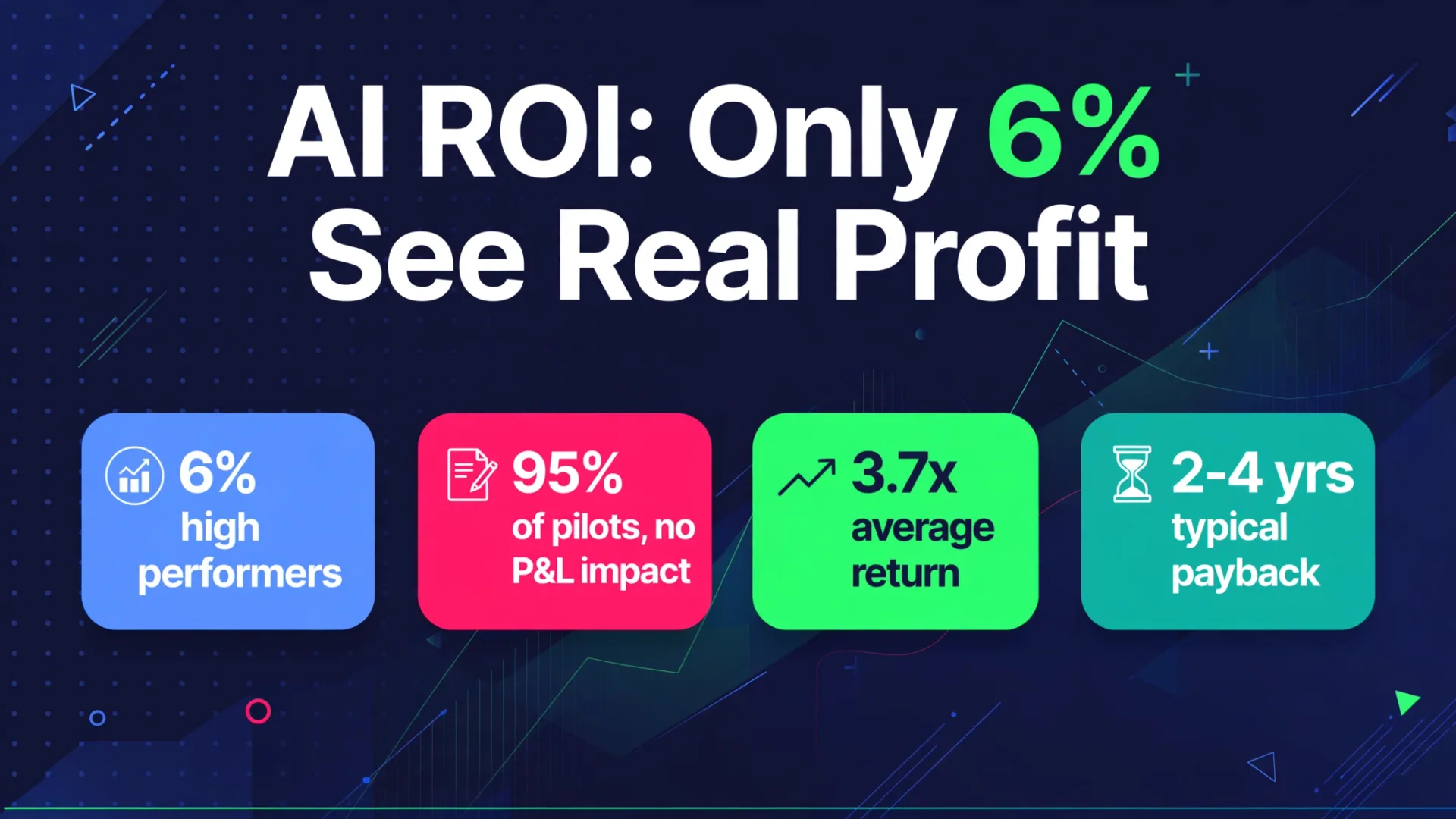
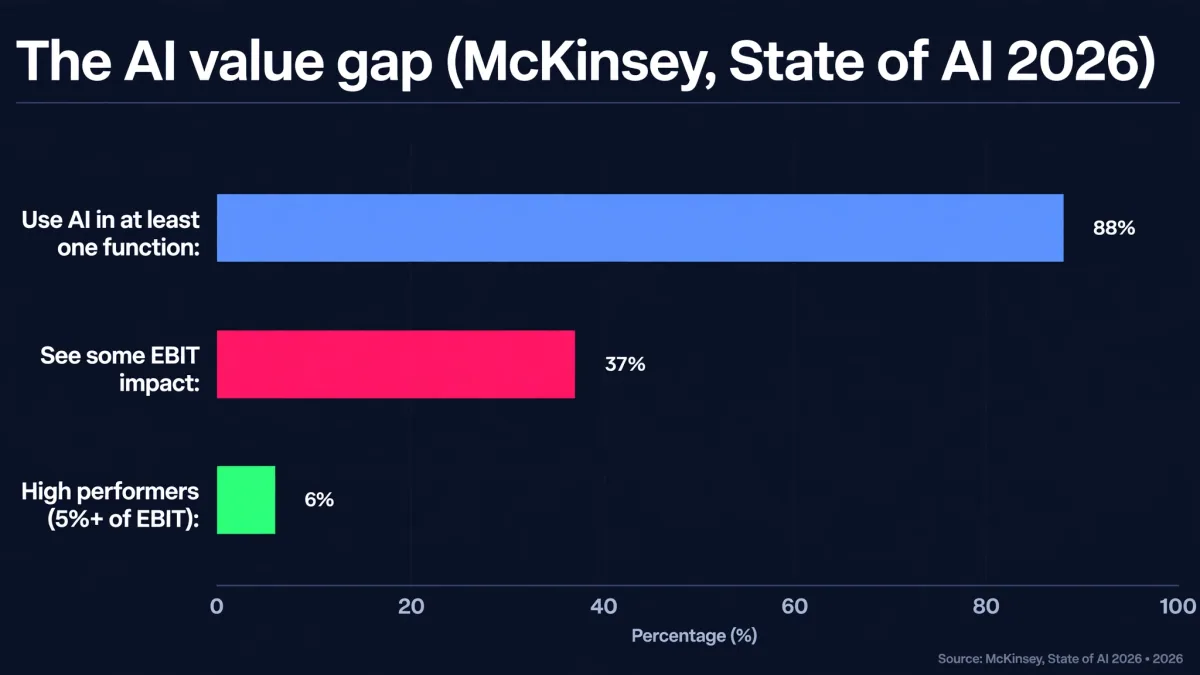
AI ROI is the financial return on an AI investment, measured as (total benefits minus total costs) divided by total costs. In 2026 most companies still cannot prove it. McKinsey's State of AI 2026 survey found only 6% of organizations are AI high performers who attribute at least 5% of EBIT to AI, while 88% now use AI in at least one business function. The gap is not a reason to skip AI. It is a reason to measure it properly, on one workflow at a time, before you scale.
The stakes are high either way. MIT's NANDA research from 2025 found about 95% of generative AI pilots delivered no measurable profit and loss impact, despite $30 to $40 billion in enterprise investment. Yet the winners win big. IDC and Microsoft measure an average 3.7x return per $1 invested in generative AI for organizations in production deployment. BCG's 2026 index found future-built companies deliver 2.3x the total shareholder return, 2.4x the revenue growth and 2.8x the EBITDA growth of AI laggards. This guide shows how to calculate AI ROI, what payback to expect, and the four steps that put your project in the winning group.
What AI ROI actually means
AI ROI answers one question: did the AI return more money than it cost? The formula is simple. The inputs are where most teams go wrong.
AI ROI (%) = (Total benefits minus total costs) divided by total costs, times 100
Total costs means the full cost of ownership, not just the build invoice. That includes development, model usage and API fees, integration with your existing systems, data preparation, staff training, human review time, hosting, maintenance and governance. Gartner expects inference, the cost of running a model each time it is called, to account for at least 70% of a model's lifetime cost. Teams that budget only for the build are surprised later.
Total benefits means money you can defend in a finance review. Four kinds count: time saved (hours redeployed times hourly cost), cost removed (a tool, a vendor, or overtime that stops), revenue gained (more conversions, faster responses, recovered sales), and errors avoided (rework, refunds, and penalties that no longer happen). Feelings of productivity do not count. McKinsey found 80% of people who use AI say it improved their individual productivity, yet only 37% of firms see any EBIT impact at all.
A quotable rule for your next AI business case: if you cannot name the baseline cost per case before the project starts, you cannot prove ROI after it ends.
How to calculate AI ROI, with a worked example
Take a customer support AI agent as the example. The numbers are illustrative, the method is the point.
- One-time build cost: $60,000
- Annual running cost: $18,000 (model usage, hosting, human review)
- Annual benefit: 12,000 tickets at $4 saved per ticket ($48,000) plus $12,000 in revenue recovered from faster replies, for $60,000 total
Year 1 ROI = ($60,000 minus $78,000) divided by $78,000 = minus 23%. That looks like a failure. It is not. AI value ramps as the system learns and volume grows. In year 2, benefits rise to $66,000 while running costs stay at $18,000, a 267% return on year 2 costs. Cumulative payback lands at about 16 months. This matches what Deloitte found across the market: typical AI ROI takes two to four years, and only 6% of businesses see payback in under a year.
Payback period = one-time cost divided by monthly net benefit. For this example: $60,000 divided by $4,000 monthly net benefit in year 2 gives 15 months from launch, plus the ramp. Report ROI monthly against the baseline you measured before launch, and judge the project on a 2 to 3 year horizon, not on month one.
AI ROI benchmarks for 2026
Not every use case pays back at the same speed. Narrow, high-volume work pays back fastest, because the benefit is countable from day one.
| Use case | Median payback | Why it pays back fast |
|---|---|---|
| Customer service AI | 4.1 months | High ticket volume, clear cost per ticket |
| Marketing operations | 6.7 months | Content and campaign volume scales quickly |
| Engineering AI | 9.3 months | Developer time is expensive, but rollout is slower |
| Typical enterprise AI project | 2 to 4 years | Broad rollouts spread benefit thin across many people |
Source: Bain Agentic AI Benchmark 2026 for the use case medians; Deloitte for the typical enterprise range.
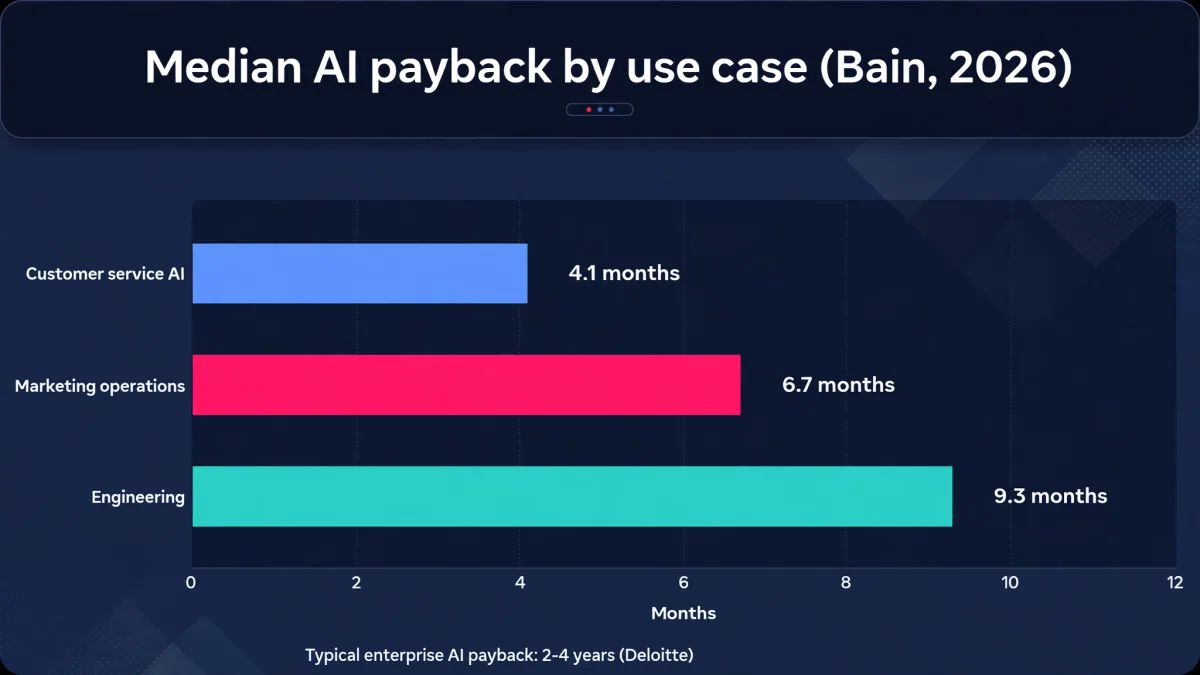
The pattern is consistent: the narrower and more repetitive the workflow, the faster the payback. Broad assistant rollouts take longest, because the benefit is spread thinly across many people and nobody owns the metric. That is also why so many companies feel more productive while their profit line stays flat.
Why most AI ROI is zero
Four mistakes explain most of the gap between AI spending and AI returns.
1. No baseline was ever measured. BCG found only 45% of finance executives can actually quantify their AI ROI. Without a pre-AI measurement of time per case, error rate, and cost per case, there is nothing to compare against, so every claim about value is a guess.
2. The pilot never reaches production. MIT's 95% figure is about pilots, not finished systems. Pilots that stay demos produce no return by definition. The 5% that generated outsized returns were integrated systems, wired into real workflows with real users.
3. The full cost was hidden. Gartner predicts at least 50% of generative AI projects will overrun their budgets through 2028. Model usage, integration, data cleanup, and human review are routinely left out of the business case, then blamed on the technology when the numbers miss.
4. Vanity metrics replaced business metrics. Prompt counts, logins, and seats measure activity, not value. IBM's 2025 CEO study found only 25% of AI initiatives delivered the expected ROI, and only 16% had scaled enterprise wide. If the metric is not tied to money, time, or quality on a real workflow, it is decoration.
The 4-step ROI-first method
This is the workflow we use at CodeMyPixel when we build AI agents that automate business work. It keeps every project measurable from the first week.
Step 1: Pick one narrow, high-volume workflow
Choose a job that is repeated, measurable, and valuable: support ticket triage, invoice chasing, lead qualification, or meeting follow-up. A job that takes a person 10 minutes and happens 50 times a day beats a grand vision nobody can test. If you are still choosing the job, our guide on how to build an AI agent walks through the same selection logic in 8 steps.
Step 2: Measure the baseline for 2 to 4 weeks
Record volume, time per case, error rate, cost per case, and backlog before the AI touches anything. Agree on one primary metric, for example cost per invoice processed or time to first response, and two supporting metrics at most.
Step 3: Ship the smallest useful agent
Build the minimum version that handles the real workflow end to end, with a human in the loop for anything uncertain. Track cost per completed task from day one, including model usage and review time. For realistic budget ranges before you commit, see our breakdown of AI development cost.
Step 4: Report ROI monthly, then scale what works
Compare actuals with the baseline every month and publish the number inside the company. Scale the workflow only when it clears payback on schedule. Kill or rework the ones that do not, and say so plainly. A fast no is cheaper than a slow maybe.
What AI actually costs, beyond the build
Use this table when you write the business case, so the total cost of ownership is honest from the start.
| Cost category | What it includes | Often forgotten? |
|---|---|---|
| Build | Design, development, testing | No, this is the quoted price |
| Model usage | API and inference fees per task | Yes, scales with volume |
| Integration | Connecting CRM, email, and internal tools | Yes |
| Data preparation | Cleaning and structuring your data | Yes |
| Human review | Staff checking AI output | Yes, budget real hours |
| Training and change | Teaching the team new workflows | Yes |
| Maintenance | Monitoring, evals, model updates | Yes |
If you are comparing vendors to build it for you, the same discipline applies to the quote. Our guide to AI development companies shows what to check before you sign, including how to spot a quote that hides the running costs.
FAQ
What is a good ROI for AI?
A good AI ROI is a positive return inside 12 to 18 months on a narrow workflow, and a 2 to 4 year payback on a broad program. IDC and Microsoft measure an average 3.7x return per $1 invested for generative AI in production. Anything measured without a pre-launch baseline is a claim, not a result.
How long does AI take to pay back?
It depends on the use case. Bain's 2026 benchmark puts median payback at 4.1 months for customer service AI, 6.7 months for marketing operations, and 9.3 months for engineering. Deloitte finds the typical enterprise AI project takes two to four years, and only 6% see payback in under a year.
Why do 95% of AI pilots fail to show ROI?
MIT's NANDA research found about 95% of generative AI pilots delivered no measurable profit and loss impact. The common causes are no baseline measurement, pilots that never reach production, hidden running costs, and vanity metrics instead of one business metric per workflow. The 5% that succeeded were integrated into real workflows with named owners.
How do you measure AI ROI for a chatbot or AI agent?
Measure cost per resolved conversation before and after launch, plus deflection rate, escalation rate, and customer satisfaction. Multiply the cost saved per conversation by monthly volume, subtract the full running cost including model usage and human review, and divide by that cost. Report it monthly against the pre-launch baseline.
Is AI worth it for a small business?
It can be, on one narrow workflow with high volume: answering common customer questions, chasing unpaid invoices, or qualifying inbound leads. The same ROI math applies at any size. Start with one workflow, measure the baseline, and only expand when the first one pays back.
The bottom line
AI ROI is not a mystery. It is a baseline, a full cost count, one primary metric, and a monthly report. The companies in McKinsey's 6% did not buy better models. They measured better, shipped narrower, and scaled only what paid back. Start with one workflow, prove the return, and let the numbers decide what comes next.
If you want that first workflow built and measured properly, CodeMyPixel builds AI agents that automate business tasks, with the ROI tracked from the first week, not guessed at the end of the year.
- ai roi
- return on investment
- ai payback
- ai metrics