AI News7 min readBy JH Akash
MAI Code 2: 98% of GPT-6.1 Sol at 40% of the Price
Microsoft launched seven MAI models at Ignite 2026. MAI Code 2 claims 98% of GPT-6.1 Sol's coding quality at 40% of the price, and 96% of Claude Opus 5.5 at 5% of the cost. Here is what launched, what it costs, and the catch.
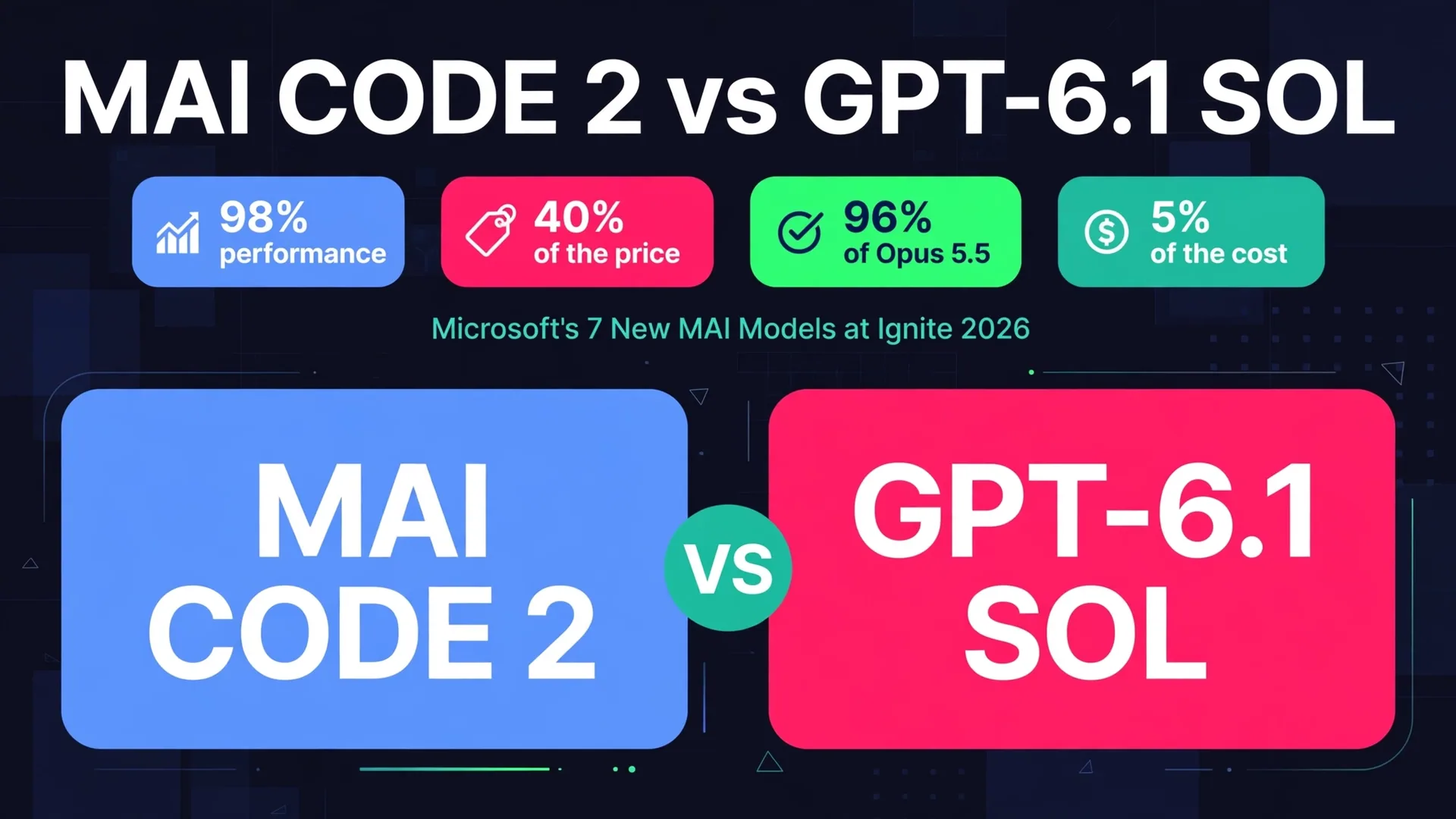
Microsoft just fired its biggest shot yet at OpenAI and Anthropic. At Ignite 2026 on November 17, Microsoft AI launched seven new MAI models in one go, and the pitch is not raw power. It is price. The headline model, MAI Code 2, claims 98% of GPT-6.1 Sol's coding quality at about 40% of the price, and 96% of Claude Opus 5.5 at just 5% of the cost. Both coding models are already generally available in GitHub Copilot.
The catch, and it matters, is that every number below is vendor-reported. Microsoft picked the benchmarks, ran most of the tests itself, and priced its models at a 50% promotional discount. This post lays out what launched, what it costs, and where the claims get thin.
Quick verdict
| Question | Short answer |
|---|---|
| What launched? | Seven MAI models: Code 2, Code 2 Flash, Cyber 2 Flash, Image 2.7, Realtime 1, Transcribe 2, Decision 1.1 |
| The headline claim | MAI Code 2: 98% of GPT-6.1 Sol, 40% of the price |
| The boldest claim | MAI Cyber 2 Flash: GPT-6 Astra quality at under 2% of the cost per task |
| Where to try it | MAI Code 2 and Code 2 Flash are live in GitHub Copilot now |
| The catch | 50% promo pricing, doubles after May 17, 2027; vendor-chosen benchmarks |
The seven MAI models at a glance
| Model | What it does | Headline claim (Microsoft-reported) | Availability |
|---|---|---|---|
| MAI Code 2 | Everyday enterprise coding | 98% of GPT-6.1 Sol at 40% of the price; 96% of Claude Opus 5.5 at 5% of the cost | Generally available in GitHub Copilot |
| MAI Code 2 Flash | Fast, high-volume coding | Matches GPT-6 Luna at 65% of the price; matches Claude Haiku 5.5 at 20% | GitHub Copilot, including Free and Student plans |
| MAI Cyber 2 Flash | Finding software vulnerabilities | GPT-6 Astra quality at under 2% of the cost per task on CyberGymE2E | Verified defenders only, through MDASH |
| MAI Image 2.7 | Image generation and editing | No. 1 on Artificial Analysis image editing, at one fifth the price of GPT Image 2.6 Sunburst (max) | MAI Labs, limited preview |
| MAI Realtime 1 | Speech-to-speech voice | Outperforms GPT-Realtime 2.1, from $0.01 per audio minute | Preview |
| MAI Transcribe 2 | Multilingual transcription, behind Dragon Copilot Transcribe | Powers 10 million patient encounters a month, multilingual error rates halved | In Dragon Copilot |
| Decision 1.1 | Model routing inside apps | 50x faster and 79x cheaper than GPT-6.1 Sol | Generally available |
Microsoft also announced Maia 200, its second-generation AI accelerator, now in production and delivering 1.7x more tokens per watt. And with MAI Licensed Weights, companies can take a frontier MAI model, customize it with their own data, and run it inside their own Azure environment.
MAI Code 2 vs GPT-6.1 Sol vs Claude Opus 5.5: benchmarks
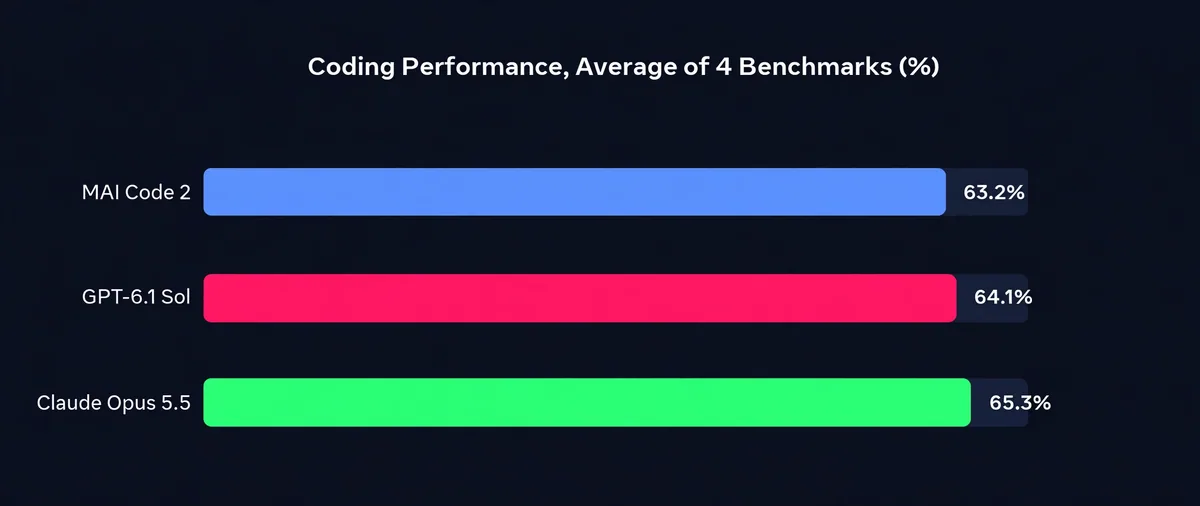
Microsoft averaged four benchmarks aimed at everyday enterprise coding: DeepSWE 1.1, Terminal Bench 2.1, SWE-Atlas, and FrontierCode v1.1. Three of the four ran on Microsoft's own evaluation platform; the fourth used results from Artificial Analysis. Here is the average score Microsoft reported.
| Model | Average score across 4 benchmarks | Share of GPT-6.1 Sol performance | Share of Claude Opus 5.5 performance |
|---|---|---|---|
| MAI Code 2 | 63.2% | 98% | 96% |
| GPT-6.1 Sol | 64.1% | 100% | 98% |
| Claude Opus 5.5 | 65.3% | 102% | 100% |
Read the chart honestly: the three models sit within about two points of each other. MAI Code 2 is not the best coder here. It is the cheapest by a wide margin, and that is the whole pitch. An average can also hide a benchmark where Code 2 trails badly, and Microsoft has not published the per-benchmark breakdown in the announcement.
Pricing: where the savings really come from
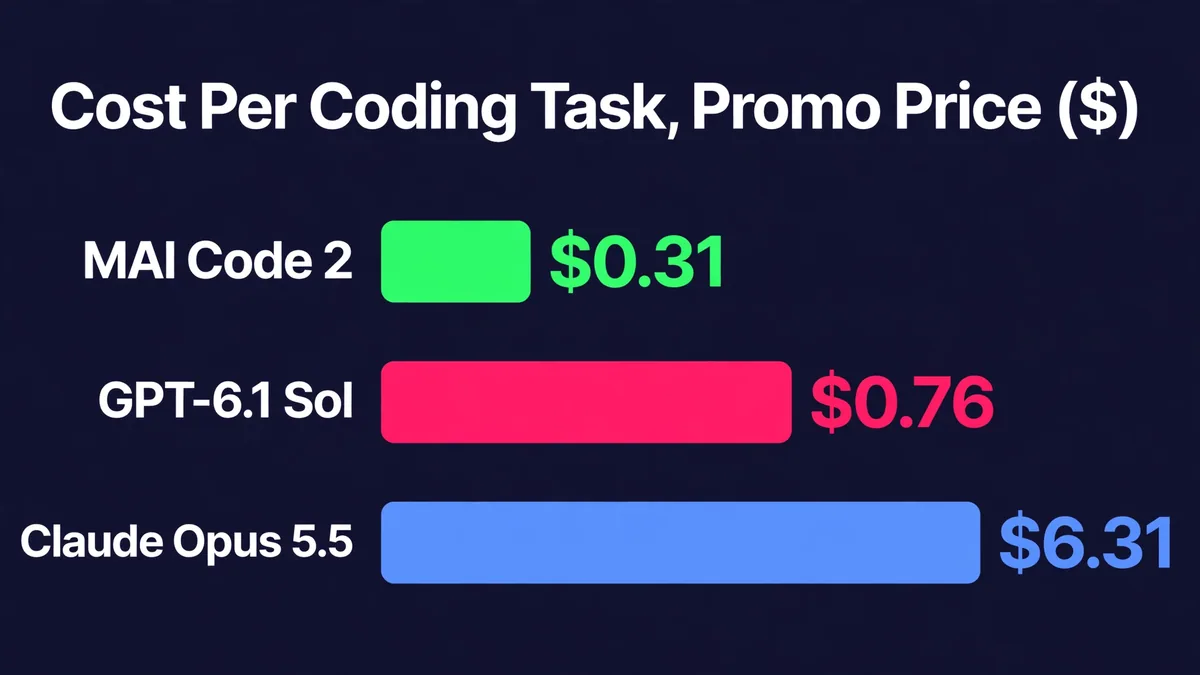
| Model | Input price per 1M tokens | Output price per 1M tokens | Cost per coding task (promo) |
|---|---|---|---|
| MAI Code 2 | $0.50 | $2.50 | $0.31 |
| MAI Code 2 Flash | $0.05 | $0.25 | Not published |
| GPT-6.1 Sol | $2.00 | $10.00 | $0.76 |
| Claude Opus 5.5 | $4.00 | $20.00 | $6.31 |
The per-task costs above are at MAI Code 2's 50% promotional price. At full price, Code 2 would cost roughly four-fifths as much as GPT-6.1 Sol per task and about a tenth as much as Claude Opus 5.5. The promotional prices double after May 17, 2027, so the 40% and 5% figures are time-limited. Still, even at list price the gap is large, and that is what makes this launch matter for teams running coding agents all day.
For image work, Microsoft quotes about $35 per 1,000 images for MAI Image 2.7 and $10 for the Flash version. MAI Realtime 1 starts at $0.01 per audio minute.
The security play: MAI Cyber 2 Flash
The most striking number of the launch is not about coding. On CyberGymE2E, a benchmark of real-world vulnerability discovery, Microsoft says MAI Cyber 2 Flash completed 92.3% of tasks against 91.5% for GPT-6 Astra, at less than 2% of the cost per task. In other words, slightly better quality for roughly one-fiftieth of the price, on Microsoft's own measurement.
There is a limit, though. Cyber 2 Flash is not open to everyone. Microsoft is making it available initially to a limited group of verified defenders, so most developers cannot try it yet. OpenAI, meanwhile, launched its own security push the same week with Daybreak Red Team, fleets of agents that pen-test web applications.
What Microsoft is really doing
This launch is about independence. Microsoft has spent years as OpenAI's biggest partner and customer. Now it is building its own frontier models, its own Maia 200 chips to run them, and a licensing model that lets enterprises customize and self-host. Microsoft AI chief Mustafa Suleyman framed it as a response to what CIOs and CFOs keep telling him: token spending is soaring, and agents that run 24 hours a day need cheaper models.
Note the timing too. OpenAI launched GPT-6.2 Astra and GPT-6.2 Sol on the same day, November 17, which means Microsoft's comparison against GPT-6.1 Sol is against the previous generation. The new GPT-6.2 Astra costs $8 per million input tokens and $40 per million output, down 20% from GPT-6 Astra, so OpenAI is cutting prices at the same time.
Which to pick
- Pick MAI Code 2 if your team lives in GitHub Copilot and runs lots of everyday coding tasks: debugging, multi-file changes, refactoring, and shipping code to production. The savings compound fast at high volume.
- Pick MAI Code 2 Flash for quick explanations, targeted edits, and routine fixes, especially on Copilot Free or Student plans where it is already included.
- Stick with GPT-6.1 Sol or Claude Opus 5.5 if you need the strongest general reasoning, frontier research, or very long-horizon agent work. Microsoft says Code 2 is explicitly not yet tuned for those.
- Watch MAI Cyber 2 Flash if you run a security team, but expect a wait unless you are a verified defender.
- Try MAI Image 2.7 in MAI Labs if image editing cost is your bottleneck. The No. 1 Artificial Analysis ranking is an independent leaderboard, which makes it the most independently verified claim in the launch.
If you are building AI agents for your business and want help choosing the right model stack, read our guide on AI agent development services or talk to us about hiring an AI automation agency. For the wider model race, see our GPT-6 Astra breakdown and our Claude Opus 5.5 overview.
FAQ
What is MAI Code 2?
MAI Code 2 is Microsoft's flagship coding model, launched November 17, 2026 at Ignite. It is built for everyday enterprise coding work such as debugging, multi-file changes, and refactoring, and it is generally available in GitHub Copilot.
How much does MAI Code 2 cost?
At its 50% promotional price, MAI Code 2 costs $0.50 per million input tokens and $2.50 per million output tokens. Microsoft says the promotional prices double after May 17, 2027.
Is MAI Code 2 better than GPT-6.1 Sol?
Not on raw scores. Microsoft reports MAI Code 2 at 63.2% averaged across four coding benchmarks, against 64.1% for GPT-6.1 Sol and 65.3% for Claude Opus 5.5. Code 2 wins on price, not on quality, and the benchmarks were chosen and mostly run by Microsoft.
Is MAI Code 2 available in GitHub Copilot?
Yes. MAI Code 2 and MAI Code 2 Flash are generally available in GitHub Copilot, in the model picker and through Copilot Fusion. Code 2 Flash is also available on Copilot Free and Student plans.
What are the seven MAI models?
MAI Code 2, MAI Code 2 Flash, MAI Cyber 2 Flash, MAI Image 2.7, MAI Realtime 1, MAI Transcribe 2 (behind Dragon Copilot Transcribe), and Decision 1.1. Microsoft also put its Maia 200 accelerator into production and launched MAI Licensed Weights for enterprise customization.
What is the catch with Microsoft's price claims?
Three things. First, the cost figures use a 50% promotional price that doubles after May 17, 2027. Second, Microsoft picked the benchmarks and ran three of the four itself, with no independent verification yet. Third, Code 2 is not tuned for frontier research or very long-horizon agent work, and the GPT-6.1 Sol comparison is against the previous generation, since GPT-6.2 launched the same day.
- MAI Code 2
- Microsoft
- GitHub Copilot
- GPT-6.1 Sol
- Claude Opus 5.5