AI8 min readBy JH Akash
Drex Max v1 Explained: 27B Decision Model on Apple Silicon
Nace AI open-sourced Drex Max v1 on Nov 1, 2026: a 27B decision model with 67.52 on Decision Index 0.4, 262K context, and local Mac runs from 24 GB.
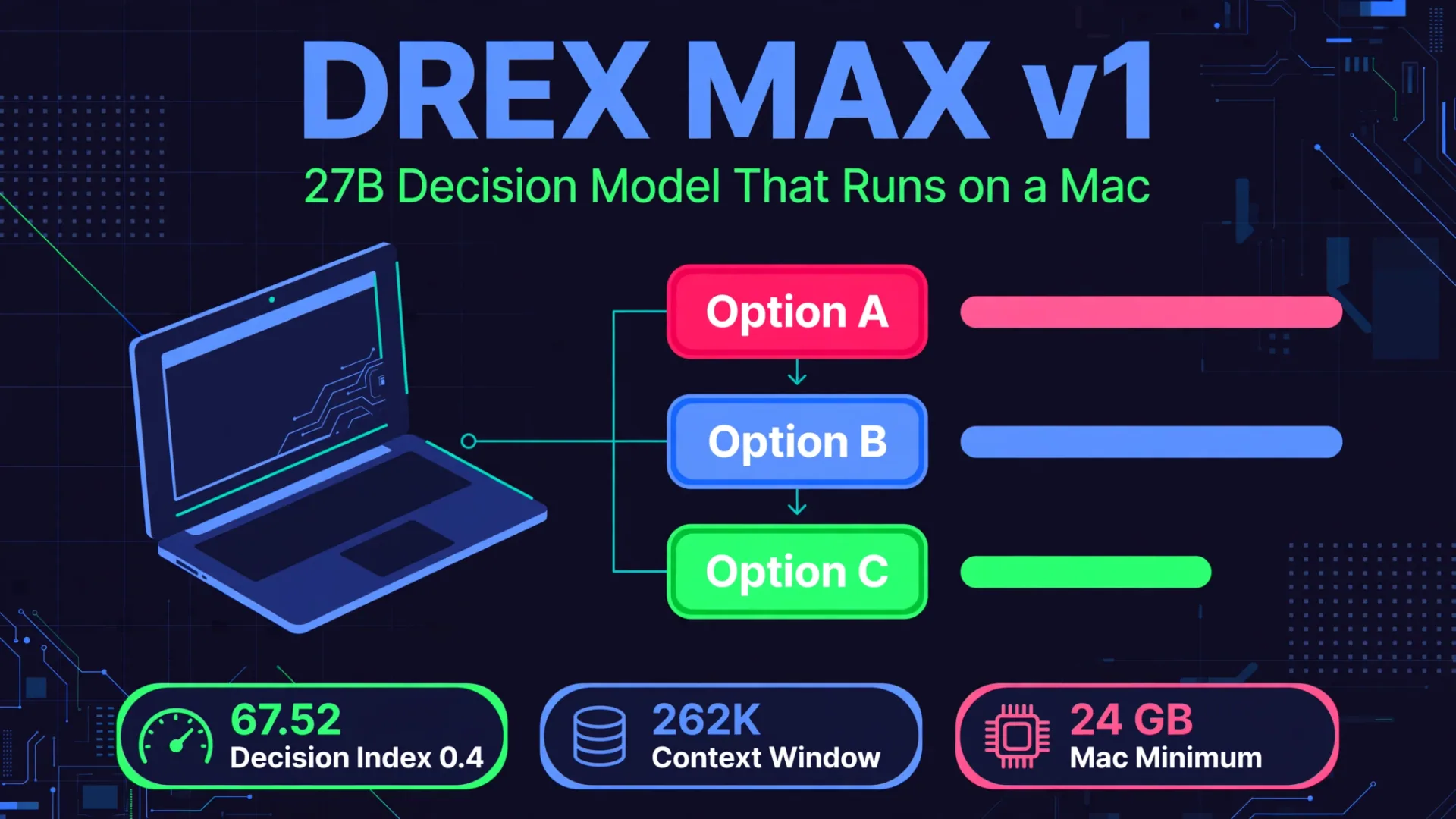
Most AI models answer you with paragraphs. Nace AI's Drex Max v1 does something different, and that difference is the whole point. Reported as open-sourced on November 1, 2026, Drex Max v1 is a 27-billion-parameter decision model. You give it a context and a typed question, and it returns a probability for every option in one forward pass. It generates no text at all.
That makes it a tool for the repeated decisions inside software: which team should handle a ticket, whether a request is urgent, which route an agent should take next. Instead of parsing a chatbot reply and hoping the format holds, you get numbers you can threshold, log, and test.
The quick verdict
| Question | Answer |
|---|---|
| What is it? | Drex Max v1, a 27B open-weight decision model from Nace AI |
| Open weights reported | November 1, 2026 |
| What it does | Answers typed questions with probabilities, in one forward pass, with no text generation |
| Model size | 27 billion parameters, dense, with a 255-way readout head |
| Context window | Up to 262,144 tokens, with 16,384 tokens as the default per request |
| Headline score | 67.52 on Decision Index 0.4 for public text, vendor-reported |
| Local Mac minimum | 24 GB of memory for the affine Q4 checkpoint, text only |
| License | Nace.AI Open RAIL-M, which is open weights, not open source in the strict sense |
| Who should try it first | Developers building routing, triage, classification, or guardrail checks |
What a decision model actually is
A normal language model takes a prompt and generates the next tokens. Drex Max takes a different input shape. A request contains a state, which can be text, JSON, or images, plus one or more named questions. Each question has a fixed type:
- Choice. Pick among named options, for example billing, technical, or other.
- Yes or no. A binary question, called
noulin the model card. - Score. An ordinal score, for example routine, soon, or urgent.
The model then returns a probability for every option. In Nace's own example, a double-charge ticket returns billing at 0.9988, technical at 0.0003, and other at 0.0009. That is a decision you can act on directly: route to billing, and only send low-confidence cases to a human.
Because nothing is generated, there is no prose to parse, no formatting drift, and no invented explanation dressed up as a reason. The tradeoff is just as clear. Drex Max cannot write your reply, summarize a document in prose, or hold a conversation. It judges. A generative model still has to do the talking.
Architecture in plain terms
Drex Max is a dense 27B backbone with 64 layers. Forty-eight are Gated DeltaNet linear-attention layers that run left to right, and 16 are full-attention layers placed every fourth layer. Those full-attention layers are non-causal, so every token can attend to the whole sequence. That detail matters for running it: the bundled loader applies the non-causal attention, and Nace warns that a plain causal chat run will not reproduce the published scores.
Images pass through a native vision tower and stay visible to every question in a request. A 255-way readout head turns the last hidden state into probabilities over up to 255 options per question. The default request limit is 16,384 tokens, and it can be raised up to the full 262,144-token window.
Benchmarks: what the numbers say, and what they do not
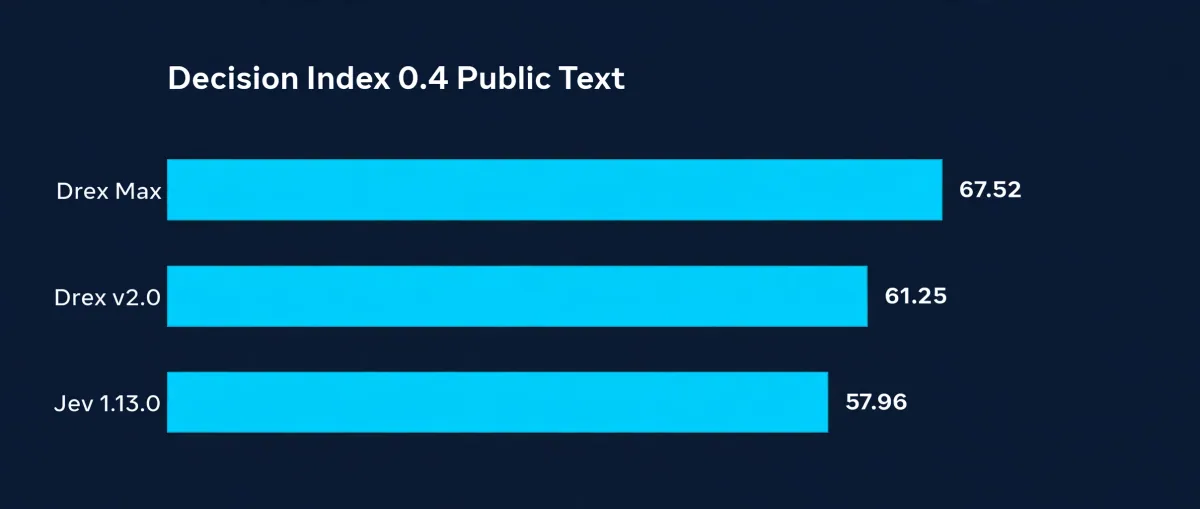
All scores below are vendor-reported by Nace AI on its Hugging Face model card, dated October 19, 2026. Treat them as Nace's own results on public suites, not as independent verification. Different benchmarks are not directly comparable, so the tables below keep each index separate.
Decision Index 0.4, public text
| Model | Public index | Raw | Tools | Language | Retrieval | Knowledge and Reasoning | Arts |
|---|---|---|---|---|---|---|---|
| Drex Max (27B) | 67.52 | 75.4 | 81.9 | 72.2 | 68.8 | 57.1 | 53.4 |
| Drex v2.0 (35B) | 61.25 | 70.55 | 76.5 | 65.3 | 63.0 | 47.9 | 53.9 |
| Jev 1.13.0 | 57.96 | 68.55 | 75.1 | 59.2 | 55.4 | 53.9 | 39.1 |
Drex Max leads Drex v2.0 by 6.27 points on this public index, and Jev 1.13.0 by 9.56 points. The public index averages 37 benchmarks in five areas. The run covered 140,620 requests, of which 140,178 were scoreable and all were answered. Unanswered requests count as wrong, which is the right rule to note before comparing scores across models.
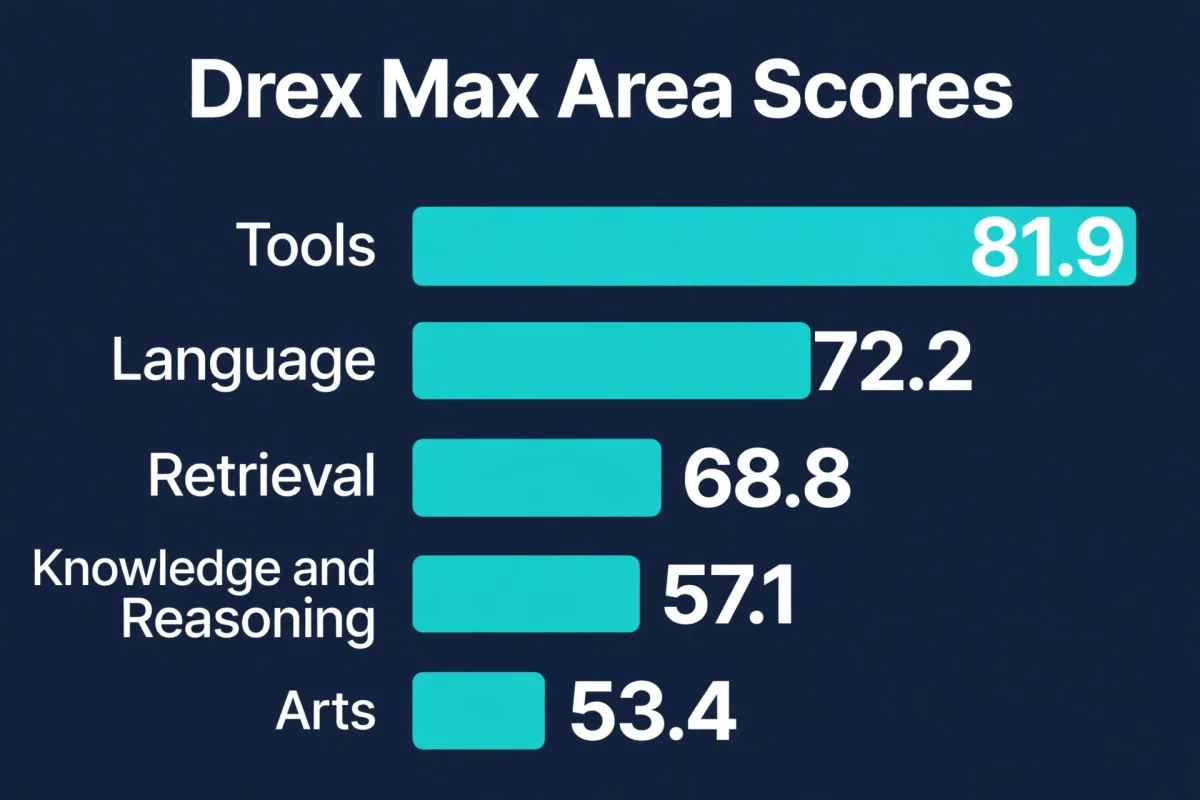
The area breakdown is more useful than the headline. Tools at 81.9 is the strongest area, followed by Language at 72.2 and Retrieval at 68.8. Knowledge and Reasoning at 57.1 and Arts at 53.4 are weaker, which fits a model built for structured decisions rather than broad knowledge or creative judgment.
Other reported scores, kept separate
| Index | Drex Max score | Notes |
|---|---|---|
| Public vision index, Decision Index 0.4 | 73.92 | Across 12,210 rows, including InfographicVQA at 97.3 |
| Artificial Analysis Decision Index | 64 | Ranked 4th of 18, one point behind the leaders at 65 |
| JevBench | 92.2 percent | 213 of 231 |
| Decision Bench v4 | 94.30 percent | 1010 of 1071 |
Do not merge these into one ranking. The Artificial Analysis index, for example, is a weighted average of its own four tests, and it places Drex Max behind three models at 65 and ahead of Claude Haiku 5.5 (Low) at 61. The honest reading is narrower: on decision-style tasks, Drex Max is competitive with the top of its own category, and strongest where the task looks like tool use or retrieval.
What it costs to run: hardware, not tokens
There is no per-token API price on the model card, so do not budget this like a hosted chatbot. The cost is download size and hardware. Nace publishes several checkpoints for different machines.
| Checkpoint | Size | Memory needed | Best for |
|---|---|---|---|
| bf16 weights | About 49 GB | NVIDIA H100 80 GB, 48.6 GiB loaded | Full-quality Python runs on NVIDIA GPUs, including images |
| 8-bit backbone | About 26 GB | NVIDIA L40S 48 GB, 25.9 GiB loaded | Smaller NVIDIA runs, including images |
| Q8_0 GGUF | 27.25 GB | 48 GB Apple Silicon Mac | Local Mac text runs through llama.cpp, Ollama, or Kapitsa |
| Affine Q4 | 14.45 GB | 24 GB or more Apple Silicon Mac | Local Mac text runs through Kapitsa or MLX |
Two limits decide the choice. First, local Mac and CPU paths are text only for now. If your decision needs images, you need the Python path on an NVIDIA GPU. Second, quantization held up well in Nace's tests: on a 48 GB Apple M5 Pro, the Q80 GGUF matched H100 bf16 output within 0.02 per probability, and affine Q4 stayed within 0.0329 of Q80 with no choice flips. Smaller did not change the selected answer in those tests.
For a first test, the practical path is the smallest one that fits your machine. Download the affine Q4 checkpoint if you have a 24 GB Mac, or the Q8_0 GGUF if you have 48 GB, and test it on your own tickets, routes, or policy checks before trusting any public score. A benchmark suite is not your workload.
Which setup to pick
If you have a 24 GB Mac and text-only decisions: use the affine Q4 checkpoint through Kapitsa or MLX, and test with your real categories first.
If you have a 48 GB Mac and text-only decisions: use the Q8_0 GGUF through llama.cpp, Ollama, or Kapitsa. It is closer to full bf16 output, and it still runs locally.
If you need image decisions: use the Python path on an NVIDIA GPU with bf16 or 8-bit weights. Do not expect the Mac builds to handle images yet.
If you do not want to run a model at all: use Nace's hosted version for routing, classification, and policy checks, and check its current pricing on the Nace console before building on it. The model card does not publish a hosted price, so this post does not invent one.
The license catch to read before commercial use
Open weights are not the same as open source. You get the weights, but not necessarily the training data or a permissive open-source license. Drex Max is released under the Nace.AI Open RAIL-M license. One independent listing that read the license flags limits worth checking with your own legal review, including free commercial use only under revenue and funding thresholds, and a bar on competing decision products. Read the actual license in the model repository before shipping a commercial product on it. For personal, research, or internal testing, the local release is the easy way to evaluate it.
Why this release matters for AI agents
Agents fail most often not on generation, but on the small decisions between steps: route this, escalate that, allow this tool call, block that one. A generative model can answer those questions, but it answers in prose, and prose needs parsing. A decision model returns a probability distribution over a fixed set of options, which is exactly what an agent router, a triage queue, or a guardrail wants.
That is also why the local angle matters. Routing and policy checks often touch sensitive tickets, documents, or screenshots. Running the decision locally keeps that context on your own hardware instead of sending it to a hosted service for every judgment. Drex Max is not a replacement for a frontier chatbot. It is a specialized judge you can run beside one, and the November 1 open-weights release is what makes that practical for developers with a capable Mac or GPU.
Want to build agents that use this kind of routing in production? Read our guides on AI agent development services and how to hire an AI automation agency. For more open-weight launches, see Mistral Large 4 open weights explained, Liquid AI LFM3 explained, Kimi K3.1 Pro explained, and Apple Intelligence in China on Alibaba Qwen.
Sources: Nace AI model card on Hugging Face (https://huggingface.co/nace-ai/drex-max-v1), MarkTechPost coverage reported November 1, 2026 (https://wisevoter.com/world/2026/11/01/nace-ai-open-sources-drex-max-v1), and Artiverse coverage, which notes it is sponsored by Nace AI (https://www.artiverse.ca/drex-max-puts-a-27b-decision-model-on-apple-silicon/).
What is Drex Max v1?
Drex Max v1 is a 27-billion-parameter decision model from Nace AI. It answers typed questions about a given context with a probability for every option, in one forward pass, and it generates no text.
Is Drex Max a chatbot?
No. It does not chat, write prose, or generate answers. It judges among options you define, which makes it useful for routing, triage, classification, and guardrail checks inside software and AI agents.
Can Drex Max run on a Mac?
Yes, for text decisions. The affine Q4 checkpoint runs on Apple Silicon Macs with 24 GB of memory or more through Kapitsa or MLX, and the Q8_0 GGUF needs 48 GB. Image decisions still need the Python path on an NVIDIA GPU.
What is Drex Max's headline benchmark score?
Nace reports 67.52 on Decision Index 0.4 for public text, ahead of Drex v2.0 at 61.25 and Jev 1.13.0 at 57.96. These are vendor-reported scores, so test the model on your own workload before relying on them.
Is Drex Max free and open source?
The weights are public under the Nace.AI Open RAIL-M license, but that is open weights, not open source in the strict sense. Check the license for commercial limits before shipping a product on it.
How much context can Drex Max handle?
Up to 262,144 tokens, with 16,384 tokens as the default per request. Raise the limit only if your requests actually need the longer window.
- drex max
- nace ai
- decision model
- open weight models
- apple silicon
- ai agents