AI10 min readBy JH Akash
Liquid AI LFM3 Explained: 6 Open-Weight 2B Models
Liquid AI launched LFM3 on Oct 27, 2026: six open-weight 2B-class models from one 1.7B backbone, 256K context, 1 GB at 4-bit, API from $0.08 per 1M tokens.
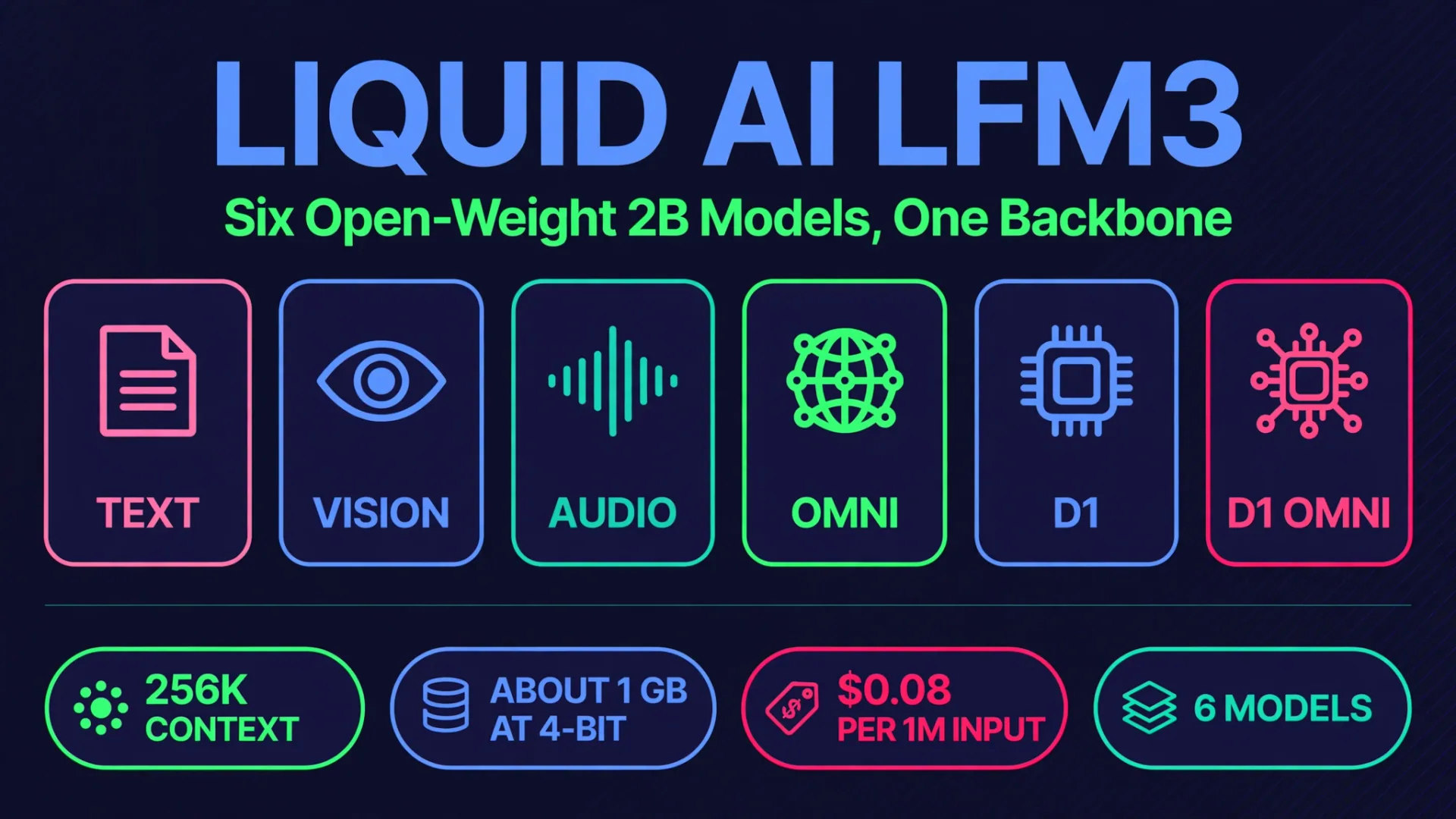
Liquid AI launched LFM3 on October 27, 2026, and it is a different kind of model release. Instead of one giant flagship, LFM3 is a family of six open-weight models in the 2B parameter class, all branched from the same 1.7B backbone. Text, vision, audio, omni, and two decision models share one architecture, so a team can pick the modality it needs without learning a new stack for each one. The pitch is not raw power. It is footprint: a capable small model that runs on phones, laptops, a Raspberry Pi 5, and edge hardware, and that can be fine-tuned on a single GPU.
The timing matters. Frontier models keep getting bigger and more expensive to run, while most real business tasks, reading a document, checking a photo, answering a voice command, scoring a list of options, do not need a giant model. They need a small, fast, private model that runs where the data already is. LFM3 is Liquid AI's bet that this is where the next wave of AI deployment happens: on device, on premises, and inside enterprise-controlled systems.
The quick verdict
| Question | Answer |
|---|---|
| What is it? | LFM3, a family of six open-weight 2B-class models from Liquid AI |
| Launched | October 27, 2026 |
| Shared backbone | LFM3-1.7B-Base, 1.73B parameters |
| Context | 256K tokens on the model card (hosted API lists 128K, see pricing note below) |
| Training data | 22T tokens of pre-training |
| Footprint | About 1 GB of memory at 4-bit precision for the text model |
| License | LFM Open License v1.0, open-weight |
| Available on | Hugging Face, Liquid AI Playground, Liquid AI API, OpenRouter, Qualcomm AI Hub, Vercel |
| Best for | On-device agents, vision inspection, voice, and calibrated decisions |
| Not for | Heavy agentic coding or complex multi-step reasoning (Liquid AI says so itself) |
The six models, one backbone
Every LFM3 model branches from LFM3-1.7B-Base. That shared backbone is what makes the family unusual: one architecture, six specializations.
| Model | Inputs | Outputs | What it is for |
|---|---|---|---|
| LFM3-1.7B | Text | Text | General text, agents, tool use |
| LFM3-VL-2B | Text, images, video | Text | Vision and video understanding, inspection |
| LFM3-Audio-2B | Text or audio | Text or speech | Voice commands, transcription, speech |
| LFM3-Omni-2B | Text, images, video, audio | Text and speech | Full multimodal assistants |
| d1-2B | Questions (list) | Calibrated answers | Decisions with probabilities, not generated text |
| d1-omni-2B | Multimodal questions | Calibrated answers | Decisions grounded in images, audio, and documents |
The decision models deserve a special note because they work differently from a normal chatbot. Instead of generating a paragraph, d1 answers a whole list of questions in a single forward pass, each with a calibrated probability. It can also return typed answers: pointing at an object, reading a value from a document, estimating a number with a range, or picking every option that applies. For business workflows like triage, scoring, and routing, that structured output is often more useful than fluent prose.
Inside the backbone: a tri-hybrid architecture
LFM3-1.7B-Base has 24 layers: 13 gated short convolutions, five sliding-window attention layers with a 256-token window, and six global attention layers. The convolutions use a kernel size of 7, up from 3 in LFM2. Three changes define the design: head-wise gated attention, which can suppress activation outliers that hurt quantization; partial RoPE, where global attention layers rotate only the highest-frequency half of each head; and a sandwich norm that normalizes each block's input and output.
Liquid AI says this architecture came out of a hardware-in-the-loop search across 14 device and backend combinations, including the Samsung Galaxy S26 Ultra, OnePlus 15, Raspberry Pi 5, Apple M4 Max, AMD Ryzen AI, Arm and x86 cloud CPUs, GPUs, and the Qualcomm Hexagon NPU. The practical results, all vendor-reported: LFM3-1.7B beats its predecessor LFM2.5-2.6B while using 35 percent fewer parameters, runs about 25 percent faster with 8K tokens in context, and decodes 1.8 to 2.8 times faster than the next model on the three on-device setups Liquid AI tested. On a single NVIDIA B300, Liquid AI says LFM3-1.7B can produce 3.6 billion tokens per day at 1,024 concurrent requests.
Pre-training ran on 22T tokens, with the final 3.5T tokens forming a mid-training stage on curated data with a larger share of agentic traces and tool calls, which also extended the context window to 256K tokens. Post-training ran in four stages: supervised fine-tuning on 1.75T tokens, mixed reinforcement learning, multi-domain on-policy distillation from six specialist reinforcement-learning teachers, and agentic reinforcement learning inside real agent harnesses.
Benchmarks: strong on agents and tools, honest about limits
All benchmark numbers below are vendor-reported by Liquid AI, from its launch post and model card. Treat them as Liquid AI's own measurements, not independent results.
| Benchmark | LFM3-1.7B | What it tests |
|---|---|---|
| LiveClaw | 45.60 | Agentic tasks |
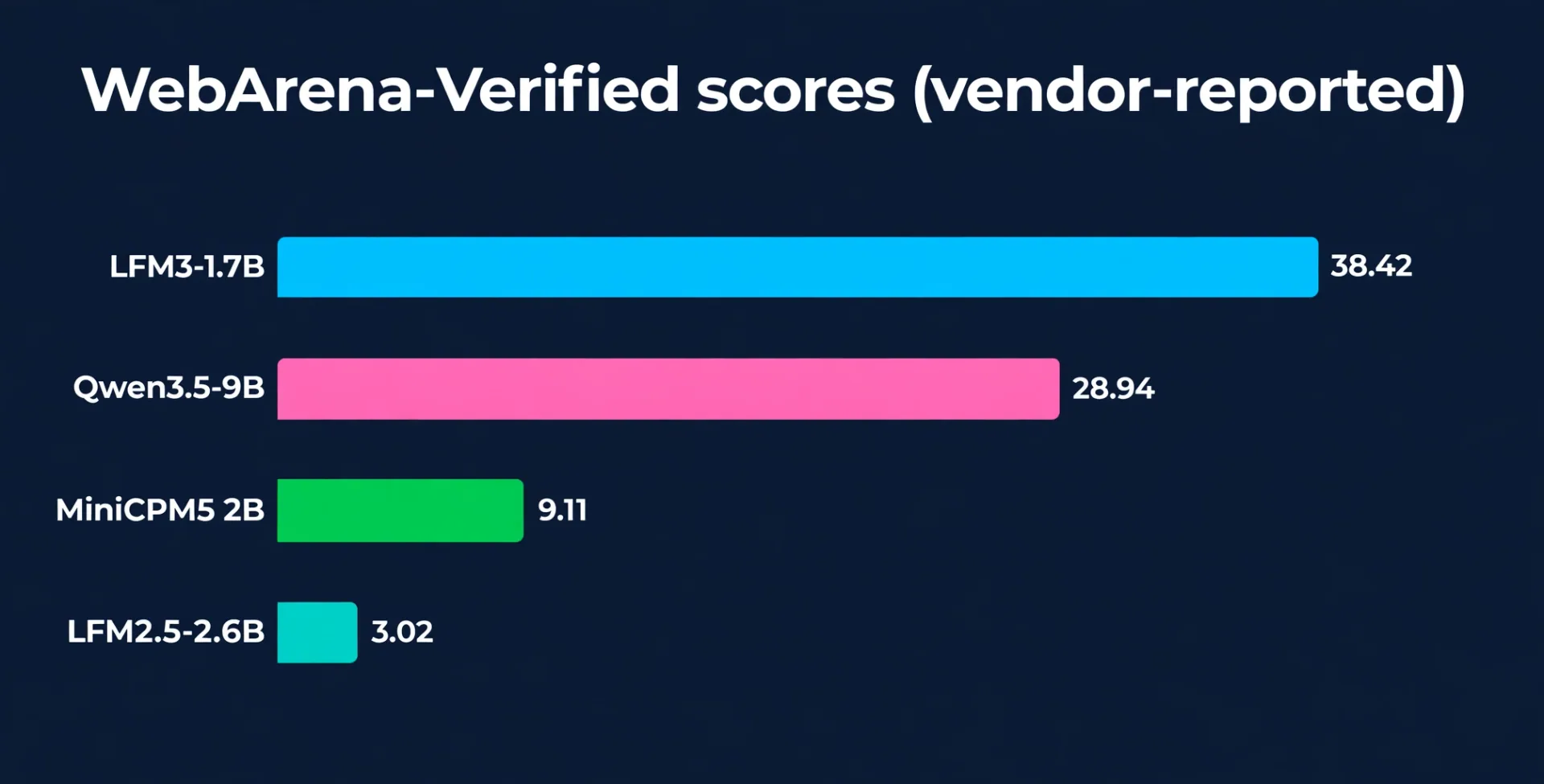
| WebArena-Verified | 38.42 | Web agent tasks |
| BFCL V4 | 71.39 | Tool calling |
| ToolSandbox | 80.36 | Tool use |
| IFEval | 96.66 | Instruction following |
| SWE-bench Verified | 43.40 | Agentic coding |
| GPQA Diamond | 63.37 | Expert knowledge |
| Humanity's Last Exam (no tools) | 7.17 | Hard knowledge |
The jump on WebArena-Verified is the headline: 38.42 for LFM3-1.7B against 3.02 for its predecessor LFM2.5-2.6B. That is a real change in kind for a 1.7B model, and it lines up with the agentic training emphasis. But the same table shows the limits: a 7.17 on Humanity's Last Exam without tools is weak, and Liquid AI's own model card states the model is not recommended for agentic coding or complex multi-step reasoning because of its small size. Small models are a trade, not a free lunch.
The other modalities have their own numbers. LFM3-VL-2B is the first LFM vision model to accept video input, and Liquid AI reports it raises the average across 62 vision benchmarks from 57.6 to 71.4 against LFM2.5-VL-3B, while using 1.9B parameters against 3.1B. LFM3-Audio-2B supports 18 languages, with speech quality of 3.83 on UTMOSv2 against 3.22 for its predecessor, time to first token as low as 50 ms, and speech generation at about 87x real time on a single CPU thread on an Apple M4 Max. LFM3-Omni-2B, at 2.2B parameters, is reported to beat models up to 10.7B parameters on the Daily-Omni, WorldSense, and AV-SpeakerBench audio-visual understanding benchmarks. The d1-2B decision model replaces d1-3B with a third fewer parameters and scores 75.5 against 64.0 on ImajevBench.
Pricing: some of the cheapest hosted tokens around
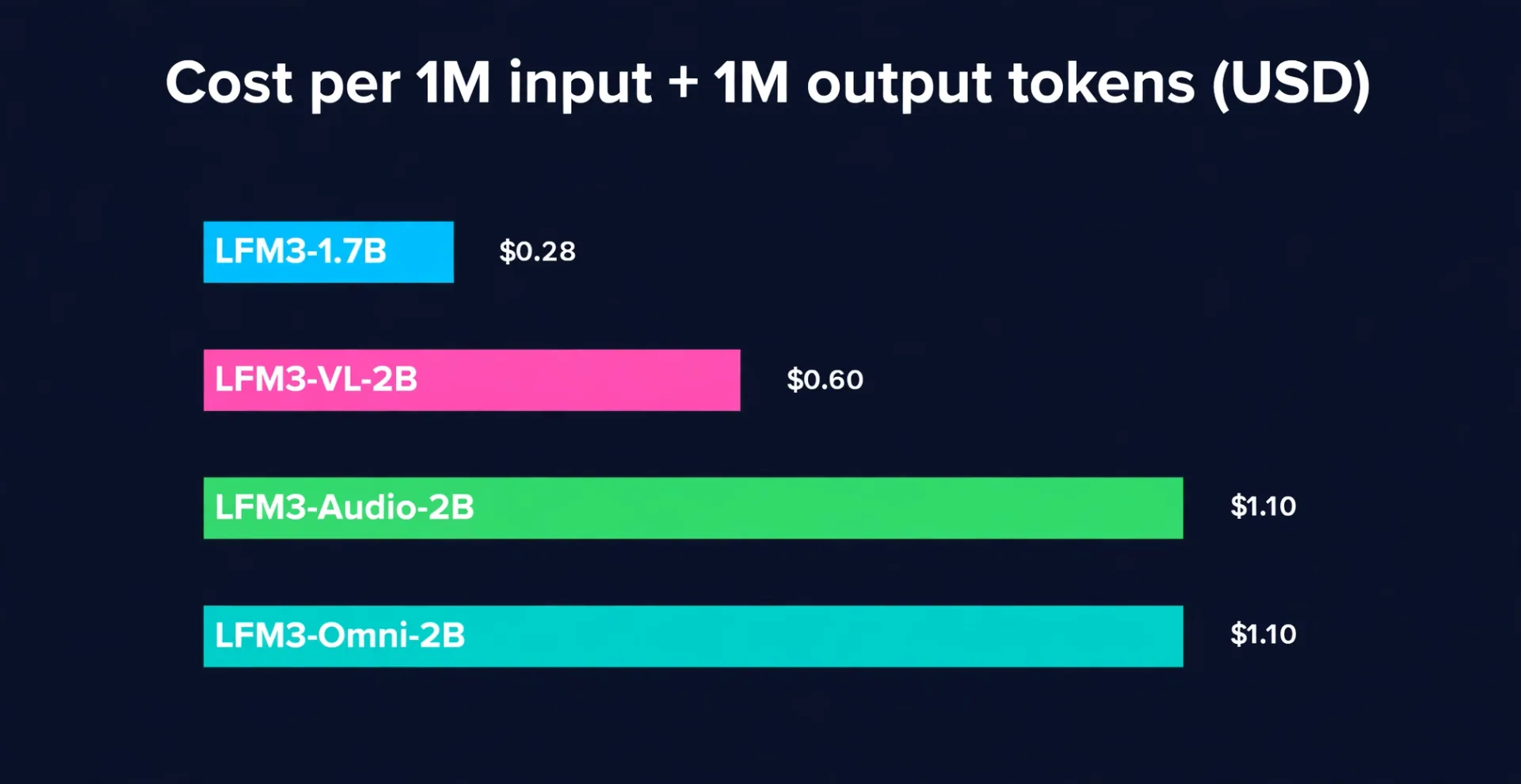
Hosted API pricing comes from Liquid AI's model catalog, as reported by VentureBeat. Prices are in USD per million tokens.
| Model | Input | Cached input | Output | 1M input + 1M output |
|---|---|---|---|---|
| LFM3-1.7B | $0.08 | $0.02 | $0.20 | $0.28 |
| LFM3-VL-2B | $0.10 | $0.02 | $0.50 | $0.60 |
| LFM3-Audio-2B | $0.10 | $0.02 | $1.00 | $1.10 |
| LFM3-Omni-2B | $0.10 | $0.02 | $1.00 | $1.10 |
Audio tokens cost extra on the Audio and Omni models: $2.00 per million audio input tokens and $10.00 per million audio output tokens. Two things to check before you budget: the hosted API lists a 128,000-token context limit, while the model card advertises 256K, so confirm which limit applies to your deployment route. And for privacy-sensitive buyers, Liquid AI states zero data retention on its hosted models: submitted material is used to fulfill requests and is not retained, logged, or used for training.
For comparison, the text model at $0.28 per million input plus million output tokens is far below the flagship tier. That is the point of this class: when you run millions of small tasks, the per-token price decides whether the product is viable at all. If you are comparing hosted small-model pricing more broadly, our recent breakdown of GPT-6.1 Terra shows how OpenAI prices its own fast mid-tier model, and our Kimi K3.1 Pro post covers another open-weight launch from the same month.
Which model should you pick?
Pick LFM3-1.7B for text agents, document work, and tool-calling workflows where cost and speed matter more than frontier reasoning. It is the default choice and the one with the most benchmark coverage.
Pick LFM3-VL-2B for anything that looks at images or video: quality inspection, document reading, damage assessment, shelf checks. Liquid AI's own example is telling: fine-tuning VL-2B on about 3,000 public wind-turbine blade photos for a few hours on one A100 raised defect classification accuracy to 67 percent. That is the small-model playbook: start from a decent general model, fine-tune on your own images, deploy on your own hardware.
Pick LFM3-Audio-2B for voice interfaces, call handling, and transcription where low latency matters. A 50 ms time to first token and on-device speech generation make it a candidate for kiosks, cars, and factory floors without a round trip to the cloud.
Pick LFM3-Omni-2B when a single assistant must handle text, image, video, and audio together, for example a field-service helper that sees the machine, hears the technician, and talks back.
Pick d1-2B or d1-omni-2B when you need decisions, not prose: triage queues, lead scoring, content routing, or any workflow where a calibrated probability and a structured answer beat a paragraph. This is the most enterprise-shaped idea in the family, and the least like a chatbot.
Every LFM3 model can be fine-tuned on a single GPU, with published notebooks for supervised fine-tuning, DPO, GRPO, and continued pre-training. Runtimes include llama.cpp, MLX, vLLM, SGLang, and Ollama, with checkpoint variants in BF16, FP8, NVFP4, GGUF, MLX, and ONNX. Day-0 launch partners include Ambarella, AMD, Arm, Intel via OpenVINO, NVIDIA, OpenRouter, Qualcomm, and Vercel, and Liquid AI says Mercedes-Benz and Shopify partnered on pre-release testing and evaluation.
Liquid AI also adapted VL-2B into three robotics models for orchestration, navigation, and manipulation, reporting 96.2 percent average success across the four LIBERO suites and 45.7 percent on RoboCasa-GR1 tabletop tasks, with action chunks generated in under 50 ms on a Jetson AGX Orin. Robotics is still early for a 2B model, but the latency number is the interesting part: small models can close the loop fast enough for real control.
The honest limits
No 1.7B model replaces a frontier model, and LFM3 does not pretend to. Knowledge-heavy questions, hard math, and long multi-step reasoning are weak spots, and Liquid AI's own guidance steers users away from agentic coding with this size class. If your task needs deep research or complex planning, you still want a bigger model, possibly with LFM3 handling the cheap, fast, high-volume layer around it. That layered setup, small models at the edge and frontier models for the hard cases, is also how most serious AI agent development projects are actually built. If you are planning that kind of system, our team builds agents this way; see how to hire an AI automation agency for what to check before you commit.
The other thing to verify is the license. LFM3 ships under the LFM Open License v1.0 as open-weight, but "open" licenses differ in their commercial terms, so read the actual license text for your revenue tier and use case before shipping a commercial product on it.
FAQ
What is Liquid AI LFM3?
LFM3 is a family of six open-weight AI models launched by Liquid AI on October 27, 2026. All six branch from the same LFM3-1.7B-Base backbone and cover text, vision, audio, omni, and decision-making, in the 2B parameter class.
How big is LFM3-1.7B, really?
The text model has 1.73B parameters, a 256K-token context window on its model card, and a 128,000-token vocabulary, with support for 16 languages. At 4-bit precision it takes about 1 GB of memory, which is why it can run on phones and small edge devices.
Can LFM3 run on a phone?
Yes, that is the design goal. Liquid AI tested it on the Samsung Galaxy S26 Ultra, OnePlus 15, Raspberry Pi 5, Apple M4 Max, AMD Ryzen AI, and the Qualcomm Hexagon NPU, and reports it decodes 1.8 to 2.8 times faster than the next model on its tested on-device setups.
How much does the LFM3 API cost?
The text model costs $0.08 per million input tokens, $0.02 cached, and $0.20 per million output tokens, which works out to $0.28 for a million input plus a million output tokens. Vision costs $0.60 on the same basis, and Audio and Omni cost $1.10 before audio-token charges.
Is LFM3 really open?
The weights are open-weight under the LFM Open License v1.0 and available on Hugging Face, the Liquid AI Playground, and the Liquid AI API. Check the license terms for your commercial use case, since open-weight licenses vary.
Which LFM3 model should I pick?
Pick 1.7B for text agents, VL-2B for images and video, Audio-2B for voice, Omni-2B for combined multimodal assistants, and d1-2B or d1-omni-2B when you need calibrated decisions with probabilities instead of generated text.
How does LFM3 compare to Kimi K3.1 Pro or GPT-6.1 Terra?
They target different tiers. Kimi K3.1 Pro is a much larger open model aimed near the frontier, and GPT-6.1 Terra is OpenAI's hosted mid-tier computer-use model. LFM3 is smaller, cheaper, and built to run on device. Compare them on your own task and hardware, not on a single benchmark, since different benchmarks measure different skills.
Where can I try LFM3?
On Hugging Face, the Liquid AI Playground, the Liquid AI API, and through partners including OpenRouter, Qualcomm AI Hub, and Vercel.
Sources: Liquid AI launch post, Unite.AI launch coverage, VentureBeat pricing coverage, and the LFM3-1.7B model card on Hugging Face.
- liquid ai lfm3
- lfm3
- open weight models
- on-device ai
- liquid ai
- ai agents
- small language models