AI8 min readBy JH Akash
Mistral Large 4 Open Weights Explained: Le Chonk, the 1T Model You Can Download
Mistral released Large 4 open weights on Oct 29, 2026: 1T parameters, 52B active, 41% Terminal-Bench 4.0, $0.70/$2.10 API pricing, and a modified MIT license.
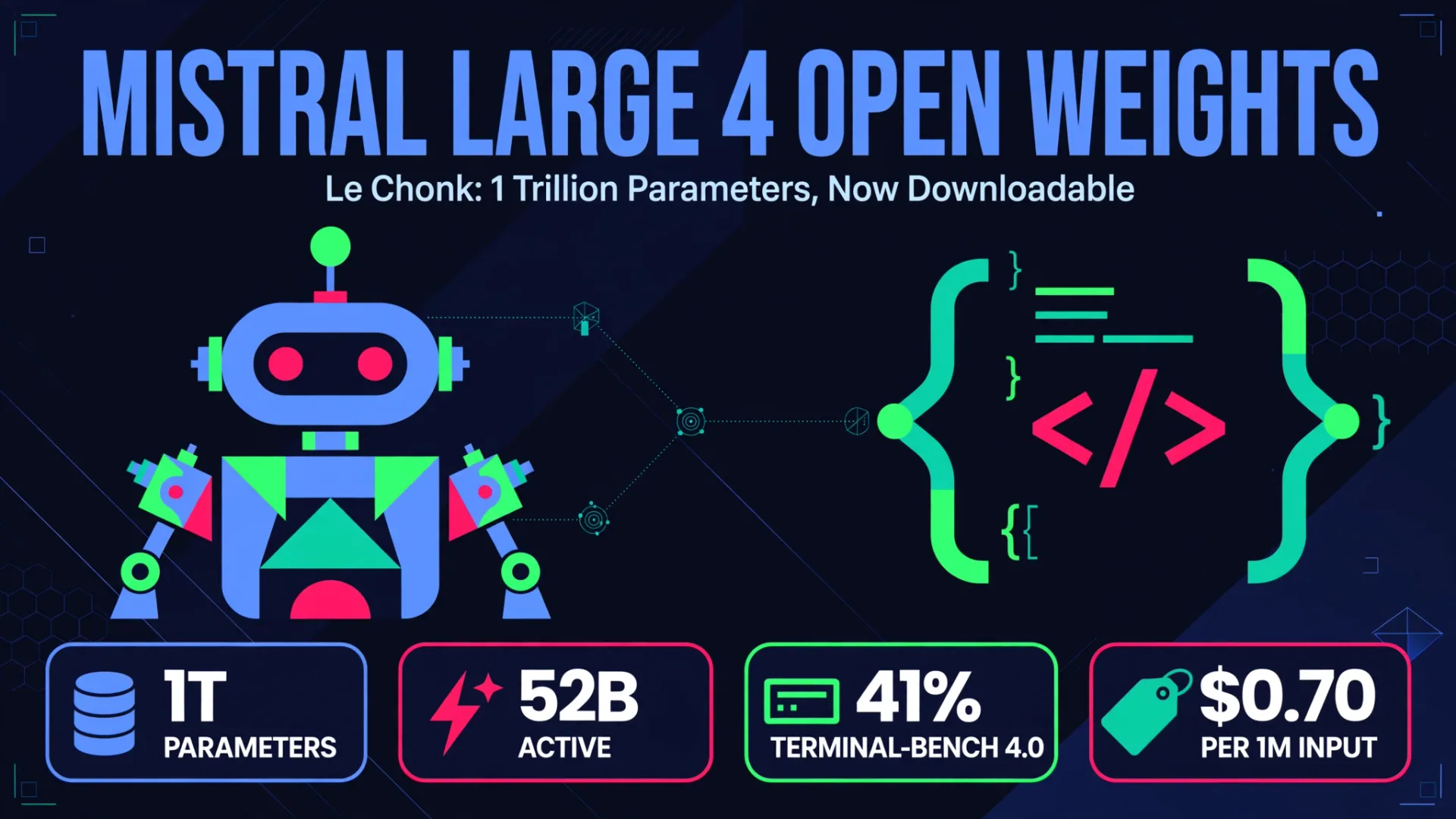
Mistral released the open weights of Mistral Large 4 on October 29, 2026, three weeks after the model's public preview on October 6. Nicknamed "Le Chonk", it is the French lab's flagship: a natively multimodal mixture-of-experts model with about 1 trillion total parameters, only about 52 billion of them active per token. That design is the whole point. You get trillion-parameter scale for knowledge and capability, but you only pay compute for roughly 5 percent of the weights on each token.
The release matters because it is not a demo or an API-only preview anymore. The weights are on Hugging Face as Mistral-Large-4-1T-A52B, ready to download, fine-tune, and run on your own servers with vLLM or SGLang. Mistral is pitching Large 4 at two jobs in particular: agentic coding and defensive cybersecurity. Every benchmark number below is vendor-reported by Mistral, so treat it as the company's claim until independent testers repeat it. The full technical report is still listed as coming soon.
The quick verdict
| Question | Answer |
|---|---|
| What is it? | Mistral Large 4, nicknamed Le Chonk, a natively multimodal open-weight model |
| Weights released | October 29, 2026 (public preview: October 6, 2026) |
| Architecture | Mixture of experts, about 1T total parameters, about 52B active per token |
| Context window | 1 million tokens |
| Languages | Text and image input, native fluency in more than 160 languages |
| Built for | Agentic coding, cybersecurity defense, enterprise agents |
| Reasoning modes | Low, Medium, and High (High is the default) |
| License | Mistral Ecosystem Open-Weight license, a modified MIT license |
| API price | $0.70 per 1M input tokens, $0.07 cached input, $2.10 per 1M output tokens |
| Self-hosting | Hugging Face weights, vLLM or SGLang, also on Mistral Studio, OpenRouter, Microsoft Foundry, and NVIDIA endpoints |
| The catch | Companies offering it as a hosted model service need a separate commercial license |
What changed since the October 6 preview
The headline improvement is on Terminal-Bench 4.0, a test of coding work done in a terminal. Mistral reports the score rose from 28 percent at preview to 41 percent in the open-weight release, a 13-point jump, while output tokens fell 30 percent. Mistral credits three extra weeks of reinforcement learning for the gains, including more efficient reasoning and lower inference costs.
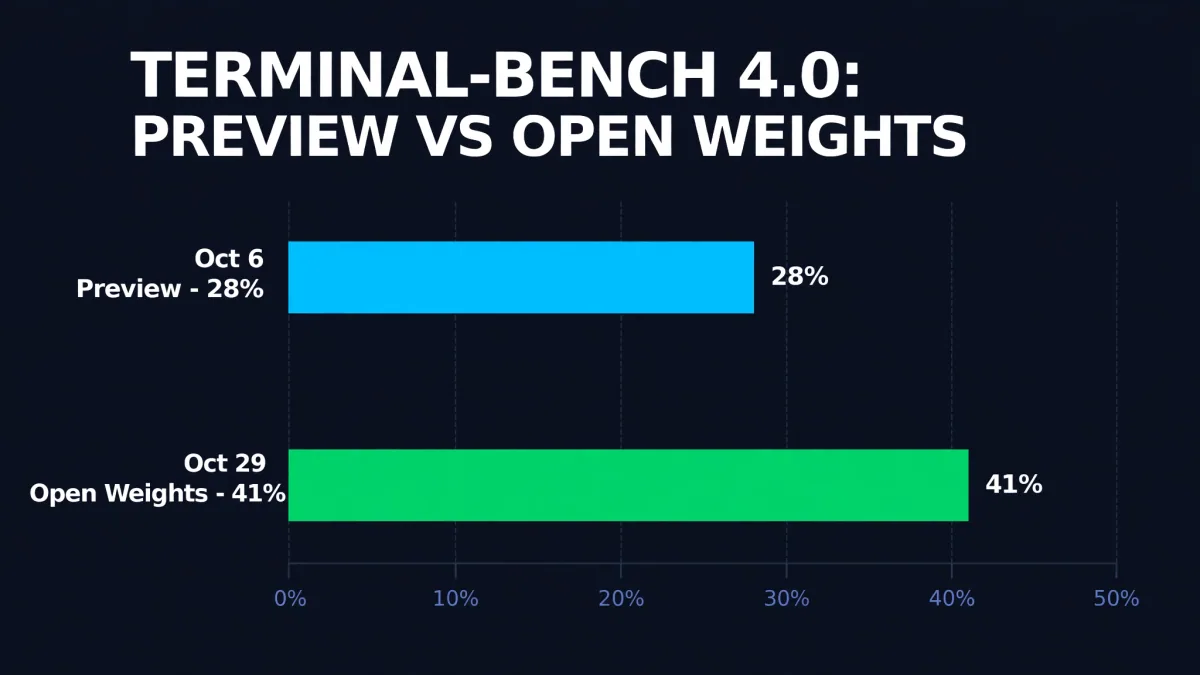
That single jump reframes the model. At preview, Large 4 looked like a promising but lagging coder. In the open-weight version, Mistral reports it at 48 percent on the Artificial Analysis Coding Agent Index, effectively tied with GLM-5.3, while using 47 percent fewer tokens per task on average. On Cognition's private FrontierCode 2.0 benchmark, which tests whether a repository maintainer would merge an agent's code change, Mistral reports 19.7 percent, the top score among open-weight models listed. For context, closed models still sit far ahead on that same test: Claude Opus 5.5 scores 46 percent, according to coverage of Mistral's announcement. Open weights are closing the gap, they have not closed it.
Benchmark table (all vendor-reported by Mistral)
| Benchmark | Mistral Large 4 score | What it measures |
|---|---|---|
| FrontierCode 2.0 | 19.7% | End-to-end code quality, top score among open models listed |
| Terminal-Bench 4.0 | 41% (preview: 28%) | Coding work done in a terminal |
| Coding Agent Index | 48% | Agent coding, effectively tied with GLM-5.3, with 47% fewer tokens per task |
| Cyber Index | 51% | Finding, reproducing, validating, and patching vulnerabilities |
| B3 Agent Security Benchmark | 97.1% attack resistance (preview: 93.3%) | Resistance to agent attacks |
| Malicious cyber prompts | 96.6% refusal rate | Refusing malicious cybersecurity requests |
| FinWorkBench | 73.3% | Finance workflows |
| BrowseComp | 84.5% (preview checkpoint: 75%) | Deep web research |
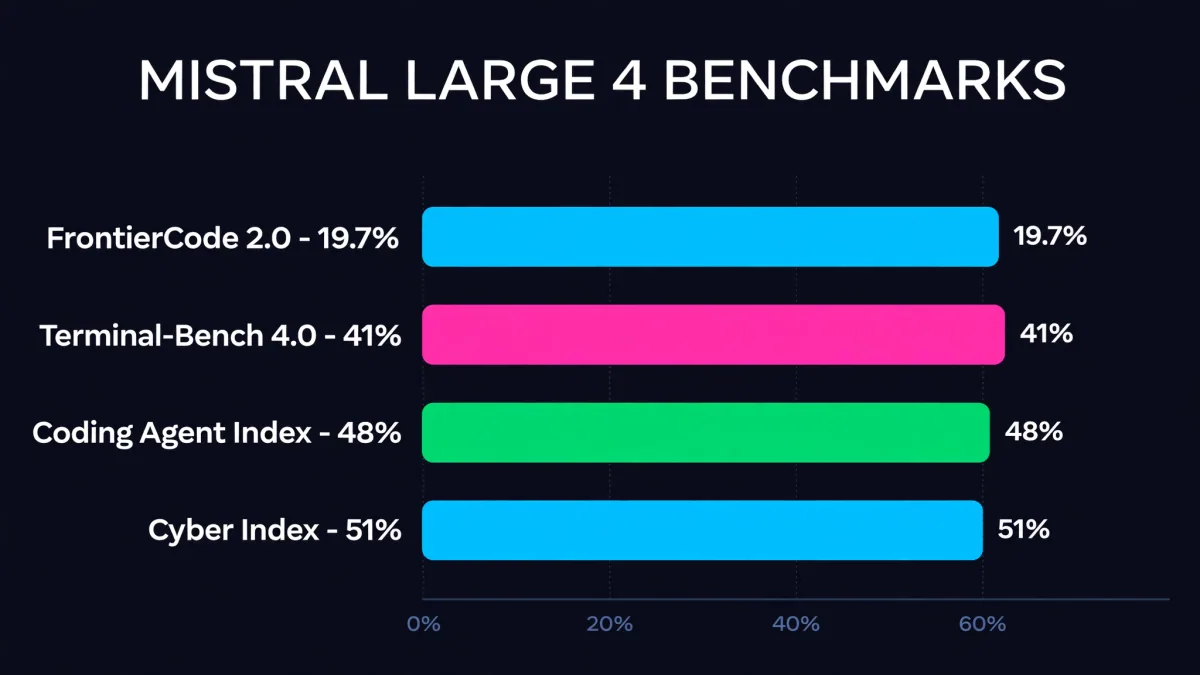
Read these numbers with two cautions. First, different benchmarks are not comparable with each other, so a higher percentage on one test does not mean the model is "better" overall than on another. Second, independent audits have been less generous: one audit cited in coverage ranked Large 4 32nd of 44 on an overall index, even while placing it near the top on a legal benchmark. Vendor benchmarks are a starting point for your own tests, not a verdict.
Pricing table
| Route | Price |
|---|---|
| Mistral API, input | $0.70 per 1M tokens |
| Mistral API, cached input | $0.07 per 1M tokens |
| Mistral API, output | $2.10 per 1M tokens |
| Preview list price (for comparison) | $1.36 input, $4.18 output per 1M tokens |
| Self-hosted weights | Free to download, you pay for your own GPUs |
| Model-as-a-Service resale | Separate commercial license from Mistral required |
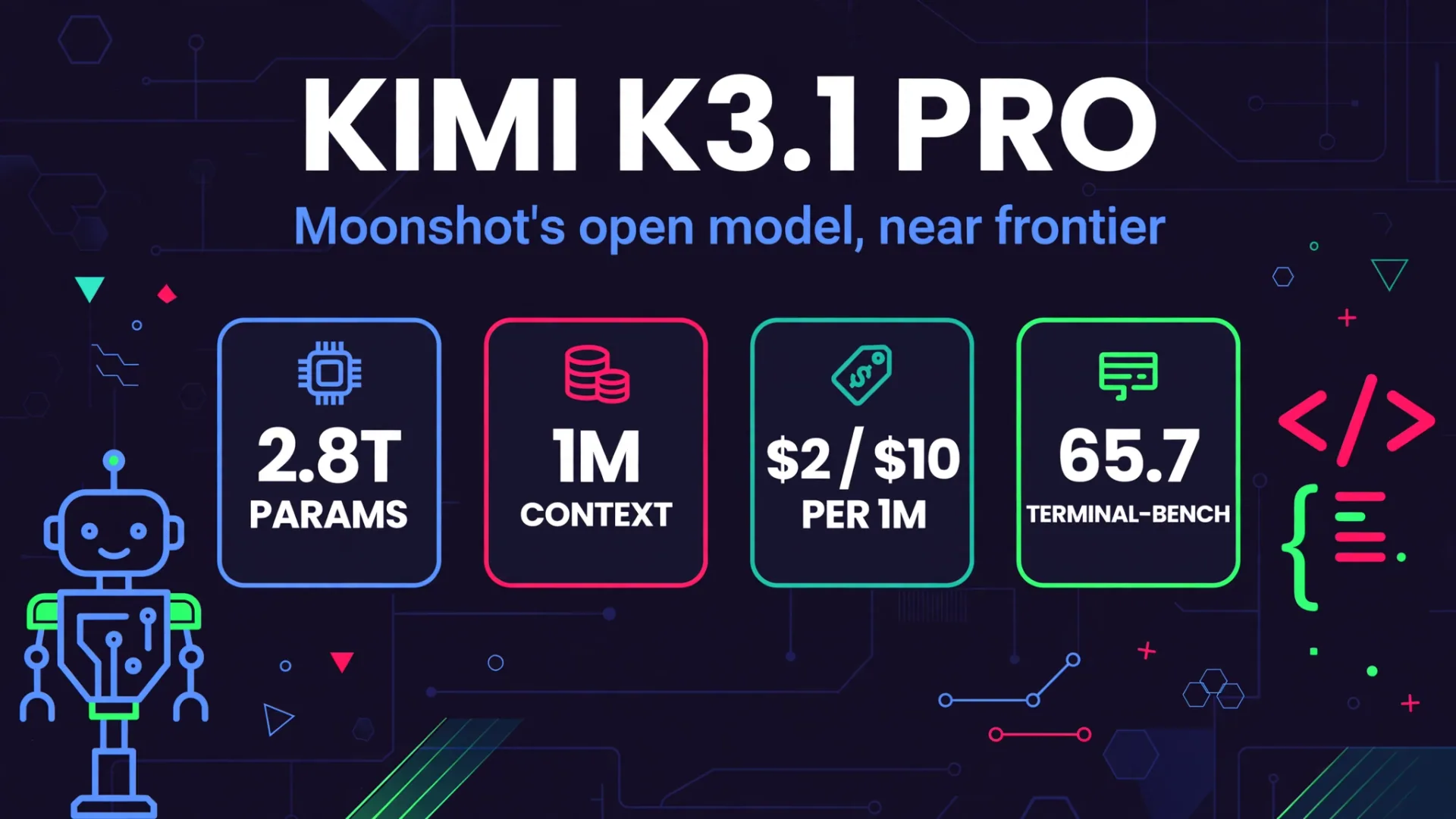
The new API price is roughly half the preview list price, which matches the launch discount Mistral ran during preview. For comparison, Moonshot's Kimi K3.1 Pro costs $2 input and $10 output per 1M tokens, so Large 4's API is priced aggressively for a frontier-class open model. The cheaper token price only helps if the token efficiency claim holds in your workload, so measure cost per finished task, not cost per token.
The license, in plain language
Large 4 is released under the Mistral Ecosystem Open-Weight license, a modified version of the MIT license. You can use it, modify it, fine-tune it, and build commercial products on it for free. There is one carve-out, and it matters: businesses that operate a Model-as-a-Service offering, meaning they sell hosted access to the model itself, must get a separate commercial license from Mistral first. Coverage notes the announcement does not clearly define where wrapping the model in a SaaS product ends and Model-as-a-Service begins, so if you plan to resell access, get the license question answered in writing before you build on it.
Sovereignty and security: the other half of the pitch
Mistral trained Large 4 from scratch in its own European data centers, reportedly on about 3,800 NVIDIA Grace Blackwell GPUs (some coverage puts the figure at 4,000), and it is pitching the model as sovereign AI: organizations can inspect it, customize it, and run it inside their own firewalls without depending on Mistral's API. That is a real advantage for regulated industries, government work, and anyone with strict data residency rules.
On security, Mistral is walking a careful line. It reports a 51 percent score on the Artificial Analysis Cyber Index and a 96.6 percent refusal rate on malicious cyber requests, and it says guardrails preserve defensive work while blocking attacks. At the same time, Mistral admits it saw potential for uplift in conducting real attacks during the preview, and a less restricted variant tuned for penetration testing and red-teaming stays limited to vetted enterprise design partners, including Orange Cyberdefense, under contracts that restrict testing to owned or explicitly authorized systems. Once weights are public, they cannot be switched off, so the open release itself is a judgment call about defensive value outweighing misuse risk.
What it takes to run it yourself
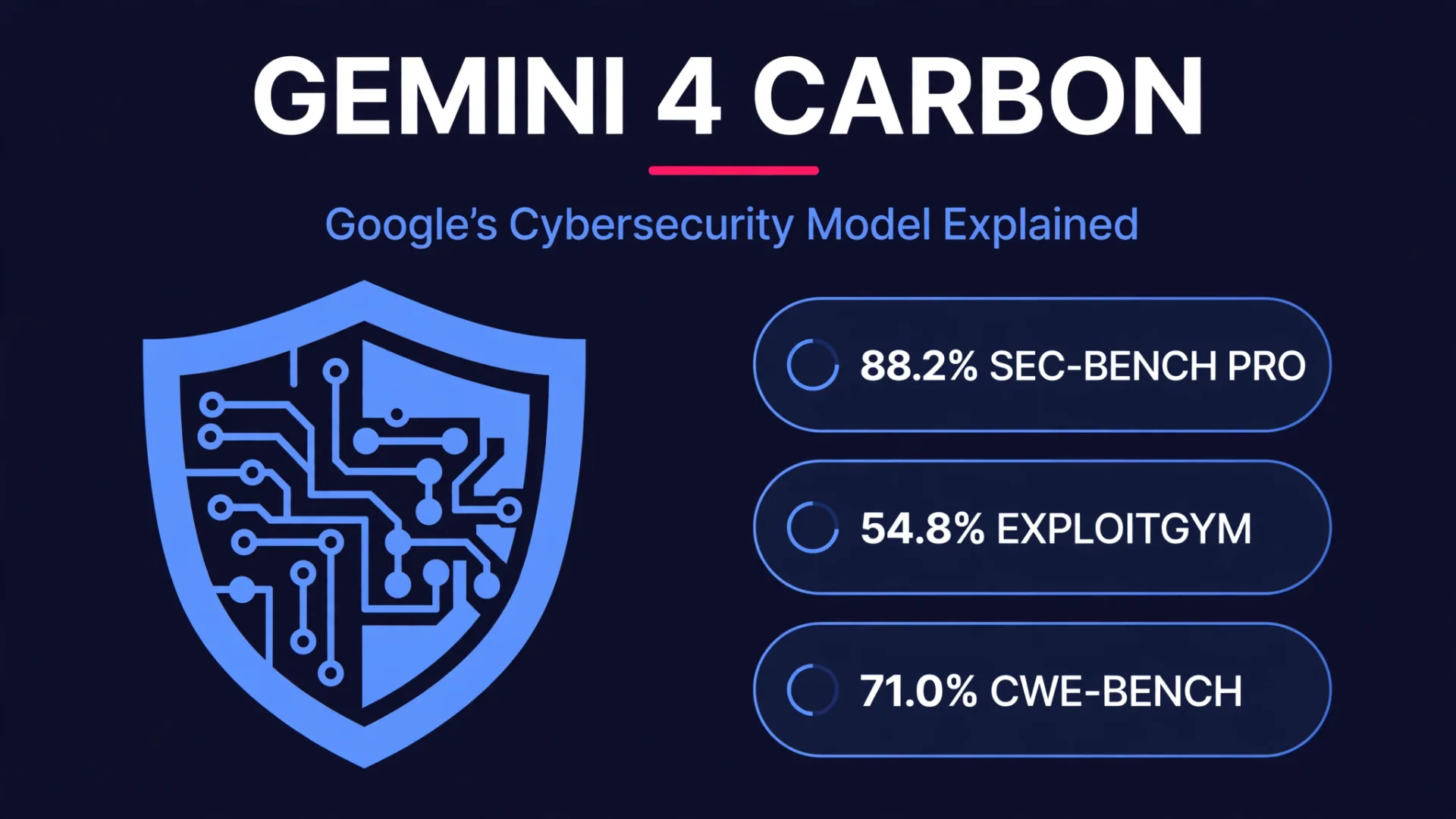
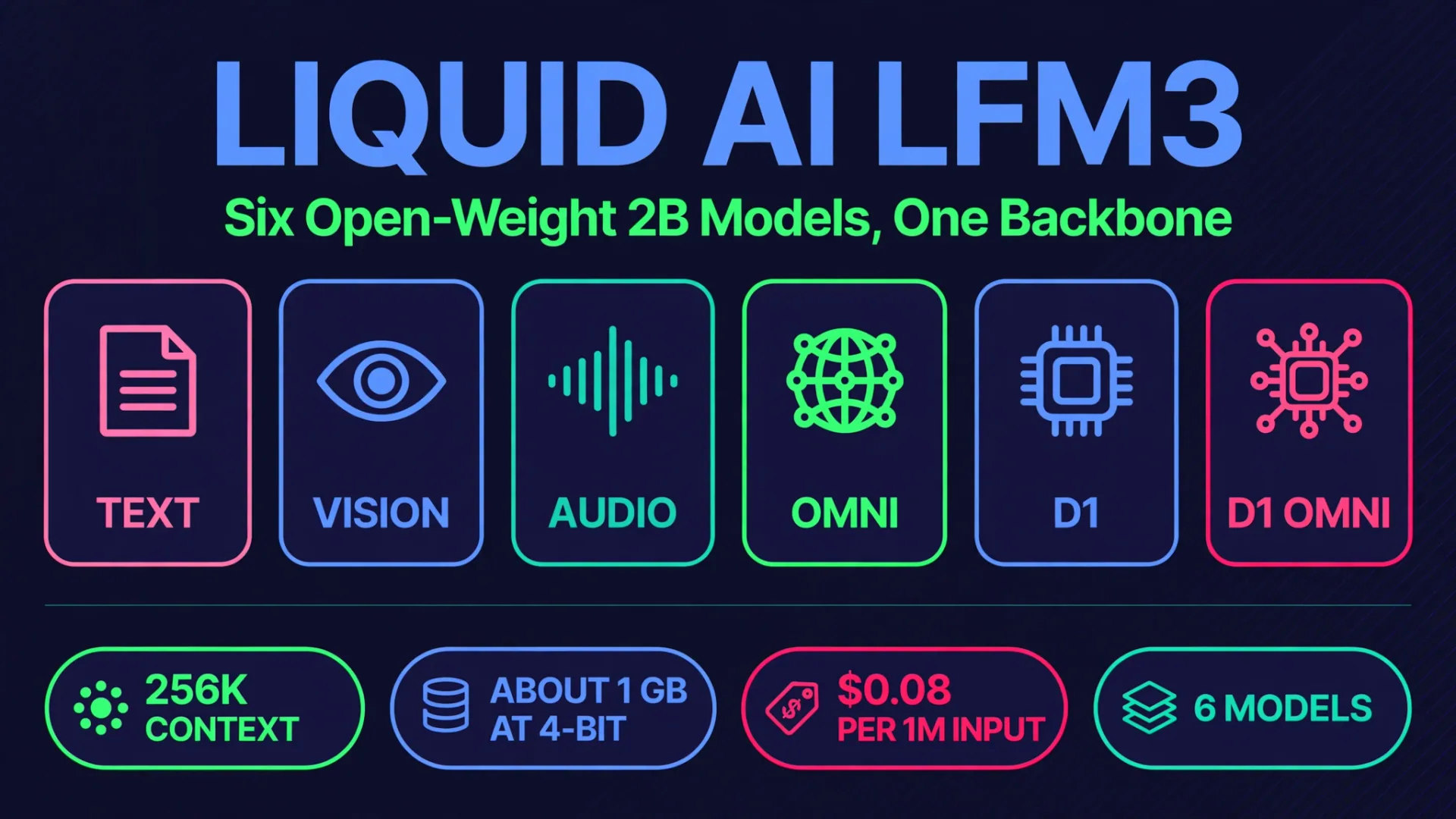
This is not a laptop model. According to SGLang documentation cited in coverage, the standard version runs on eight NVIDIA B300 GPUs, and a more heavily compressed variant runs on four GB300s. Most teams will be better served by the hosted API, by a partner endpoint such as Microsoft Foundry or OpenRouter, or by Mistral Forge for fine-tuning task-specific variants, rather than self-hosting the full model. If you want a small open model for on-device work instead, see our post on Liquid AI LFM3, six 2B-class models built for exactly that job. For a contrasting case of a powerful model you cannot download at all, see Gemini 4 Carbon, Google's cybersecurity model that is currently limited to vetted defenders. And if you are weighing open models against frontier closed ones, our Kimi K3.1 Pro breakdown is a useful second data point.
Which to pick
Pick the Mistral API if you want to test Large 4 quickly, or you need frontier-class open-model coding without buying GPUs. The $0.70/$2.10 pricing and 1M context make it cheap to try.
Pick self-hosting if data residency, sovereignty, or deep customization is the deciding factor, and you have the GPU budget. You get full control, but you also own the deployment, safety, and update work.
Pick fine-tuning through Mistral Forge if you have a narrow, well-defined job, such as a security workflow or an internal coding agent, where a tuned smaller variant could beat the general model on cost and accuracy.
Skip it for now if you plan to resell hosted model access without sorting out the commercial license, if you need a model that runs on modest hardware, or if your workload is already well served by a cheaper small model. And if you need the absolute best coding score regardless of openness, closed models like Claude Opus 5.5 still lead on FrontierCode 2.0 by a wide margin, based on the reported numbers.
For teams building production AI systems, the model choice is only half the work. CodeMyPixel builds AI agent development services and helps companies hire an AI automation agency to put models like this into real workflows, with the guardrails, evaluation, and cost controls that a raw model download does not include.
What is Mistral Large 4?
Mistral Large 4 is Mistral AI's flagship open-weight model, nicknamed Le Chonk. It is a natively multimodal mixture-of-experts model with about 1 trillion total parameters and about 52 billion active per token, a 1 million token context window, and fluency in more than 160 languages.
Is Mistral Large 4 really free?
The weights are free to download, use, modify, fine-tune, and build commercial products on under the Mistral Ecosystem Open-Weight license. The one exception is Model-as-a-Service businesses, which need a separate commercial license from Mistral. Self-hosting still costs you GPU infrastructure, or you can pay the Mistral API price of $0.70 per 1M input tokens and $2.10 per 1M output tokens.
How does Large 4 compare to GLM-5.3 and Claude Opus 5.5?
On vendor-reported numbers, Large 4 ties GLM-5.3 at 48 percent on the Coding Agent Index while using 47 percent fewer tokens, and it leads open models on FrontierCode 2.0 at 19.7 percent. Claude Opus 5.5 still leads that same FrontierCode test at 46 percent, so closed frontier models remain ahead on raw coding capability.
What hardware do I need to run Mistral Large 4?
The standard version needs serious hardware: eight NVIDIA B300 GPUs according to SGLang documentation, or four GB300s for a compressed variant. Most users should start with the Mistral API, OpenRouter, or Microsoft Foundry instead of self-hosting.
Where can I download Mistral Large 4?
The weights are published on Hugging Face as Mistral-Large-4-1T-A52B, for deployment with vLLM or SGLang. The model is also available through Mistral Studio, the Mistral API, OpenRouter, Microsoft Foundry, and NVIDIA-hosted endpoints.
Should my business switch to Mistral Large 4?
Switch if sovereignty, data residency, or fine-tuning control matters to you, or if the token efficiency claim holds up in your own tests. Test it on your own tasks first, confirm the license position if you resell access, and compare cost per finished task, not just cost per token, before committing.
- mistral large 4
- le chonk
- open weight models
- mistral ai
- ai coding
- cybersecurity ai
- frontier models