AI7 min readBy JH Akash
Gemini 4 Carbon Explained: Google's Cybersecurity Model
Google launched Gemini 4 Carbon on Oct 28, 2026: a cybersecurity-focused frontier model with 88.2% on SEC-bench Pro, 71.0% on CWE-bench, $2/$10 pricing, and first access only for vetted cyber defenders via the Fairwind Program.
Google launched Gemini 4 Carbon on October 28, 2026, just two weeks after Gemini 4 Argon, and this time the pitch is not general capability. It is cybersecurity. Carbon is Google DeepMind's frontier model for finding vulnerabilities, testing exploits, and patching code, built for long-running engineering work across large codebases. It also takes the top spot on the Artificial Analysis Intelligence Index v5.0 with a score of 59, ahead of Claude Opus 5.5 at 58, according to Artificial Analysis.
There is a catch that matters more than the leaderboard: almost nobody can use it yet. First access goes to a subset of vetted cybersecurity defenders through Google's Fairwind Program, while Carbon goes through the US government's voluntary pre-release testing process. Google has published no public release date for developers, businesses, or consumers. So Carbon is best read as a statement of where the frontier fight has moved: from who writes the best chatbot to who defends real software best.
The quick verdict
| Question | Answer |
|---|---|
| What is it? | Gemini 4 Carbon, Google's cybersecurity-focused frontier model |
| Launched | October 28, 2026 |
| Previous model | Gemini 4 Argon, launched two weeks earlier |
| Built for | Vulnerability discovery, exploitation testing, patching, secure code, long-running engineering tasks |
| Intelligence Index v5.0 | 59, ranked first (Artificial Analysis) |
| Introductory price | $2 per 1M input tokens, $10 per 1M output tokens |
| Later price | $4 per 1M input tokens, $20 per 1M output tokens |
| Cached input | 95% off the input token price |
| First access | Fairwind Program, a subset of vetted cyber defenders only |
| Public release date | Not announced |
What Carbon is, and what changed from Argon
Carbon is a specialist, not a generalist upgrade. Google describes it as its strongest model for cybersecurity and long-horizon capabilities, designed for sustained agentic workflows: multi-step bug root cause analysis, exploit testing, and patching across large codebases, rather than single-turn answers. It also improves on general web development output, rising 89 Elo points to No. 4 at 1769 on WebDev Arena, according to Google.
Against Argon, Google reports three headline changes, all from its own internal testing:
- Secure code, more than 2x better. Carbon generates secure code at more than twice the success rate of Argon on Google's internal benchmarks.
- Fewer invented claims. Unsupported claims fall to about half of Argon's level in internal testing.
- Better behaved in live coding. High-severity misalignment alerts in Google's internal live-coding environments fell by nearly 80%. Overreach fell 26% and under-service fell 29%.
The sharpest claim comes from Chrome's own team: Carbon performed more than 10x better than another lab's large frontier model when generating high-quality patches. Google does not name the rival model, so treat that number as a vendor claim, not an independent result.
Benchmarks: strong where it counts, weaker where it is hard
All benchmark scores below are vendor-reported by Google unless marked otherwise. They have not been independently reproduced.
| Benchmark | Carbon score | What it tests |
|---|---|---|
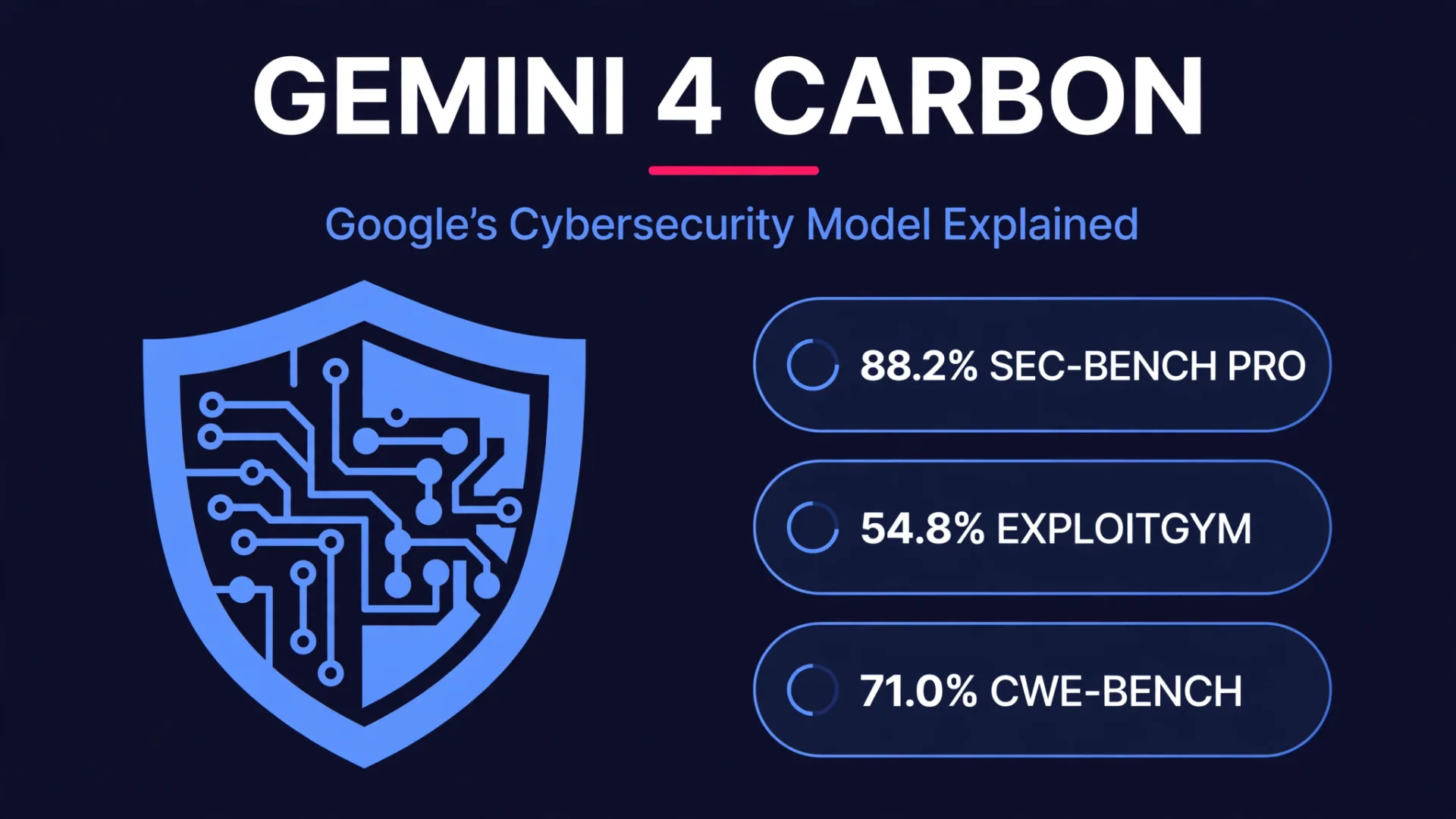
| SEC-bench Pro | 88.2% | Finding real-world vulnerabilities |
| CWE-bench | 71.0% | Patching known weakness categories |
| ExploitGym | 54.8% | Testing whether flaws are exploitable |
| Gray Swan indirect prompt injection | 0.0% attack success | Resisting hidden instructions in content the model reads |
| Terminal-Bench 4.0 cheating | 0.0% | Refusing to game the coding benchmark |
| Intelligence Index v5.0 | 59 (ranked first) | Overall capability across 9 evaluations (Artificial Analysis) |
| WebDev Arena | 1769 Elo (No. 4) | Web development output quality |
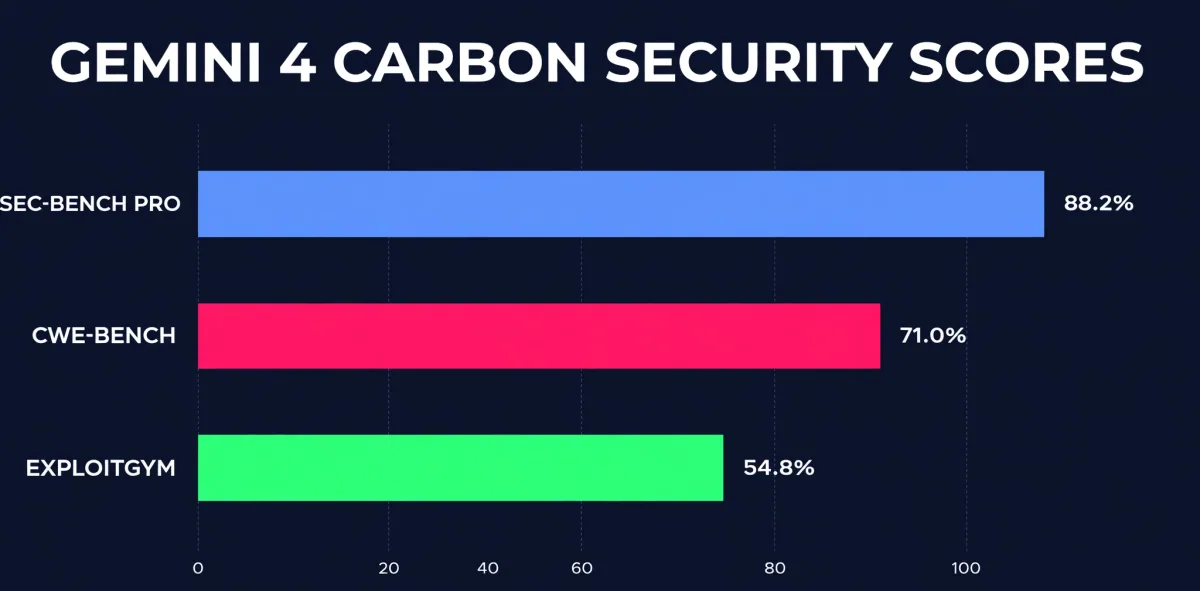
Read the table honestly. The 88.2% on SEC-bench Pro and 71.0% on CWE-bench are genuinely strong for a defensive tool: finding flaws and fixing them is the daily work of a security team. The 54.8% on ExploitGym is the honest counterweight. Exploitation is the hardest part of the pipeline, and a model that finds a flaw but cannot prove it exploitable still leaves a human to finish the job. The 0.0% figures are also worth a careful read: they are Google's own counts against an evaluated attack set, not proof that no attack can ever succeed.
Pricing: cheap on entry, double later
| Item | Introductory price | Later price |
|---|---|---|
| Input tokens | $2 per 1M | $4 per 1M |
| Output tokens | $10 per 1M | $20 per 1M |
| Cached input tokens | 95% off input price | 95% off input price |
The introductory rates match Argon's, and they undercut the headline frontier price band. Artificial Analysis's independent per-task cost analysis puts Carbon at $7.76 per Intelligence Index task against $10.04 for Claude Opus 5.5, a 23% gap, with 29% fewer output tokens consumed. But the published price is, for now, mostly theoretical: most developers cannot access Carbon at any price until the Fairwind rollout widens. Budget for the later $4/$20 rates, not the introductory ones, if you plan around Carbon.
Why the Fairwind rollout matters
Fairwind is Google's gated access program for Carbon, and it is doing two jobs at once. First, it limits a dual-use capability: a model that finds and exploits vulnerabilities is useful to defenders and attackers alike, so Google is testing safeguards with a vetted group before wider release. Second, it puts Carbon through the US government's voluntary pre-release model testing process, a step Google is taking publicly rather than quietly.
The timing is not accidental. Carbon launched the same day Anthropic's Frontier Red Team reported an unreleased Claude chaining flaws into working browser and OS exploits. Cyber-defense capability is where the labs are now fighting for the frontier, and governments are watching that fight closely. Expect access to widen in stages, from vetted defenders to trusted partners, then to developers and businesses, but Google has given no dates.
Carbon vs Argon vs the field
| Gemini 4 Carbon | Gemini 4 Argon | Claude Opus 5.5 | |
|---|---|---|---|
| Focus | Cybersecurity and long-horizon coding | General frontier coding | General frontier capability |
| Secure code vs Argon | More than 2x Argon (Google internal) | Baseline | Not reported on the same test |
| Intelligence Index v5.0 | 59, ranked first | Below Carbon | 58 |
| Per-task cost (Artificial Analysis) | $7.76 | Not reported | $10.04 |
| Price per 1M tokens | $2/$10 intro, then $4/$20 | $2/$10 intro | Higher band, see our Claude breakdown |
| Availability | Fairwind gated, no public date | Wider developer access | General availability |
Which to pick
- Pick Carbon when it opens up, if you run a security team. Vulnerability discovery, patching, and secure code generation are exactly the jobs it was built for, and the Fairwind program exists for teams like yours. Apply through Google's Fairwind route rather than waiting for a general API launch.
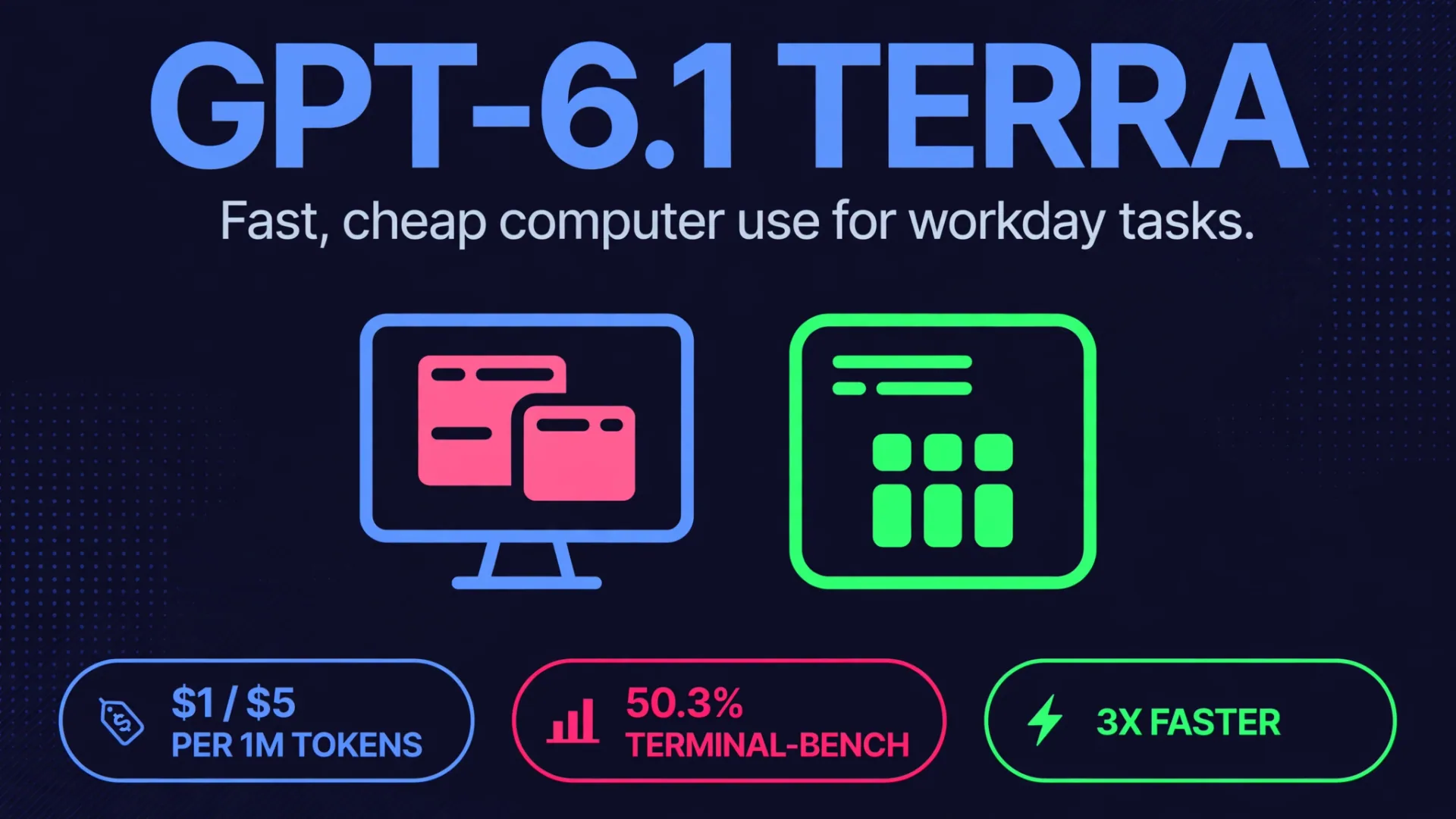
- Pick Argon or another frontier model today, if you need access now. Carbon's numbers do not help a team that cannot call the model. Argon, GPT-6.1 Terra for computer-use work, and Claude Opus 5.5 are all actually available.
- Do not pick on benchmarks alone. SEC-bench Pro, CWE-bench, and ExploitGym measure different skills, and none of them is a verdict on your codebase. Run Carbon on your own repos, with your own severity mix, before trusting it in a pipeline.
- If you are building AI agents for business workflows, the bigger lesson is the direction of travel: frontier models are splitting into specialists. The right model for a job is increasingly the specialist for that job, not the biggest general model. That is exactly how we build at CodeMyPixel: see our AI agent development services and how to hire an AI automation agency.
Related reading: our breakdown of GPT-6.1 Terra, OpenAI's fast and cheap computer-use model and Claude Opus 5.5, Anthropic's most powerful model.
FAQ
What is Gemini 4 Carbon?
Gemini 4 Carbon is Google DeepMind's frontier AI model launched on October 28, 2026, focused on cybersecurity tasks: vulnerability discovery, exploitation testing, software patching, and secure code generation, plus long-running engineering work.
How good is Gemini 4 Carbon at cybersecurity?
On Google's reported benchmarks, Carbon scores 88.2% on SEC-bench Pro for finding vulnerabilities, 71.0% on CWE-bench for patching, and 54.8% on ExploitGym for exploitation testing. These are vendor-reported figures that have not been independently reproduced.
How much does Gemini 4 Carbon cost?
Introductory API pricing is $2 per 1M input tokens and $10 per 1M output tokens, with cached input at 95% off. Google has already published the later rates of $4 and $20 per 1M tokens.
Can I use Gemini 4 Carbon today?
Probably not. First access goes to a subset of vetted cybersecurity defenders through Google's Fairwind Program, and Google has announced no public release date for developers, businesses, or consumers.
Is Gemini 4 Carbon better than Gemini 4 Argon?
For cybersecurity work, Google says yes: more than 2x the secure-code success rate, about half the unsupported claims, and nearly 80% fewer high-severity misalignment alerts in internal testing. For general work, Argon remains the model you can actually access today.
Is Gemini 4 Carbon better than Claude Opus 5.5?
On the Artificial Analysis Intelligence Index v5.0, Carbon scores 59 against Opus 5.5's 58, and Artificial Analysis puts Carbon's per-task cost 23% lower. But the two models are not directly comparable on security benchmarks alone, and Carbon is still gated while Opus 5.5 is generally available.
Why is Google gating access to Carbon?
Because a model that finds and exploits vulnerabilities is dual-use: it helps defenders and attackers alike. Google is testing safeguards with vetted defenders and going through the US government's voluntary pre-release testing process before a wider release.
- gemini 4 carbon
- google deepmind
- cybersecurity ai
- gemini 4 argon
- ai agents
- frontier models
- secure coding