AI6 min readBy JH Akash
Kimi K3.1 Pro Explained: Moonshot's Open Model Nears Frontier
Moonshot launched Kimi K3.1 Pro on Oct 23, 2026: a 2.8T open-weight model, 1M context, 65.7 on Terminal-Bench 4.0, priced at $2/$10 per 1M tokens, weights due Nov 4.
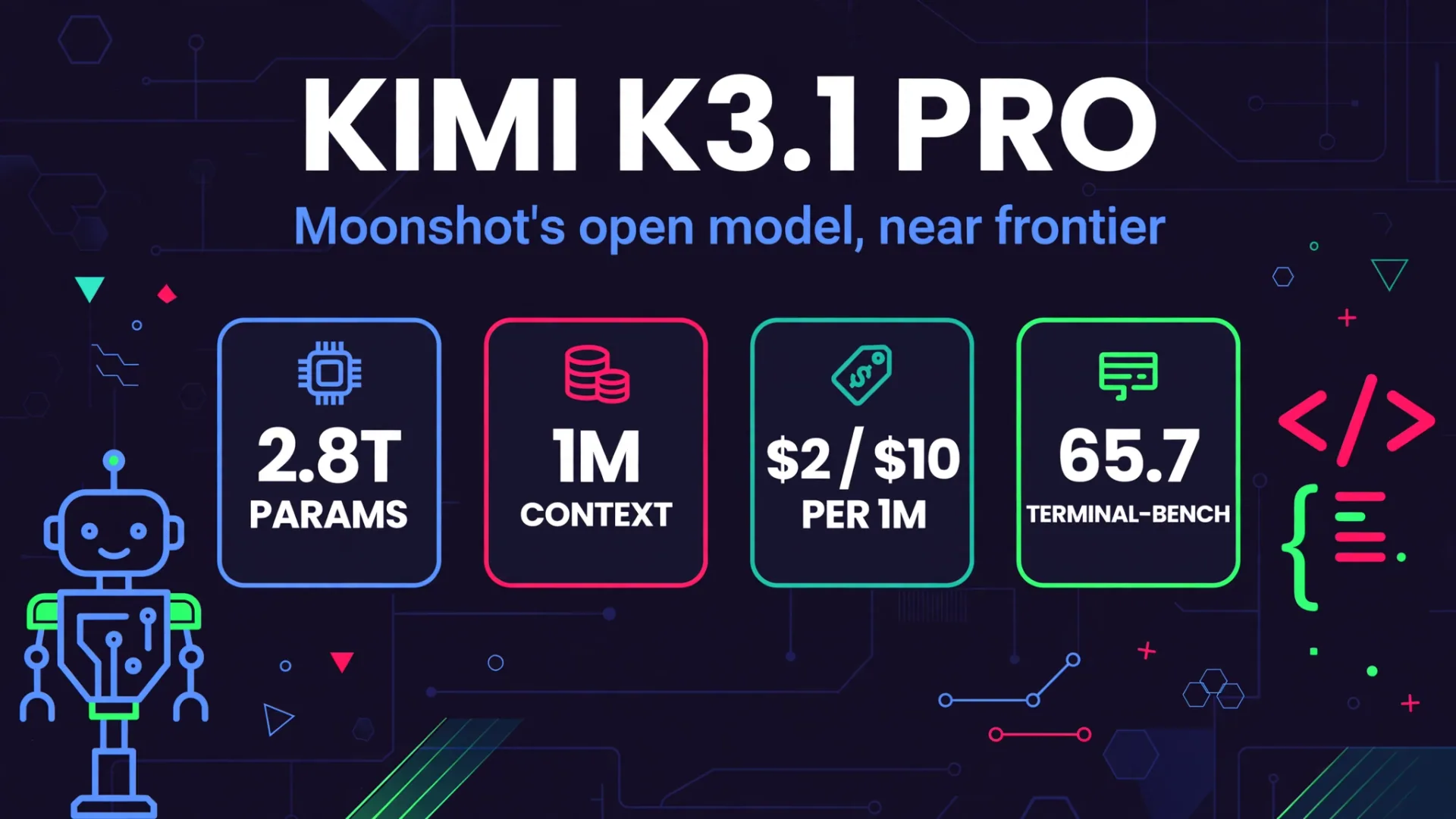
Moonshot AI launched Kimi K3.1 Pro on October 23, 2026, and it is the freshest proof that the gap between open-weight models and closed frontier models is now very small. It is not a brand new base model. Moonshot describes it as a post-trained version of Kimi K3, pushed through far more reinforcement learning across hundreds of domains. The result is a mixture-of-experts model with about 2.8 trillion total parameters, 104 billion active per token, and a 1 million token context window, with text and image input.
It is live now on Kimi.ai, Kimi Work, Kimi Code, and the Kimi API. A companion variant, Kimi K3.1 Pro Highspeed, promises the same capabilities at 2 to 3 times the speed. Full model weights are promised by November 4, 2026, which would make it the strongest open-weight model on independent rankings if that ranking holds. Until then, the API is the only way to run it, and the license and hardware requirements for self-hosting are still unknown.
The quick verdict: Kimi K3.1 Pro vs Claude Opus 5.5 vs GPT-6 Astra
| Kimi K3.1 Pro | Claude Opus 5.5 | GPT-6 Astra | |
|---|---|---|---|
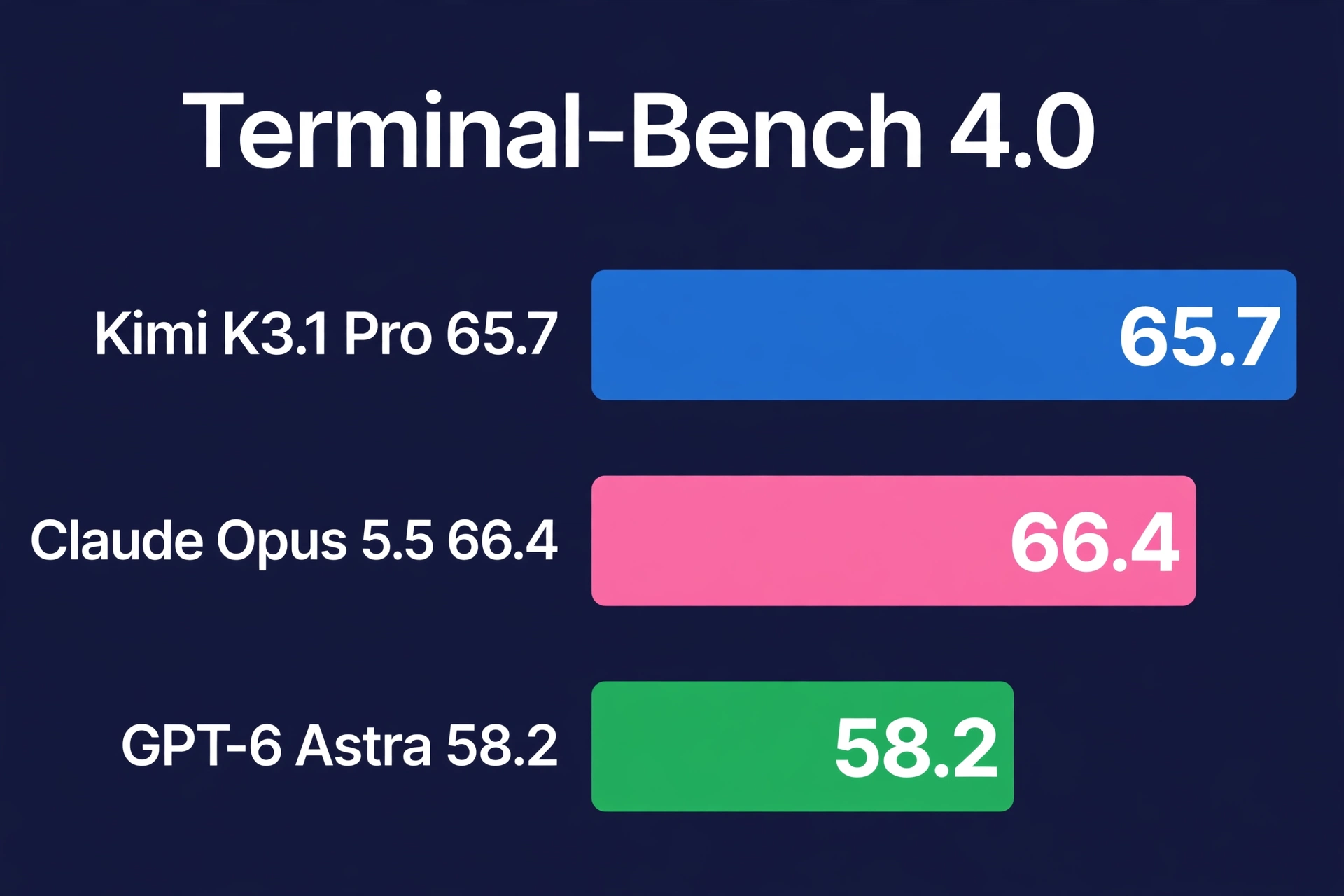
| Terminal-Bench 4.0 (vendor-reported) | 65.7 | 66.4 | 58.2 |
| SWE Marathon (vendor-reported) | 51.7 | 46.3 | 42.5 |
| Agents' Last Exam (vendor-reported) | 43.2 | 42.6 | 32.8 |
| Artificial Analysis Intelligence Index | 55 | 58 | 53 |
| Context window | 1M tokens | Not compared here | Not compared here |
| API input price per 1M tokens | $2 | $4 (reported, via Highspeed match) | Not listed in this comparison |
| Open weights | Promised by Nov 4, 2026 | No | No |
Read the table carefully. Kimi K3.1 Pro trails Opus 5.5 by only 0.7 points on Terminal-Bench 4.0 and sits ahead of GPT-6 Astra on the same test, but different benchmarks measure different skills, so no single score makes one model the overall winner. The honest story is narrower: on coding-agent tests, this open-weight model now plays in the same league as the closed frontier.
What changed from Kimi K3
Kimi K3 launched in July 2026 as a 3T-class open model. K3.1 Pro keeps that base and scales up post-training instead of pretraining a new model from scratch. Moonshot says it optimized its reinforcement learning framework, long-context processing, training efficiency, and infrastructure. The practical gains show up in full-project work: coding across a whole codebase, parametric 3D modeling in Blender and CAD tools, full-project builds in Unity, Unreal, and Godot, and end-to-end financial workflows.
One vendor claim deserves a clear label. Moonshot says hallucinations in financial modeling tasks are down 65% compared with the previous generation. That is a vendor-reported figure, not an independently verified result, so treat it as a claim to test on your own financial tasks, not as a guarantee.
Pricing
| Model | Input per 1M tokens | Output per 1M tokens | Cached input per 1M tokens |
|---|---|---|---|
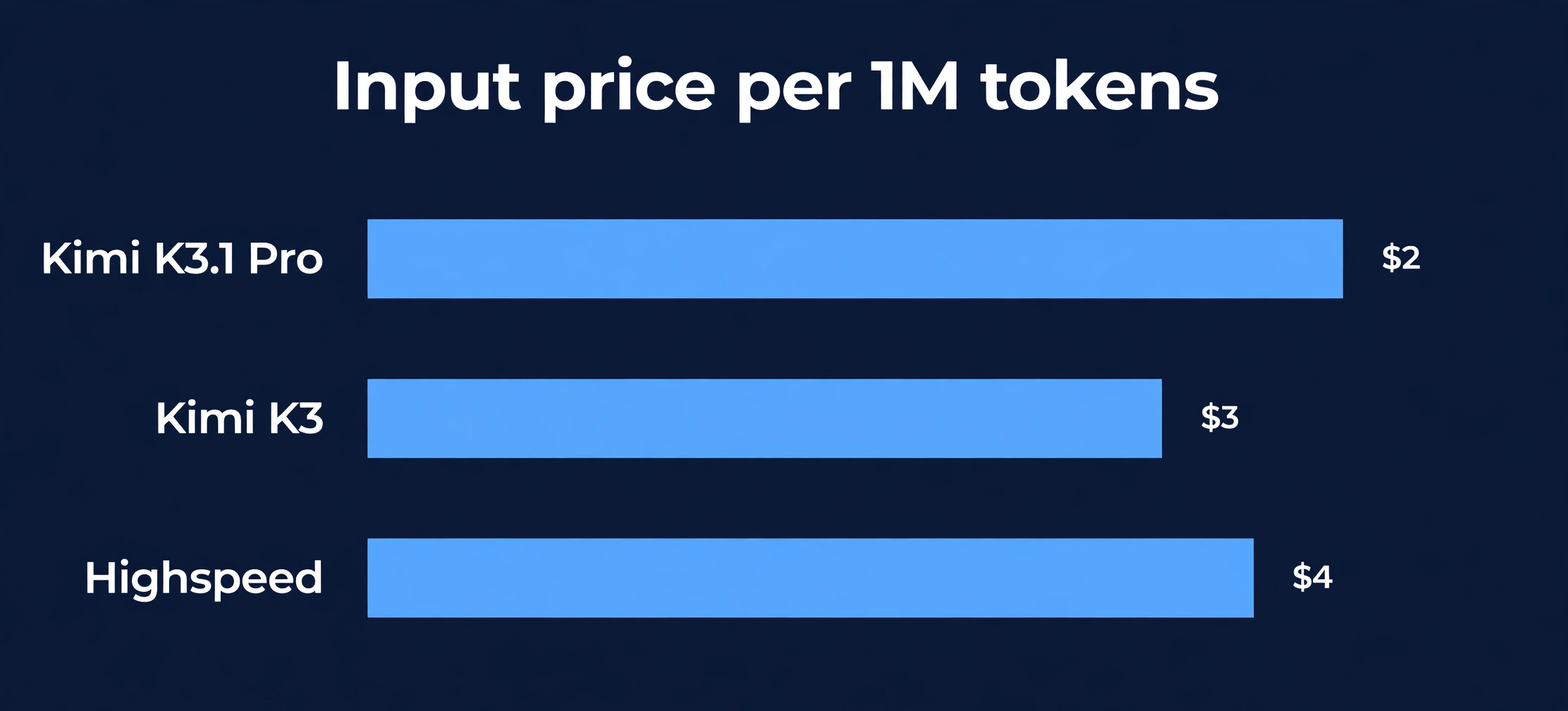
| Kimi K3.1 Pro | $2 | $10 | $0.20 |
| Kimi K3.1 Pro Highspeed | $4 | $20 | $0.20 |
| Kimi K3 | $3 | $15 | $0.30 |
That is a one-third cut from K3 on input, output, and cached input. The standard price matches GPT-6.1 Sol at $2/$10, according to launch coverage, while the Highspeed tier at $4/$20 matches the reported Opus 5.5 rate. There is no long-context surcharge listed, and cache writes are billed separately by TTL (5 minutes or 1 hour).
The catch is token usage. Artificial Analysis measured Kimi K3.1 Pro at 77 tokens per second of output and estimated about $1.98 to $2.11 per benchmark task, nearly unchanged from K3, because the new model uses more output tokens to reach its scores. Cheaper per token does not always mean cheaper per finished task, so measure your own workloads before switching.
Benchmarks, with the honest caveats
All benchmark figures in this table are vendor-reported, from Moonshot's launch chart, with models run at maximum thinking effort. Independent verification is still limited because the weights are not out yet.
| Benchmark | Kimi K3.1 Pro | Claude Opus 5.5 | GPT-6 Astra |
|---|---|---|---|
| Terminal-Bench 4.0 | 65.7 | 66.4 | 58.2 |
| SWE Marathon | 51.7 | 46.3 | 42.5 |
| Agents' Last Exam | 43.2 | 42.6 | 32.8 |
| OfficeQA Pro v2 | 64.4 | 62.2 | 54.4 |
| Humanity's Last Exam, with tools | 70.0 | 67.7 | 57.2 |
| OSWorld V2.1 | 79.6 | 81.8 | 75.8 |
| BenchCAD, with tools | 92.7 | 96.2 | 95.9 |
| Terminal-Bench Science 0.1 | 38.1 | 63.3 | 68.1 |
The weak spot is real. On Terminal-Bench Science 0.1, Kimi K3.1 Pro scores 38.1 against 63.3 for Opus 5.5 and 68.1 for GPT-6 Astra. If your work is heavy science research in a terminal, this is not yet the model to pick on benchmarks alone. Independent checks also add nuance: Artificial Analysis scores Kimi K3.1 Pro at 55 on its Intelligence Index, fourth overall, up 11 points from K3's 44, behind Opus 5.5 at 58 and Claude Sonnet 5.5 and Muse Wonder Full tied at 56. One independent tester rated its 3D scene and website work above GPT-5.6 Sol but below GPT-6.1 Sol, so creative quality still trails the very top on some tasks.
The safety story that matters before the weights drop
Moonshot deliberately limited this model before promising open weights. During training, the team found that vulnerability discovery and exploitation skills rose as fine-tuning scaled, driven by cybersecurity materials in the training corpus and related reinforcement learning tasks. It removed that data at both stages.
On its internal xdev-bench-hard test, where the model gets source code with a recently disclosed vulnerability and must write an exploit in an isolated environment, the unrestricted experimental version scored 90.5%, the final K3.1 Pro scored 81%, and Kimi K3 scored 33.3%. Those are internal, unverified figures, and Moonshot itself says the model still lags leading proprietary models that have been available for at least three months on such tasks, while remaining useful for defensive software audits. The point for buyers is simple: open weights are powerful, and Moonshot chose to ship them only after pulling back the sharpest cyberattack capability.
Which one should you pick?
Pick Kimi K3.1 Pro if you want near-frontier coding-agent performance at $2/$10 pricing, a 1M context window, and a path to open weights on November 4. It fits full-project coding, agent loops, 3D and CAD workflows, and financial research where you can verify outputs.
Pick Kimi K3.1 Pro Highspeed if latency is the bottleneck in your agent loop and you can pay double per token for 2 to 3 times the speed.
Stick with Claude Opus 5.5 if your work leans on science-heavy terminal tasks or the highest independent index score, and you accept closed weights and higher per-task cost. Stick with GPT-6 Astra if you are already built on OpenAI's stack and its ecosystem matters more than the per-token saving.
If you are building agent workflows on any of these models, this is exactly the kind of plumbing that decides cost and speed in production. CodeMyPixel builds custom AI agent development solutions and full AI automation systems for teams that need models doing real work, not just generating text. For model context, see our breakdowns of GPT-6 Astra and Claude Opus 5.5.
FAQ
What is Kimi K3.1 Pro?
A post-trained version of Moonshot AI's Kimi K3, launched October 23, 2026. It is a mixture-of-experts model with about 2.8 trillion total parameters, 104 billion active per token, a 1 million token context window, and text plus image input. It is available on Kimi.ai, Kimi Work, Kimi Code, and the Kimi API.
How much does Kimi K3.1 Pro cost?
Standard pricing is $2 per 1 million input tokens, $10 per 1 million output tokens, and $0.20 per 1 million cached input tokens. The Highspeed variant costs $4/$20/$0.20. That is one-third cheaper per token than Kimi K3, which was $3/$15/$0.30.
Is Kimi K3.1 Pro better than Claude Opus 5.5?
Not across the board. On vendor-reported Terminal-Bench 4.0, Kimi K3.1 Pro scores 65.7 against Opus 5.5 at 66.4, and it leads on SWE Marathon and Agents' Last Exam. On Terminal-Bench Science 0.1 it trails badly at 38.1 against 63.3. On the independent Artificial Analysis Intelligence Index, Opus 5.5 leads at 58 against Kimi K3.1 Pro at 55. Different benchmarks are not comparable as a single winner, so pick by your workload.
When will the Kimi K3.1 Pro weights be released?
Moonshot says it plans to release the full model weights by November 4, 2026. The license and hardware requirements are not confirmed yet, so self-hosting plans should wait for that release.
What is Kimi K3.1 Pro Highspeed?
A faster variant of the same model that Moonshot says delivers 2 to 3 times faster output at double the token price ($4 input, $20 output per 1 million tokens, cached input unchanged at $0.20). It suits latency-sensitive agent loops where speed is worth the premium.
- kimi k3.1 pro
- moonshot ai
- open weight models
- ai coding agents
- claude opus 5.5
- gpt-6 astra