KI-Tools & Updates6 Min. LesezeitVon JH Akash
Perplexity Orchestrator: 45+ Models at 0% Platform Fee
Perplexity launched the Orchestrator API on Nov 17: 45+ models from OpenAI, Anthropic, Google and xAI behind one API, automatic same-model failover, and no platform fee. Here are the tiers, the benchmarks, and how it stacks up against OpenRouter.
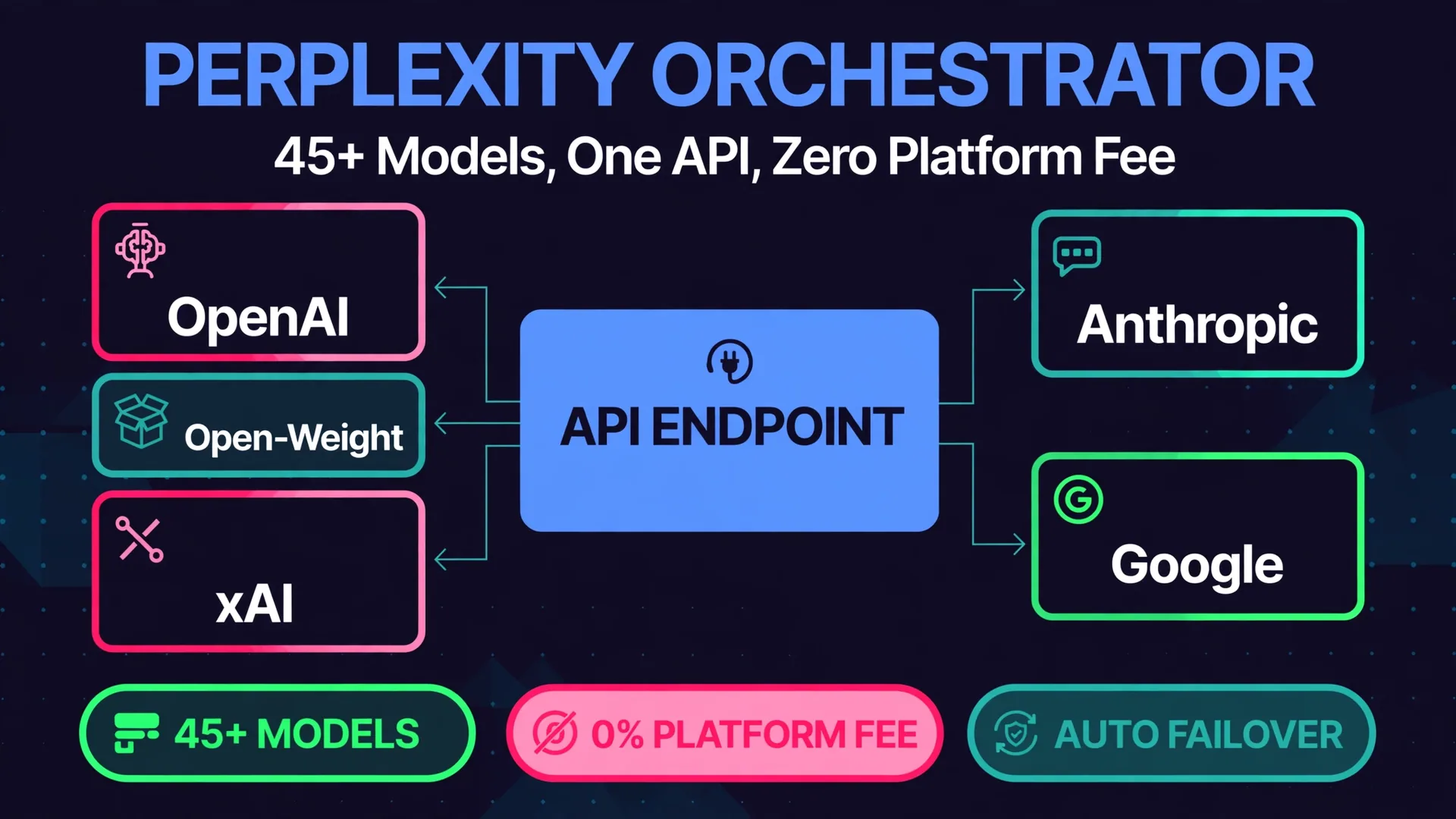
Perplexity launched the Orchestrator API on November 17, 2026, and it is a direct shot at OpenRouter. One API key and one base URL now reach 45+ models from OpenAI, Anthropic, Google and xAI, plus open-weight models like GLM, Kimi and DeepSeek. The pitch is simple: your app stops caring which provider is down today, because Orchestrator retries the same model on another host automatically, and Perplexity charges no platform fee on top of token prices.
That last part is the hook. OpenRouter takes 5.5% on Standard credit purchases and 8% on Business. Orchestrator takes 0%. Here is what launched, what it costs, where the numbers hold up, and who should switch.
Quick verdict
| Question | Answer |
|---|---|
| What is it? | One hosted gateway for 45+ frontier and open-weight models |
| Base URL | https://api.perplexity.ai/orchestrator/v1 |
| Platform fee | None. You pay each model's published per-token rate |
| Failover | Automatic, same model on another deployment (for example Anthropic to AWS Bedrock) |
| Auto model routing | perplexity/auto in preview, 1 to 5 routes |
| Access today | Private preview, request access by email |
| Bring your own key | Not supported |
What actually launched
Orchestrator separates two decisions that most teams currently hard-code. The first is where a model runs. You ask for a model, Orchestrator picks a deployment by observed error rates, available capacity and latency, and if that deployment errors, rate-limits or times out, it retries the same model somewhere else. Requests that fail before producing output are not billed. If every deployment fails, you get HTTP 429 with a Retry-After header.
The second decision is which model answers. That layer is the perplexity/auto preview. You set a default model plus 1 to 5 routes, each route being a plain-language description of the work and the model that should handle it. A lightweight decision model reads the conversation and the descriptions, never the model IDs, and picks a route per turn. Response headers (x-perplexity-autoroute-route, -outcome, -confidence) tell you what it chose. With no custom config, the default policy sends work to GPT-6.1 Sol and simple requests to GPT-6 Luna.
Integration is deliberately boring: the API accepts OpenAI Chat Completions, OpenAI Responses and Anthropic Messages formats, so most teams change the API key and base URL and keep their SDK. It is stateless, so your app sends the full conversation each time, and a stable prompt_cache_key or x-session-id improves cache reuse on the same deployment.
Perplexity says this is the same layer it runs internally across 85+ models and more than a dozen providers, handling hundreds of millions of daily requests. The public catalog in private preview is smaller: 45+ models.
Pricing and access tiers
Every request is billed at the answering model's published per-token rate, whichever provider serves it. Failover does not change the rate, and there is no additional platform fee on credits. One published example: perplexity/glm-5.3 lists $1.40 input, $4.40 output and $0.26 cache read per 1M tokens. Usage draws from prepaid Perplexity API credits, also sold through AWS Marketplace.
Access is tiered by cumulative credit purchases:
| Tier | Cumulative credits | Models unlocked |
|---|---|---|
| Tier 0 | $0 | Google, xAI and open-weight models |
| Tier 1 | $50 | OpenAI and most Anthropic models |
| Tier 2 | $250 | Claude Opus 5, Opus 5.5 and the Fable models |
The catch: there is no bring-your-own-key option. Traffic runs on Perplexity's provider relationships and billing, so teams with negotiated enterprise rates lose those rates on anything routed through Orchestrator.
The numbers Perplexity published
Treat everything in this section as vendor-reported. Perplexity measured its own production traffic from October 4 to November 2, 2026, and published no percentage success rates, only the claim that Claude and GPT requests through Orchestrator succeeded more often than requests to any single provider it tracked, with steadier daily rates during provider incidents.
Two speed data points show why static provider picks go stale. For Claude Opus 5.5, Anthropic was fastest on 15 of 30 days and AWS Bedrock on the other 15. For GPT-5.6 Sol, Azure's median output speed was 27% higher than OpenAI's. Speed-aware model selection is still in development, so today latency shapes deployment choice, not model choice.
The most interesting test is the refusal workaround. Anthropic documents that Claude Fable 5.2 safeguards can block benign security and life sciences work. Perplexity ran Claude Code on a self-selected 63-task subset of Terminal-Bench 4.1, with Fable as the default and security, biology and after_refusal routes pointed at a GPT-6 model:
| Configuration | Tasks solved (of 63) | Cost |
|---|---|---|
| Claude Fable 5.2 alone | 38 | Lower |
| Fable + routes to GPT-6.1 Sol | 41 | Higher |
| Fable + routes to GPT-6 Astra | 41 | Higher |
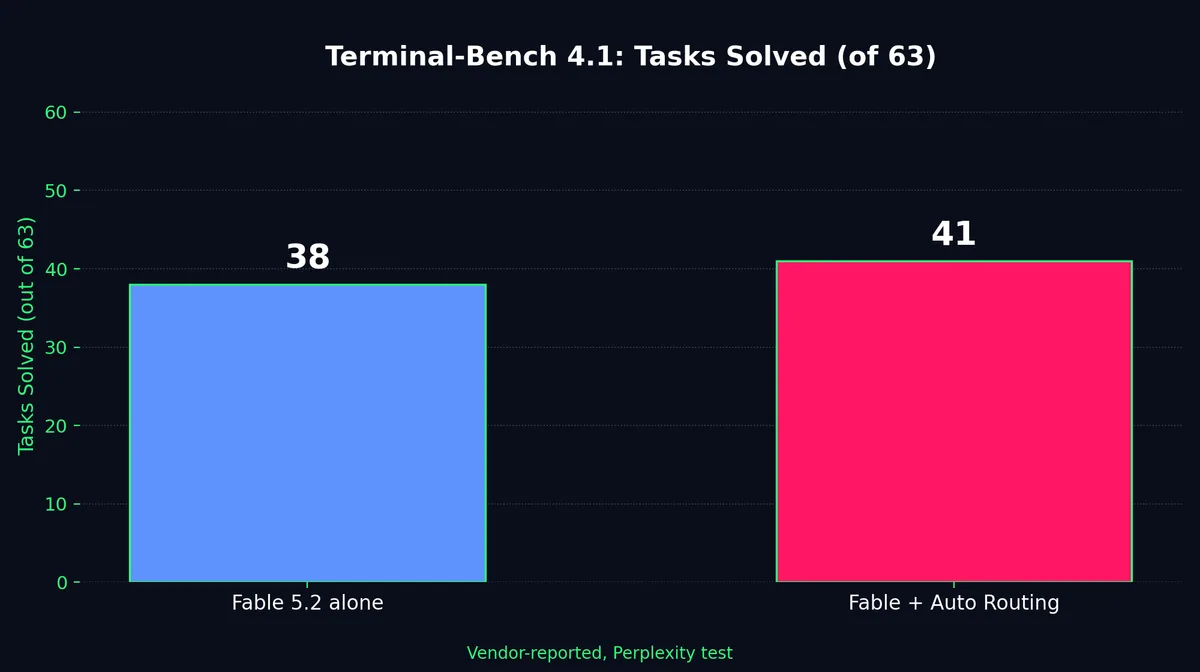
That is +3 tasks on a subset Perplexity chose, at a higher estimated cost per task. It supports a narrow, real use case: keep your preferred model as default and route known refusal categories elsewhere. It does not prove Orchestrator is faster or cheaper for your workload. Run your own prompts before moving critical traffic.
Orchestrator vs OpenRouter vs Vercel AI Gateway
| Feature | Perplexity Orchestrator | OpenRouter | Vercel AI Gateway |
|---|---|---|---|
| Model catalog | 45+ in preview (85+ internally) | 400+ models, 70+ providers | 400+ models |
| Platform fee | None on credits | 5.5% Standard, 8% Business | None, no token markup |
| Same-model failover | Yes, automatic | Yes, automatic fallback | Yes, automatic |
| Prompt-based auto router | perplexity/auto, preview, 1 to 5 routes | openrouter/auto, no router fee | Not disclosed |
| Bring your own key | Not supported | Supported, 5% fee above allowance | Supported, no markup |
| Access | Private preview | Public | Public |
OpenRouter still wins on catalog size and openness. Orchestrator's edge is the combination of zero fee, Perplexity-hosted open-weight models, and routing described in plain language instead of model IDs. Vercel matches the zero fee and adds BYOK, so the real contest is features and reliability, not price alone.
The limits worth knowing
Media bypasses auto routing: conversations with images, audio, video or files go straight to your default model. Each routing config caps at 5 routes with descriptions limited to 1,000 bytes. Interrupted streams are not retried; a stream that dies mid-output ends with an in-band error and the delivered tokens stay billable. And access is still gated: private preview by email, with the built-in auto policy requiring Tier 1 or higher.
Which one should you pick?
Pick Orchestrator if you run a mix of simple and complex requests, you keep hitting single-provider outages or rate limits, or you have predictable refusal categories you want routed around. The zero platform fee matters most at volume.
Stay on OpenRouter if you need the long tail of 400+ models, public access today, or your own provider keys. Pick Vercel AI Gateway if zero fee plus BYOK with your negotiated rates is the priority.
If you are choosing models to route between, our recent tests help: Gemini 4 Neon: #1 Coding Agent at $3, Beats Opus 5.5, GPT-6.2 Astra vs Fable 5.2: 7-5 Win Costs 7.2x More, and Gemini 4 Hydrogen: $1.50, Free Tier, Beats Argon. For production agent work where model routing is only one piece, see our AI agent development services.
FAQ
What is the Perplexity Orchestrator API?
It is a hosted inference gateway launched November 17, 2026. One API key and base URL reach 45+ models from OpenAI, Anthropic, Google, xAI and open-weight families, with automatic same-model failover across providers and consolidated billing.
How much does Perplexity Orchestrator cost?
You pay each model's published per-token rate with no additional platform fee. Access tiers unlock by cumulative credits: Tier 0 is free for Google, xAI and open-weight models, Tier 1 at $50 adds OpenAI and most Anthropic models, and Tier 2 at $250 adds Claude Opus 5, Opus 5.5 and Fable models.
How is Orchestrator different from OpenRouter?
OpenRouter offers 400+ models and bring-your-own-key support but charges 5.5% to 8% on credit purchases. Orchestrator offers 45+ models in private preview, no platform fee, Perplexity-hosted open-weight models, and plain-language auto routing, but no BYOK.
Does Orchestrator really fix provider outages?
It retries the same model on another deployment when a provider errors, rate-limits or times out, and failed-before-output requests are not billed. Perplexity reports higher success rates than any single provider over October 4 to November 2, 2026, but published no percentages, so verify with your own traffic.
Can I use Orchestrator today?
Access is in private preview. Developers request access by email, and the perplexity/auto routing layer is a separate preview. The API is OpenAI and Anthropic SDK compatible, so migration is mostly a base URL and key change once you are in.
- Perplexity Orchestrator
- Perplexity
- OpenRouter
- AI APIs
- model routing
- AI infrastructure