AI News6 min readBy JH Akash
Gemini 4 Neon: #1 Coding Agent at $3, Beats Opus 5.5
Google's Gemini 4 Neon launched Nov 18 with the #1 coding agent ranking, a 61 intelligence score, and a $3/$15 price that undercuts GPT-6.2 Astra by 62.5%. Here are the benchmarks, the price math, and who should switch.
Google launched Gemini 4 Neon on November 18, 2026, and it is the most interesting Gemini release of the month. It is not the biggest model in the Gemini 4 family, and it is not the cheapest. It is the one Google built for the work developers actually repeat all day: complex coding, multi-step agents, and long documents.
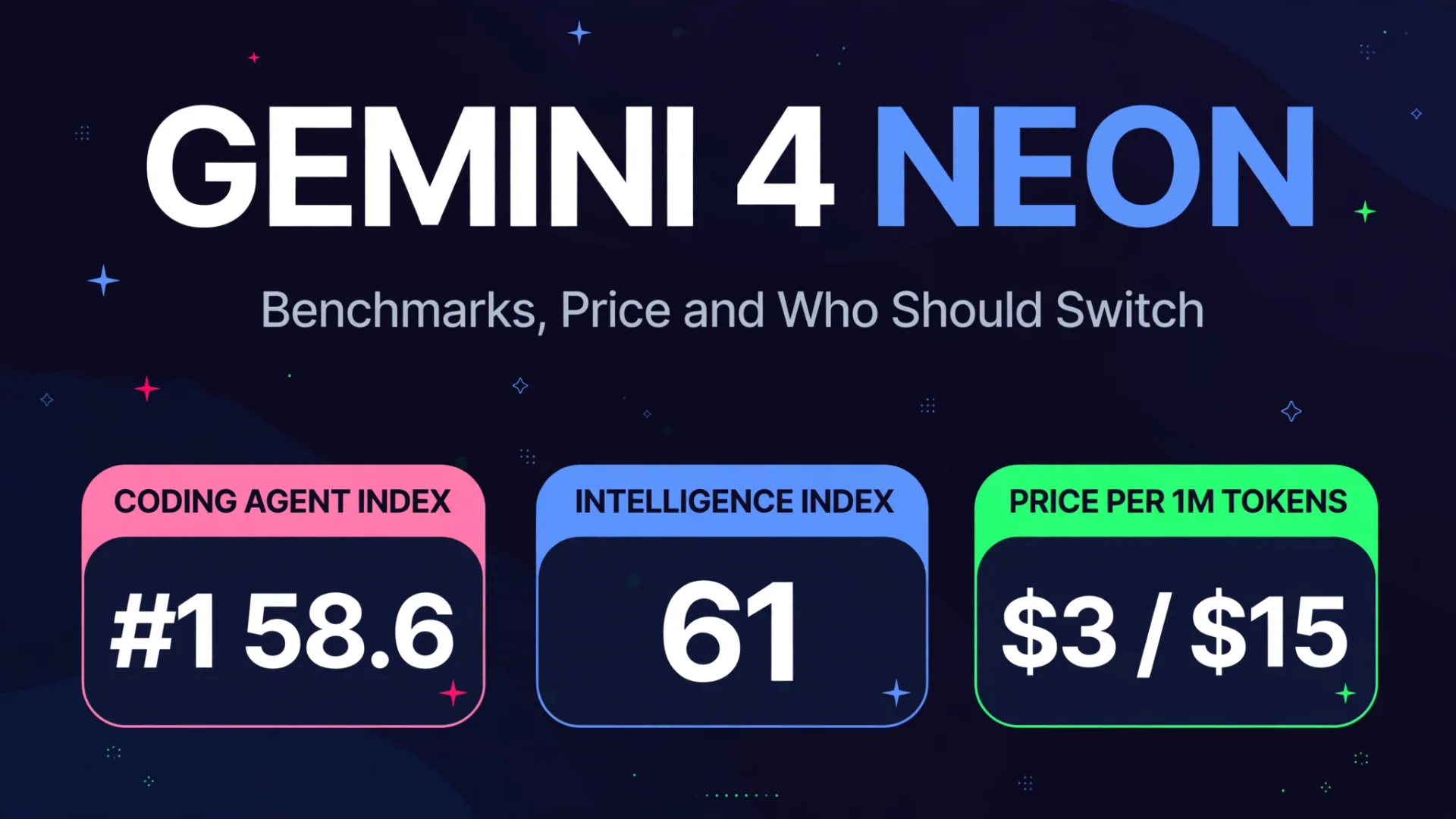
The headline numbers are strong. Neon ranks #1 on the Artificial Analysis Coding Agent Index with a score of 58.6, scores 61 on the Artificial Analysis Intelligence Index at its highest thinking level, and costs $3 per million input tokens and $15 per million output tokens. That is 62.5% cheaper than GPT-6.2 Astra on both input and output.
Every benchmark in this post comes from Google's own announcement and model card, so treat it as the manufacturer's spec sheet. No independent lab has had time to re-run these tests yet.
Quick verdict
| Model | Best for | Input / 1M tokens | Output / 1M tokens | Intelligence Index |
|---|---|---|---|---|
| Gemini 4 Neon | Complex coding and agents, daily | $3.00 | $15.00 | 61 |
| Gemini 4 Carbon | Hardest long-horizon work | $2.00 promo, $4.00 from Dec 1 | $10.00 promo, $20.00 from Dec 1 | 60 |
| Gemini 4 Hydrogen | Fast everyday tasks | $1.50 | $7.50 | Lower |
| GPT-6.2 Astra | Frontier professional work | $8.00 | $40.00 | Higher |
Neon sits in the middle of Google's own ladder on price and capability: Carbon for the hardest work, Hydrogen for fast everyday execution, Neon for complex, high-frequency workflows. At its default high thinking level, Google says Neon costs 32% less per completed task than Carbon, and 50% to 80% less per task than top competing frontier models.
What Gemini 4 Neon actually is
Neon is adapted from Gemini 4 Carbon, Google's heaviest reasoning tier. It keeps the 1-million-token context window and multimodal inputs (text, image, audio, video), with default output of up to 64,000 tokens. It has four thinking levels, Low, Medium, High, and Extra High, so teams can trade intelligence against token spend.
Google positions it for production-grade enterprise workflows: multi-file debugging and refactoring across repositories, analytical reasoning, and science tasks. Its knowledge cutoff is March 2026.
It is available now in the Gemini API, Google AI Studio, Gemini for business, the Gemini app for paid Pro and Ultra subscribers, Google Antigravity, and GitHub Copilot, where it is generally available for agentic coding.
Pricing: the math that matters
| Model | Input / 1M | Output / 1M | Cached input / 1M |
|---|---|---|---|
| Gemini 4 Neon | $3.00 | $15.00 | $0.15 |
| Gemini 4 Carbon (promo to Nov 30) | $2.00 | $10.00 | - |
| Gemini 4 Carbon (from Dec 1) | $4.00 | $20.00 | - |
| Gemini 4 Hydrogen | $1.50 | $7.50 | - |
| GPT-6.2 Astra | $8.00 | $40.00 | - |
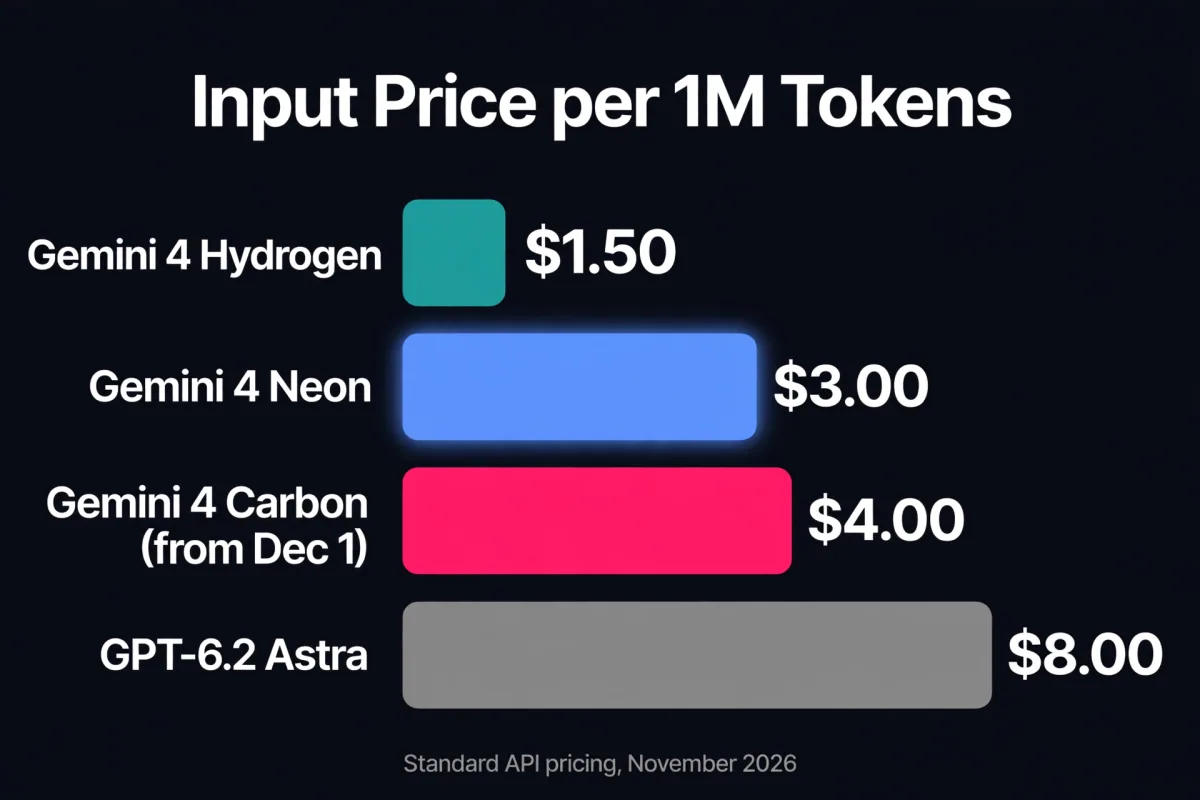
Three pricing details are easy to miss. First, cached input costs $0.15 per million tokens, a 95% discount, which matters a lot for agents that re-read the same long codebase. Second, the Batch API is exactly half the standard price, so Neon batch runs cost $1.50/$7.50. Third, Carbon is cheaper per token than Neon until November 30 only because of its introductory pricing. From December 1, Carbon moves to $4/$20 and Neon becomes 25% cheaper per token.
Benchmarks: where Neon wins
| Benchmark | Neon score | Rank |
|---|---|---|
| Artificial Analysis Coding Agent Index | 58.6 | #1 |
| Artificial Analysis Intelligence Index (xhigh) | 61 | #3 |
| Terminal-Bench 4.1 | 65.2% | Best in class |
| FrontierCode 2.0 (high) | 46.2% | - |
| Vals Index | 70.9% | #2 |
| Agent Arena Index | 1336 | #2 |
| Terminal-Bench Science | 70.5% | Best in class |
| RiemannBench | 84.0% | Best in class |
| HLE-Diamond | 71.3% | Best in class |
| Vending-Bench 2 | $16,843 | #1 |
| Zapier AutomationBench | 56.3% | #1 |
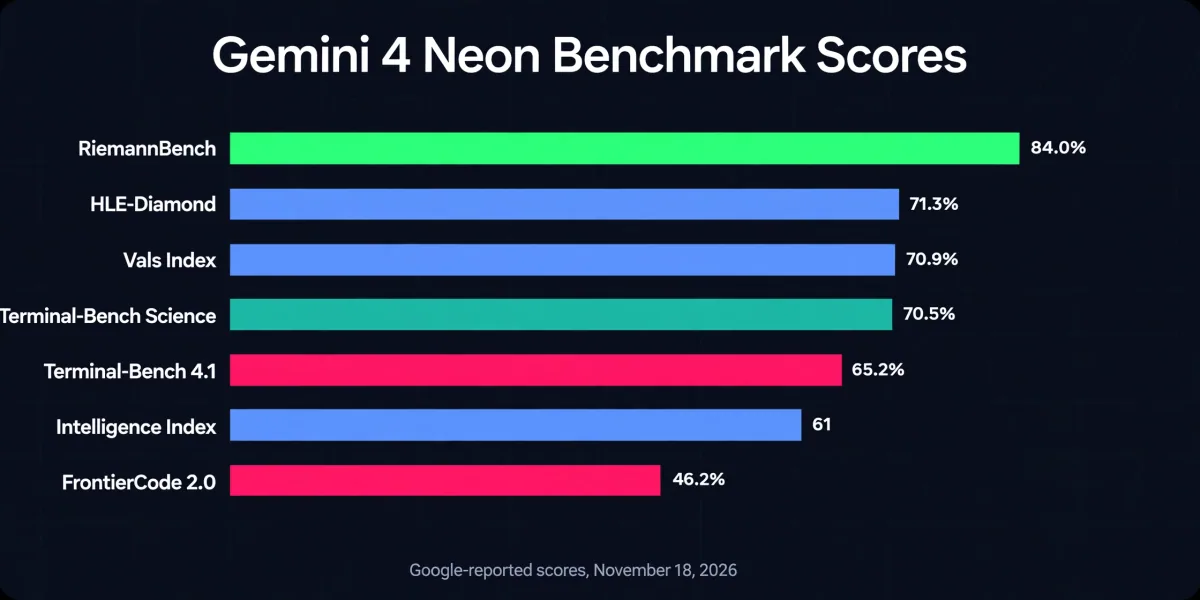
In Google's own selected comparison table, Neon leads 16 of 19 reported results against Claude Opus 5.5 and GPT-6.2 Sol. That is the basis for the "beats Opus 5.5" claim in the title, and it is Google's comparison, not an independent test. On the overall Intelligence Index, Neon trails the biggest frontier models: it scores 61 against Carbon's 60, but sits behind Fable 5.2 and GPT-6.2 Astra.
The catch: read this before you switch
No launch benchmark should be taken at face value, and Neon has three caveats worth knowing.
First, harness sensitivity is real. On SWE-sweep, Neon scores 12.8% with the mini-SWE harness but 39.0% in Google Antigravity. The same model, different harness, very different number. Your own results will depend on your tooling.
Second, the cyber numbers are strong but not generally available. Google reports state-of-the-art results on WebExploitBench (51.26%) and SEC-bench Pro (90.5%), but Neon for cyber work is rolling out separately, not in the general release.
Third, Google reports its lowest fabrication rate yet in internal Antigravity testing, and Neon refuses 1.98% of tasks on Terminal-Bench 4.0. That is progress on reliability, but hallucinations remain possible, and the model card says so plainly.
Which model should you pick?
Pick Gemini 4 Neon if you run coding agents or agentic workflows all day and your bill is mostly input tokens. The $3/$15 price with $0.15 cached input is built for exactly that pattern, and the #1 coding agent ranking is the strongest signal in the launch.
Pick Gemini 4 Carbon if you need maximum reasoning on the hardest long-horizon tasks and can live with the higher per-task cost after December 1. Until November 30, its promo price is actually lower than Neon per token.
Pick Gemini 4 Hydrogen if your work is fast, short, everyday execution and you want the cheapest Gemini 4 option at $1.50/$7.50.
Stick with GPT-6.2 Astra if you need the top overall intelligence score and are willing to pay $8/$40 for it. Neon is 62.5% cheaper, but Astra still leads on raw capability. Our full breakdown of Astra is here: GPT-6 Astra: The Model That Changed Everything.
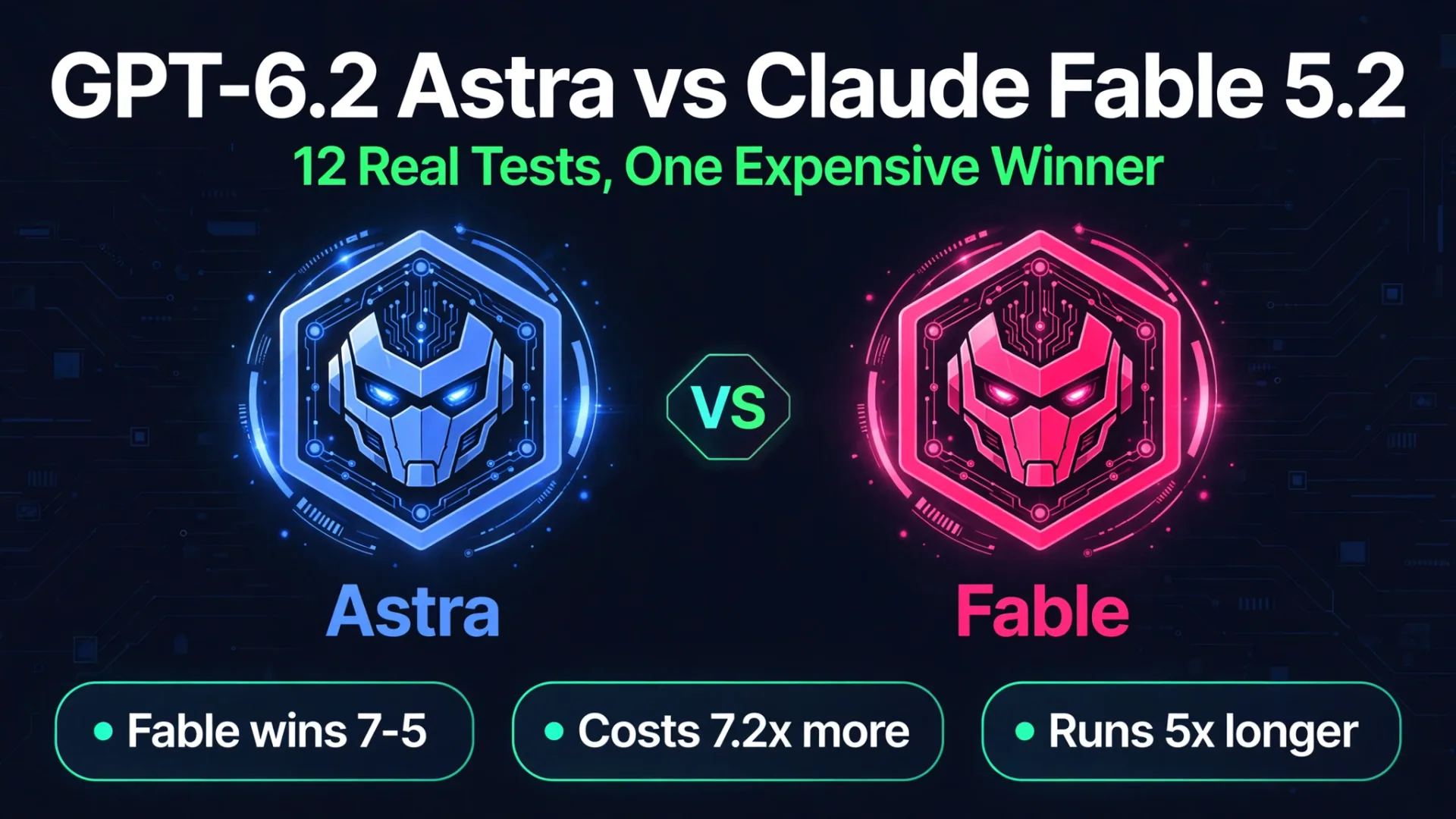
If you are comparing the wider field, our Claude Opus 5.5 review covers the model Neon is measured against most directly, and our GPT-6.2 Astra vs Claude Fable 5.2 test shows what happens when frontier models face 12 real tasks.
For teams that want this kind of model wired into their own workflows, CodeMyPixel builds AI agents for business automation, and you can hire our AI automation team to put a coding agent like this into production.
FAQ
Is Gemini 4 Neon free?
No. Neon is a paid API model at $3 per million input tokens and $15 per million output tokens. It is included for paid Google AI Pro and Ultra subscribers in the Gemini app, and it is available in the Gemini API and AI Studio.
Is Gemini 4 Neon better than GPT-6.2 Astra?
On price, yes: Neon is 62.5% cheaper on both input and output. On raw intelligence, no: Astra still leads the Artificial Analysis Intelligence Index. On coding agents specifically, Neon ranks #1 on the Coding Agent Index. The right pick depends on whether you need maximum capability or maximum value per task.
Is Gemini 4 Neon better than Claude Opus 5.5?
In Google's own selected comparison, Neon leads 16 of 19 reported results against Opus 5.5. That is a vendor-reported comparison, not an independent benchmark, so treat it as a strong signal rather than proof.
What is the context window of Gemini 4 Neon?
1 million tokens, with up to 64,000 tokens of output in default synchronous mode. Longer output is available through a background mode.
Where can I use Gemini 4 Neon?
In the Gemini API, Google AI Studio, Gemini for business, the Gemini app for Pro and Ultra subscribers, Google Antigravity, and GitHub Copilot, where it is generally available for agentic coding.
When does Gemini 4 Carbon's promo price end?
November 30, 2026. From December 1, Carbon rises to $4 per million input tokens and $20 per million output tokens, which makes Neon 25% cheaper per token.
- Gemini 4 Neon
- Google DeepMind
- GPT-6.2 Astra
- Claude Opus 5.5
- AI coding agents
- Gemini API