AI News6 min readBy JH Akash
Gemini 4 Hydrogen: $1.50, Free Tier, Beats Argon
Google launched Gemini 4 Hydrogen on Nov 12 as the cheapest Gemini 4 model, at $1.50 per million input tokens with a free API tier. It scores 51 on the Artificial Analysis Intelligence Index, one point above Argon, and triples Flash on Terminal-Bench. Here are the benchmarks, the price math, and who should switch.
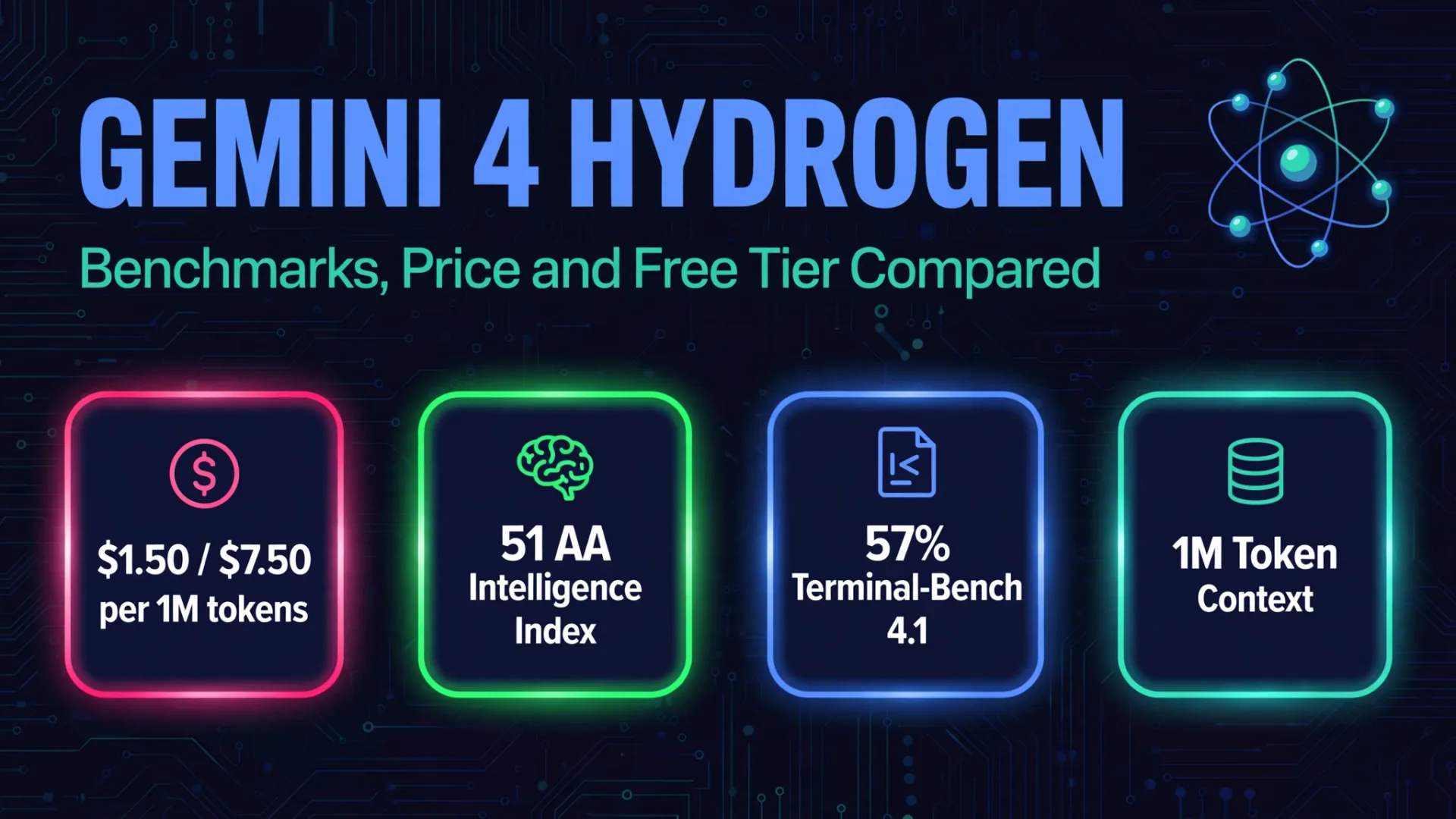
Google released Gemini 4 Hydrogen on November 12, 2026, and it is the cheapest model in the Gemini 4 family. It costs $1.50 per million input tokens and $7.50 per million output tokens, it is the first Gemini 4 model with a free API tier, and on the independent Artificial Analysis Intelligence Index it scores 51 at its default setting, one point above Gemini 4 Argon, the model that sits above it in Google's own lineup. At the new xhigh thinking level it reaches 54.
That combination is the story. Google built Hydrogen as the fast, everyday model for coding and agentic work, priced at half of Gemini 4 Neon, and the independent numbers say it gives up surprisingly little to get there. Here are the specs, the full price math, the benchmarks, and who should actually switch.
Quick verdict
| Question | Answer |
|---|---|
| Release date | November 12, 2026 |
| API price | $1.50 input / $7.50 output per 1M tokens |
| Free tier | Yes, rate-limited, on the Gemini API and AI Studio |
| Context window | 1,048,576 tokens (1M), no long-context surcharge |
| AA Intelligence Index | 51 at high, 54 at xhigh (Argon: 50, Neon: 61) |
| Terminal-Bench 4.1 | 57% (Gemini 3.8 Flash: 18.2%) |
| Best for | High-volume coding, agents, and everyday tasks on a budget |
What is Gemini 4 Hydrogen?
Hydrogen is the speed tier of the Gemini 4 line, adapted from Gemini 4 Carbon. Where Carbon and Argon handle deep, long-horizon reasoning, Hydrogen is built for everyday coding and multi-step agent workflows. It replaces the old "Flash" name in Google's lineup.
The key specs:
- Model ID: gemini-4-hydrogen
- Context window: 1,048,576 tokens, shared across input, thinking, and output
- Max output: 65,536 tokens per synchronous response, more with long decode
- Thinking levels: low, medium, high (the default), and a new xhigh
- Knowledge cutoff: March 2026
- Availability: Gemini API and AI Studio on every tier including free, the Gemini app, Google Search, Android Studio, and Gemini for business
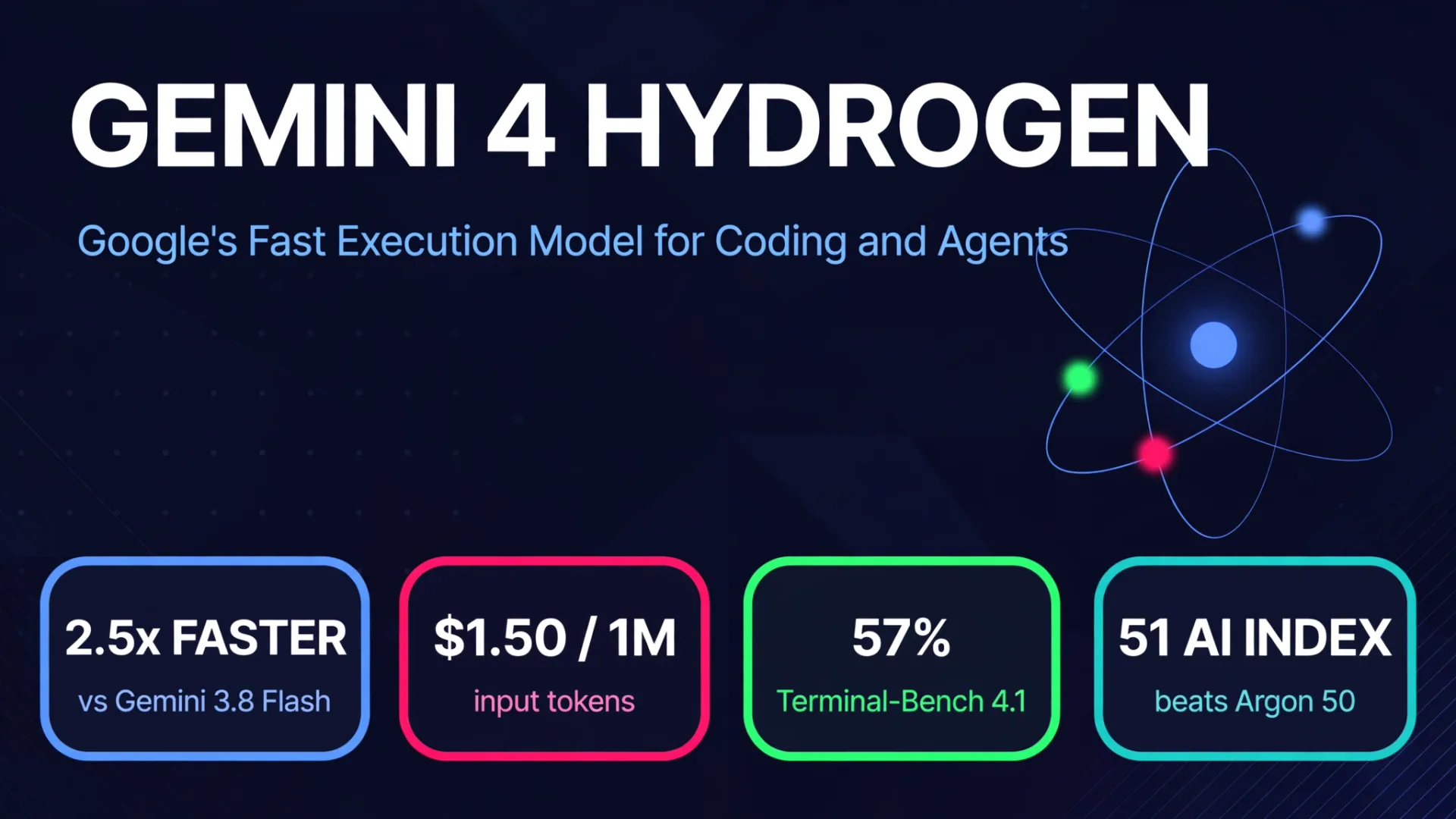
Google says Hydrogen finishes tasks 2.5 times faster than Gemini 3.8 Flash at the default high level and cuts fabricated claims by more than 5 times. Those are Google's own measurements, so treat them as vendor-reported until independent testing catches up.
Gemini 4 Hydrogen pricing
Hydrogen lists at $1.50 per million input tokens and $7.50 per million output tokens, flat across the whole 1M context window with no long-context surcharge. Cached input costs $0.075 per million tokens through implicit caching. Batch and Flex tiers run at half price, and Priority costs 1.8x.
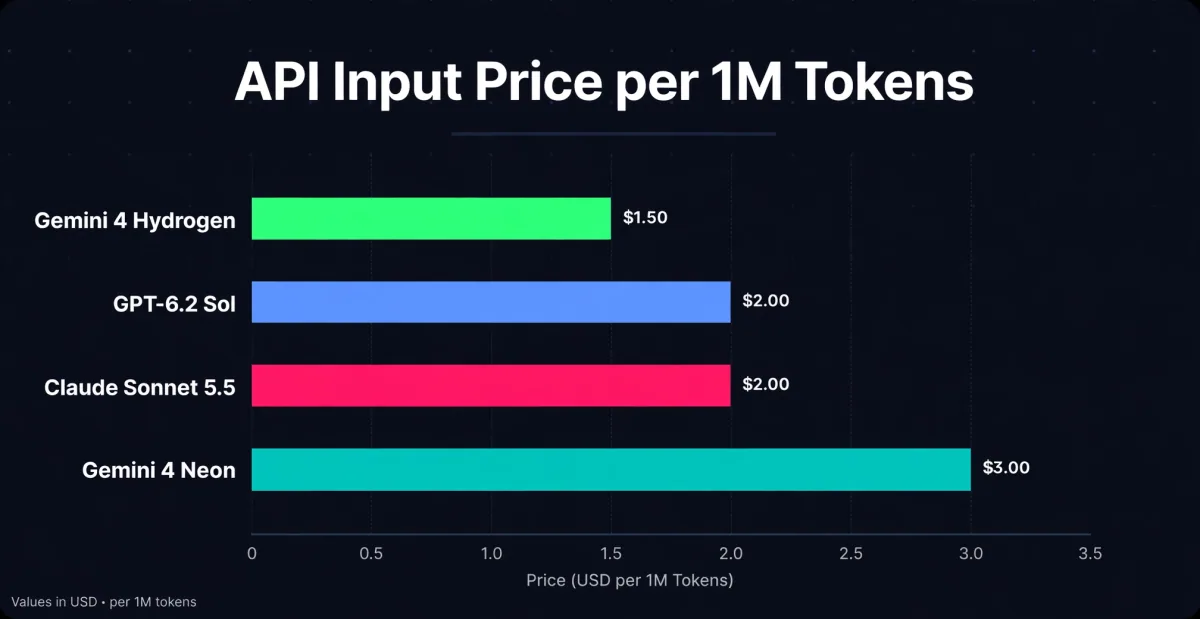
| Model | Input / 1M | Output / 1M | Free API tier |
|---|---|---|---|
| Gemini 4 Hydrogen | $1.50 | $7.50 | Yes |
| Gemini 3.8 Flash | $0.75 | $3.75 | Yes |
| GPT-6.2 Sol | $2.00 | $10.00 | No |
| Claude Sonnet 5.5 | $2.00 | $10.00 | No |
| Gemini 4 Neon | $3.00 | $15.00 | No |
Two things stand out. First, Hydrogen undercuts Carbon's list price by about 62 percent and comes in about 25 percent below Argon's introductory pricing. Second, it is exactly half the price of Gemini 4 Neon, Google's coding-focused model that launched six days later.
The catch: Hydrogen's standard rates are twice Gemini 3.8 Flash's current $0.75/$3.75 until January 1, 2027, when Flash moves to the same $1.50/$7.50. So the price gap between Hydrogen and Flash is temporary. The capability gap is not.
Benchmarks: ahead of Argon, behind Neon
On the Artificial Analysis Intelligence Index, the independent score Google itself cites, Hydrogen scores 51 at its default high thinking level and 54 at xhigh. Argon scores 50. Neon, at double the price, scores 61. The older Gemini 3.8 Flash scores 31.
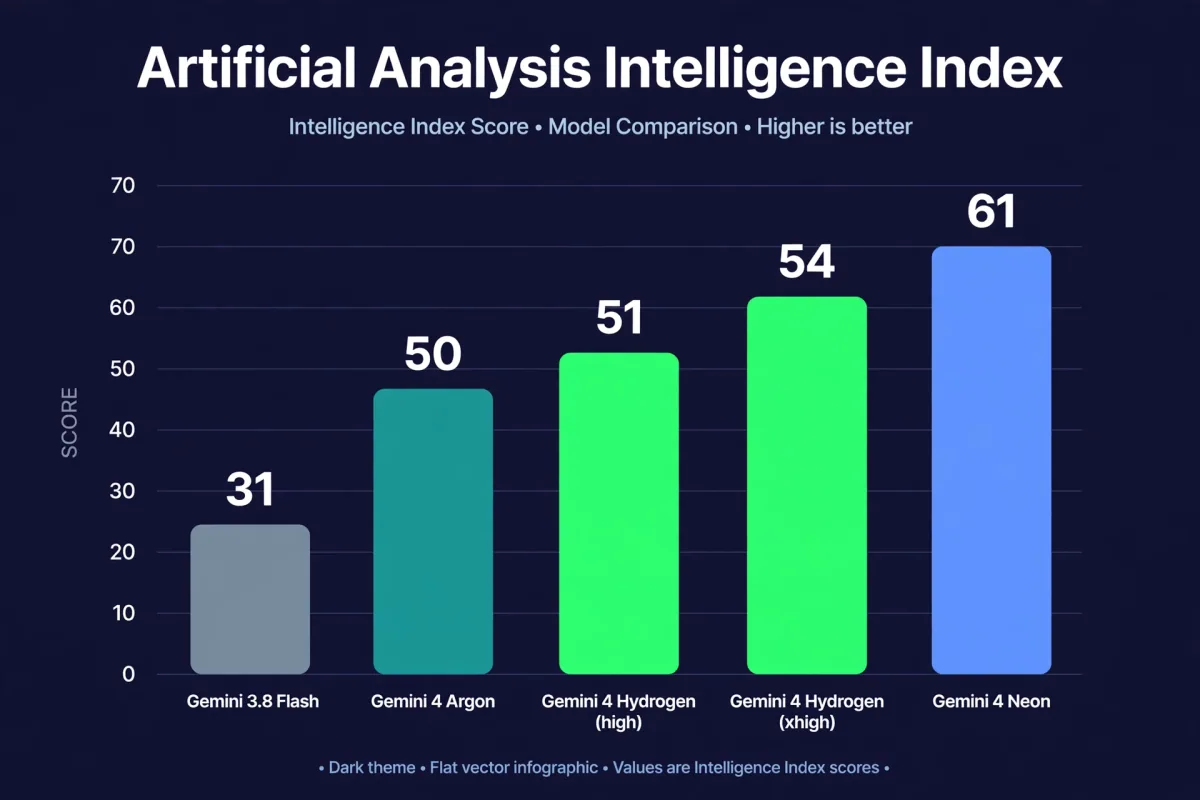
On Terminal-Bench 4.1, the command-line coding test, Google reports Hydrogen at 57 percent, more than triple Flash's 18.2 percent and close to Carbon's success rate while using 24 percent less quota and finishing 19 percent faster. On the same test, Claude Sonnet 5.5 sits at 63.9 percent on the cheating-adjusted table, so Hydrogen is not the coding leader. Google also reports 58.8 percent on HLE-Diamond, leading its class, and a fifth-place rank on Agent Arena for multi-step agentic work.
Artificial Analysis measured output speed at 185 tokens per second at xhigh, with about 43 seconds to the first answer token. That slow start is the trade-off of the xhigh setting: the median for comparable models is about 13.6 seconds. At the default high level, Hydrogen used 110 million output tokens to run the index against Flash's 126 million, while scoring 51 to 31.
All benchmark figures above are a mix of Google-reported results and Artificial Analysis measurements as of November 14, 2026. Google supplied the competitor scores in its own model card table, so read cross-model comparisons with that in mind.
Who gets it for free?
Hydrogen is the first Gemini 4 model free users can reach, through three routes:
- Gemini API and AI Studio free tier: rate-limited, and free-tier data may be used to improve Google's products
- Gemini app: free users reach it through Auto model selection when Google decides a prompt fits; they cannot pick it directly
- Google Search: available to all users worldwide, where Google calls it the new default model in AI Mode
Paid Google AI Pro and Ultra subscribers can select Hydrogen directly in the model menu and get it in Antigravity and Gemini inside Google Sheets. It is also already available in Cursor, the AI coding editor.
Which Gemini 4 model should you pick?
- Pick Hydrogen if you run high-volume coding or agent workloads and want the lowest cost per task in the Gemini 4 family. At $1.50/$7.50 with a free tier to test on, it is the default choice for most production traffic.
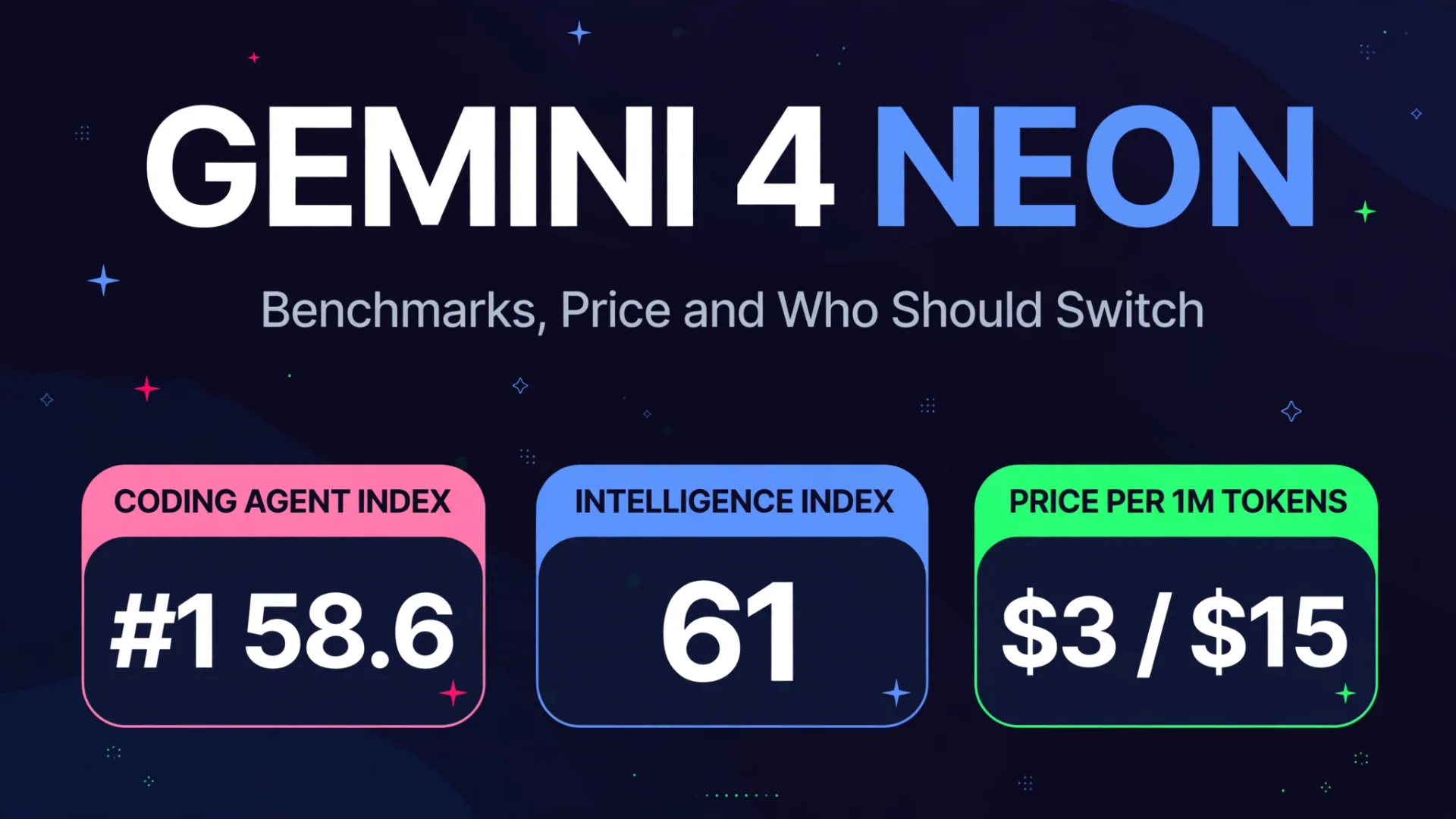
- Pick Neon if coding quality is the priority. It holds the number 1 coding agent ranking at $3/$15, exactly double Hydrogen's price. Our Gemini 4 Neon breakdown has the full numbers.
- Pick Argon or Carbon for deep, long-horizon reasoning where the extra thinking budget matters more than cost.
- Stay on 3.8 Flash only until January 1, 2027, when its price rises to match Hydrogen. After that, Hydrogen is strictly better for the same money.
For teams comparing across vendors, the same price band now includes GPT-6.2 Sol at $2/$10 and Microsoft's MAI Code 2, which claims 98 percent of GPT-6.1 Sol's coding quality at 40 percent of the price. Hydrogen's edge in this group is the free tier and the 1M context at a flat rate.
FAQ
How much does Gemini 4 Hydrogen cost?
Gemini 4 Hydrogen costs $1.50 per million input tokens and $7.50 per million output tokens on the Gemini API, with cached input at $0.075 per million. There is also a rate-limited free tier in AI Studio and the Gemini API.
Is Gemini 4 Hydrogen better than Gemini 4 Argon?
On the Artificial Analysis Intelligence Index, yes by a small margin: Hydrogen scores 51 at its default high setting and 54 at xhigh, against Argon's 50. Argon still targets deeper reasoning work, so the right pick depends on the task.
Can free users use Gemini 4 Hydrogen?
Yes. Free Gemini app users reach Hydrogen through Auto model selection, developers get a rate-limited free tier on the API and AI Studio, and it powers AI Mode in Google Search for all users. Free users cannot select it manually in the app.
How fast is Gemini 4 Hydrogen?
Google says it finishes tasks 2.5 times faster than Gemini 3.8 Flash at the default high level. Artificial Analysis measured 185 output tokens per second at xhigh, with about 43 seconds to the first answer token at that setting.
When was Gemini 4 Hydrogen released?
Google released Gemini 4 Hydrogen on November 12, 2026, across the Gemini API, AI Studio, the Gemini app, and Google Search.
- Gemini 4 Hydrogen
- Google DeepMind
- Gemini API
- AI models
- Gemini 4 Neon
- AI pricing