AI News5 min readBy JH Akash
LingSante-3.1-flash: Free 560B Medical AI, MIT License
Ant Group open-sourced LingSante-3.1-flash, a 560B medical AI with 25B active parameters, a 1M-token context, and a free MIT license. It tops open models on InclusionMed and leads HealthBench Professional at 65.72.
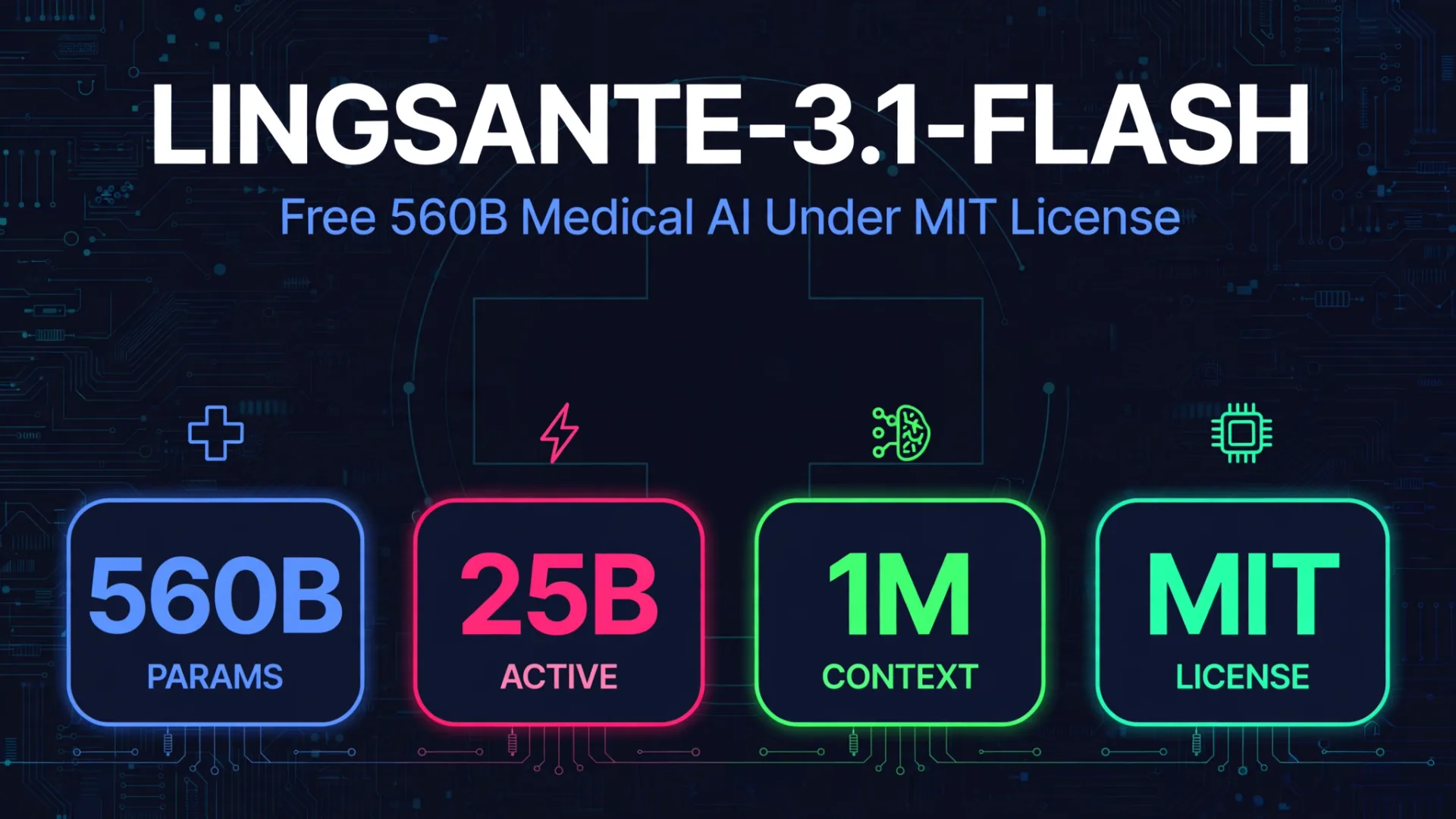
Ant Group just gave away its best medical AI. LingSante-3.1-flash, the model family behind the Afu health app, is now open-weight under the MIT license. Anyone can download it, change it, and use it commercially, with no license fee at all.
The numbers are serious: 560 billion total parameters, about 25 billion active per token, and a 1 million-token context window. On Ant's own model card, it leads a 9-model field on HealthBench Professional with 65.72, ahead of GPT-6 Astra at 64.18 and Claude Opus 5.5 at 61.19. It also ranks first among open models on the new InclusionMed benchmark, placing 5th overall out of 23 configurations, with only closed models above it.
There is a catch, and it is a big one. This is a 560B model. Running it needs serious hardware, and the model card is clear that it is a research model, not a medical device. Here is what it does, what it costs, and who should actually use it.
LingSante-3.1-flash at a glance
| Spec | Detail |
|---|---|
| Announced | November 23, 2026 |
| Total parameters | 560B (MoE) |
| Active per token | About 25B |
| Context window | 1 million tokens |
| License | MIT, free commercial use |
| Modality | Text only |
| Weights | Hugging Face and ModelScope |
| Architecture | 63 linear-attention layers, 9 gated MLA layers, 512 routed experts plus 1 shared expert |
| Behind it | Afu health app, 150 million users, nearly 20 million consultations a day |
What does it cost?
| Option | Price |
|---|---|
| Weights, FP8 build | Free, MIT license |
| Weights, MXFP4 build | Free, MIT license |
| Sibling model air-VL, 124B | Free, MIT license |
| Hosted API through Computrix | Pricing not published |
Free here means no license fee. The hardware to run a 560B model is the real cost, and it is not small.
Benchmarks: where it leads and where it trails
All scores below come from Ant Group's own model card, so treat them as vendor-reported until independent labs rerun them. Artificial Analysis scored the model at 23.3% on long-context medical reasoning.
| Benchmark | LingSante-3.1-flash | Best rival in the comparison |
|---|---|---|
| HealthBench Professional | 65.72 | GPT-6 Astra, 64.18 |
| EHR-Complex | 74.40 | GPT-6 Astra, 74.20 |
| BrowseComp with context | 94.10 | Kimi-K3.1-Pro, 92.10 |
| HLE text-only with tools | 72.22 single-agent, 74.87 multi-agent | Not disclosed |
| MedQA-USMLE | 94.50 | Gemini 4 Argon, 97.33 |
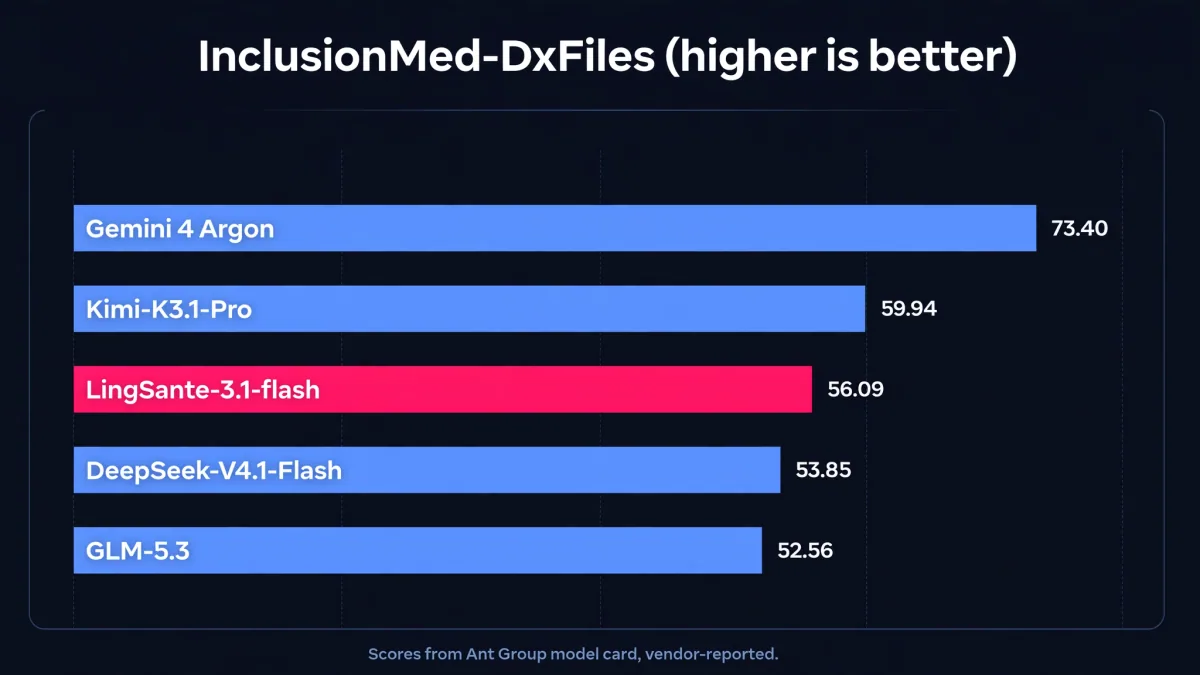
| InclusionMed-DxFiles | 56.09 | Gemini 4 Argon, 73.40 |
| Terminal-Bench 4.0 | 26.5 | Kimi-K3.1-Pro, 67.2 |
| InclusionMed Index | 45.064, 5th of 23 | Gemini 4 Argon, 49.1 |
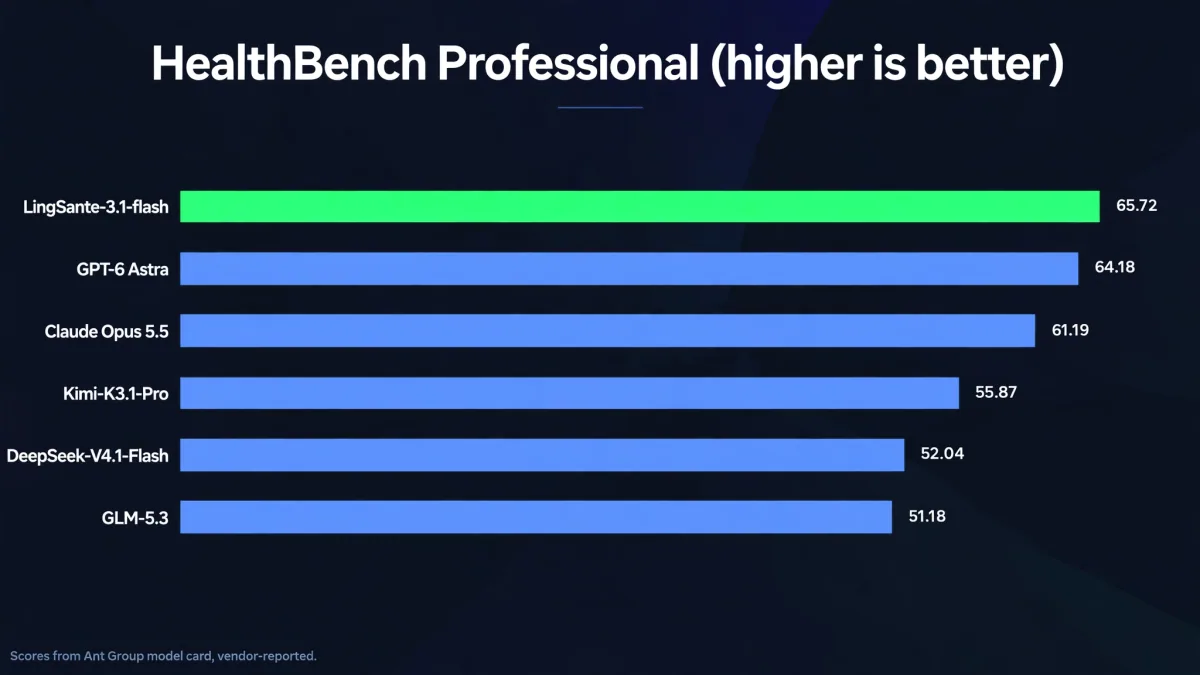
The HealthBench lead is real but narrow, and it is the model's best result. The same table shows the weak spots clearly. On Terminal-Bench 4.0, a general coding and CLI test, it scores 26.5 against 67.2 for Kimi-K3.1-Pro. On InclusionMed-DxFiles, diagnostic file work, it trails Gemini 4 Argon by more than 17 points.
The InclusionMed Index tells the same story in one number. LingSante-3.1-flash scores 45.064, 5th of 23 configurations, and the four models above it are all closed: Gemini 4 Argon at 49.1, Claude Opus 5.5 at 48.9, Claude Fable 5.1 at 48.9, and GPT-6 Astra at 45.1. That is the basis for Ant's "number 1 open model" claim, and it holds up on this benchmark, by a hair over GPT-6 Astra.
How it compares with other open models
| Feature | LingSante-3.1-flash | DeepSeek-V4.1-Flash | GLM-5.3 | Kimi-K3.1-Pro |
|---|---|---|---|---|
| Total params | 560B | 552B backbone | 753B | 2.8T |
| Active params | About 25B | 16B decode, 8B prefill | Not disclosed | 104B |
| Context | 1M | 1M | 1M | 1M |
| License | MIT | MIT | GLM-5.3 license | Kimi K3.1 Pro license |
| Medical tuning | Yes | No | No | No |
| HealthBench Professional | 65.72 | 52.04 | 51.18 | 55.87 |
| MedQA-USMLE | 94.50 | 95.13 | 93.09 | 96.15 |
| InclusionMed-DxFiles | 56.09 | 53.85 | 52.56 | 59.94 |
Among open models, LingSante-3.1-flash is the only one tuned specifically for medicine, and it shows on HealthBench Professional, where it beats the next open rival by almost 10 points. On general medical exam questions, MedQA-USMLE, the untuned rivals actually score higher, which is a useful reminder that a specialist model is not better at everything.
What it takes to run it
This is the part most readers should not skip. Ant's reference SGLang setup uses 8x H200 or 4x GB300 GPUs. The FP8 checkpoint is about 574 GB, and an MXFP4 quantized checkpoint at 313 GB cuts the memory need. It also runs on vLLM with tensor parallelism 8 and expert parallelism. Recommended sampling is temperature 1.0, topp 0.95, topk 20, with thinking enabled.
In plain terms, this is a multi-GPU server model, not a laptop model. If you do not have that hardware, the hosted API through Computrix is the practical route, though its pricing is not published yet.
The rest of the LingSante family
Ant announced five models at its healthcare ecosystem conference on November 23. Two shipped weights under MIT, and three are named but not yet open:
- LingSante-3.1-air-VL: 124B total, 5.5B active, 256K context. Reads images and reports, also MIT licensed.
- LingSante Pulse: predicts risk for more than 150 conditions. Only a signal encoder is public so far.
- LingSante MedGuard: screens medical answers for safety, compliance, and bioethics risks.
- LingSante Live: a real-time video consultation agent already inside the Afu app.
Which one should you pick?
- Research teams with a multi-GPU server who need a free, self-hostable medical reasoning model: LingSante-3.1-flash is the obvious pick, especially for long case files, medical evidence work, and tool-using medical agents.
- Teams that also need image reading: pair it with the sibling air-VL model, which covers imaging reports, skin photos, and diet photos.
- Anyone building a clinical product today: do not use it. The model card says it must not diagnose, prescribe, choose treatment, or make triage decisions on its own, and it is not a medical device. Outputs may be incomplete or inaccurate.
- General coding or CLI agent work: pick something else. Terminal-Bench 4.0 at 26.5 shows this model is a specialist, not a generalist.
FAQ
Is LingSante-3.1-flash really free?
Yes. The weights carry the MIT license, one of the most permissive open-source licenses. You can download, modify, and use the model commercially at no license cost. The hardware to run a 560B model is the real cost.
Is LingSante-3.1-flash better than GPT-6 Astra?
Not overall. It leads GPT-6 Astra on HealthBench Professional (65.72 vs 64.18) and EHR-Complex (74.40 vs 74.20), but trails it on MedQA-USMLE (94.50 vs 97.33) and sits just behind it on the overall InclusionMed Index (45.064 vs 45.1). It is the top open model on InclusionMed, not the top model.
Can I use it in a hospital or clinic?
Not as a medical device. The model card limits use to research and evaluation, and says outputs may be incomplete or inaccurate and must not substitute for professional medical advice, diagnosis, or treatment.
What hardware do I need to run it?
Ant's reference setup is 8x H200 or 4x GB300 GPUs with SGLang. An MXFP4 quantized checkpoint at 313 GB lowers the memory need. Expect a multi-GPU server either way.
Where do I download it?
From Hugging Face at inclusionAI/LingSante-3.1-flash, with the MXFP4 build beside it, and on ModelScope. A hosted API is available through Computrix.
Keep reading
- Namazu Small: 30B Model Beats NVIDIA's 120B
- Gemini 4 Neon: #1 Coding Agent at $3, Beats Opus 5.5
- GPT-6.2 Astra vs Fable 5.2: 7-5 Win Costs 7.2x More
Sources: Ant Group LingSante-3.1-flash model card via MarkTechPost (November 28, 2026), AI Weekly, Machine.net, Frontier Now. All benchmark scores are vendor-reported from Ant's model card.
- LingSante-3.1-flash
- Ant Group
- medical AI
- open-weight AI
- MIT license