AI6 min readBy JH Akash
AI Consulting Companies: 7 Checks Before You Hire
About 8,700 people a month search for AI consulting companies. Most cannot tell a good firm from a slick sales deck. These 7 checks, plus verified 2026 cost data, show how to pick one that actually ships working AI.
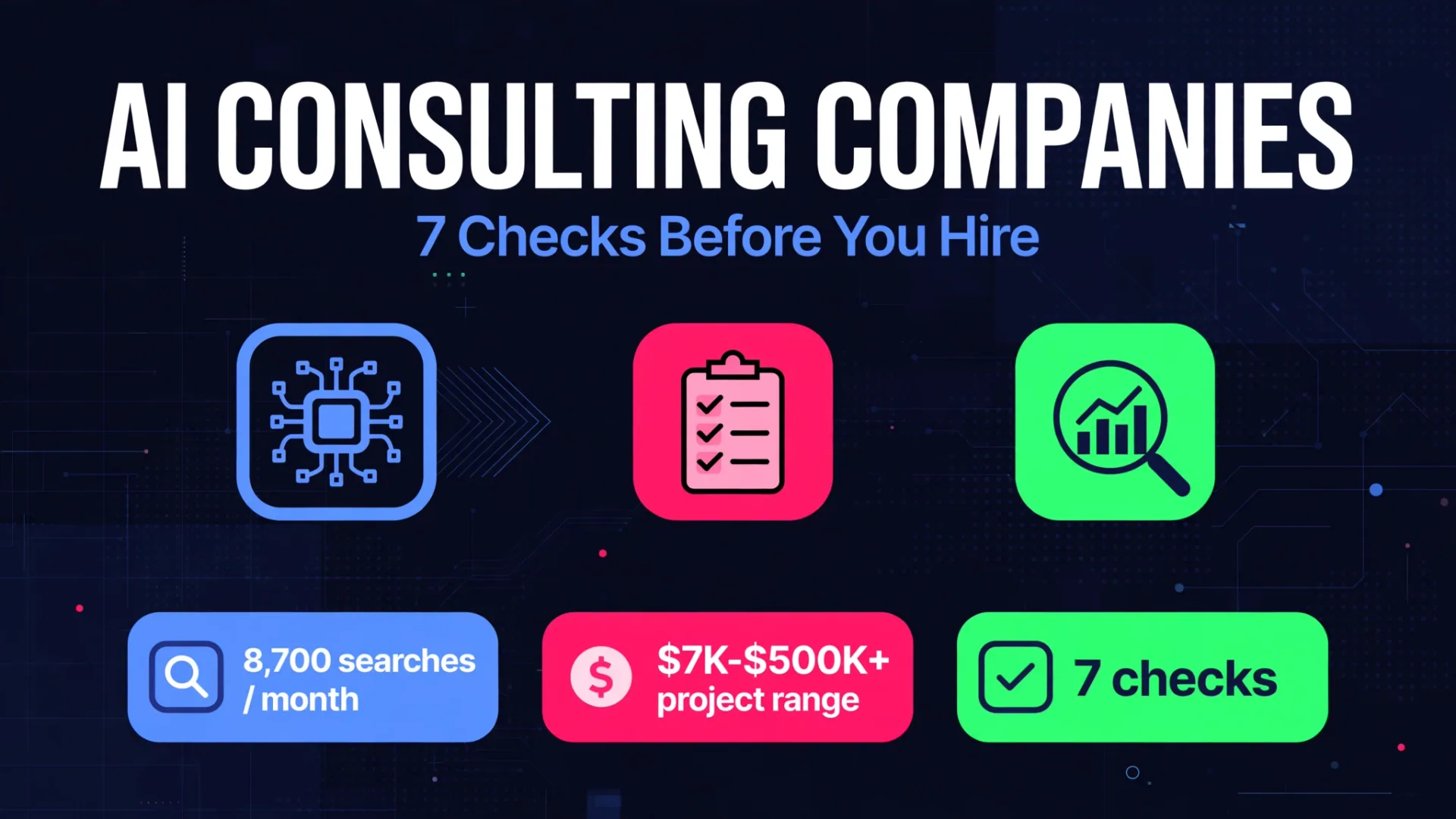
Every month, about 8,700 people in the US search for AI consulting companies, AI consulting firms, or an AI consulting agency. Most of them are business owners who know AI could help, but cannot tell a good firm from a slick sales deck. This guide gives you the 7 checks that separate firms that ship working AI from ones that sell slides.
What AI consulting companies actually do
An AI consulting company helps a business find where AI pays off, then builds it and makes it stick. The work usually falls into four parts:
- Strategy. Finding the 2-3 workflows where AI saves real money or time, and saying no to the rest.
- Build. Developing the agent, chatbot, integration, or automation that does the work.
- Integrate. Connecting it to the tools the business already uses: CRM, inbox, calendar, phone system, spreadsheets.
- Support. Monitoring it after launch, fixing drift, and improving it as the business changes.
The best firms do all four. A firm that only writes strategy decks leaves you with a PDF. A firm that only builds without strategy builds the wrong thing fast.
Check 1: Shipped work you can verify
Ask for two things: a live product you can click, and a client you can call. Case studies with logos but no live link are marketing. A firm that has shipped AI agents into real businesses will show you the agent working, not just describe it.
Red flag: every case study is "confidential" and nothing is demonstrable.
Check 2: They automate a real workflow, not a demo
A demo chatbot that answers three canned questions proves nothing. Ask the firm to name the exact workflow they would automate first in your business, what happens when the AI is unsure, and who approves the AI's work before it reaches a customer. If they cannot name the workflow in one sentence, they have not thought about your business yet.
At CodeMyPixel, the first question is always the same: which repeated task eats the most hours? Missed calls, lead follow-up, inbox triage, scheduling. That is where automation pays first. Read how our AI agent development services pick the first workflow.
Check 3: A human stays in the loop
AI that acts without approval is a liability. Orders, refunds, customer replies, and anything that touches money or reputation should pass a human check, at least at first. Ask the firm how their agents handle uncertainty: do they ask, escalate, or guess? "They guess" is the wrong answer.
Check 4: Pricing is clear before you sign
AI consulting is priced three ways: fixed project fee, monthly retainer, or hourly. Each is fine, but the firm should tell you which one applies and what is included before you commit. Hidden costs are the classic trap: platform licences, integration work, and maintenance routinely add 30-50% on top of the headline consulting fee, according to 2026 pricing guides.
What AI consulting costs in 2026
| Engagement | Typical range | Notes |
|---|---|---|
| Readiness assessment | $2,000-$25,000 | A short audit of where AI fits |
| Proof of concept | $25,000-$80,000 | 4-8 weeks, one working use case |
| Strategy + first build | $25,000-$75,000 | Roadmap plus a shipped pilot |
| Full production build | $75,000-$500,000+ | Multi-use-case rollout |
| Monthly retainer | $2,000-$50,000/month | Ongoing access and iteration |
Sources: Founders Workshop 2026 pricing guide, Master of Code Global 2026 cost guide. Clutch reports the average AI project at about $120,600, with the most common budget band $10,000-$49,999 and a typical timeline around 10 months. Hourly rates run about $75-$350 for freelancers, $125-$500 for boutique firms, and $250-$1,000+ at Big 4 firms.
One market signal tells you how competitive this space is: advertisers pay roughly $50 every time someone clicks an ad for "AI consulting companies". Firms would not pay that if the work were cheap or the clients small.
Check 5: They say no to bad fits
A good firm turns work down. If a use case has no clean data, no measurable outcome, or a payback period longer than the business can wait for, the honest answer is "not yet". A firm that says yes to everything is selling hours, not outcomes.
Check 6: Support after launch is in the contract
AI systems drift. Models change, data changes, customer language changes. Ask what happens in month 4: who monitors accuracy, who fixes a broken integration, and what it costs. If support is a vague promise instead of a line item, budget for a second firm to rescue the first one's work.
Check 7: Security and data handling are specific
Ask three questions: where does our data go, who can see it, and how do we get it back? The firm should answer in plain language: which models and vendors touch your data, what retention settings apply, and what happens on exit. "We take security seriously" without specifics is not an answer.
AI consulting company vs agency vs freelancer
| Option | Best for | Typical cost | Watch out for |
|---|---|---|---|
| AI consulting company | Strategy plus build, one or two use cases | $25,000-$250,000 per project | Strategy-only firms that never ship |
| AI automation agency | Automating repeated work fast | Project or monthly retainer | Demo-only agents with no human approval |
| Freelance AI consultant | One narrow task or a second opinion | $75-$350/hour | No support after delivery |
| Big 4 / MBB | Enterprise-wide programs | $250,000-$1,000,000+ | Senior attention goes to the biggest accounts |
The right choice depends on the size of the problem. A 20-person business with a missed-call problem does not need a Big 4 program. It needs one working agent, live in weeks, with a human approving its work. Our guide to hiring an AI automation agency covers the agency side of this decision in detail.
Red flags: walk away if you see these
- No live work to show, only slides and promises.
- A fixed price quoted before they have seen your tools and data.
- "Fully autonomous, no human needed" for customer-facing work.
- No named person responsible for support after launch.
- They want a 12-month contract before a pilot exists.
FAQ
How much does AI consulting cost?
Most engagements run from about $7,000 for a readiness assessment to $500,000 or more for a full production build. A proof of concept typically costs $25,000-$80,000 and takes 4-8 weeks. The most common project budget, per Clutch, is $10,000-$49,999.
How long does a first AI project take?
A pilot for one workflow usually takes 4-10 weeks from kickoff to live. Strategy-only engagements are faster (2-4 weeks) but ship nothing. Full rollouts run 3-10 months.
What is the difference between an AI consulting company and an AI agency?
A consulting company usually starts with strategy and covers the full journey from roadmap to rollout. An agency usually starts with building and automating specific workflows. The labels overlap a lot: judge the firm by what it ships, not what it calls itself.
What should I prepare before the first call?
Three things: the workflow that costs the most hours, rough numbers on what it costs today (hours x hourly cost, or missed revenue), and who in your team will approve the AI's work. With those, a good firm can give you a straight answer in the first call.
Do I need clean data before AI can help?
You need data the AI can read: a CRM, an inbox, a spreadsheet, a booking system. It does not need to be perfect. Part of a good first project is cleaning the exact data that one workflow needs, not the whole company.
The bottom line
The firms worth hiring pass seven checks: verifiable shipped work, a named workflow, a human in the loop, clear pricing, the honesty to say no, support after launch, and specific security answers. Everything else is sales.
If you want to see what the first step looks like, CodeMyPixel builds AI agents that automate repeated business work, starting with a free 15-minute missed-call audit: we check how many enquiries never get a follow-up and what that is worth in a month. Book it at codemypixel.com/for/missed-call-audit.
- ai consulting companies
- AI consulting
- AI agency
- AI automation
- AI strategy