AI News5 min readBy JH Akash
Namazu Small: 30B Model Beats NVIDIA's 120B
Sakana AI's Namazu Small is a 30B reasoning model built on NVIDIA's Nemotron 3 Nano base. It averages 60.1 across 25 benchmarks, ahead of the 120B Nemotron 3 Super at 56.2, with a huge lead on web research and a weak spot on factual recall.
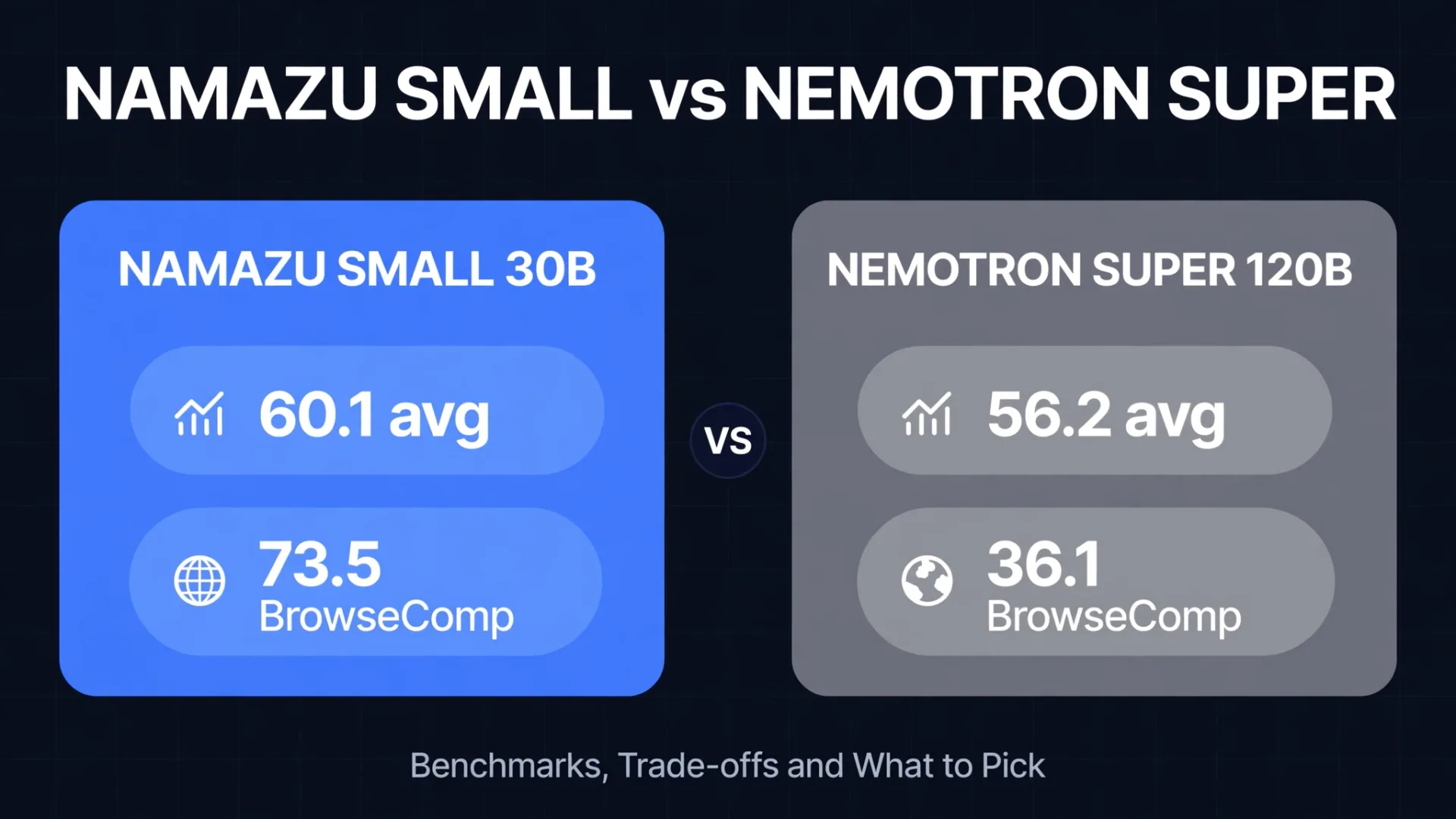
Sakana AI has a new reasoning model, and the headline number is hard to ignore: its 30B Namazu Small averages 60.1 across 25 benchmarks, ahead of NVIDIA's own 120B Nemotron 3 Super at 56.2. A model one quarter the size, built on NVIDIA's own smaller base, outscoring the big one on Sakana's test suite. That is the kind of result that makes teams rethink what they pay for in inference hardware.
But averages hide trade-offs, and this one has a big one. Namazu Small is brilliant at web research and long-document work, and weak at answering from its own memory. Before you plan around it, here is the full picture.
What is Namazu Small?
Namazu Small is a 30-billion-parameter reasoning model from Sakana AI, announced on November 26, 2026. It has 3 billion active parameters (30B-A3B) and is built on the pretrained base of NVIDIA's Nemotron 3 Nano, a hybrid Mamba-Transformer mixture-of-experts model. Sakana did not simply reuse NVIDIA's finished model: it ran continued pretraining and post-training in-house, starting from Nano's pretrained base rather than NVIDIA's post-trained release, using techniques the lab developed for its original Namazu model.
Sakana positions the model for web-assisted research, long-document question answering, and answers grounded in supplied evidence. The Nemotron 3 Nano base supports up to 1M tokens of context, though Sakana has not disclosed Namazu Small's own context length.
Quick verdict
| Question | Answer |
|---|---|
| What is it? | 30B-A3B reasoning model from Sakana AI, built on Nemotron 3 Nano |
| Headline score | 60.1 average on 25 benchmarks, vs 56.2 for Nemotron 3 Super |
| Biggest strength | Web research: 73.5 on BrowseComp, about 2x Super's 36.1 |
| Biggest weakness | Factual recall: 6.8 on SimpleQA Verified, vs 18.1 for Super |
| Can you download it? | No. Weights are not released; on-prem details due early to mid December 2026 |
| Price | Not announced |
All benchmark scores in this post are self-reported by Sakana AI and have not been independently verified.
Benchmarks: where it wins, where it loses
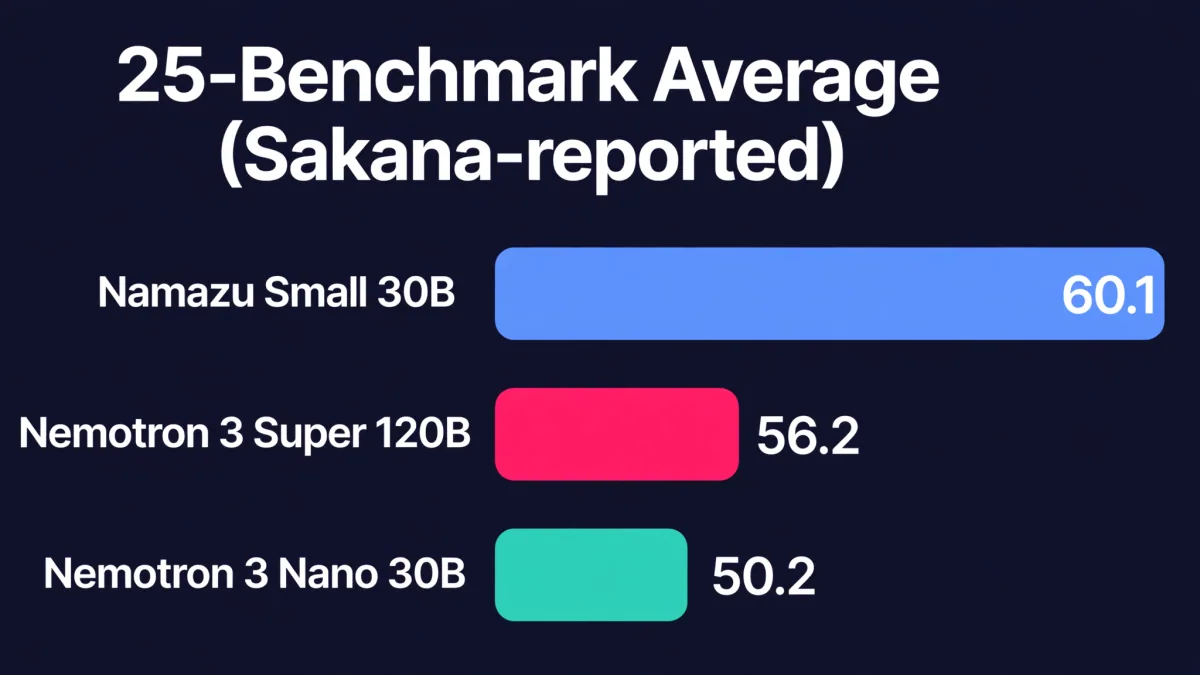
Sakana compared Namazu Small against NVIDIA's own post-trained versions of Nemotron 3 Nano (30B-A3B) and Nemotron 3 Super (120B-A12B) across 25 benchmarks in three groups: web search, context grounding and instruction following, and knowledge.
| Benchmark group | Namazu Small 30B | Nemotron 3 Super 120B | Nemotron 3 Nano 30B |
|---|---|---|---|
| Overall (25 benchmarks) | 60.1 | 56.2 | 50.2 |
| Web search (9 tests) | 59.9 | 54.6 | 49.3 |
| Context grounding and instruction following (8 tests) | 67.1 | 56.4 | 53.9 |
| Knowledge (8 tests) | 53.2 | 57.8 | 47.6 |
The individual scores tell the real story:
| Benchmark | Namazu Small | Nemotron 3 Super | Nemotron 3 Nano |
|---|---|---|---|
| BrowseComp | 73.5 | 36.1 | 29.3 |
| DeepSearchQA | 84.3 | 65.4 | 70.7 |
| LLM-jp LongBench | 86.0 | 60.0 | 67.0 |
| FaithEval | 78.3 | 59.1 | not reported |
| LongBench v2 | 45.7 | 53.1 | not reported |
| SimpleQA Verified | 6.8 | 18.1 | 9.1 |
| Japanese SimpleQA | 8.0 | 24.9 | 9.2 |
Namazu Small beats Super on 13 of the 25 benchmarks and beats Nano on 22 of 25. The pattern is consistent: it wins where the answer comes from searching the web or reading a long document, and it loses where the answer must come from the model's own stored knowledge. Sakana itself acknowledges that performance improved little on tasks answered from internal knowledge without outside information.
Availability and pricing
| Item | Status |
|---|---|
| Weights | Not released |
| Public API | No listing at launch |
| On-premises details | Expected early to mid December 2026 |
| Hardware | Not disclosed; the Nano base was designed for DGX Spark, H100 and B200 GPUs |
| Price | Not announced |
In short, this is a research and product signal for now, not something you can deploy today. The next concrete milestone is Sakana's on-premises announcement in December.
Which to pick?
Pick Namazu Small if your workload is research-heavy: web search agents, long-document QA, and evidence-grounded answers. That is exactly where its 73.5 BrowseComp and 86.0 LLM-jp LongBench scores sit, and its 30B size means far cheaper inference than a 120B model if Sakana's on-premises offering prices by size.
Pick Nemotron 3 Super if your workload leans on the model's own knowledge: closed-book factual QA, general knowledge, and long-context work where Super still leads (53.1 vs 45.7 on LongBench v2). Super's weights are also open on Hugging Face today, while Namazu Small's are not.
Pick Nemotron 3 Nano if you want an open, downloadable 30B model right now. It trails on the average (50.2), but it is available today and shares the same base architecture.
The honest takeaway: parameter count is a weak predictor here. A smaller model with the right continued training beat a model four times its size on most of the suite, but lost badly on factual recall. Test on your own workload before choosing, and watch Sakana's December on-premises announcement before planning a deployment.
For context on how the frontier models are stacking up right now, see our coverage of GPT-6 Astra and Claude Opus 5.5. If you want a team to build an AI agent around a model like this, see our AI agent development services.
FAQ
What is Sakana Namazu Small?
Namazu Small is a 30-billion-parameter reasoning model from Sakana AI, announced on November 26, 2026. It has 3 billion active parameters and is built on the pretrained base of NVIDIA's Nemotron 3 Nano, with continued pretraining and post-training done in-house by Sakana.
How does Namazu Small compare to Nemotron 3 Super?
On Sakana's 25-benchmark suite, Namazu Small averages 60.1, ahead of the 120B Nemotron 3 Super at 56.2. It wins big on web research (73.5 vs 36.1 on BrowseComp) but trails on factual recall (6.8 vs 18.1 on SimpleQA Verified). All scores are self-reported by Sakana.
Is Namazu Small open source?
No, not yet. The weights have not been released, and there is no public API listing. Sakana plans to share on-premises availability details in early to mid December 2026.
What is Namazu Small best at?
Web-assisted research and long-document question answering. Its strongest reported scores are BrowseComp (73.5), DeepSearchQA (84.3), and LLM-jp LongBench (86.0), all tasks where the model searches or reads supplied documents rather than recalling facts.
What is its biggest weakness?
Closed-book factual recall. It scores 6.8 on SimpleQA Verified and 8.0 on Japanese SimpleQA, below both Nemotron 3 Nano and Super. If your use case needs the model to answer from its own knowledge without retrieval, Super is the safer pick.
Sources: MarkTechPost, Wisevoter, ExplainX. All benchmark figures are self-reported by Sakana AI.
- Namazu Small
- Sakana AI
- Nemotron 3
- NVIDIA
- AI reasoning models
- open-weight AI