AI News7 min readBy JH Akash
Inkling 2 Mini: 26B Model That Runs on Your Laptop
Thinking Machines released Inkling 2 Mini on Nov 20: a 26.4B open-weight model that runs offline on a 32GB Mac, ties Qwen3.8-27B at 20.1 on the AA Index, and costs about 6x less per task. Here are the benchmarks, the price, and how to run it.
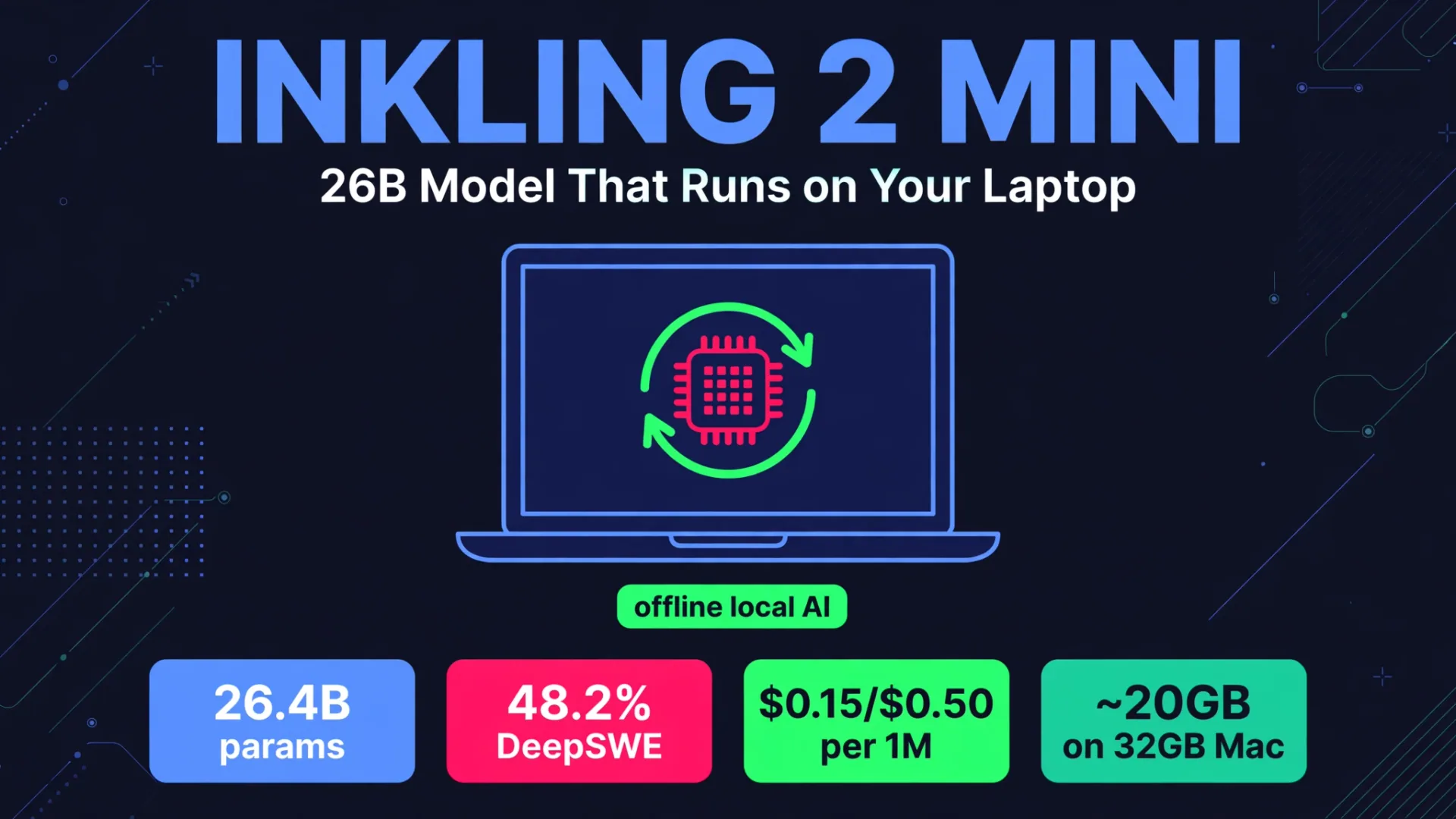
Thinking Machines Lab released Inkling 2 Mini on November 20, 2026, and it is the first model in its class built to run fully offline on a laptop without giving up agentic coding power. It has 26.4 billion total parameters, a memory footprint of about 20GB, and open weights under the Apache 2.0 license. On the Artificial Analysis Intelligence Index it scores 20.1, exactly tying Alibaba's dense Qwen3.8-27B, while costing about six times less per task and finishing about four times faster. This post covers what changed, the verified benchmarks, the price, and who should actually switch.
Quick verdict
| Question | Answer |
|---|---|
| What is Inkling 2 Mini? | A 26.4B open-weight looped transformer from Thinking Machines, released Nov 20, 2026 |
| Can it run on my laptop? | Yes, on Macs with 32GB or more RAM via Ollama, and on NVIDIA DGX Spark |
| How smart is it? | 20.1 on the AA Intelligence Index v5.0, tied with Qwen3.8-27B |
| What does the API cost? | $0.15 input / $0.50 output per 1M tokens, first-party |
| What is the catch? | Weaker factual recall and multi-turn chat than dense peers of the same size |
If you want a private coding agent that never phones home, this is now the strongest open option under 100B parameters on agentic coding tests. If you need the best closed-book knowledge in a small model, Qwen3.8-27B still has an edge. The tables below show why.
What Thinking Machines actually shipped
Inkling 2 Mini is a 24-layer decoder-only Mixture-of-Experts model. Each token routes to 8 of 128 experts, activating 3.4B parameters on a standard pass. The twist is the loop: the first six layers and the final six layers run once, while the middle 12 layers run three times with shared weights. That gives 48 effective layer applications per token and 5.4B effective active parameters, without storing a bigger model.
Thinking Machines says the loop lets the model reason longer internally instead of writing longer chains of thought. In its own scaling test, a non-looping baseline needed 140% more inference compute to match the looped model's loss on 512K-token agentic traces. Most weights ship natively in 4-bit NVFP4, with the last four layers in 8-bit MXFP8, which is why the full checkpoint fits in about 20GB with no post-training quantization loss.
The model is natively multimodal: text and images in, text out, with a 1M-token context window. Thinking Machines demoed it in airplane mode on a 48GB M5 Pro MacBook Pro building a playable flight simulator in minutes, and running 20 persistent villagers in a local town simulation on a single offline MacBook. Weights are on Hugging Face under Apache 2.0, with day-one support in Ollama, SGLang, vLLM, and the Tinker platform for inference and fine-tuning.
Benchmarks: where it leads, where it trails
All scores below are vendor-reported by Thinking Machines unless marked as Artificial Analysis. Evaluation setups vary by model, so treat cross-model gaps under one point as noise.
| Benchmark | Inkling 2 Mini | Qwen3.8-27B | Gemma 4 31B |
|---|---|---|---|
| AA Intelligence Index v5.0 | 20.1 | 20.1 | 4.4 |
| DeepSWE v1.1 | 48.2% | 42.2% | 0.3% |
| SWE-bench Pro v2 Hard | 77.9% | 73.8% | 14.2% |
| SWE-bench Verified | 79.2% | 77.8% | 46.1% |
| Vals Index v2.2 | 46.5% | Not reported | Not reported |
| DeepSearchQA | 85.3% | 79.7% | 61.7% |
| BrowseComp | 79.0% | 61.6% | 37.0% |
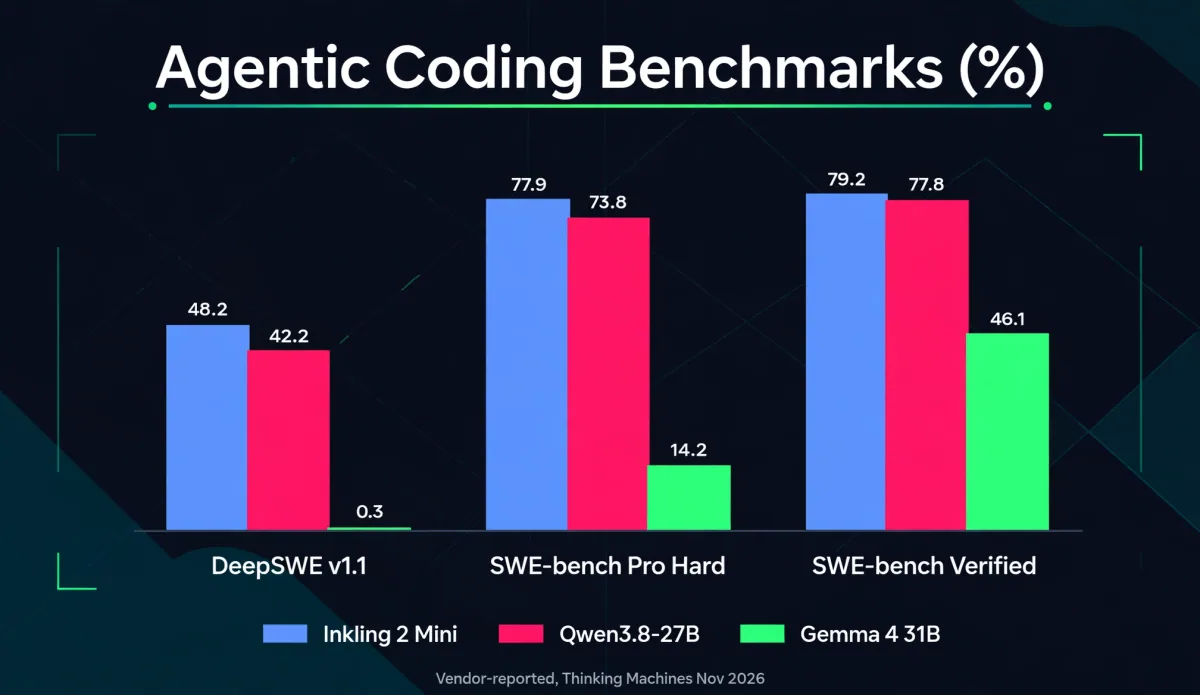
The pattern is clear. On long-horizon agentic work, coding, search, and tool use, Inkling 2 Mini leads every open-weights model under 100B parameters that Thinking Machines measured. On factual recall it does not: it scores -8.6 on AA-Omniscience v1.1 with a 63.4% non-hallucination rate, behind Qwen3.8-27B at -6.4 and 71.4%. Looping buys reasoning depth, not stored facts, and knowledge still scales with total parameter count. It also trails Qwen3.8-27B on multi-turn chat (50.0% on MultiChallenge) and multi-constraint instructions (33.4% on ComplexConstraints v1.1).
Stanford's intelligence-per-joule test on an NVIDIA DGX Spark adds one more angle: Inkling 2 Mini scored 0.703, ahead of Qwen3.6-35B-A3B at 0.430 and Gemma-4-26B-A4B at 0.159. For battery-powered or always-on local agents, that efficiency gap matters more than a one-point benchmark lead.
Pricing: the real reason to care
| Model | Input per 1M | Output per 1M | Notes |
|---|---|---|---|
| Inkling 2 Mini (first-party) | $0.15 | $0.50 | Cache hit $0.015 per 1M |
| Qwen3.8-27B (Alibaba Cloud) | $0.50 | $3.00 | Dense 27B, heavier per token |
| Gemma 4 31B (AI Studio) | $0.20 | $0.40 | Far weaker on coding tests |
Token price alone understates the gap, because the models use different amounts of compute per task. Artificial Analysis measured the full cost to finish an Intelligence Index task:
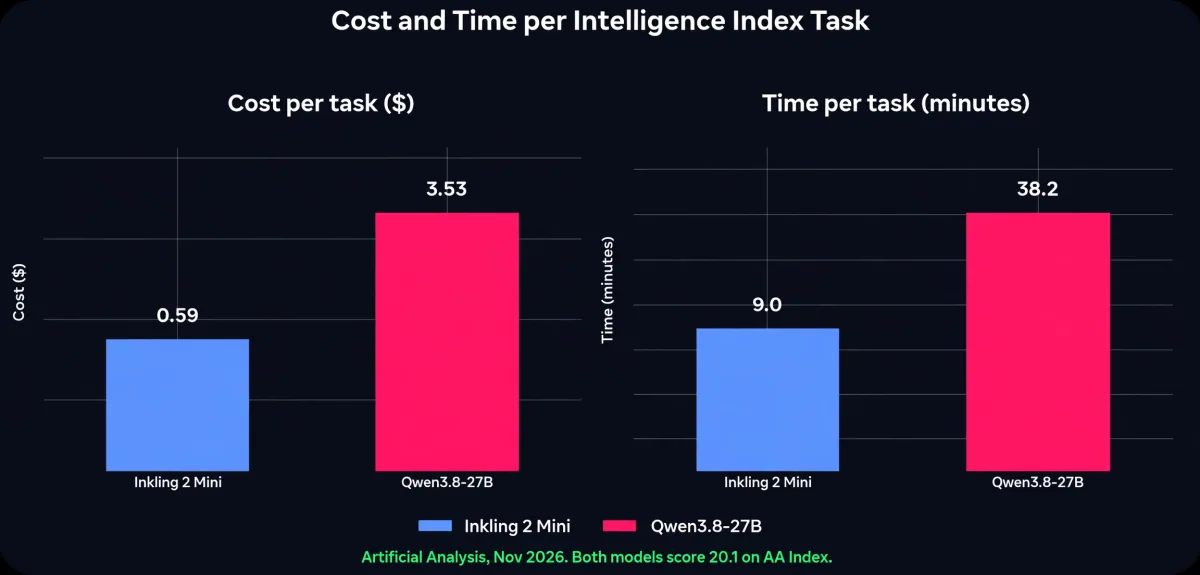
At the same 20.1 index score, Inkling 2 Mini costs $0.59 and takes 9.0 minutes per task, versus $3.53 and 38.2 minutes for Qwen3.8-27B. That is roughly 6x cheaper and 4x faster for the same measured intelligence, using about 2.8x less compute on Artificial Analysis's proxy measure. Running it locally removes the API bill entirely after the download, which is the whole point for private codebases.
How to run it today
- Mac (32GB or more): install via Ollama on any MacBook or Mac Mini with at least 32GB of unified memory. The native checkpoint is about 20GB, and GGUF builds can fit in 16GB.
- Desktop GPU: NVIDIA DGX Spark is officially supported. For other GPUs, Thinking Machines recommends 32GB or more of VRAM.
- Hosted: use the Tinker platform for inference and fine-tuning, or the Tinker Playground for chat, if you do not want to self-host.
- Serving stacks: SGLang and vLLM had day-zero support at launch, alongside MLX and llama.cpp GGUF quants.
Which one should you pick?
Pick Inkling 2 Mini if you run coding agents, search-heavy research, or tool-use workflows and you want them private, offline, or cheap at scale. It is the best sub-100B open model on DeepSWE and SWE-bench Pro Hard in Thinking Machines' table, and the cost-per-task gap is large enough to change how many agent runs you can afford.
Pick Qwen3.8-27B if your workload is knowledge-heavy question answering, long multi-turn chat, or strict multi-constraint instructions, where its dense weights store more facts and follow constraints more reliably.
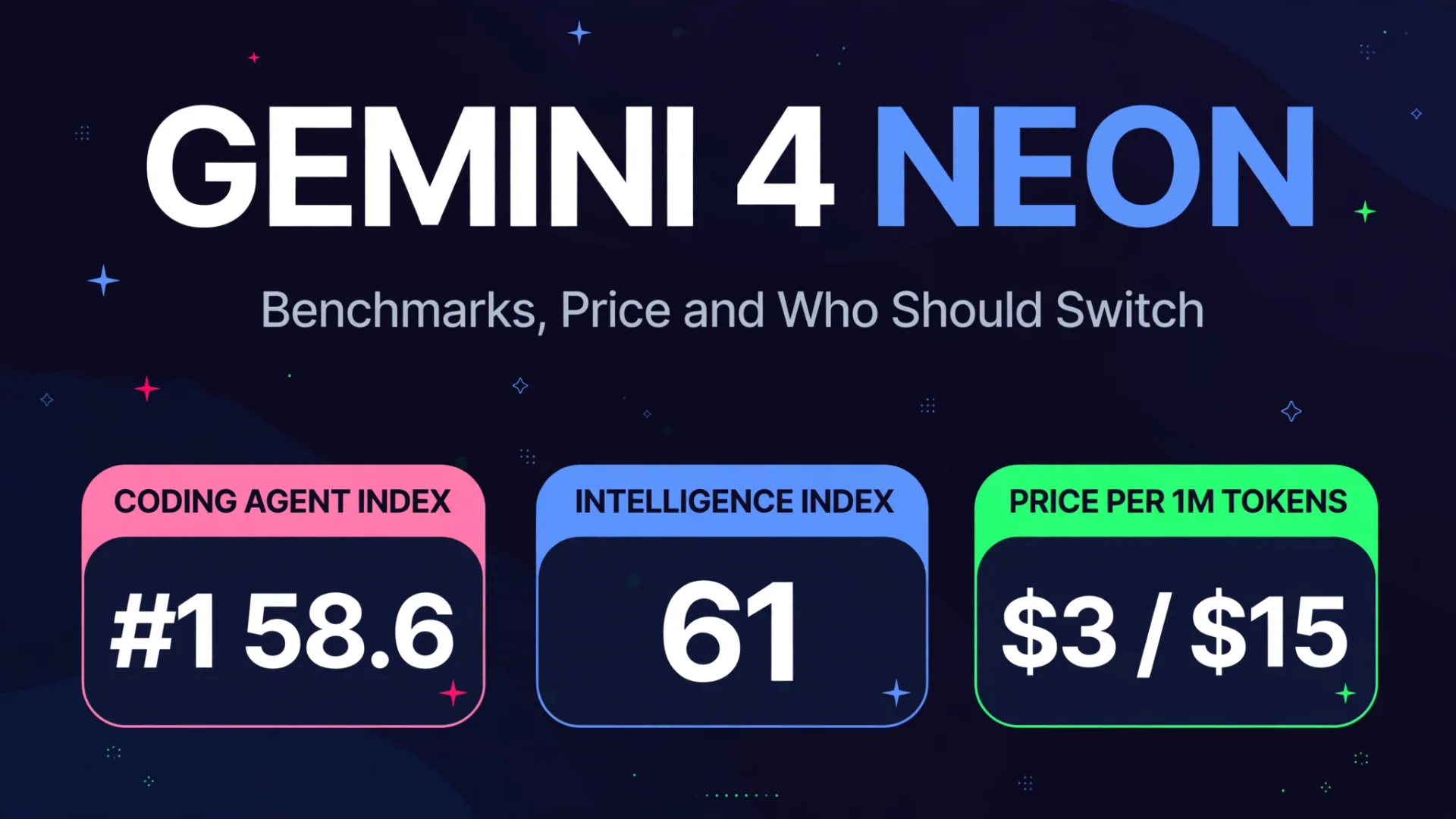
Pick a frontier cloud model if you need maximum raw intelligence. Inkling 2 Mini at 20.1 is a small-model score. For comparison, Gemini 4 Neon scored 61 on the same index family at $3/$15 per 1M tokens, and Microsoft's MAI Code 2 targets a similar coding niche from the cloud side. Local and frontier are complements, not substitutes.
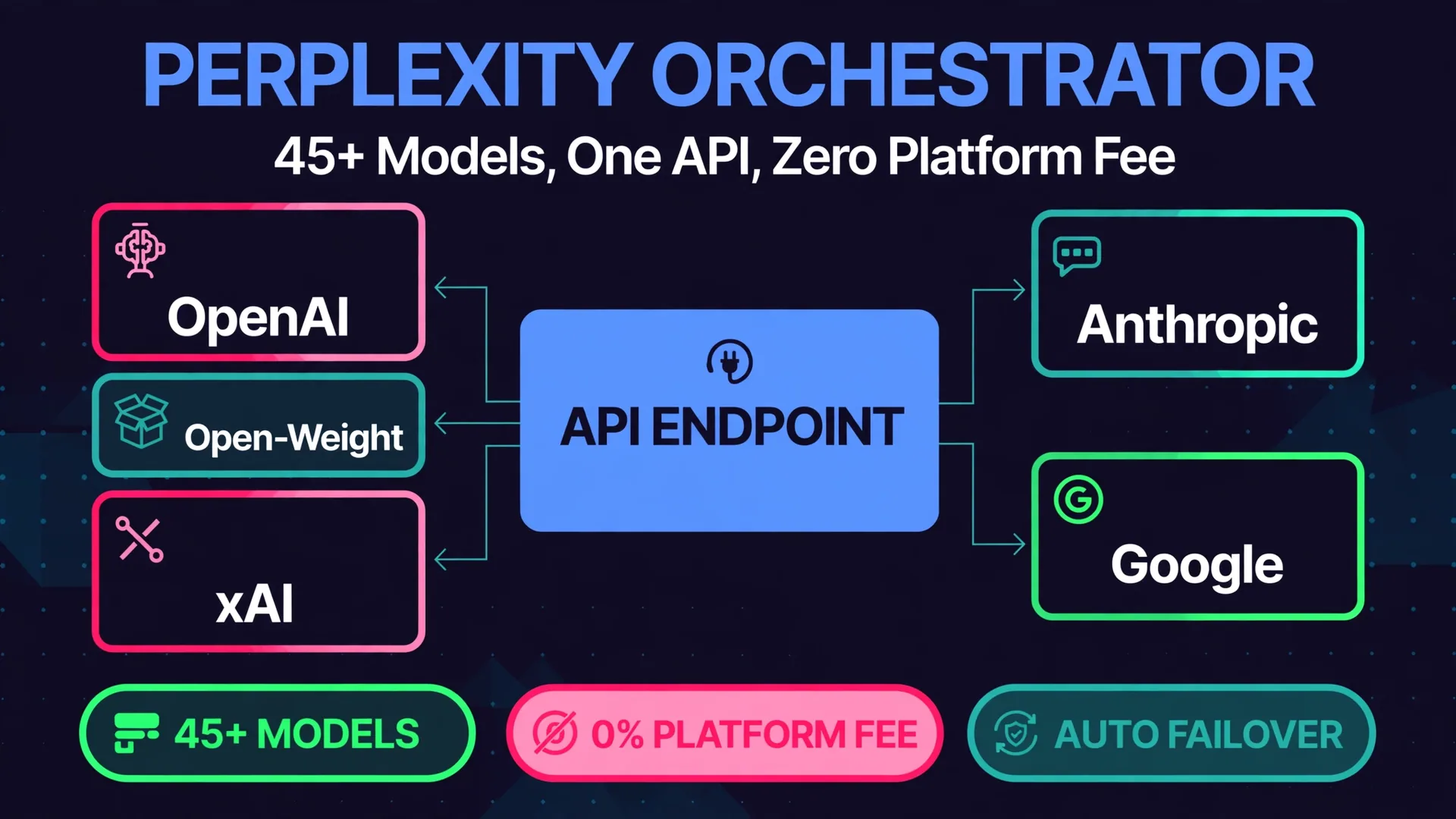
If you route between hosted models instead of self-hosting, the same week brought Perplexity Orchestrator with 45+ models at 0% platform fee, which is the cloud-side answer to the same cost problem. And if you prefer a fully local personal agent around a model like this, see our n8n Nod free open-source agent guide.
FAQ
Is Inkling 2 Mini really free to use commercially?
Yes. The weights are released under the Apache 2.0 license, so you can download, modify, fine-tune, and embed the model in proprietary commercial products royalty-free, provided you include the original copyright notice and license text. A standard Model Acceptable Use Policy also applies.
What hardware do I need to run Inkling 2 Mini locally?
A Mac with 32GB or more of unified memory via Ollama, an NVIDIA DGX Spark, or a GPU with 32GB or more of VRAM for the native checkpoint. The weights take about 20GB. GGUF quantized builds can run in 16GB with some quality trade-off.
How does the looped transformer work in plain terms?
A normal model passes each token through its layers once. Inkling 2 Mini passes each token through its middle 12 layers three times, reusing the same weights. The model gets more sequential reasoning steps per token without needing a larger file on disk, which helps most on coding and multi-hop reasoning tasks.
Does looping make the model harder to monitor?
Thinking Machines tested this with a variable-loop research variant. More loops extended the no-chain-of-thought reasoning horizon from 16 seconds to 37 seconds and roughly halved chain-of-thought length, but the remaining reasoning stayed human-legible and showed no upward trend in covert sabotage on its control benchmark. These are preliminary, vendor-run results.
Inkling 2 Mini vs Qwen3.8-27B: which is smarter?
They tie at 20.1 on the Artificial Analysis Intelligence Index v5.0. Inkling 2 Mini leads on agentic coding and search benchmarks, Qwen3.8-27B leads on factual recall, multi-turn chat, and multi-constraint instructions. The practical difference is efficiency: Inkling 2 Mini reaches the same index score at about one-sixth the cost and one-quarter the time per task.
Where can I try Inkling 2 Mini without installing anything?
On the Tinker Playground for chat, or through the Tinker platform for API inference and fine-tuning. Hosted pricing starts at $0.15 per 1M input tokens and $0.50 per 1M output tokens.
- Inkling 2 Mini
- Thinking Machines
- open weights
- local AI
- Qwen3.8-27B
- AI coding agents