AI Tools & Updates7 min readBy JH Akash
K-EXAONE 2.5: LG's Free 750B Model vs DeepSeek
LG opened K-EXAONE 2.5 as a free API on Nov 9, 2026: 750B parameters, 31B active per token, a 512K context window, and agentic benchmark scores roughly level with DeepSeek V4.1 Flash and GLM 5.3. Here is what it does, what it costs, and the catch.
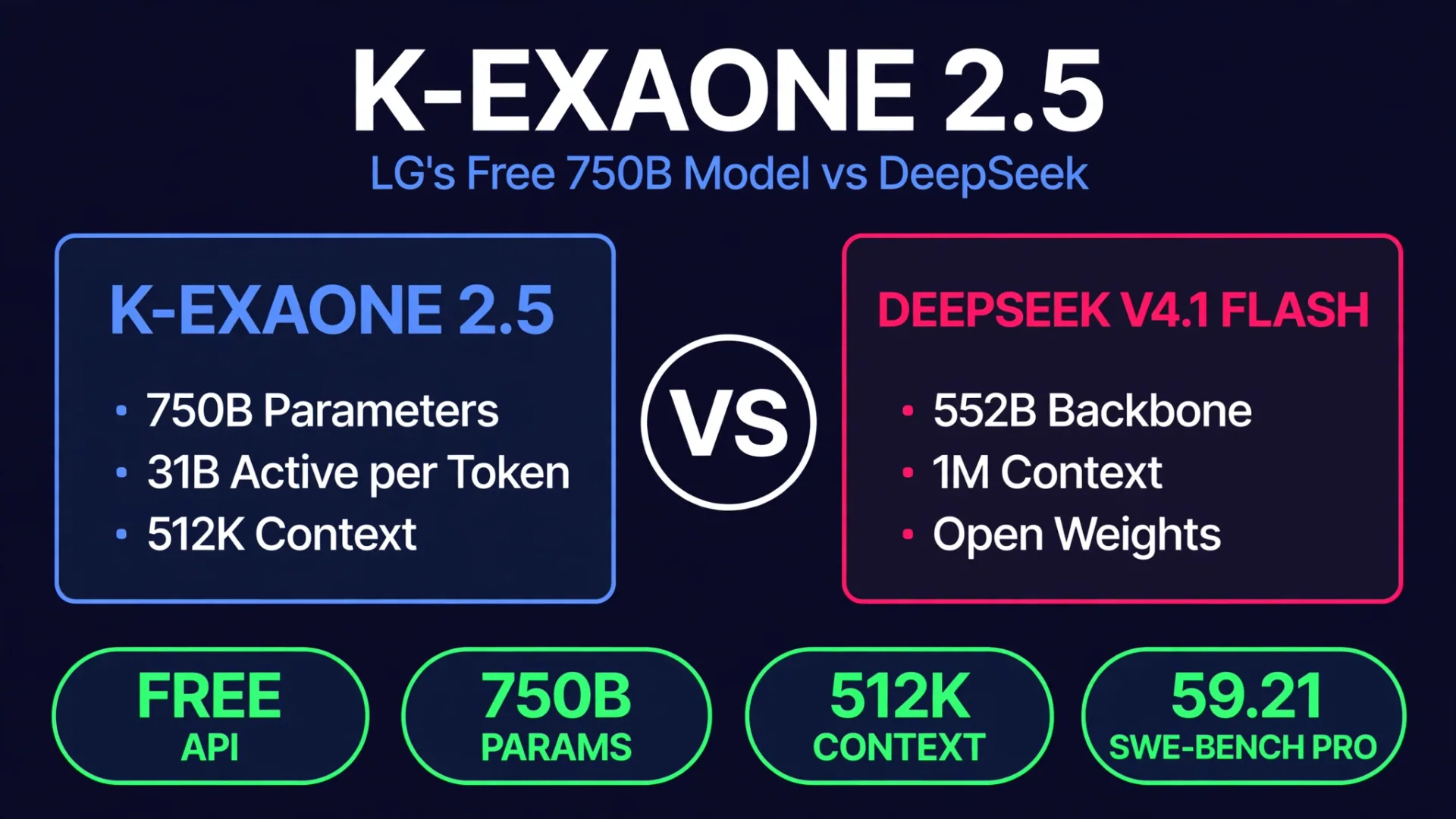
LG just put a 750 billion parameter model on a free API. On November 9, 2026, LG AI Research opened the EXAONE API Platform at NVIDIA AI Day Seoul, giving developers free access to K-EXAONE 2.5, its sovereign AI language model. The headline numbers are serious: 750B total parameters with 31B active per token, a 512K token context window, and agentic benchmark scores that sit roughly level with DeepSeek V4.1 Flash and GLM 5.3, two of the strongest open-weight models from China.
There is a catch, of course. The weights are not open, the free period has no announced end date, and every benchmark number below is LG's own measurement, not an independent test. Still, a free frontier-class API from a Korean lab is the kind of launch worth testing before the free window closes.
Quick verdict
| Question | Short answer |
|---|---|
| What launched? | K-EXAONE 2.5 API, free during the launch period |
| How big is it? | 750B parameters, 31B active per token |
| Context window | 512K tokens (524,288 token combined input and output budget) |
| Languages | Korean and English, text only |
| What it does | Chat, tool calling, structured outputs, code generation, streaming |
| How it scores | Roughly level with DeepSeek V4.1 Flash and GLM 5.3 on agentic benchmarks |
| The catch | API only, no open weights for 2.5; free period length and limits unannounced |
What is K-EXAONE 2.5?
K-EXAONE 2.5 is a technology validation model, built by further training the second-generation K-EXAONE model LG released in August 2026. LG says internal analysis across 24 evaluation metrics showed overall performance up more than 70% on the August model, achieved in about eight weeks. The model has a January 2026 knowledge cutoff and a reasoning_effort setting (low, high, or max, with max as the default) that controls how long it thinks before answering.
The endpoint is OpenAI compatible, so existing code can point at it with the model name k-exaone_v2.5. The platform also lists a second model, EXAONE Tabular, a small model for predictions on structured data.
LG frames the free API as real-world validation ahead of its next model. Co-head of research Lim Woo-hyung said the team is concentrating on a third-generation model and aims to complete an EXAONE model with frontier-level performance by January 2027. NVIDIA has already published a Dynamo inference guide for K-EXAONE, and LG is considering NVIDIA Dynamo software to improve serving efficiency.
Benchmarks: K-EXAONE 2.5 vs DeepSeek V4.1 Flash vs GLM 5.3
LG compares K-EXAONE 2.5 with DeepSeek V4.1 Flash and GLM 5.3 on four agentic benchmarks, all measured by LG itself on open datasets. Treat these as vendor-reported until independent tests land.
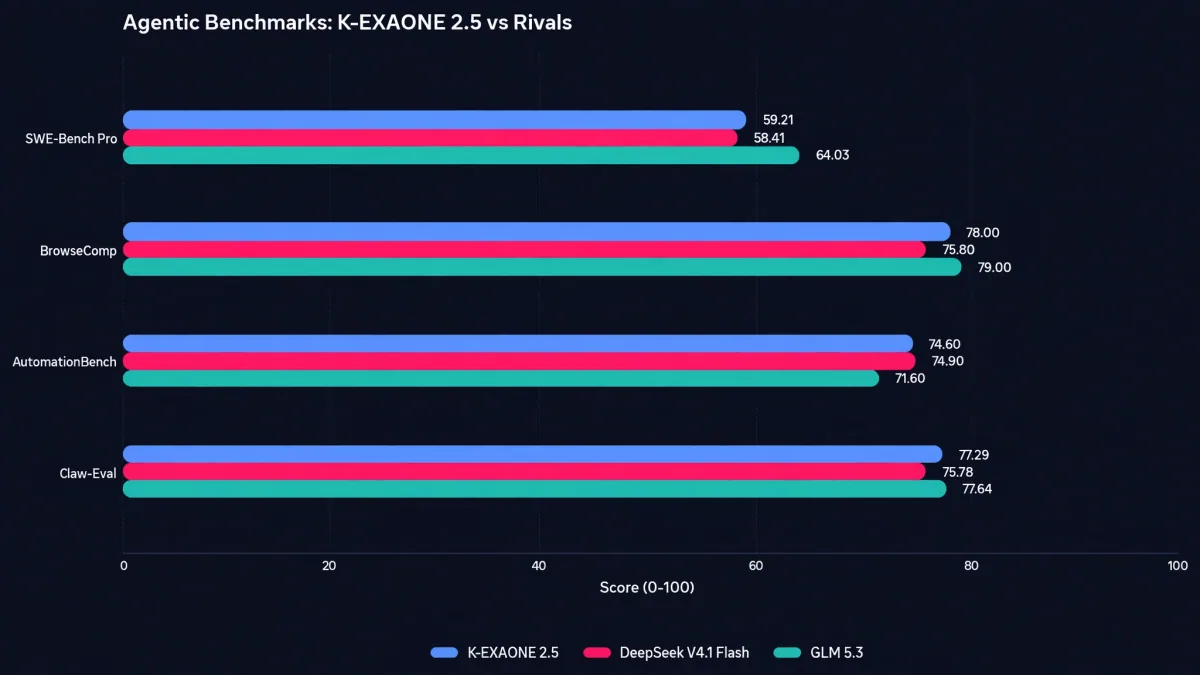
| Benchmark | K-EXAONE 2.5 | DeepSeek V4.1 Flash | GLM 5.3 | What it tests |
|---|---|---|---|---|
| SWE-Bench Pro | 59.21 | 58.41 | 64.03 | Software development and modification tasks |
| BrowseComp | 78.00 | 75.80 | 79.00 | Finding information through web browsing |
| AutomationBench | 74.60 | 74.90 | 71.60 | Automating work with SaaS tools |
| Claw-Eval | 77.29 | 75.78 | 77.64 | Agent problem-solving in workplace settings |
Read the table honestly: K-EXAONE 2.5 edges DeepSeek on three of the four benchmarks and trails GLM 5.3 on SWE-Bench Pro by a clear margin (59.21 vs 64.03) and on BrowseComp by a point (78 vs 79). On AutomationBench it sits a hair behind DeepSeek (74.6 vs 74.9). Nobody wins all four, and the gaps are small enough that the choice should come down to price, language, and access, not a single score.
For context, the August model, K-EXAONE 2.0, scored 47.1 on SWE-Bench Pro, 50.87 on BrowseComp, 16.9 on AutomationBench, and 62.11 on Claw-Eval. The jump on AutomationBench, from 16.9 to 74.6, is the most dramatic improvement in the set and suggests the extra training was aimed squarely at agentic tool use.
Pricing: free beats cheap, for now
| Model | Input per 1M tokens | Output per 1M tokens | Notes |
|---|---|---|---|
| K-EXAONE 2.5 | Free | Free | Launch period; no end date or limits announced |
| DeepSeek V4.1 Flash | $0.15 off-peak / $0.30 peak | $0.60 off-peak / $1.20 peak | Peak hours 01:00-04:00 and 06:00-10:00 UTC, weekdays |
| GLM-5.3-Flash | $0.15 | $0.50 | Flat rate, no peak hours |
| GLM-5.3 (flagship) | $1.40 | $4.40 | Z.ai flagship pricing |
DeepSeek and GLM prices are list prices checked against official pricing pages in late October 2026. K-EXAONE 2.5 at $0 is unbeatable while it lasts, but free with no announced limits is a launch tactic, not a price. Expect a paid tier once LG has the validation data it wants. If you build on it, keep your code portable: the OpenAI-compatible endpoint makes switching to DeepSeek or GLM cheap.
Which model should you pick?
Pick K-EXAONE 2.5 if you work in Korean or English, want a free frontier-class API right now, or build agents that call SaaS tools. Its AutomationBench and Claw-Eval scores are genuinely competitive, and the 512K context window is large enough for long documents and multi-step agent runs. Test it while it is free, but do not hard-code it as your only provider.
Pick DeepSeek V4.1 Flash if you need open weights, a 1M token context, or multimodal input. DeepSeek's model takes images as well as text, its weights are MIT licensed, and its off-peak price of $0.15/$0.60 per 1M tokens is the cheapest paid option here. It also leads on independent agentic tests such as DeepSWE v1.1, where it scored 74.2% in DeepSeek's own paper.
Pick GLM 5.3 if coding is the priority. It leads this group on SWE-Bench Pro at 64.03, and its flagship API at $1.40/$4.40 per 1M tokens is the most expensive of the three, so use the cheaper GLM-5.3-Flash at $0.15/$0.50 for routine work.
For businesses building AI agents, the practical move is the same one we recommend for every new model: run your own benchmark on your own tasks. Vendor scores measure vendor tasks. If you need help wiring a model like this into a real workflow, our AI agent development services cover exactly that, and you can hire an AI automation agency to run the evaluation for you.
What this means for the open-weight race
K-EXAONE 2.5 matters for a reason beyond its scores. Until now, the frontier open-weight race has been a US versus China story: DeepSeek, GLM, and Qwen on one side, and open releases from Mistral and Meta on the other. LG is now a third pole, a Korean lab with a sovereign AI mandate and a stated goal of frontier-level performance by January 2027. Korea joins a small club of countries that can field a 750B-class model at all.
The other signal is the price. Free API access to a model this size is a deliberate land grab for developer mindshare, the same playbook DeepSeek used to force the whole industry to cut prices. If LG's free tier holds for a few months, expect pressure on every budget model in this class.
FAQ
Is K-EXAONE 2.5 really free?
Yes, for now. LG says the EXAONE API Platform is currently free of charge. The company has not said how long the free period will last or what limits will apply once it ends, so treat free access as temporary.
Is K-EXAONE 2.5 open source?
No, not this release. The API is open to developers, but LG has not announced open weights for version 2.5. LG has published weights for earlier K-EXAONE models on Hugging Face. DeepSeek V4.1 Flash, by contrast, ships open weights under an MIT license.
What languages does K-EXAONE 2.5 support?
Korean and English only, text input and text output. There is no image or multimodal input in this release.
How do I use the K-EXAONE 2.5 API?
Sign up for an API key at the EXAONE API Platform (docs.exaone.ai) and call the OpenAI-compatible chat completions endpoint with the model name k-exaone_v2.5. A reasoning_effort parameter (low, high, or max) controls how much the model thinks before answering.
How does K-EXAONE 2.5 compare with DeepSeek V4.1 Flash?
On LG's own agentic benchmarks, the two are close: K-EXAONE 2.5 leads on SWE-Bench Pro (59.21 vs 58.41), BrowseComp (78 vs 75.8), and Claw-Eval (77.29 vs 75.78), and trails slightly on AutomationBench (74.6 vs 74.9). DeepSeek has the bigger context window (1M vs 512K), open weights, and multimodal input. All benchmark figures are vendor-reported.
When will LG release a frontier EXAONE model?
LG aims to complete a third-generation EXAONE model with frontier-level performance by January 2027, according to co-head of research Lim Woo-hyung.
Sources
LG AI Research announced the free API on November 9, 2026, at NVIDIA AI Day Seoul. Benchmark figures come from LG's model card and the EXAONE API Platform documentation, as reported by Spectrum Web, the Korea Herald, and Aju Press. DeepSeek and GLM prices are from the official DeepSeek and Z.ai pricing pages, checked in late October 2026. Related reading: our GPT-6 Astra breakdown and our Claude Opus 5.5 review.
- K-EXAONE 2.5
- LG AI Research
- DeepSeek V4.1 Flash
- GLM 5.3
- AI benchmarks