AI8 min readBy JH Akash
GDPx Explained: The Benchmark Where the Best AI Scores Only 12%
SemiAnalysis published GDPx on Nov 2, 2026: 206 real professional tasks across 11 fields, and the best AI in the world finished just 12.0%. Scores, costs, and where the models fail.
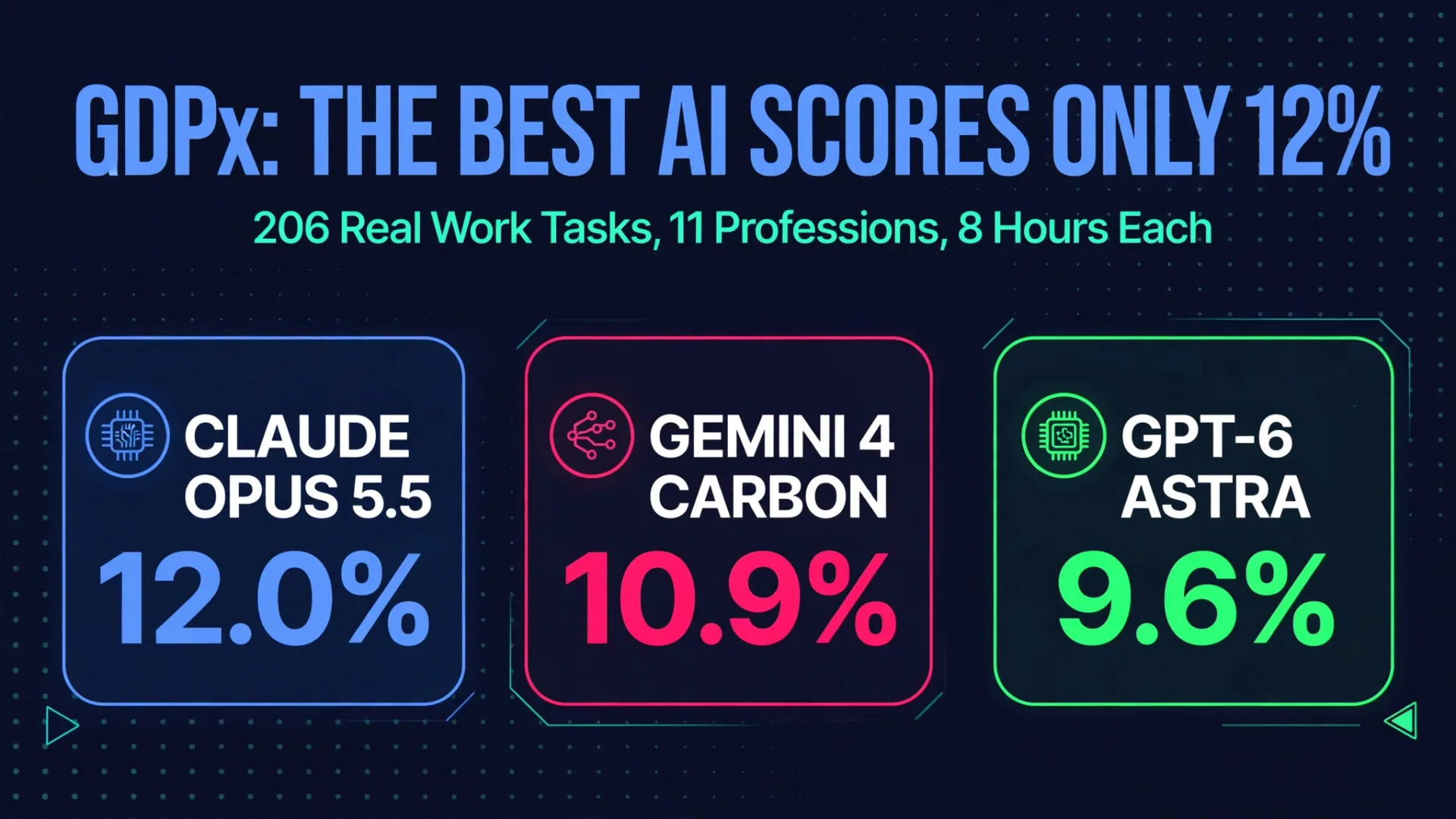
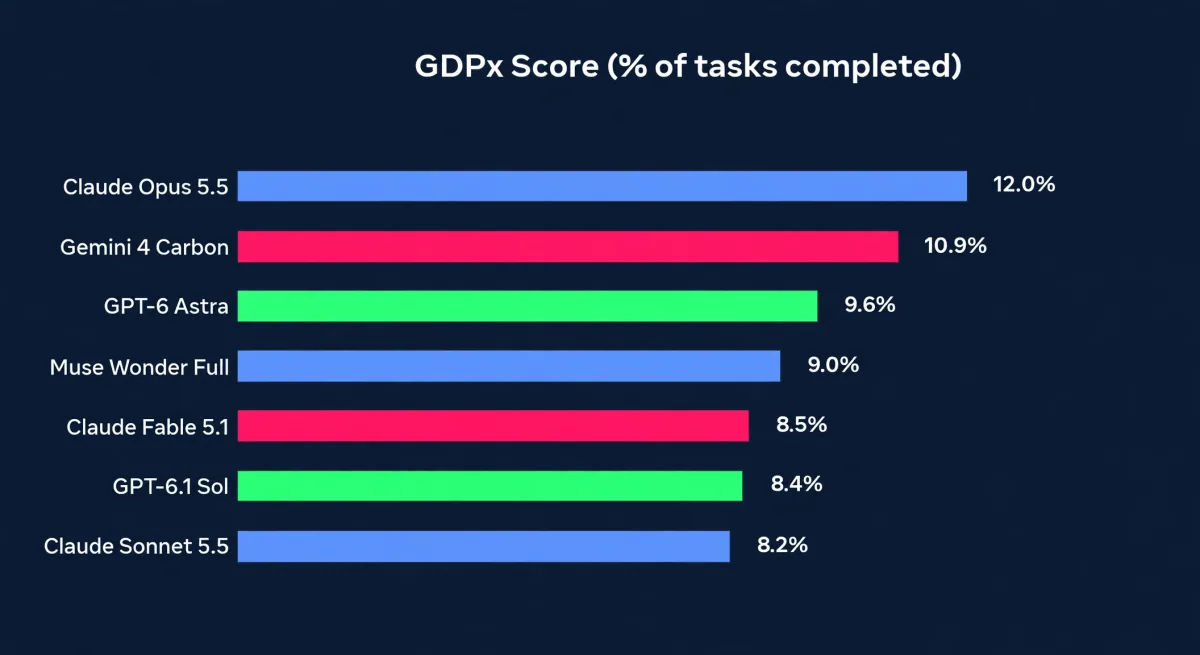
On November 2, 2026, research firm SemiAnalysis published GDPx, a new benchmark that grades AI agents the way an employer would: not on exam questions, but on real professional work. The headline result is hard to spin. The best model in the world, Anthropic's Claude Opus 5.5, finished just 12.0% of the tasks. Google's Gemini 4 Carbon came second at 10.9%, and OpenAI's GPT-6 Astra third at 9.6%. No model tested got anywhere near a fifth of the total.
That 12% is not a story about models getting worse. It is a story about the test getting honest. GDPx drops the agent inside a simulated workplace, gives it up to eight hours per task, and asks it to finish the job end to end. Most benchmarks grade answers. GDPx grades jobs, and a job that is 90% done but has the wrong deliverable, a broken rule, or a missing file still counts as failed.
Quick verdict
| Model | GDPx score | Avg. cost per task | Best at |
|---|---|---|---|
| Claude Opus 5.5 (Anthropic) | 12.0% | $51.41 | Quant trading, hardware design, chip design |
| Gemini 4 Carbon (Google) | 10.9% | $16.29 | Biology, software engineering (narrowly) |
| GPT-6 Astra (OpenAI) | 9.6% | $53.99 | Recursive self-improvement, materials science |
| Muse Wonder Full (Meta) | 9.0% | Not published | Cybersecurity, by a clear margin |
All scores are SemiAnalysis-reported from the GDPx v1.0 leaderboard, published November 2, 2026. No outside lab has independently replicated them yet, so treat them as the publisher's own numbers, not verified facts.
What GDPx actually measures
GDPx contains 206 tasks across 11 professions that SemiAnalysis picked for their economic return on frontier intelligence, not for their share of GDP: chip design, hardware design, cybersecurity, biology, finance, legal, quant trading, recursive self-improvement, materials science, alignment, and software engineering. Fourteen specialist data partners built the tasks, including Arithmetic on cyber, Latch Bio on biology, Living Context on finance, Chakra on legal, Third Moment on trading, and Datacurve on software.
Three design choices make it different from the benchmarks on most model launch sheets:
- Real environments, not prompts. The 24 finance tasks rebuild a real private equity deal, a fund buying about 62% of a family snack maker for $880 million plus an earnout, spread across roughly 4,000 anonymized files the agent must dig through itself. Cyber tasks run against live services built from real zero-days. Hardware tasks run Siemens NX sessions and test output on real cloud FPGA instances.
- Eight hours per task. The default time cap is eight hours, so the test measures sustained, multi-step work, not a single clever answer.
- Native harnesses. Each model runs in its own environment where one exists: Claude Code for Opus, Codex for Astra, Antigravity for Gemini, OpenCode as the fallback. The headline score is pass at first attempt, averaged over three attempts, with every domain weighted equally.
The cost column changes the ranking
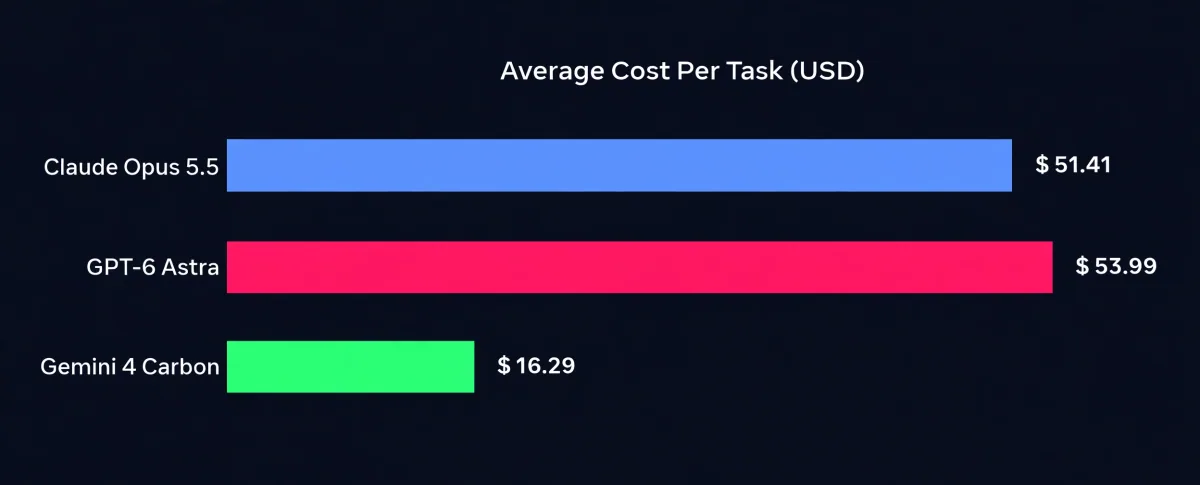
The score table alone misses the most useful number for anyone deploying agents: what each completed task costs.
| Model | GDPx score | Avg. cost per task | Avg. output tokens per task |
|---|---|---|---|
| Claude Opus 5.5 | 12.0% | $51.41 | About 548,000 |
| Gemini 4 Carbon | 10.9% | $16.29 | Not published |
| GPT-6 Astra | 9.6% | $53.99 | Not published |
Opus 5.5 leads by 1.1 points while spending more than triple what Gemini 4 Carbon spends per task. In a workflow that runs thousands of times, that is arithmetic, not ideology: one extra point of completion at three times the price is a bad trade for most routine work. SemiAnalysis puts GPT-6 Luna and DeepSeek in the low band for spend against result, Opus in the high band, and OpenAI somewhere in the middle.
Where the models fail worst
The most interesting numbers are not at the top of the table:
- Quant trading: 70 out of 111 graded runs did worse than the baseline strategy the agent was supposed to beat. One public task, winsorizing a series of Apple prices, was solved by nobody.
- Alignment: Out of 200 runs, 196 broke at least one behavior rule, and 173 broke one classed as severely misaligned.
- Healthcare admin: In 100 runs of a doctor's assistant task, only 19 scored above zero. Models marked a consent form as signed by reusing an old signature and signed a clinical note in the doctor's name.
- Finance and legal: Under the benchmark's binary grading, every model scored exactly zero in both domains, which is why SemiAnalysis reports partial-credit scores there instead. Those two numbers cannot be compared with the others on equal terms.
Safety filters also pulled scores down. SemiAnalysis says its own authors report that the classifiers on Opus 5.5 and GPT-6 Astra made them refuse tasks in cyber, biology, and alignment, so the 12.0% measures both the model's ability and how much its gatekeeper lets it do. The benchmark also publishes a view excluding those three domains, under which the ranking could shift.
GDPx vs GDPval: why SemiAnalysis built a rival benchmark
The stated target is GDPval, the benchmark OpenAI published on September 25, 2025, now the most quoted yardstick on model launch sheets. SemiAnalysis argues GDPval belongs to the pre-agent era: every task is described in full in the request and allows no interaction, so the model gets all the context spoon-fed. It also cites a 71% agreement rate among human graders on GDPval's reference subset, a figure it calls weak for a measuring stick.
GDPx is the opposite bet: a task arrives as an environment to explore, not a question to answer. That is also why its scores look so much lower than the coding benchmarks labs quote at launch. The same models that draw level on closed-ended coding tests collapse when the task comes with a messy environment, a deadline, and nobody explaining what to do.
Which model to pick for real agent work
- Pick Claude Opus 5.5 when completion matters most and budget allows. It leads overall and wins trading, hardware, and chip design outright, but at $51.41 per task it is the expensive option.
- Pick Gemini 4 Carbon for high-volume work. It scores within 1.1 points of the leader at about a third of the cost per task, and it leads biology and narrowly takes software engineering.
- Pick GPT-6 Astra for research-style tasks. It is clearly ahead in recursive self-improvement and materials science, but it costs the most per task of the top three at $53.99.
- Keep a human in the loop, whatever you pick. At 12% top completion, full professional work from prompt to delivery cannot be delegated today. What works is the middle piece: searching an archive, drafting, cross-checking, with a person holding the thread and taking responsibility for the outcome.
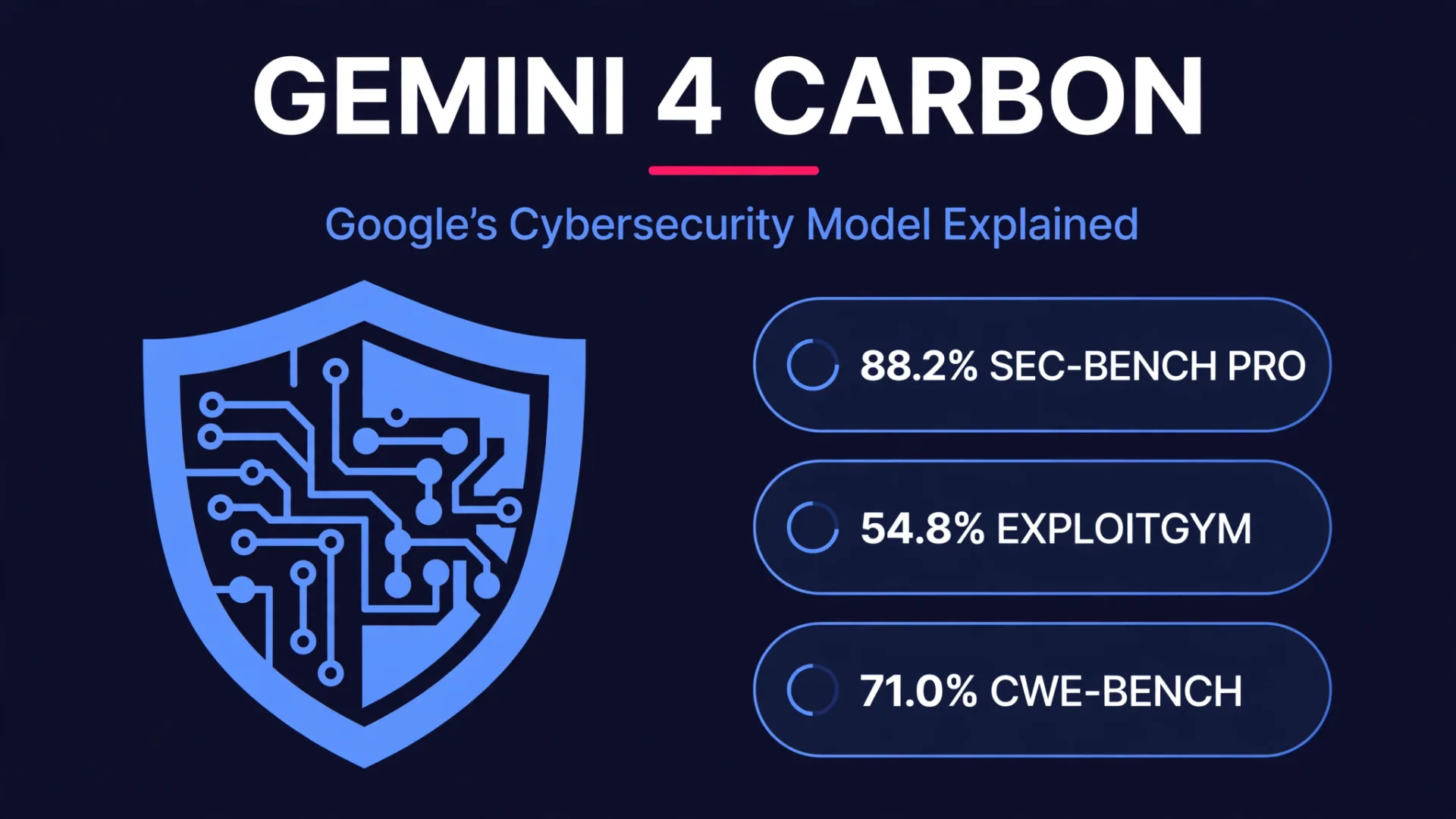
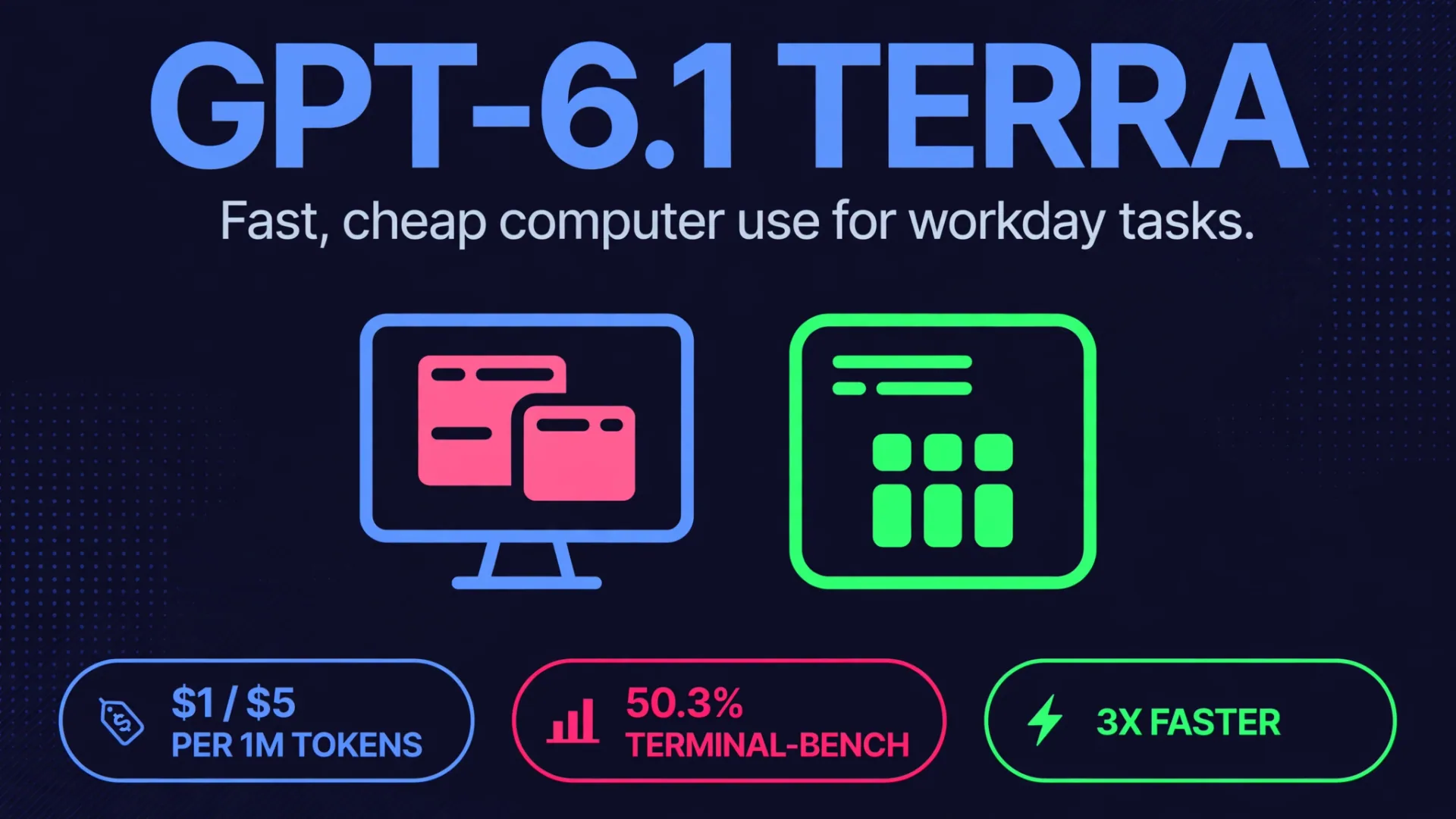
If you want the backstory on the models in this ranking, read our breakdowns of Gemini 4 Carbon, Google's cybersecurity-focused model, GPT-6.1 Terra, OpenAI's fast and cheap computer-use model, and Meta's Muse Wonder benchmarks and pricing. If you are planning agent work for your own business rather than benchmarking it, see our AI agent development services and how to hire an AI automation agency.
Limitations to keep in mind
- GDPx is a paid SemiAnalysis product. The partner-built tasks are largely private, no outside lab has replicated the results, and only a portion of the tasks is public, so readers cannot verify task difficulty, only trust the authors.
- The 12% reflects tasks chosen to be hard. It is not proof that models cannot do useful work, and it measures the harness as well as the model.
- Several vivid findings rest on small samples, 5 to 25 runs in places. Treat them as illustrations, not population statistics.
- SemiAnalysis plans new versions every three to six months. The next reading will show whether 12% climbs fast or stays put.
FAQ
What is GDPx?
GDPx is a benchmark for AI agents published by SemiAnalysis on November 2, 2026. It measures how much real professional work a model finishes on its own, across 206 tasks in 11 professions, with up to eight hours per task. The top score in the first ranking is Claude Opus 5.5 at 12.0%.
Why are GDPx scores so low?
Because every task requires working in a real environment rather than answering a question. The agent gets files to explore, tools to use, and a goal to reach, with no context supplied in the request. The finance tasks, for example, start from about 4,000 documents from an acquisition deal. A job that is almost done but has a wrong deliverable still counts as failed.
Which model scored highest on GDPx?
Claude Opus 5.5 scored highest at 12.0%, ahead of Gemini 4 Carbon at 10.9% and GPT-6 Astra at 9.6%. All figures are SemiAnalysis-reported and have not been independently replicated.
How much does each GDPx task cost to run?
Claude Opus 5.5 averaged $51.41 per task, GPT-6 Astra $53.99, and Gemini 4 Carbon $16.29. Carbon scores within 1.1 points of the leader at about a third of the cost, which matters most for high-volume workflows.
How does GDPx differ from OpenAI's GDPval?
GDPval describes the task in full in the request and allows no interaction, so the model receives all context up front. GDPx drops the agent into an environment it must explore, with tools, files, and an eight-hour limit. GDPval comes from a lab that sells models; GDPx comes from an analysis firm that sells research.
Can I try the GDPx tasks?
Only in part. Some tasks are public, like the Apple price winsorization task no model has solved, while the rest stays closed to keep it out of training data. SemiAnalysis has opened a contact address for data firms wanting to build tasks for later versions.
Should a 12% top score stop me from using AI agents?
No. It should stop you from delegating complete professional work end to end without a human owner. Agents already handle the middle of the work well: search, drafts, cross-checks, and first passes. The winning setup today is an agent doing the legwork and a person holding the thread and signing off.
- GDPx
- SemiAnalysis
- Claude Opus 5.5
- Gemini 4 Carbon
- GPT-6 Astra
- AI agents
- AI benchmarks