AI News6 min readBy JH Akash
Muse Ember: Haiku's 36 Score at One-Third the Cost
Meta's Muse Ember matches Claude Haiku 5.5 at 36 on the Artificial Analysis Index for about a third of the cost per task. Here are the benchmarks, the price, and the catch.
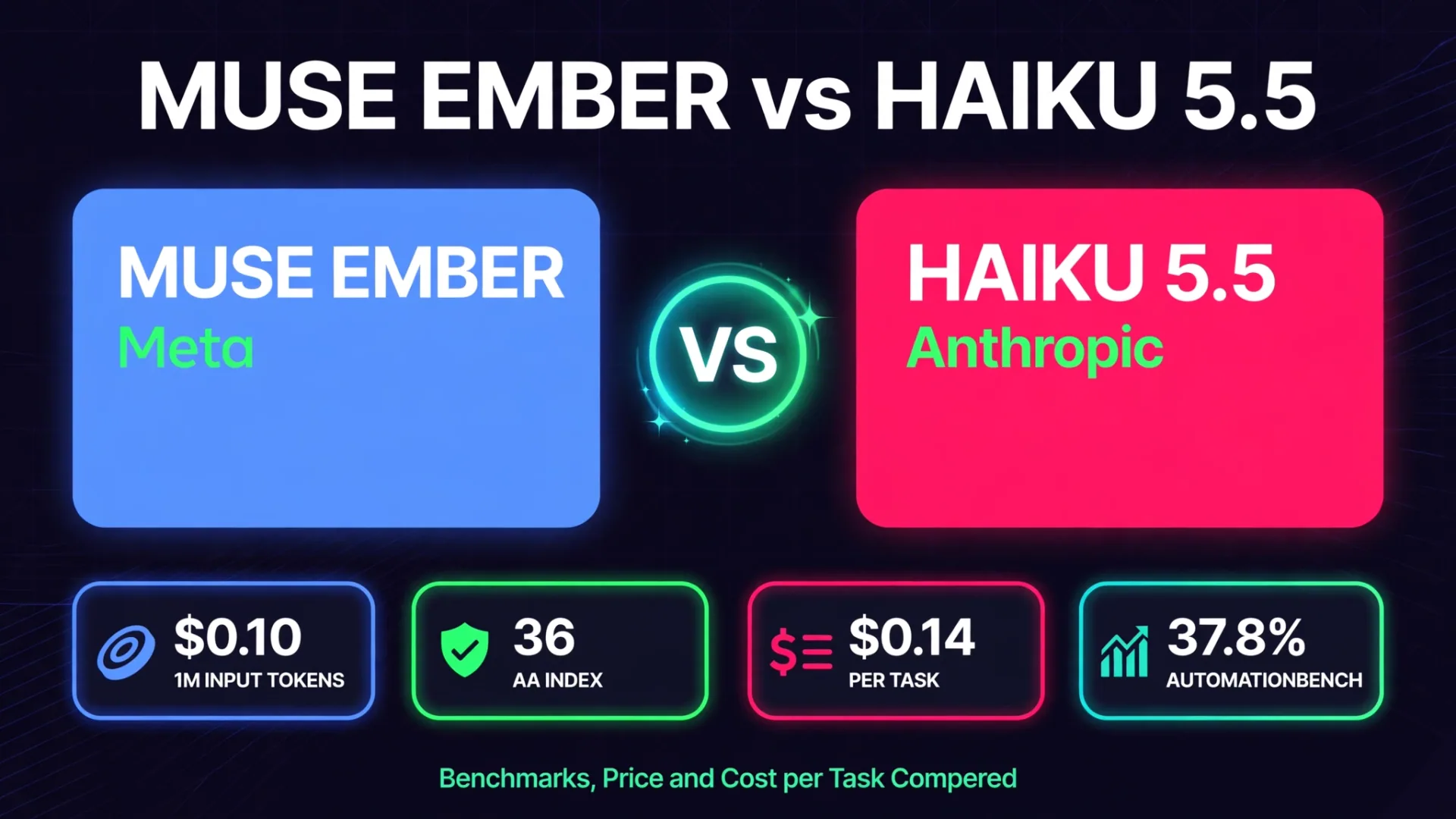
Meta launched Muse Ember on November 9, 2026, and the headline number is hard to ignore: it matches Claude Haiku 5.5 at 36 on the Artificial Analysis Intelligence Index, while costing about a third as much per task. Ember is Meta's smallest and cheapest Muse model, built for the repetitive work AI agents do all day: tool calls, coding subtasks, routing, extraction, and long-document parsing.
The catch is in the fine print. The token prices are identical to Haiku 5.5 and GPT-6 Luna. Ember wins on cost per task because it uses far fewer output tokens to reach the same score. And on one benchmark, the one closest to real mergeable code, Haiku still wins clearly. This post compares all three models on price, benchmarks, and the workloads each one is actually built for.
Quick verdict
| Model | AA Intelligence Index | Cost per task | Best for |
|---|---|---|---|
| Muse Ember | 36 | $0.136 | High-volume agent work, business workflows |
| Claude Haiku 5.5 | 36 | $0.411 | Mergeable code, office work |
| GPT-6 Luna | 28 | $0.152 | Cheap general tasks, lowest per-task cost after Ember |
All scores are at maximum reasoning effort, as reported by Meta from Artificial Analysis data dated November 9, 2026. Benchmarks published by a vendor are vendor-reported until independently retested.
What Muse Ember is
Ember is the fourth model in Meta's Muse family. Muse Spark arrived in April 2026 as the mid-weight model, Glimmer followed in August as its open-weight twin, and the frontier model Muse Wonder launched in October. Ember is the small one, and Meta calls it the most efficient model in the family.
It is a multimodal model: it takes text, images, audio, and video in a single call, so an agent can read screenshots, charts, scanned documents, voice memos, and video without a separate model. The context window is 1,048,576 tokens (1M), with up to 524,288 output tokens (512K) per request. That is enough to feed a whole codebase or a large document set into one call.
It is available now as muse-ember-1.0 on the Meta Model API and in Muse Code, and also on Google Cloud and Oracle Cloud. The weights are closed, so this is an API-only model, not an open download. Meta also says Ember is the first model trained with Muse Wonder Full, its frontier model, and that even cheaper models are already in training. On the same day, Meta also put Muse on Apple Watch and Wear OS.
Pricing: the same sticker price, a very different bill
Here is the part most headlines get wrong. Ember's per-token prices are exactly the same as Haiku 5.5 and GPT-6 Luna. The savings come from efficiency, not from a cheaper rate card.
| Price per 1M tokens | Up to 200K tokens | Above 200K tokens |
|---|---|---|
| Input | $0.10 | $0.30 |
| Cached input | $0.004 | $0.012 |
| Output | $0.50 | $1.50 |
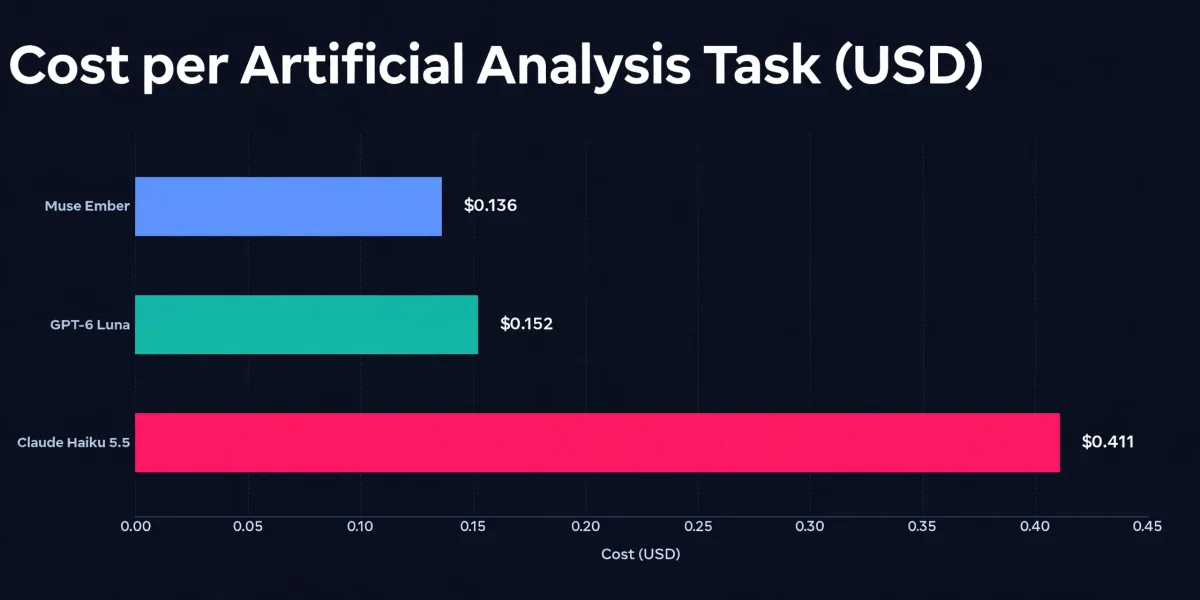
The higher tier applies to the whole request once it passes 200,000 tokens, so long-context calls cost three times more per token. The real number to watch is cost per finished task. On Artificial Analysis benchmarks, Ember averages about $0.14 per task, Haiku 5.5 about $0.41, and GPT-6 Luna about $0.15. Ember reaches the same score as Haiku while using roughly a third of the output tokens, and that is where the bill shrinks.
For scale, Meta's own larger model Muse Spark 1.3 scores 37 on the same index, one point above Ember, but costs $2.39 per task, about 17 times more than Ember. The trade is clear: one extra index point for 17 times the task cost.
Benchmarks: where Ember wins, and where it loses
Meta published ten head-to-head comparisons at maximum reasoning effort. The biggest gap is on business workflows, the smallest on mergeable code.
| Benchmark | Muse Ember | Claude Haiku 5.5 | GPT-6 Luna |
|---|---|---|---|
| Artificial Analysis Index | 36 | 36 | 28 |
| Cost per AA task | $0.136 | $0.411 | $0.152 |
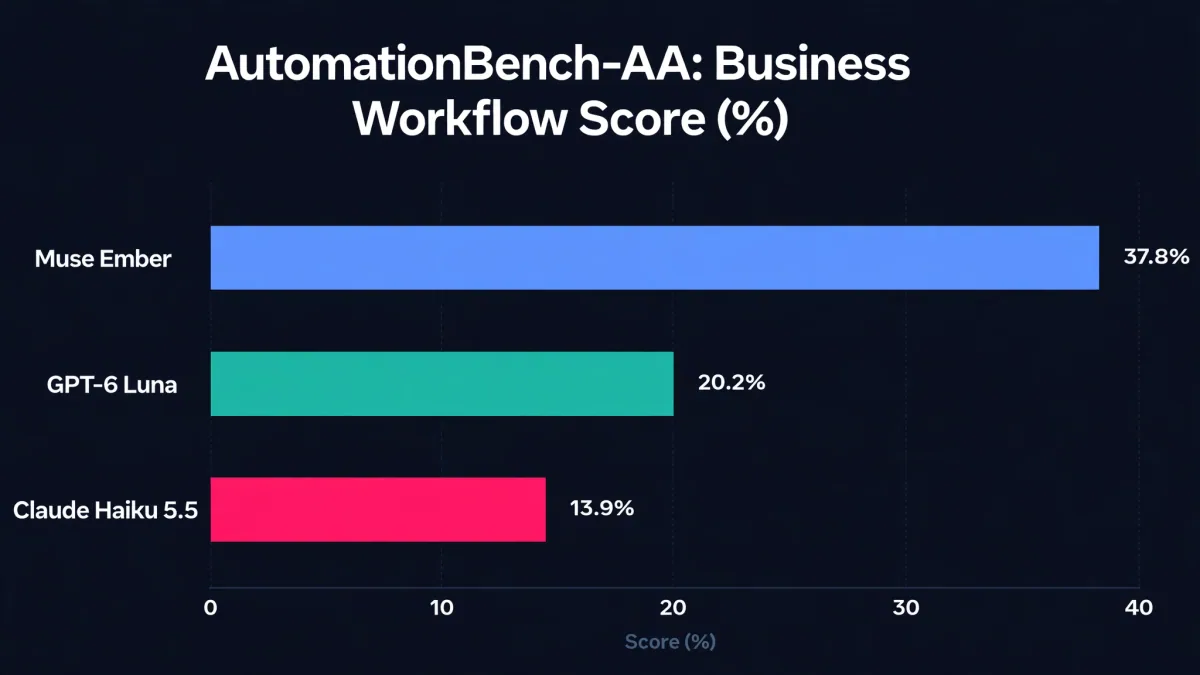
| AutomationBench-AA (business workflows) | 37.8% | 13.9% | 20.2% |
| Agents' Last Exam | 61.6% | 57.0% | 57.1% |
| Terminal-Bench 4.0 (agentic coding) | 40.9% | 39.2% | 16.4% |
| Coding Agent Index-AA | 46 | 37 | 31 |
| FrontierCode 2.0-AA (mergeable code) | 27.2% | 34.9% | 25.2% |
| OSWorld 2.1 (computer use, binary) | 33.8% | 27.8% | 17.0% |
| GDP.pdf-AA (long documents) | 22.8% | 20.8% | 22.8% |
| PerceptionBench (visual, with tools) | 80.6% | 78.6% | 62.8% |
Read the table with care. Ember's standout result is AutomationBench-AA, which runs 657 real business workflows: 37.8% against Haiku's 13.9%, almost three times higher. It also leads on agentic coding in Terminal-Bench and on the Coding Agent Index, which measures the model inside its real coding harness.
But FrontierCode 2.0-AA, the test closest to code you can merge without edits, goes the other way: Haiku 5.5 scores 34.9% against Ember's 27.2%. And on the headline index itself, the tie is rounded: unrounded, Haiku is 36.2 and Ember is 35.8. Same score on the chart, a small real gap underneath. Meta also ran four of the ten comparisons itself and calls the rival runs best-effort, so treat the numbers as vendor-reported.
Which model to pick
Pick Muse Ember if you run agents at volume: support triage, document extraction, routing, tool calls, and repeated coding subtasks. The 1M context window and $0.14 per-task cost make it the cheapest way to run Haiku-level intelligence all day. Watch the 200K token tier, where prices triple.
Pick Claude Haiku 5.5 if your agent writes code that must merge cleanly, or if you need an established data processing agreement and ecosystem. It costs about three times more per task for the same index score, but it wins the mergeable-code benchmark by a wide margin.
Pick GPT-6 Luna if you want the lowest-risk cheap option inside OpenAI's ecosystem. It trails both rivals on the index at 28, but its per-task cost is nearly as low as Ember's, and it ties Ember on long-document work.
For teams building agents, the practical move is a split: Ember for the high-volume repetitive steps, and a stronger model for the final code or decision that has to be right. That is exactly the workload Ember was built for. If you are planning that kind of setup, our guide to AI agent development services breaks down what an agent system costs to build, and you can also hire an AI automation agency to build it for you.
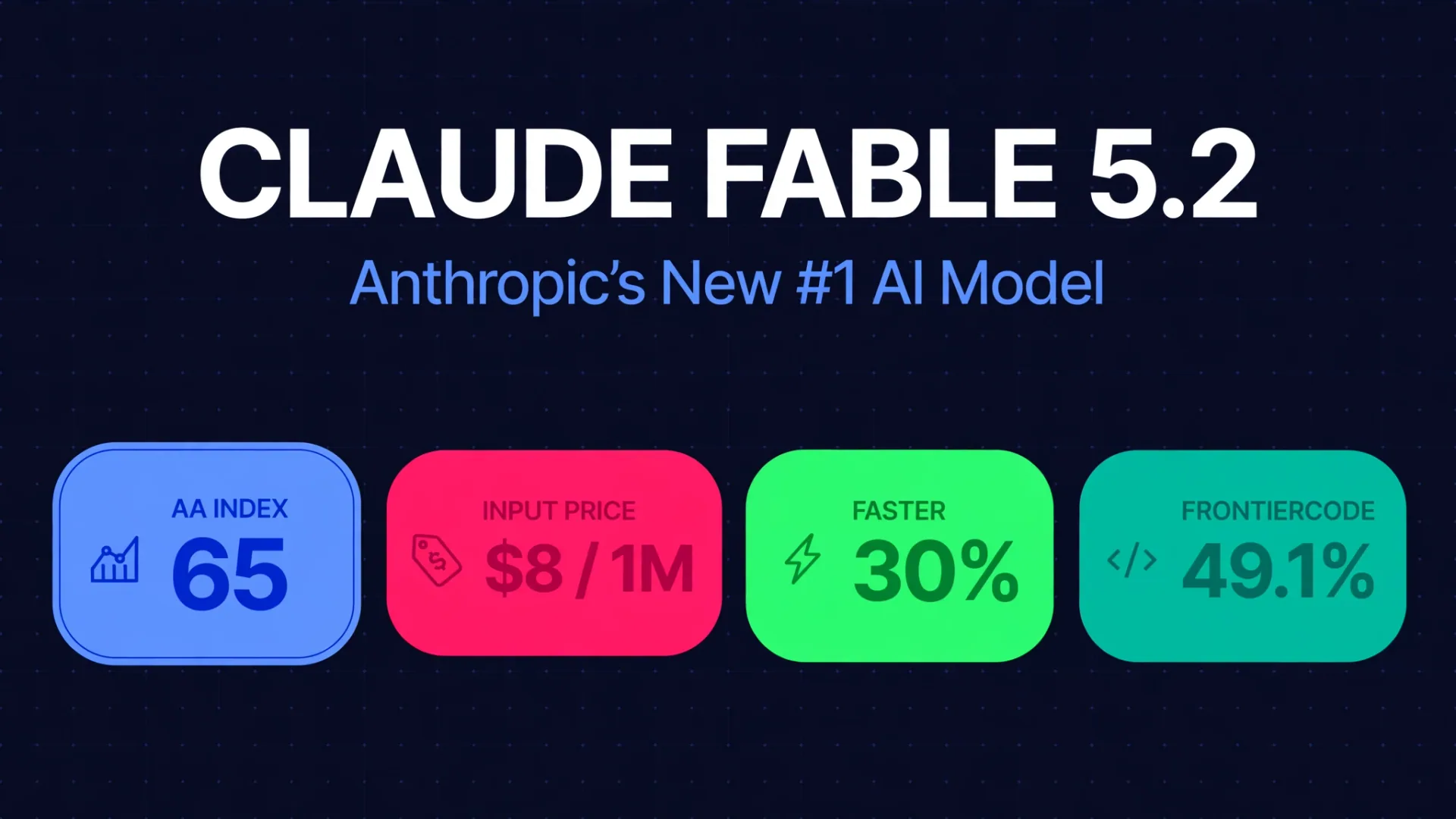
Anthropic is not standing still either. Its new frontier model Claude Fable 5.2 took first place on the same index at 65, and OpenAI's flagship GPT-6 Astra is the model Ember's bigger siblings are measured against. The small-model race is now about cost per finished task, not cost per token, and Ember just set the number to beat: $0.14.
FAQ
What is Meta Muse Ember?
Muse Ember is Meta's smallest and most efficient AI model, launched November 9, 2026. It is built for the repetitive work AI agents do all day: tool calls, coding subtasks, routing, extraction, and long-document parsing. It is available as muse-ember-1.0 on the Meta Model API and Muse Code.
How much does Muse Ember cost?
Muse Ember costs $0.10 per million input tokens and $0.50 per million output tokens for prompts up to 200,000 tokens, with cached input at $0.004. Above 200,000 tokens the rates rise to $0.30 input, $0.012 cached, and $1.50 output. On Artificial Analysis benchmarks it averages about $0.14 per task.
Is Muse Ember better than Claude Haiku 5.5?
On the Artificial Analysis Intelligence Index both score 36 at maximum reasoning, and Ember costs about a third as much per task. Ember also wins big on business workflows (37.8% vs 13.9% on AutomationBench-AA). Haiku 5.5 is stronger on mergeable code, scoring 34.9% vs Ember's 27.2% on FrontierCode 2.0-AA.
Is Muse Ember open source?
No. Meta has not released the weights. Muse Ember is an API-only model, available through the Meta Model API, Muse Code, Google Cloud, and Oracle Cloud.
What is Muse Ember's context window?
Muse Ember has a 1,048,576-token (1M) context window and supports up to 524,288 output tokens (512K) per request. It accepts text, images, audio, and video as input.
Sources: Meta AI Research, "Introducing Our Smallest, Most Efficient Model: Muse Ember", November 9, 2026; Artificial Analysis Intelligence Index v5, November 9, 2026. Benchmark figures are as published by Meta and are vendor-reported.
- Muse Ember
- Meta Muse
- Claude Haiku 5.5
- GPT-6 Luna
- AI benchmarks