ИИ6 мин чтенияАвтор JH Akash
Jev Explained: TypeSafe's AI Decision Model, Price and Rivals
TypeSafe AI raised $870 million at a $7.5 billion valuation for Jev, a model that returns decisions instead of text. How it works, what it costs, and where OpenAI and Amazon's rivals fit in.
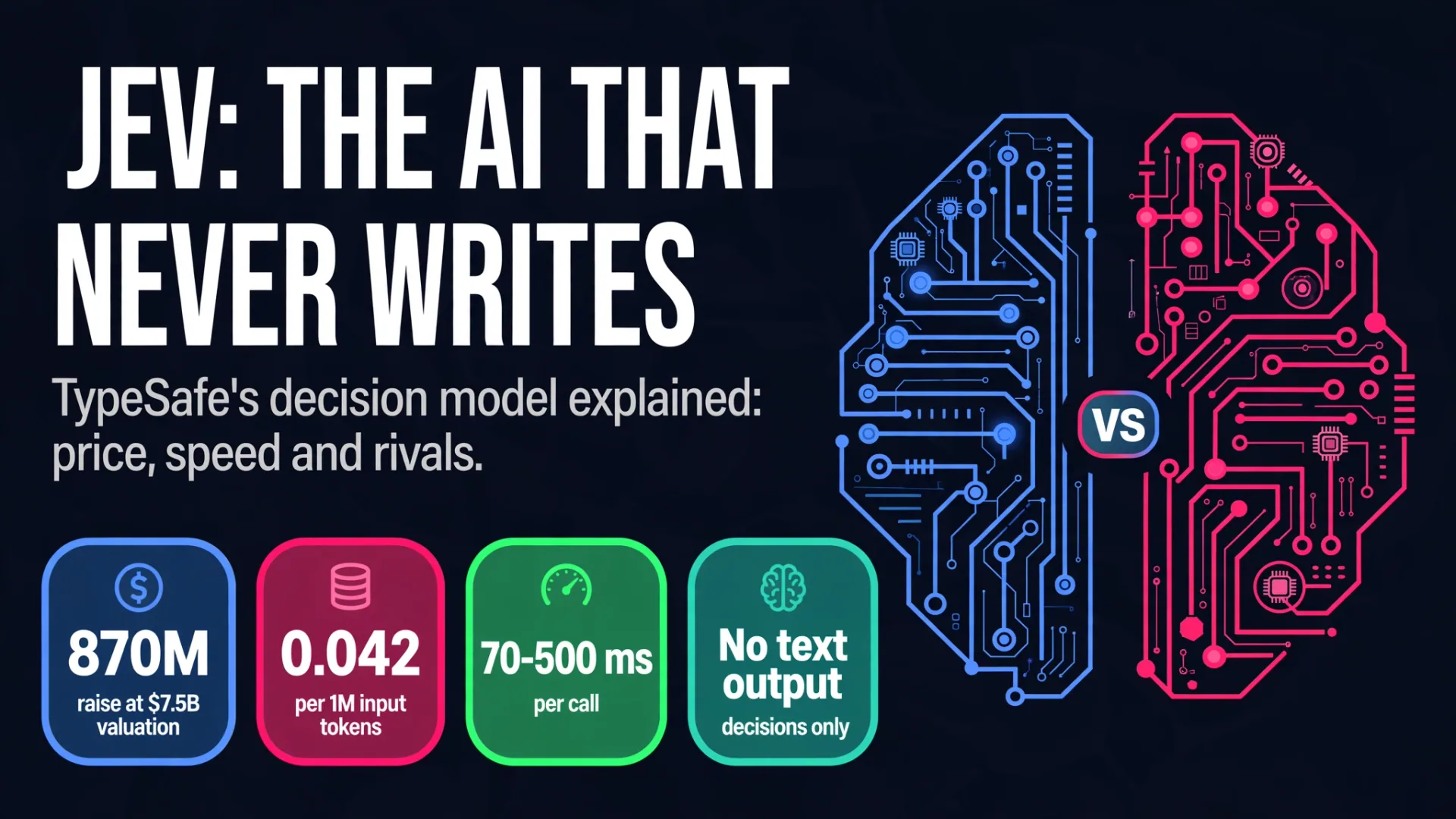
On October 9, 2026, a startup most people had never heard of six weeks ago raised $870 million at a $7.5 billion valuation. The company is TypeSafe AI, founded in 2024 in San Francisco by Diogo Almeida (previously at OpenAI, a co-author of the InstructGPT paper), Sasha Sheng (previously at Meta), and Erik Gafni. Its product is called Jev, and it is the first widely known AI model that cannot write. It cannot chat, summarize, or code. It only decides.
You hand Jev a piece of text or JSON and a set of typed questions with fixed answers, and it returns probabilities, not prose. Since its September 15 launch it went viral on X, cleared a 140,000+ waitlist in days, pulled OpenAI and Amazon into shipping rival decision products, and now claims (TypeSafe's own claim) that a third of Fortune 500 companies are already using it. Here is what it is, what it costs, and what it cannot do.
Quick verdict
If your software makes the same kind of judgment thousands of times a day, Jev is the cheapest fast option on the market right now. If you need words out of it, it is useless. The honest take: Jev is a specialist tool, not a chatbot replacement, and its rivals are already closing in.
What Jev actually does
Every Jev call has two inputs: the state (the text or JSON to be judged, like an email, a support ticket, or a document) and one or more questions. Each question is one of three primitives:
| Primitive | What it returns |
|---|---|
| Choice | One label from a list you supply (up to 255 options), with a probability for every option and a confidence score |
| Score | A rating on an ordered scale you define (2 to 10 levels), with probabilities and a confidence score |
| Noul | A single probability between 0 and 1 that a statement is true |
The key difference from an LLM is that Jev never generates its answer word by word. TypeSafe says it answers every question in one parallel pass, so asking ten questions about the same text costs barely more than asking one, and it can never return anything outside your predefined options. TypeSafe frames this as "cannot hallucinate": it can still be wrong, but only by picking one of your options. That is the company's claim and it has not been independently audited.
The real selling point is calibration. Jev was trained with a method TypeSafe calls RLCD (Reinforcement Learning for Calibrated Decisions), which rewards honest probabilities instead of answers human raters like. The aim is simple: when Jev says it is 90 percent sure, it should be right about 90 percent of the time, so software can act on its own when confidence is high and send the rest to a person.
How much Jev costs
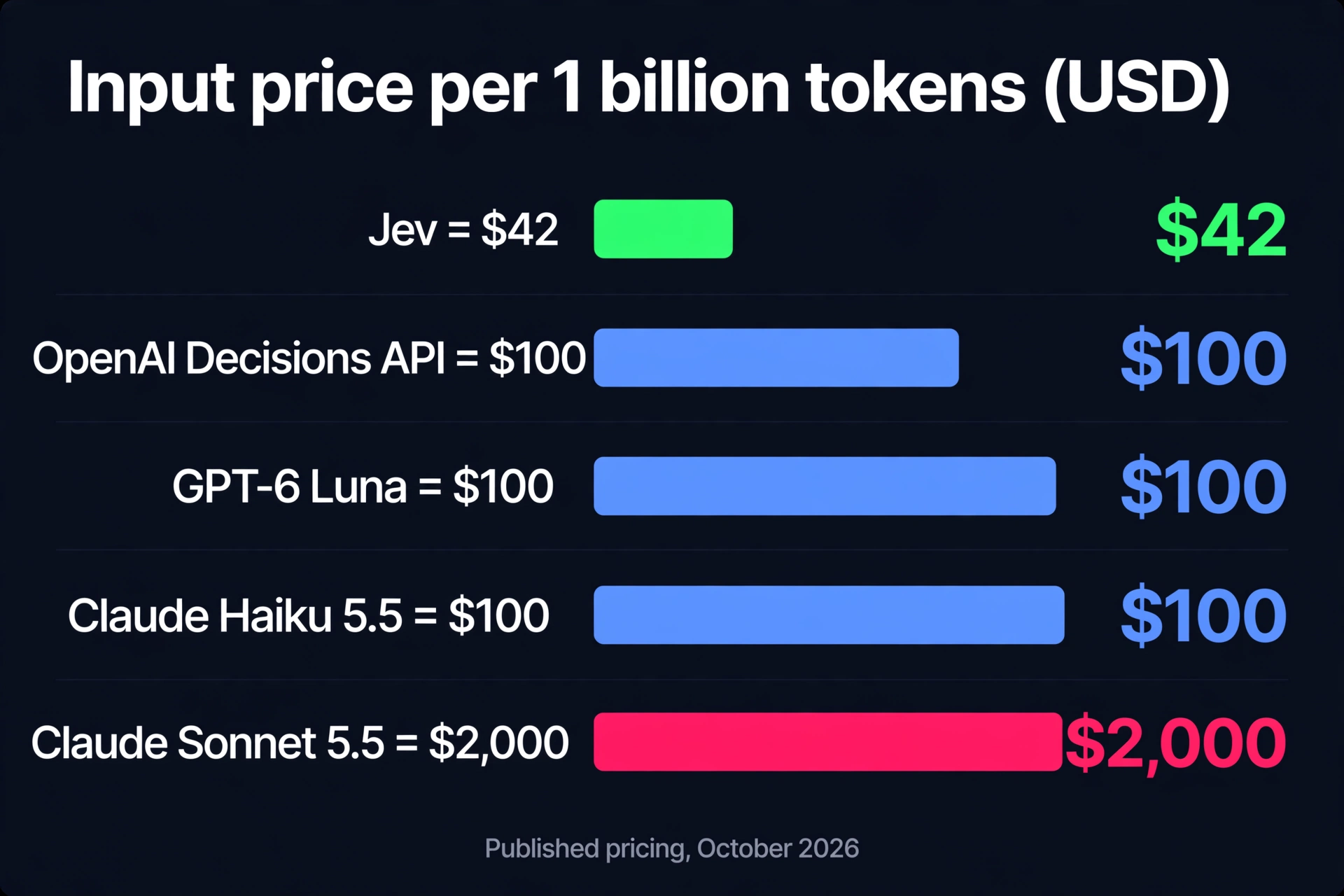
| Model | Input price per 1M tokens |
|---|---|
| Jev 1.13 | $0.042 |
| OpenAI Decisions API | $0.10 |
| GPT-6 Luna | $0.10 |
| Claude Haiku 5.5 | $0.10 |
| Claude Sonnet 5.5 | $2.00 |
Output tokens on Jev are free. TypeSafe puts its input price at 238 times lower than Anthropic's Claude Fable 5.1, which is TypeSafe's own figure, not independently verified. Per 1 billion input tokens, the gap is stark:
How fast Jev is
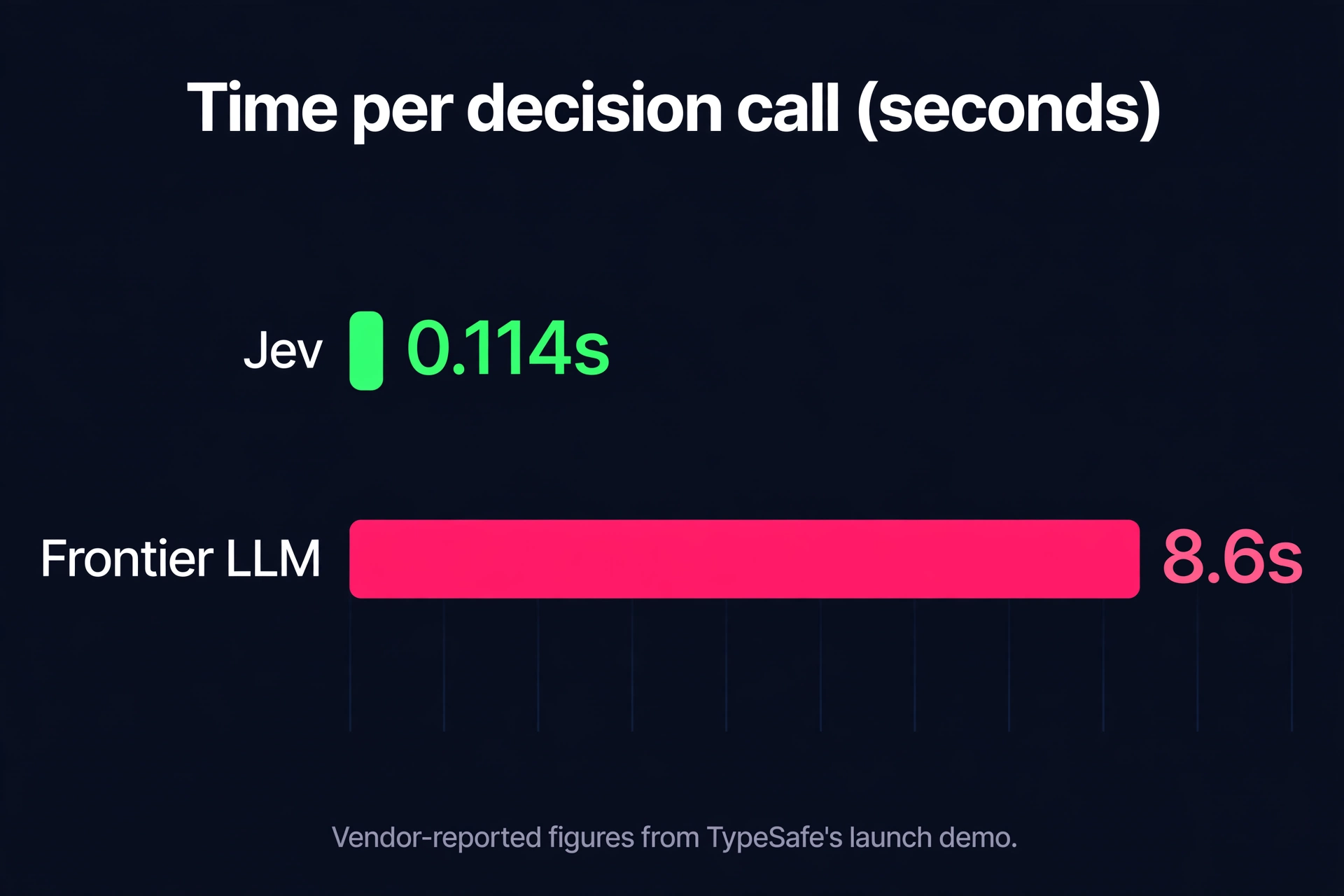
TypeSafe quotes 70 to 500 milliseconds per call, against several seconds for a frontier LLM doing the same job. In the company's own launch demo, one Jev call took 0.114 seconds and cost $0.000081, against 8.6 seconds and $0.013880 for an LLM. Those are vendor-reported figures, and TypeSafe admits it cannot prove its prices are not subsidized:
The rivals
Two weeks after Jev's launch, the big players responded:
| Jev (TypeSafe) | Decisions API (OpenAI) | Strands Decider 2B (AWS) | |
|---|---|---|---|
| Launched | Sep 15, 2026 | Public beta Oct 6, 2026 (announced at DevDay, Sep 29) | Oct 1, 2026 |
| Built on | TypeSafe's own model | A specialized GPT-6 Luna | Qwen3.5-2B with a scoring head |
| Images | No | Yes | No |
| Open weights | No | No | Yes (Apache 2.0) |
| Runs | TypeSafe's API | OpenAI's API | Your own CPU or GPU |
| Access | Early access waitlist | Public beta | Free download |
OpenAI's Decisions API works the same way (context plus predefined answers) at $0.10 per million input tokens with no output charges, and OpenAI says it answers about 10 times faster than its Responses API. Amazon's Strands Decider 2B runs locally in tens of milliseconds, but AWS is upfront that it is far worse than reasoning models at complex problems.
What Jev cannot do
TypeSafe unusually publishes a list of Jev's weak spots, which it calls "jaggedness". For version 1.13:
- No text output. No summaries, replies, or code. For that you still need an LLM.
- Bad at math and counting. It does not reliably count words or items, or compare numbers, color codes, or dates. TypeSafe says to do that in code.
- Reads literally. It answers the question you wrote, not the one you meant, so questions need exact conditions.
- Struggles with indirection. Multi-step reasoning and large inputs full of irrelevant detail are less accurate.
- Closed system. Proprietary weights, API only, no EU region, and English is its strongest language. Context is 64,000 tokens per request.
Which one should you pick
- You need thousands of cheap, fast judgments in software: try Jev first, but test it against your own labeled data before trusting its calibration on your domain.
- You need images in the decision, or want to stay with one provider: OpenAI's Decisions API is the simpler bet.
- Data cannot leave your machines: Strands Decider 2B runs locally, with weaker accuracy on complex problems.
- You need text, code, or conversation: stick with an LLM like GPT-6 Astra or Claude Opus 5.5.
Why this matters if you build with AI
This is the layer that makes AI agents cheap to run. Every agentic workflow is a loop of small decisions: which ticket goes where, which tool fires next, is this reply safe to send. Putting a frontier LLM on each of those steps is exactly why so many agents are too expensive to ship. Decision models attack that cost directly. In our AI agent development work, we start by mapping where those judgments happen, then route each one to the cheapest model that can handle it. That is how you cut an agent's operating cost instead of paying frontier prices for reflexes. If you want a team that builds this way, hire an AI automation agency that designs around the decisions layer from day one.
FAQ
What is Jev AI?
Jev is an AI model from TypeSafe AI, a San Francisco startup. Instead of writing text, it answers typed questions about a piece of text or JSON: it picks an option from a list (Choice), scores something on a scale (Score), or gives the probability that a statement is true (Noul), each with a confidence figure.
Is Jev an LLM?
Not in the usual sense. TypeSafe calls it the first "System One model", after Daniel Kahneman's fast, intuitive System 1 thinking. It reads text like an LLM but cannot generate text. It answers all questions in one parallel pass, constrained to the options you define, instead of writing a reply word by word.
How much does Jev cost?
Jev 1.13 costs $0.042 per million input tokens, and output tokens are free. That is 238 times cheaper than Anthropic's Claude Fable 5.1 by TypeSafe's own comparison. Access is through an early access waitlist, with rate limits of 100,000 tokens and 40 requests per second.
Is Jev open source?
No. Jev is proprietary and only available through TypeSafe's API. Weights cannot be downloaded and TypeSafe has not published a technical paper on its architecture. If you need a decision model you can self-host, Amazon's open-source Strands Decider 2B works in a similar way.
Can Jev write text or code?
No. Jev has no text output at all: no summaries, no replies, no code. TypeSafe says it is not a drop-in replacement for the model behind Claude Code, Cursor, or Copilot. You can, however, use a coding agent to write software that calls Jev.
How do I get access to Jev?
Sign up for early access on typesafe.ai. Once you are let in, you can create API keys in the TypeSafe console and call the API directly or through the Python or JavaScript SDK. There is also a Playground for trying questions without writing code.
Sources: TechCrunch (October 9, 2026), Reuters (October 7, 2026), TypeSafe AI docs, Sanity, DEV Community.
- Jev AI
- TypeSafe AI
- decision models
- AI pricing
- AI agents
- OpenAI Decisions API