ИИ8 мин чтенияАвтор JH Akash
Google Gemini Agent: One AI Worker for Every Business Task
Google Cloud just launched the Gemini agent: one AI worker that plans tasks, routes between Gemini and Claude models, and pauses when spend caps hit. We break down what it does, what it costs, and who should care.
Google's Gemini Agent for Work: One AI Employee for Every Task
Google just made its biggest enterprise AI move of the year. On October 8, 2026, Google Cloud CEO Thomas Kurian took the stage at the Gemini at Work 2026 event and introduced the Gemini agent: one AI agent meant to do real work across your whole business, not just chat in a sidebar.
The pitch is simple. Instead of juggling a chatbot, a code assistant, and a meeting summarizer, you give Gemini an objective and it plans the work, picks the right model, uses your company's tools, and brings back finished work. Documents, emails, code, images. From one prompt window.
Here is what was announced, what it costs, and what it means for your business.
The quick verdict
| Question | Answer |
|---|---|
| What is it? | A single AI agent for work, inside Gemini Enterprise |
| Announced | October 8, 2026 at Gemini at Work 2026 |
| Models it can use | Gemini family and Anthropic Claude today, more later |
| Where it works | Web, mobile, desktop, command line, Google Workspace, Microsoft 365, Slack |
| Pricing | Consumption-based via Gemini Enterprise, no separate SKU announced |
| Availability | Early access for SMBs now, general availability expected late Oct or early Nov 2026 |
| Biggest differentiator | Built-in cost controls: smart routing and project spend caps that pause the agent |
What the Gemini agent actually does
Kurian's framing: you delegate an outcome, not instructions. You give the agent an objective and come back to finished work. For that to work, the agent needs connections to your workflows, your systems of record, and your enterprise controls.
One agent, every surface. The same agent answers questions, writes documents, creates images and media, and writes and runs code. It lives on the web, iOS and Android, Windows and Mac, the command line, inside Google Workspace apps (Gmail, Drive, Docs, Slides, Sheets, Chat, Calendar), Microsoft 365, and Slack. It can also run headless inside third-party apps, with no interface of its own.
It keeps working when you close your laptop. Execution is persistent in the cloud. The agent keeps one set of memories, context, and personalization across devices, so work that lasts hours or days continues after the laptop is closed.
It can clone itself. Under multi-agent orchestration, it assembles sub-agents: temporary, job-specific agents, each with its own identity, to take on multi-step tasks in parallel. It can also act as a coworker agent: a persistent team member with its own email address (Google uses @agents.company.com addresses), its own calendar, its own Drive, and a place in the company directory. Colleagues add it to a Chat space or @mention it, and it appears under its own name in version history. It sees only the context people explicitly share with it.
It learns how your company talks. Three layers carry company knowledge. A tools registry connects the agent to Confluence, Teams, Slack, Git, Jira, Salesforce, ServiceNow, BigQuery, Databricks, Postgres, Snowflake, and any Model Context Protocol (MCP) server. Skills are reusable instruction packs that teach multi-step tasks; Gemini ships with a global library, departments can publish their own, and individuals can write personal ones. Memory comes in four types: session memory for the task at hand, semantic memory built from documents and conversations, procedural memory for how a job gets done, and episodic memory of past work.
The model routing trick: Gemini plus Claude
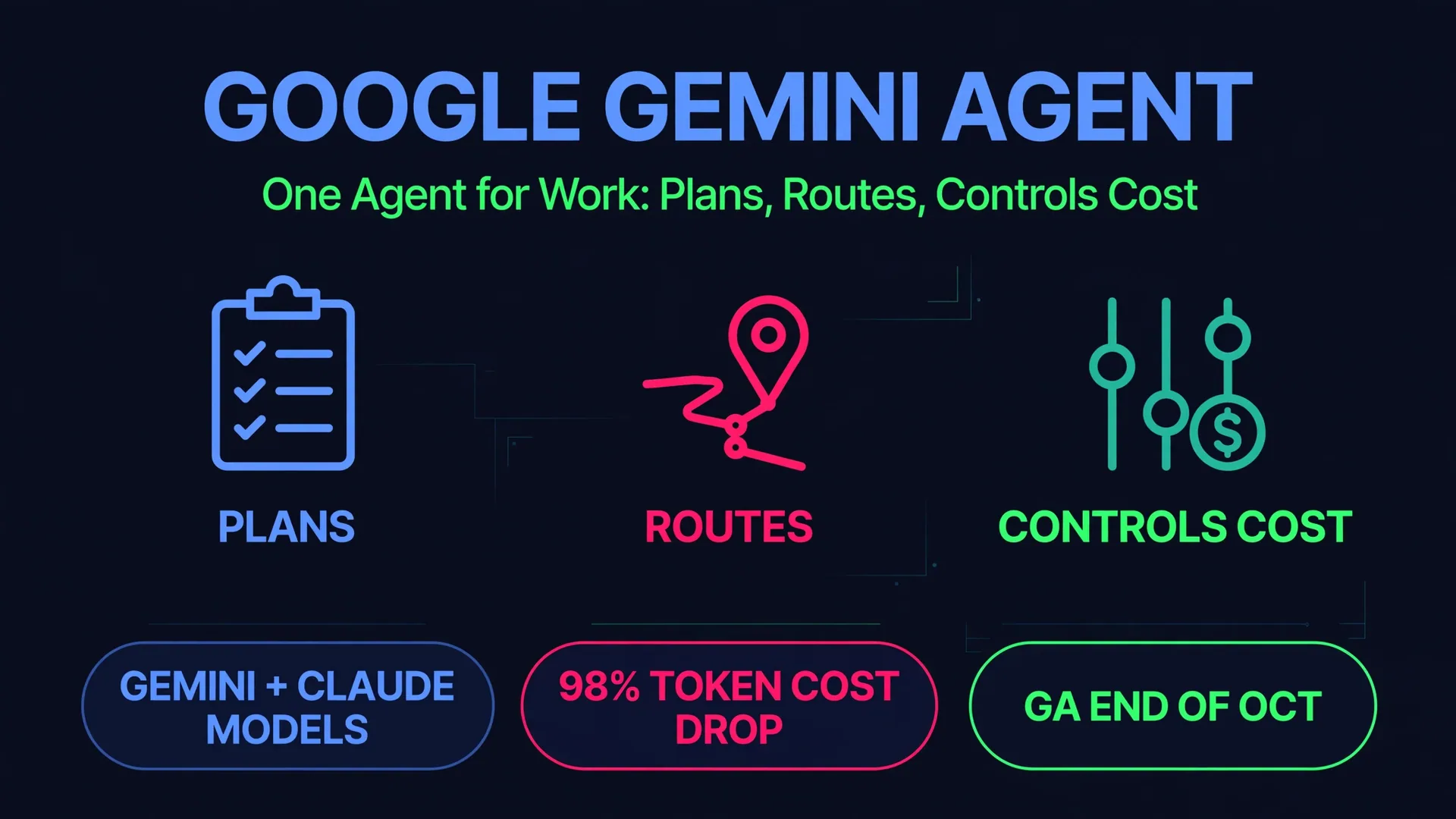
Here is the part that surprised everyone. The Gemini agent does not just run on Gemini models. Gemini is the agent, and the model underneath is a separate decision. It orchestrates across the Gemini family and Anthropic's Claude models today, with other closed and open models to follow.
Why? Economics. As Kurian put it, running every simple loop through a premium model quickly breaks corporate budgets. The routing logic matches the model to the job: the strongest model for hard work, the cheapest one that still gets it right for simple work. Google named PayPal as an early tester of this multi-model routing, reportedly routing 10 million multi-model requests per week.
Google has not said exactly which Claude models the agent can route to, or what the agent itself costs. What we know about the pieces:
| Model or pricing detail | What we know |
|---|---|
| Anthropic Claude Haiku 5.5 | $0.10 per million input tokens for short prompts, announced Oct 7, 2026 (vendor-reported) |
| Per-token prices overall | Down 98% since 2024, per Google Cloud |
| Gemini agent pricing | Consumption-based via Gemini Enterprise, no extra SKU |
| Spend control | Project-level caps set in Cloud Billing; the agent pauses when the cap is hit, resumes with one click |
The cost story: why Google is betting on caps
Agents are powerful, but their bills are unpredictable. One user request can trigger many model calls, tool calls, retries, and context retrievals. Cost grows independently of headcount, which terrifies CFOs.
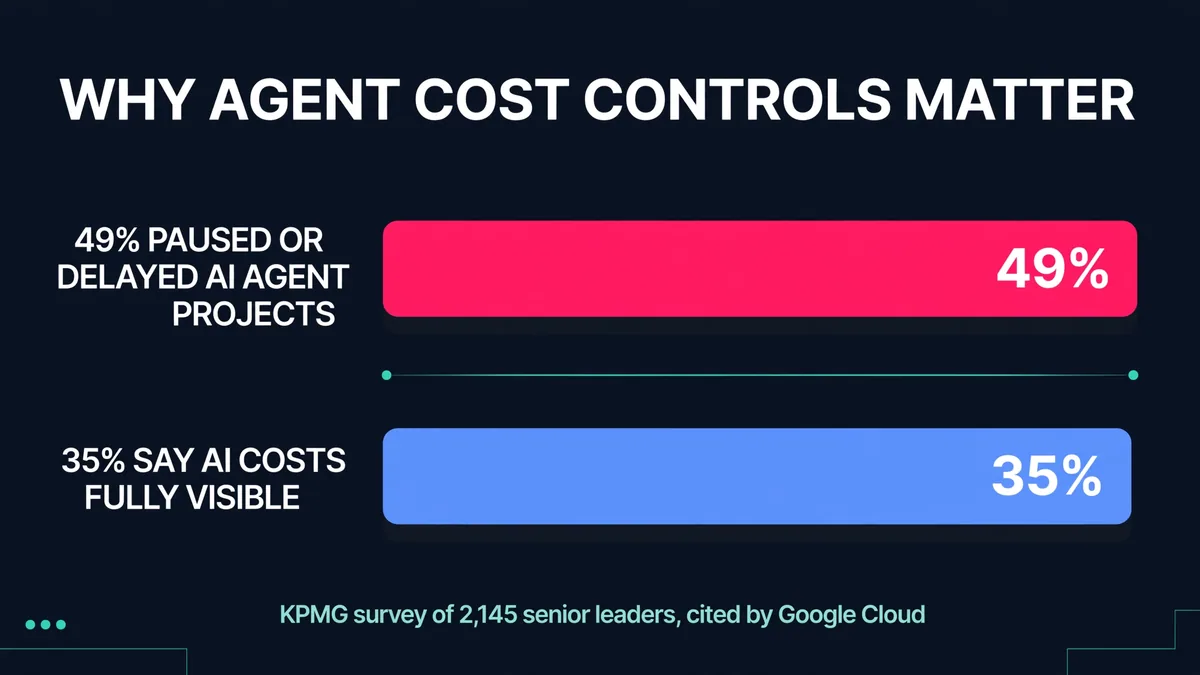
That fear is real in the data. A KPMG survey of 2,145 senior leaders found that 49% had narrowed, delayed, or paused AI agent deployments, with expected operating costs outrunning value as the main driver. Only 35% said their AI operating costs were fully visible and actively monitored.
Google's answer is three controls built into the platform:
- Multi-model orchestration picks the right model per job.
- Smart Routing triages workloads to the model delivering maximum performance at the lowest cost.
- Real-time spend caps set a hard monthly ceiling per project. When the cap is hit, that project's agent pauses automatically. Because tracking is per project, companies can charge AI costs back to specific departments.
Analysts at Constellation Research called the open model approach a standout: enterprises can bring LLMs they already trust and have already paid for into the automation scope of the Gemini agent, instead of being locked to one vendor's models.
The proof points (all vendor-reported)
Google's announcement came with customer claims from Gemini Enterprise deployments. Treat these as Google-reported, not independently audited:
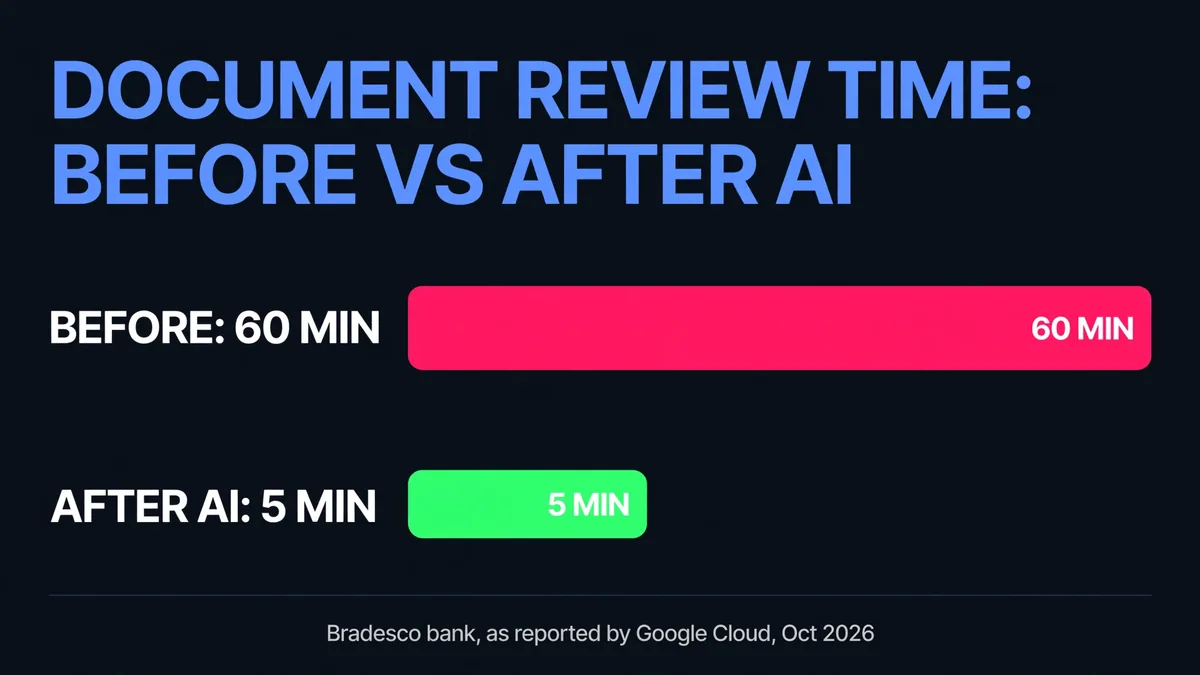
- Bradesco, the Brazilian bank, cut document review from one hour to five minutes and reduced risk inconsistencies by 60%.
- Bunnings (Wesfarmers) saved half a million hours of administrative work with an internal agent; shopping agents raised conversion at Kmart and Officeworks up to three times.
- Bloomberg Media lifted SQL query accuracy by 63% by grounding data agents in Google's Knowledge Catalog.
- Snap cut diagnostic troubleshooting from 30 minutes to 30 seconds.
- Google's own stats: nearly 80% of Google Cloud customers use its AI products, about 500 customers each processed over one trillion tokens in the past year, and nearly 90% of the Fortune 100 use Gemini Enterprise.
Gemini agent vs the other agent plays
Google is not first to the always-on agent race. It is answering two launches from September:
| Google Gemini agent | Meta Muse | OpenAI dots | |
|---|---|---|---|
| Announced | Oct 8, 2026 | September 2026 | September 2026 |
| Focus | Enterprise work across business systems | Personal AI agent: shops, books travel, sends email, makes payments | Always-on agents that chase goals across apps |
| Governance | Enterprise identity, sandbox, agent gateway, audit trails | Consumer product | Developer tooling |
| Cost story | Spend caps, smart routing, per-project chargeback | Not the focus | Not the focus |
Google's bet: the agent war for businesses will be won on governance and cost, not raw model power. Personal agents like Muse create shadow AI problems for IT departments; Google is positioning the Gemini agent as the governed alternative.
Who should care, and what to do next
If you run an SMB, you can apply for early access now. The SMB track comes with connectors to Asana, Box, Clay, Docusign, Dropbox, GitHub, LegalZoom, Notion, Salesforce, Shopify, Slack, and Wix, and roles like project manager, bookkeeper, inventory manager, or marketing consultant.
If you are in financial services or legal, industry packages with 50+ domain skills (drawing on FactSet, LSEG, S&P Global, and SEC filings for finance; NetDocuments and iManage permissions for legal) are in preview now. Government, healthcare, and retail versions are coming.
If you are a CTO or CFO, the real news is the cost model. Per-token prices have collapsed 98% since 2024, and the pricing conversation has moved from "how much does the model cost" to "how do we cap, route, and charge back agent spending." That is a budgeting conversation most companies have not had yet.
And if you are a growing business that wants this kind of automation without waiting for enterprise sales cycles, this is exactly what agencies like CodeMyPixel build: custom AI agents wired into your actual workflows. Google's launch validates the direction. The work starts in the prompt window, but the real value is everything behind it.
FAQs
What is the Google Gemini agent for work?
It is a single AI agent from Google Cloud, announced October 8, 2026, that plans tasks, uses company tools and data, and returns finished work across Workspace, Microsoft 365, Slack, and other surfaces. It can run autonomously in the cloud for hours or days.
Which models does the Gemini agent use?
It routes across the Gemini model family and Anthropic's Claude models today, with more closed and open models coming later. The idea is to match the cheapest capable model to each task.
How much does the Gemini agent cost?
Google has not published a price. It bills consumption-based through Gemini Enterprise with no separate SKU, and admins can set project-level spend caps that pause the agent when the monthly limit is hit.
When is the Gemini agent available?
Small and midsize businesses are in early access now. Analysts expect general availability around the end of October or early November 2026; Google itself only says "soon."
What is a coworker agent?
A persistent AI teammate with its own identity: its own email address, calendar, Drive, and directory listing. You @mention it in chat like a colleague, and it only sees the context explicitly shared with it.
How does the Gemini agent control AI spending?
Three mechanisms: multi-model orchestration picks the right model per job, Smart Routing triages work to the cheapest capable model, and real-time project spend caps in Cloud Billing pause the agent automatically when a monthly ceiling is reached.
Is the Gemini agent safe for enterprise data?
Google describes agent identities cryptographically attested and governed like employees, least-privilege permissions, full audit trails, an Agent Sandbox with its own network boundary, and an Agent Gateway described as an AI network firewall that enforces policies like "agents may not open documents classified Need to Know" in real time.
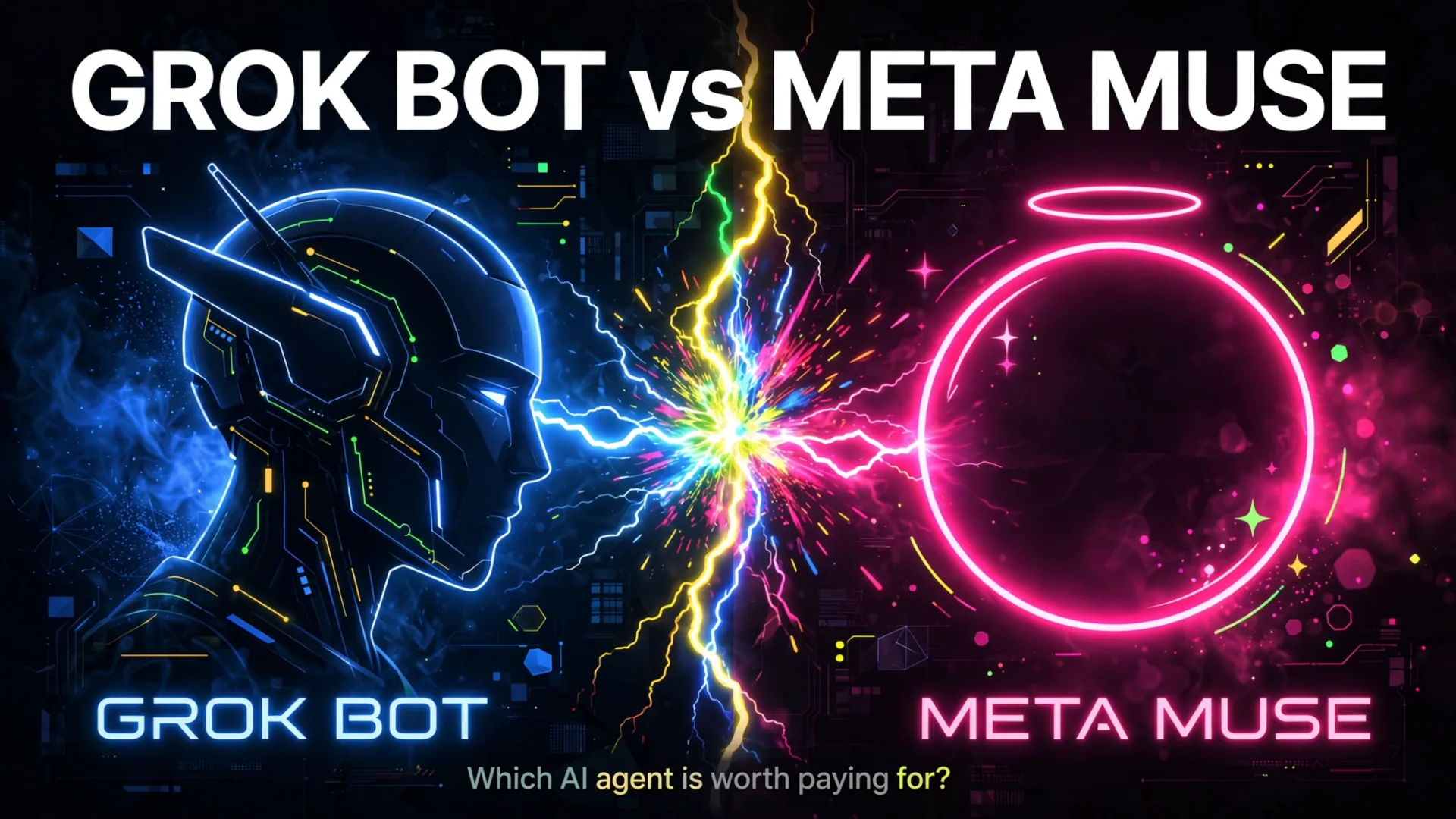
Want to see what the Google Gemini agent means for your team? Read our breakdown of Meta's enterprise agent platform or Grok Bot vs Meta Muse, and if you are ready to automate your own workflows, see our AI development services guide.
- Google Gemini agent
- AI agents
- Google Cloud
- enterprise AI
- AI cost control