KI6 Min. LesezeitVon JH Akash
Nvidia Wants Reflection AI: Inside the $25B Open-Weight Deal
Nvidia is reportedly in talks to acquire or invest deeper in Reflection AI, the open-weight lab behind the Beam model, valued at $25B.
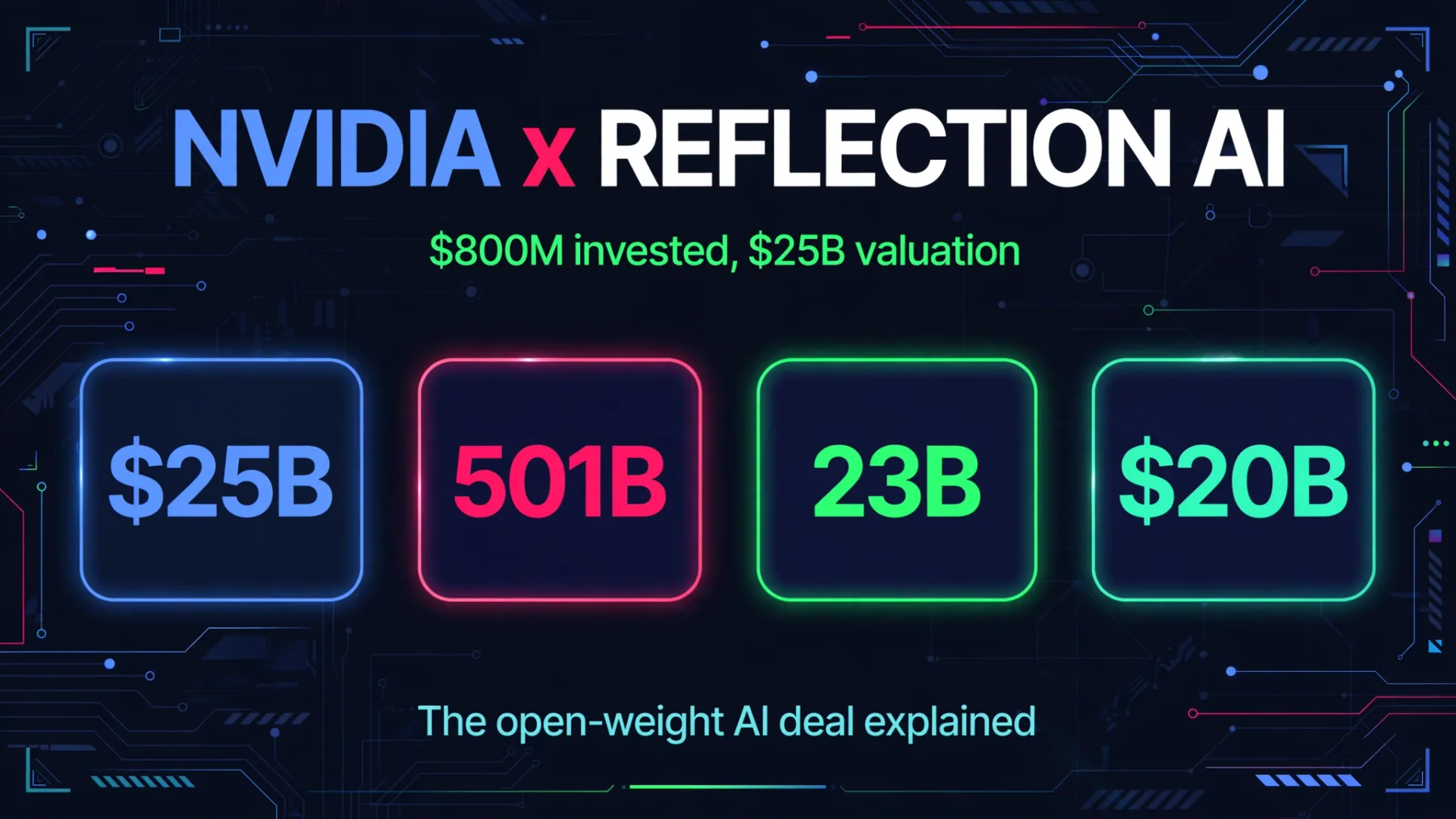
Nvidia is reportedly in early-stage talks to buy, invest deeper in, or acquihire Reflection AI, the open-weight AI lab it has already backed with a reported $800 million. The Financial Times broke the story on October 10, 2026, and Bloomberg, SiliconANGLE, Reuters, SBS, and the Seoul Economic Daily corroborated it within a day. No deal has been signed, and the talks could still fall apart, but the message is loud: Nvidia no longer wants to just sell the chips that train AI. It wants a seat at the model-development table itself.
Reflection AI is a Brooklyn startup founded in 2024 by former Google DeepMind researchers Misha Laskin and Ioannis Antonoglou, an AlphaGo co-creator. Its identity is open-weight models, the middle ground between fully closed systems like GPT-6 and Claude, and the open releases coming out of Chinese labs. It was last valued at $25 billion in a March 2026 funding round, and has raised roughly $4.7 billion per PitchBook, backed by Nvidia, Sequoia, and Lightspeed.
The story in 30 seconds
| Detail | |
|---|---|
| What | Nvidia reportedly in talks for a deeper Reflection AI deal |
| Reported | October 10, 2026 (Financial Times), corroborated October 11 |
| Options on the table | Full acquisition, added equity investment, acquihire, more chip supply |
| Status | No agreement, no terms, talks could collapse |
| Nvidia's existing stake | Reported $800 million investment |
| Reflection AI valuation | $25 billion (March 2026 round) |
The four possible deal structures
Reports describe four distinct paths, each leaving Reflection AI in a very different position:
| Structure | What it means for Reflection AI | What it means for Nvidia |
|---|---|---|
| Full acquisition | Becomes a wholly owned Nvidia subsidiary, loses independence | Owns the models, team, and IP; biggest capital commitment and regulatory exposure |
| Added equity investment | Stays independent, gains capital on top of the existing $800M stake | Deepens financial exposure without operational control, lowest regulatory friction |
| Acquihire | Core team and technology move to Nvidia, old entity winds down or pivots | Gets talent and IP license fast, sidesteps some acquisition scrutiny |
| Chips and compute supply | Gains more GPU capacity to keep training | Strengthens the hardware relationship without taking equity or ownership |
The acquihire option is the one to watch. It has become a familiar maneuver in AI dealmaking over the past two years, letting big tech absorb talent and technology while dodging some of the antitrust scrutiny a formal acquisition triggers. Nvidia used a similar approach in a large transaction involving Groq.
What Nvidia would be buying: Beam
On October 5, 2026, Reflection AI unveiled Beam, its first public model and the first American open-weight challenger aimed squarely at the Chinese labs that have dominated open-model downloads this year.
| Spec | Beam |
|---|---|
| Architecture | Sparse mixture of experts, text only |
| Total parameters | 501 billion |
| Active per token | 23 billion (4.6%) |
| Context window | 1 million tokens |
| Pretraining data | 23.8 trillion tokens |
| Training | Under 4 weeks on 6,144 Nvidia GB300 GPUs |
| Reinforcement learning | 10,500 GB300 GPUs, 100M+ rollouts, 1.3B evaluation sandboxes |
| License | Apache 2.0 weights promised later in October 2026 |
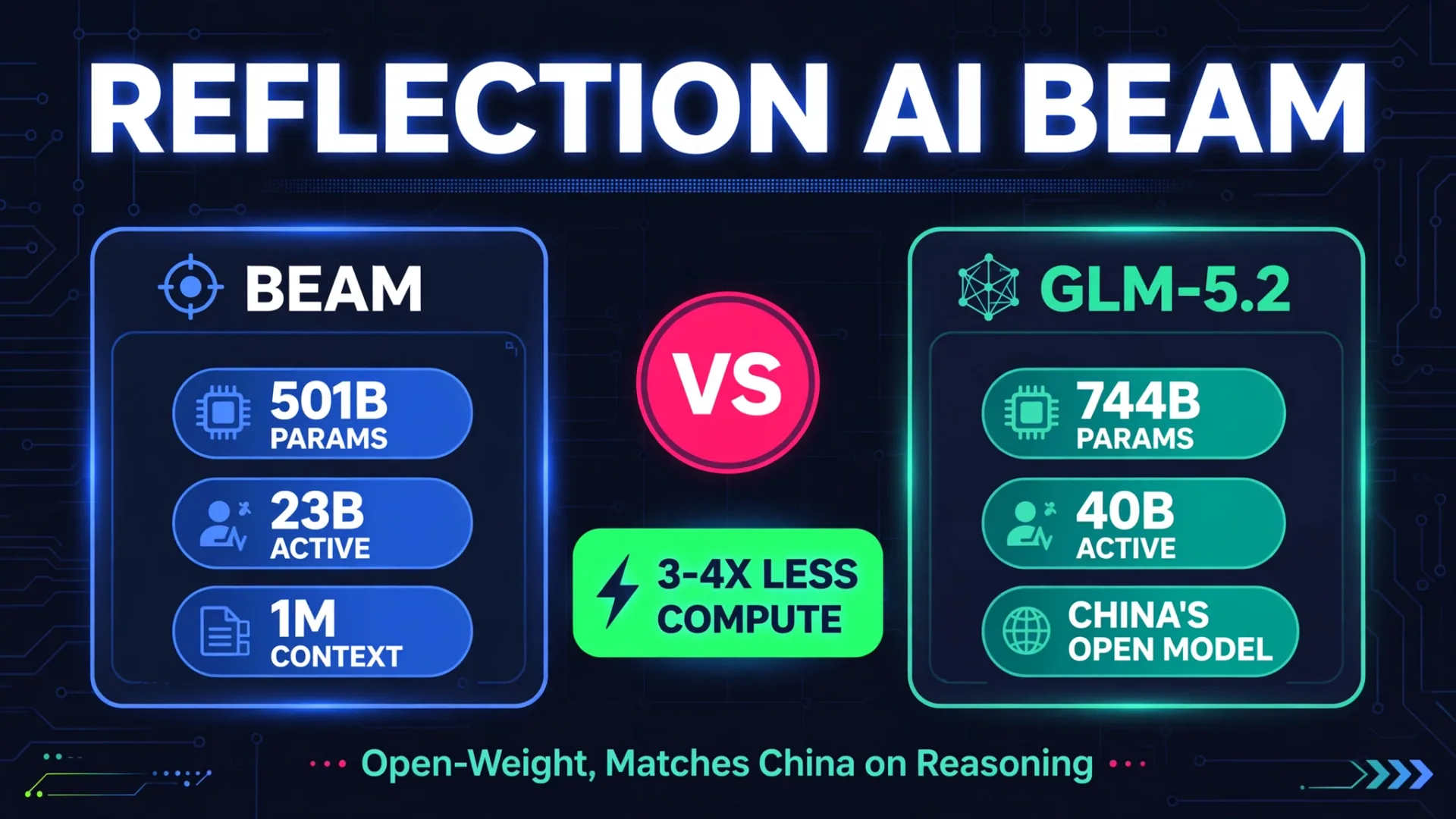
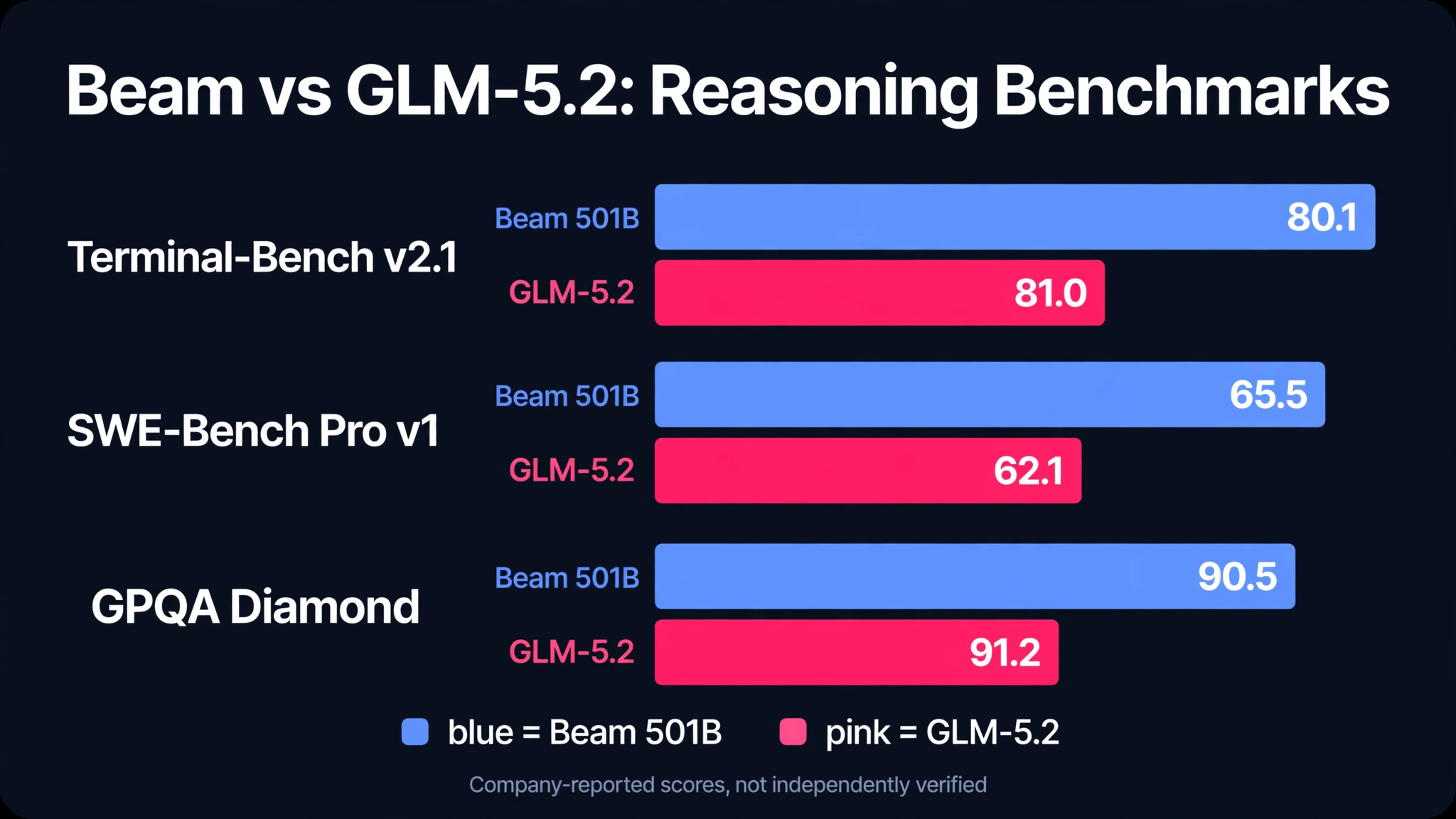
The headline is efficiency, not raw power. Reflection claims Beam matches Z.ai's GLM-5.2 (744 billion total, 40 billion active) on advanced reasoning benchmarks at roughly one quarter to one third the inference compute. Its own numbers also show Beam ahead of Thinking Machines' Inkling on coding tests and approaching Alibaba's Qwen 3.8-Max, though Moonshot AI's Kimi K3 still leads in Reflection's own table. All of these scores are company-reported and not yet independently verified; the weights are still going through red-teaming.
Beam vs GLM-5.2 benchmarks (company-reported)
| Benchmark | Beam 501B | GLM-5.2 |
|---|---|---|
| Terminal-Bench v2.1 | 80.1 | 81.0 |
| SWE-Bench Pro v1 | 65.5 | 62.1 |
| GPQA Diamond | 90.5 | 91.2 |
| Humanity's Last Exam (no tools) | 36.2 | 40.5 |
Why Nvidia wants this deal
A seat in model development, not just chip sales. Nvidia's core business is still chips, but which labs train on its hardware and software stack is now its competitive moat. Owning or partially owning an open-weight lab gives it influence over how a prominent open model is trained, tuned, and distributed.
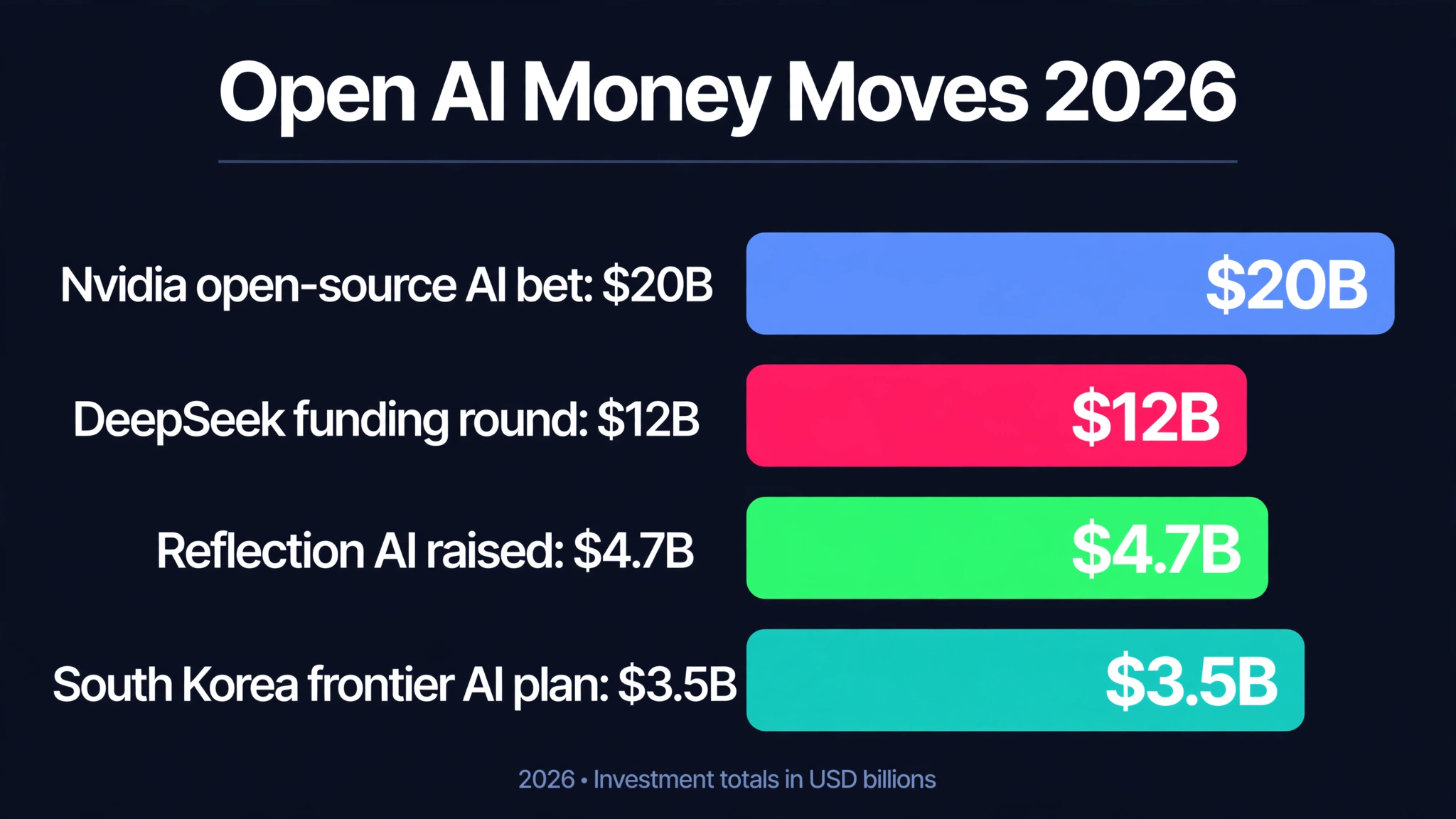
The China counter. Open-weight releases have become a US-China battleground. DeepSeek is reportedly near a $12 billion Tencent and CATL backed funding round after launching DeepSeek-V4.1-Flash, and Chinese labs like Z.ai, Moonshot, and Alibaba dominate open-model downloads. Nvidia has already committed a reported $20 billion to open-source AI initiatives to counter China's lead. An Nvidia-aligned open-weight model gives enterprises and governments a Western option that still runs on Nvidia hardware.
Government tailwinds. Reflection AI has partnered with the Pentagon and the Department of Energy, and the Trump administration has expressed interest in fostering US-based open-weight models that can compete with Chinese alternatives. That political cover makes the $25 billion valuation easier to defend.
The money map below shows just how much capital is flowing into the open-model race this year.
Who should care
If your business runs or plans to run open-weight models, this deal matters to you. If the talks lead anywhere, expect Nvidia-tuned open models optimized for Nvidia hardware, plus more predictable enterprise support and licensing around Beam. Watch the Apache 2.0 weight release promised later in October 2026: that is when independent developers can actually test Reflection's efficiency claims. If the release slips, or the scores do not replicate, the $25 billion price tag gets much harder to justify.
For investors, the absence of confirmed terms is itself a signal. When acquisitions are close to signing, leaked term sheets follow within days. The reporting is still at the "possible structures" stage, which means the two sides are working through fundamental questions about which path to take, not finalizing paperwork.
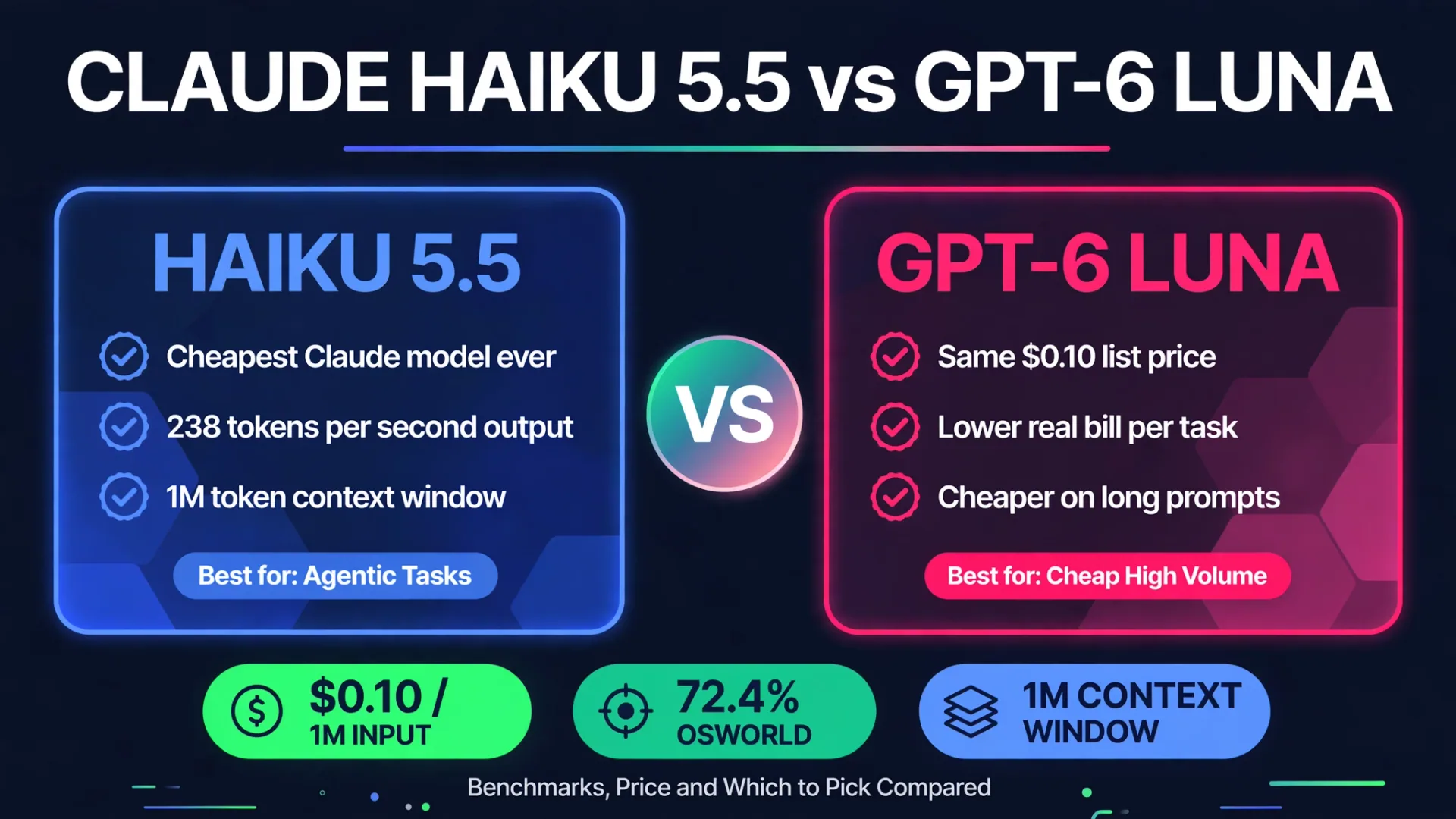
Related reads on our blog: Claude Haiku 5.5 vs GPT-6 Luna: The $0.10 Small-Model Showdown, Jev Explained: TypeSafe's AI Decision Model, Price and Rivals, and Google Gemini Agent: One AI Worker for Every Business Task.
FAQ
Is Nvidia buying Reflection AI?
Not confirmed. Nvidia and Reflection AI are in early-stage discussions covering a full acquisition, additional equity investment, an acquihire, or more chip supply. No agreement has been announced and no deal terms have been set. The talks could still end with no transaction.
How much has Nvidia already invested in Reflection AI?
Reports put Nvidia's existing investment at $800 million, making it one of Reflection AI's most significant backers before any talk of a deeper deal.
What is Reflection AI's Beam model?
Beam is a 501-billion-parameter sparse mixture-of-experts open-weight model, with 23 billion active parameters per token, a 1-million-token context window, and a text-only design focused on reasoning, coding, and agentic workloads. Reflection claims it matches Z.ai's GLM-5.2 on reasoning benchmarks at 3 to 4 times less inference compute, but these are company-reported scores, not independently verified.
When will Beam's weights be released?
Reflection said it will release Beam's weights under the Apache 2.0 license later in October 2026, along with a technical report and model card. An early version is currently available through a waitlisted beta API while red-teaming and evaluations finish.
What does open-weight mean?
Open-weight models let outside developers download and run the trained parameters themselves, even though the training data and methodology stay proprietary. That middle ground sits between fully closed systems like OpenAI's and Anthropic's models and fully open-source releases.
Why does Nvidia care about open-weight models?
Open-weight releases shape how enterprises and governments evaluate AI vendors outside the closed-model ecosystem. An Nvidia-aligned open-weight model keeps those workloads on Nvidia hardware and counters China's lead in open models, which is also why Nvidia reportedly committed $20 billion to open-source AI initiatives.
- Nvidia
- Reflection AI
- open-weight AI
- Beam
- AI investments
- DeepSeek