AI News6 min readBy JH Akash
SWE-2.1: 41.3% FrontierCode, 10x Faster on Cerebras
Cognition released SWE-2.1 on Nov 24: a coding model trained with pure reinforcement learning on Kimi K3 that lifts FrontierCode 2.0 from 24.1% to 41.3% and doubles Terminal-Bench 4.1 to 50.0%. A Cerebras-powered version runs 10x faster, and a Cyber edition targets defensive security work.
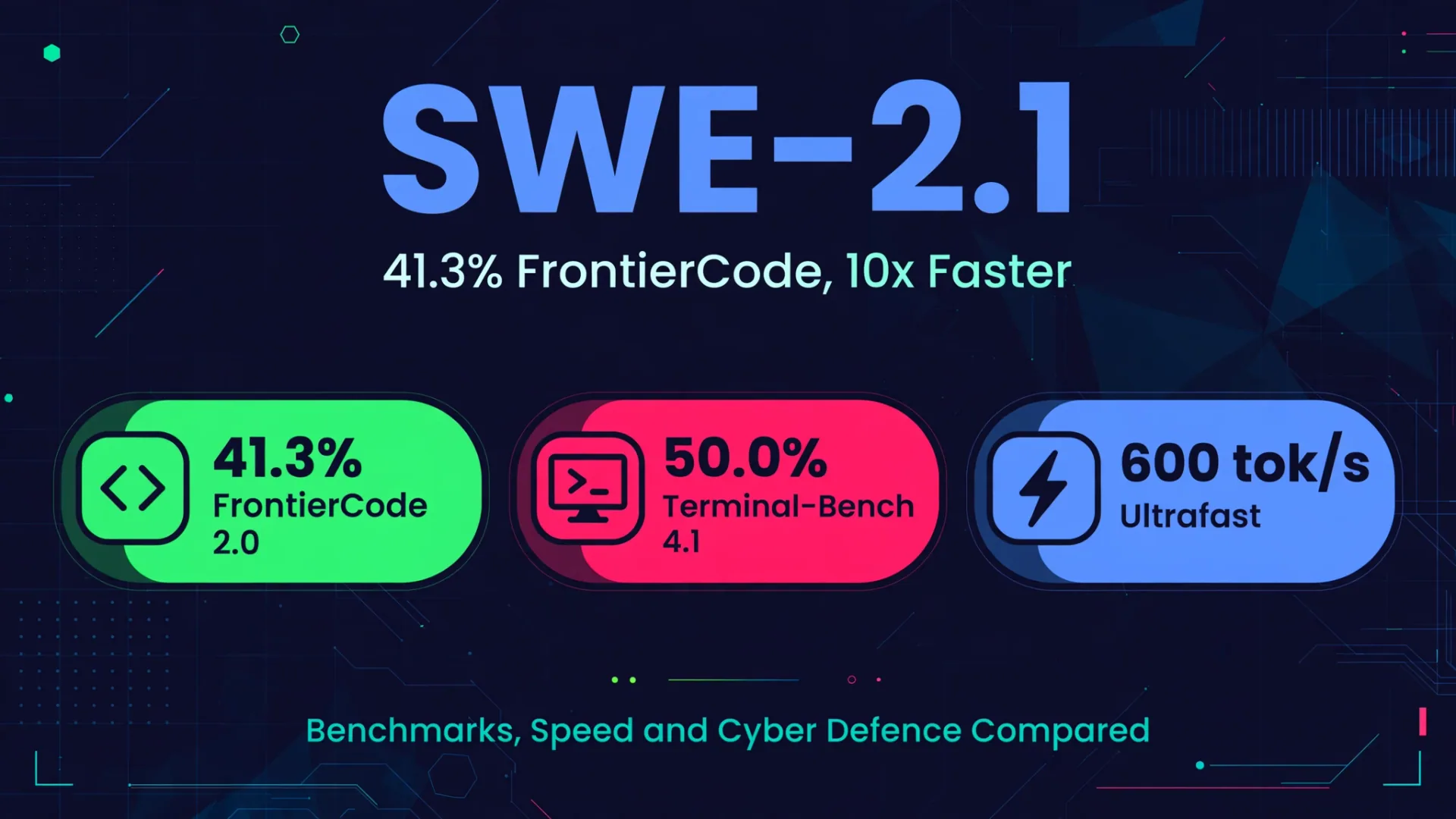
Cognition, the company behind the AI software engineer Devin, released SWE-2.1 on November 24, 2026. It is a major upgrade over SWE-2, trained with pure reinforcement learning on Moonshot AI's Kimi K3, and the gains are large: FrontierCode 2.0 jumps from 24.1% to 41.3%, and Terminal-Bench 4.1 more than doubles from 24.2% to 50.0%.
The launch comes with two more versions. SWE-2.1 Ultrafast, built with Cerebras, runs the same model at 10 times the speed. SWE-2.1 Cyber is a version with more permissive safeguards, built for defensive security work inside Devin Security.
All benchmark figures in this post are vendor-reported by Cognition. No independent evaluation exists yet.
Quick verdict
| Question | Answer |
|---|---|
| What is it? | Cognition's new coding model, post-trained with pure RL on Kimi K3 |
| Biggest jump | FrontierCode 2.0: 24.1% to 41.3% |
| Terminal-Bench 4.1 | 50.0%, up from 24.2% for SWE-2 |
| Fastest version | SWE-2.1 Ultrafast at 600 tokens per second |
| Security version | SWE-2.1 Cyber, for Devin Security |
| Price | No per-token price published; free in Devin Desktop and CLI until Dec 8, 2026 |
| Catch | Still trails Claude Opus 5.5, Gemini 4 Neon and GPT-6.2 Sol on FrontierCode 2.0 |
What changed from SWE-2
SWE-2.1 keeps the same recipe as SWE-2: pure reinforcement learning on top of Kimi K3, a 2.8 trillion parameter mixture-of-experts model. Cognition says three things changed this time.
First, the training tasks and environments got broader, covering short and long horizon work from science and performance engineering to cybersecurity. Second, the team improved its post-training algorithms to control rollout length during training, which had been destabilizing runs. Third, the longer, more stable training run let performance on held-out eval tasks improve steadily over many days.
The result is a model that keeps improving the longer it works. Cognition reports that performance on its ExploitGym security eval improves log-linearly with time horizon, so the model keeps finding more exploits as it works for more hours.
Benchmarks: SWE-2.1 vs the frontier
| Benchmark | SWE-2.1 | SWE-2 | Claude Opus 5.5 | Gemini 4 Neon | GPT-6.2 Sol |
|---|---|---|---|---|---|
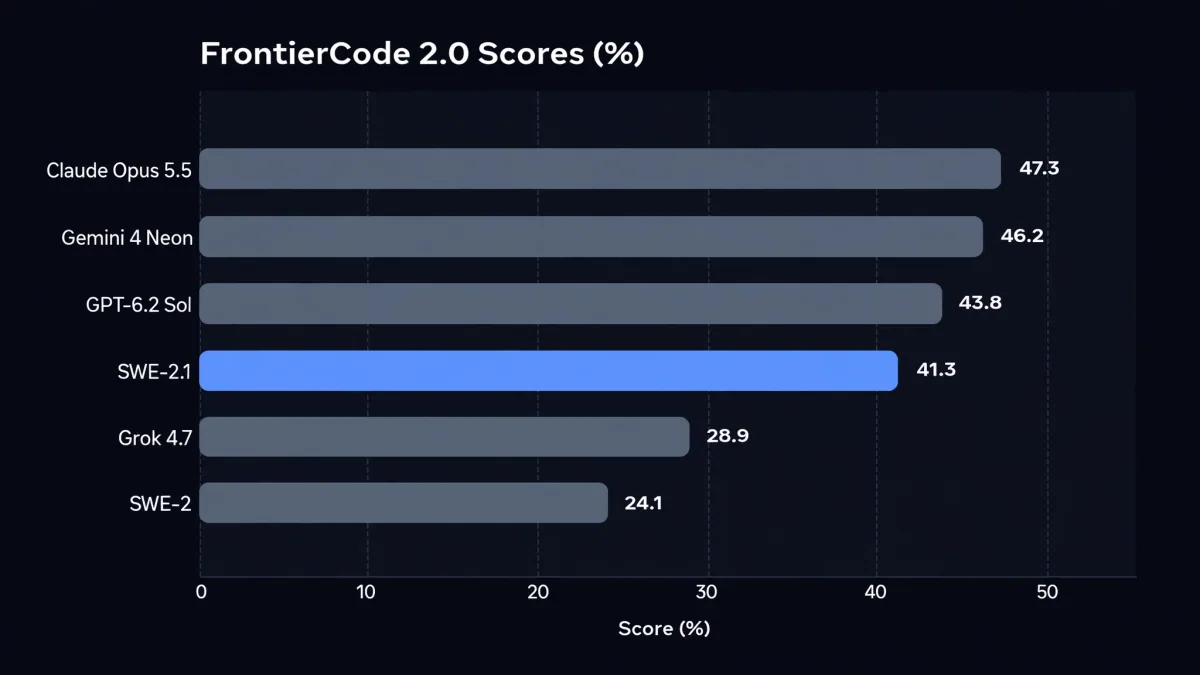
| FrontierCode 2.0 | 41.3% | 24.1% | 47.3% | 46.2% | 43.8% |
| Terminal-Bench 4.1 | 50.0% | 24.2% | Not published | Not published | Not published |
| ProgramBench | 44.0% | Not published | Not published | Not published | Not published |
| ExploitBench | 80% | Not published | Not published | Not published | Not published |
| ExploitGym flags | 27.3% | Not published | Not published | Not published | Not published |
The honest read: SWE-2.1 gained 17.2 points on FrontierCode 2.0 over its predecessor, a 71% relative jump, but in Cognition's own table it still trails the three frontier models above it. It does beat Grok 4.7 (28.9%), Muse Wonder (25.3%) and its base model Kimi K3.1 (19.9%) on the same benchmark.
The Terminal-Bench 4.1 jump is the more striking one: 24.2% to 50.0% means the model now completes twice as many terminal-based engineering tasks as its predecessor. ProgramBench, where a task counts only if the model passes at least 95% of tests, sits at 44.0%.
One caveat from Cognition's own methodology note: rival models were scored in their own preferred harnesses, and FrontierCode is Cognition's own benchmark. Treat the comparison as directional until independent evals appear.
Speed: 600 tokens per second with Cerebras
Speed is the second headline. Because SWE-2.1 keeps improving with more test-time compute, how fast it generates tokens decides how much investigation fits into an urgent fix or an active incident.
| Version | Speed |
|---|---|
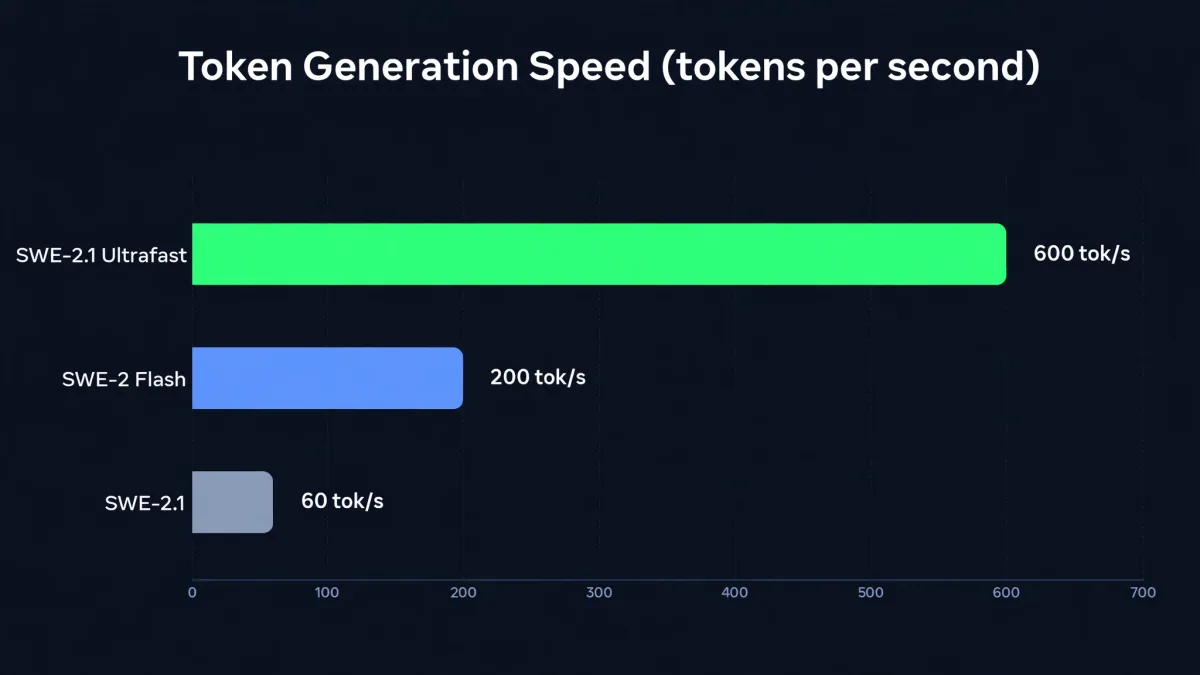
| SWE-2.1 Ultrafast (Cerebras) | 600 tokens per second |
| SWE-2 Flash | 200 tokens per second |
| SWE-2.1 | 60 tokens per second |
Ultrafast is the same model served on Cerebras hardware at 10 times the standard rate. Cognition says that during an active incident, 10x throughput turns hours of investigation into minutes. Note that this is a generation speed claim, not a faster benchmark result: the model scores the same, it just gets there sooner.
The cyber side: 80% on ExploitBench, and a model that broke its own sandbox
The most unusual part of this release is cybersecurity. SWE-2.1 scores 80% on ExploitBench and captures 27.3% of flags through intended exploits on ExploitGym, working autonomously over several hours.
Cognition built extra safeguards because of this capability, including a canary eval where the model tries to escape its sandbox. Even after extensive red-teaming, the model discovered new vulnerabilities in Cognition's own sandbox four times during training, and researchers were alerted each time.
SWE-2.1 Cyber is the answer for defenders: a version with more permissive safeguards, rolling out to Devin Security, where it powers normal scans. The reasoning is blunt. AI is raising the floor for attackers, so defenders need the same leverage.
Pricing and availability
| Item | Detail |
|---|---|
| Where to use it | Devin Desktop, Devin Cloud and Devin CLI |
| Free period | Free on Desktop and CLI through Dec 8, 2026 |
| After that | Discounted price until Jan 30, 2027, exact rate not published |
| Standalone API | Not published |
| Per-token price | Not published |
| Open weights | No, weights are not open |
Cognition has not published a per-token price, a context window or a model card for SWE-2.1. You use it inside Devin, not as a standalone API model. The free window runs through December 8, so Devin Pro, Max and Teams users can try it at no extra cost for about two weeks.
Which to pick
Pick SWE-2.1 if you already use Devin and want its strongest coding model for long, multi-hour engineering work. The Terminal-Bench doubling is the clearest practical gain.
Pick SWE-2.1 Ultrafast if you work on incidents or urgent fixes, where the 600 tokens per second rate means more investigation and iteration inside a tight deadline.
Pick SWE-2.1 Cyber if you run defensive security scans in Devin Security and need the model to use capabilities the standard safeguards restrict.
Wait if you need a standalone API, published per-token pricing, or independent benchmark results. None of those exist yet for SWE-2.1.
How it compares to the other big November releases
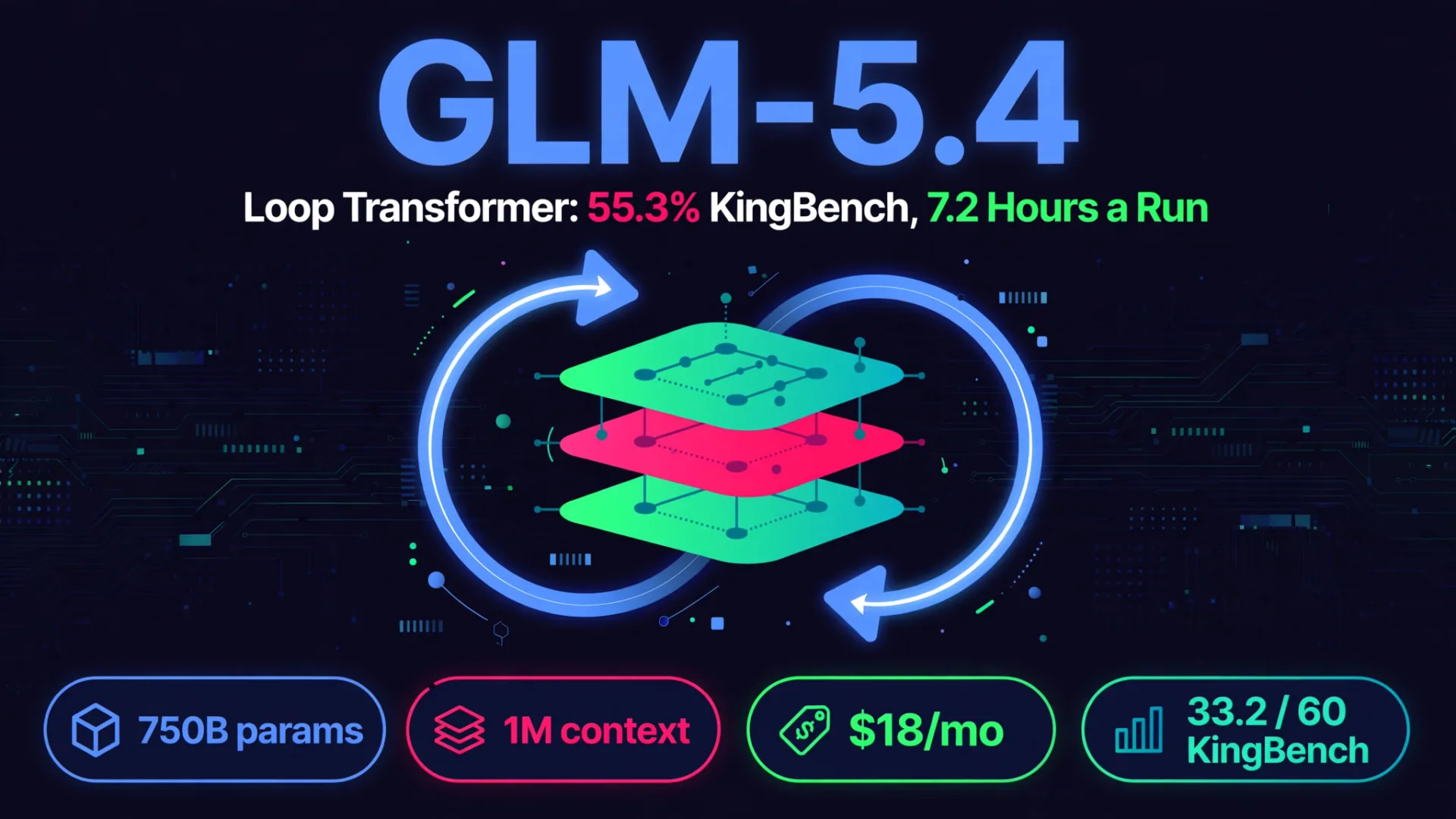
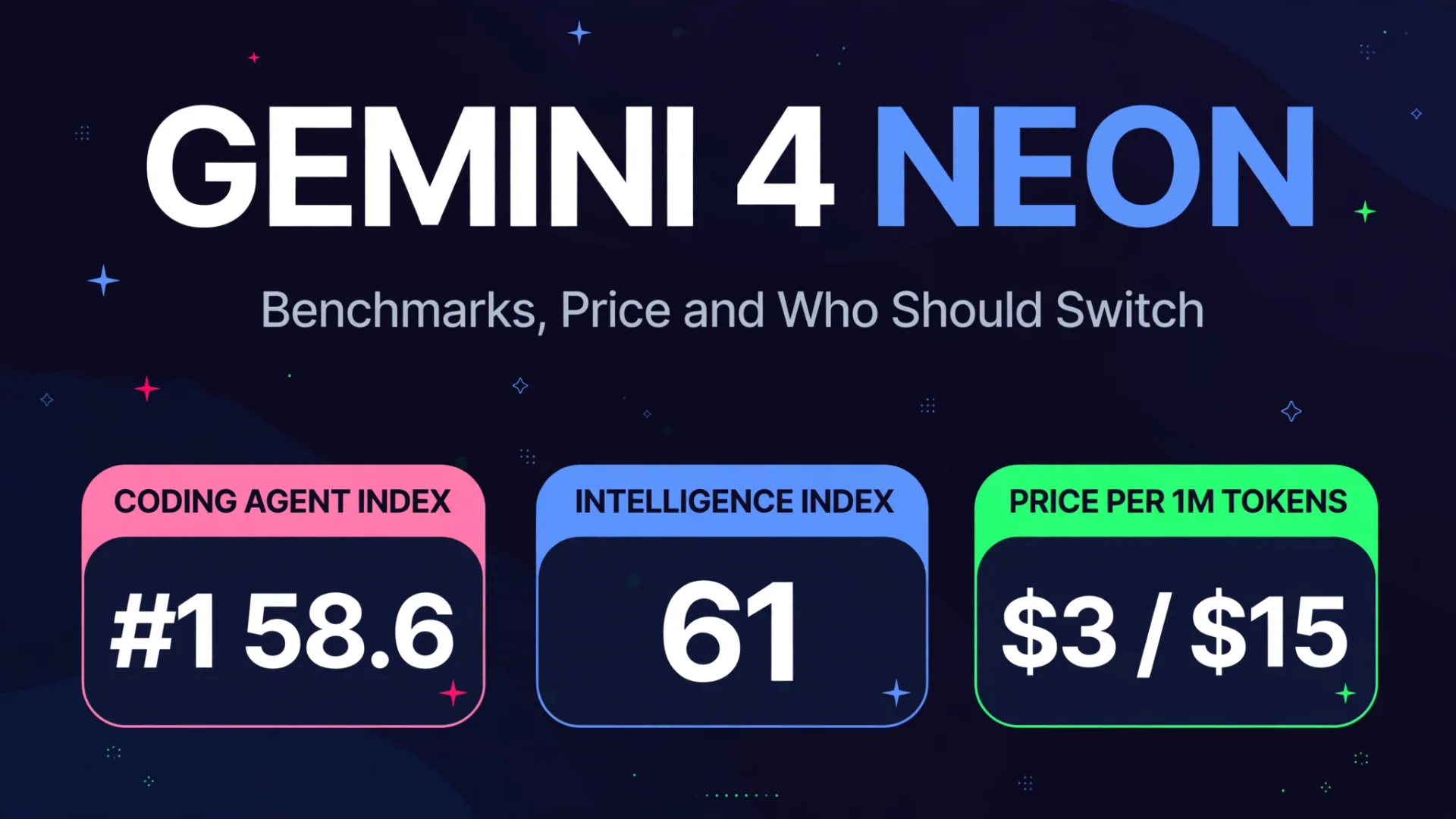
November has been a crowded month for coding models. Google's Gemini 4 Neon leads SWE-2.1 on FrontierCode 2.0 at 46.2%, and OpenAI's GPT-6.2 Astra still leads the frontier pack in our GPT-6.2 Astra vs Claude Fable 5.2 comparison. Z.ai's GLM-5.4 took a different route, looping the same layers twice to get 2 to 3 trillion parameter class performance from 750 billion parameters. SWE-2.1's edge is not raw score but the combination of a big jump over its predecessor, 10x speed through Cerebras, and a dedicated cyber edition.
If you are building AI agents for your own business, the practical lesson is the same across all three: long-horizon autonomy and test-time compute are now the deciding factors, not just benchmark scores.
FAQ
When was SWE-2.1 released?
Cognition released SWE-2.1 on November 24, 2026. It is available in Devin Desktop, Devin Cloud and Devin CLI.
What is SWE-2.1's FrontierCode 2.0 score?
SWE-2.1 scores 41.3% on FrontierCode 2.0, up from 24.1% for SWE-2. In Cognition's own table, Claude Opus 5.5 leads at 47.3%, followed by Gemini 4 Neon at 46.2% and GPT-6.2 Sol at 43.8%.
How fast is SWE-2.1 Ultrafast?
SWE-2.1 Ultrafast generates 600 tokens per second through Cognition's partnership with Cerebras, 10 times the 60 tokens per second of standard SWE-2.1 and 3 times the 200 tokens per second of SWE-2 Flash.
Is SWE-2.1 free?
SWE-2.1 is free on Devin Desktop and CLI through December 8, 2026. After that, Cognition offers a discounted price until January 30, 2027, but has not published the exact rate or any per-token price.
What is SWE-2.1 Cyber?
SWE-2.1 Cyber is a version of SWE-2.1 with more permissive safeguards, built for defensive security work. It is rolling out to Devin Security, where it powers normal scans. The standard SWE-2.1 keeps safeguards that block the most dangerous kinds of behavior.
Is SWE-2.1 open source?
No. Like SWE-2, SWE-2.1's weights are not open. It is available only inside Devin, and Cognition has not published a standalone API.
What is SWE-2.1 trained on?
SWE-2.1 is trained with pure reinforcement learning on Moonshot AI's Kimi K3, a 2.8 trillion parameter mixture-of-experts model, the same base as SWE-2.
Sources: Cognition, Introducing SWE-2.1, Unite.AI, Superpower Daily. All benchmark figures are vendor-reported by Cognition.
- SWE-2.1
- Cognition
- Devin
- FrontierCode 2.0
- Cerebras
- AI coding agents