AI4 min readBy JH Akash
OpenAI Decisions API Explained: What GA Means for AI Agents
OpenAI made its Decisions API generally available on Oct 22, 2026. Powered by GPT-6 Luna, it returns probabilities, choices, and scores up to 10x faster, priced from $0.10 per 1M tokens. Pricing, benchmarks, and when to use it.
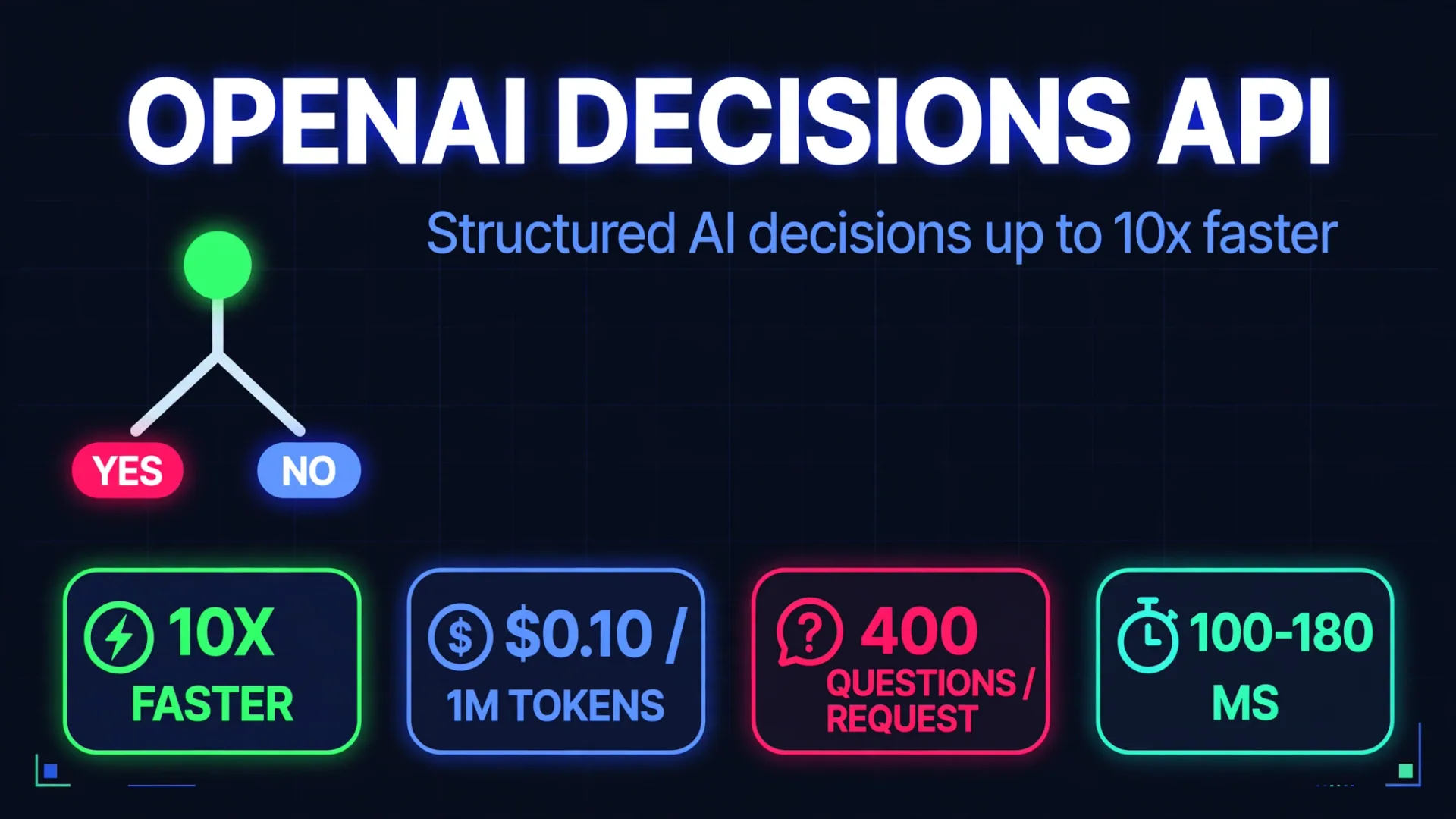
OpenAI has made its Decisions API generally available, a developer interface powered by GPT-6 Luna that returns probabilities, choices, and scores instead of paragraphs of text. OpenAI says it can deliver those decisions up to 10 times faster than GPT-6 Luna through the Responses API, with input pricing starting at $0.10 per 1 million tokens. Here is what changed in the October 22, 2026 GA release, what it costs, and whether your app should use it.
The quick verdict: Responses API vs Decisions API
| Aspect | Responses API | Decisions API |
|---|---|---|
| Output | Open-ended text | Probability, choice, or score |
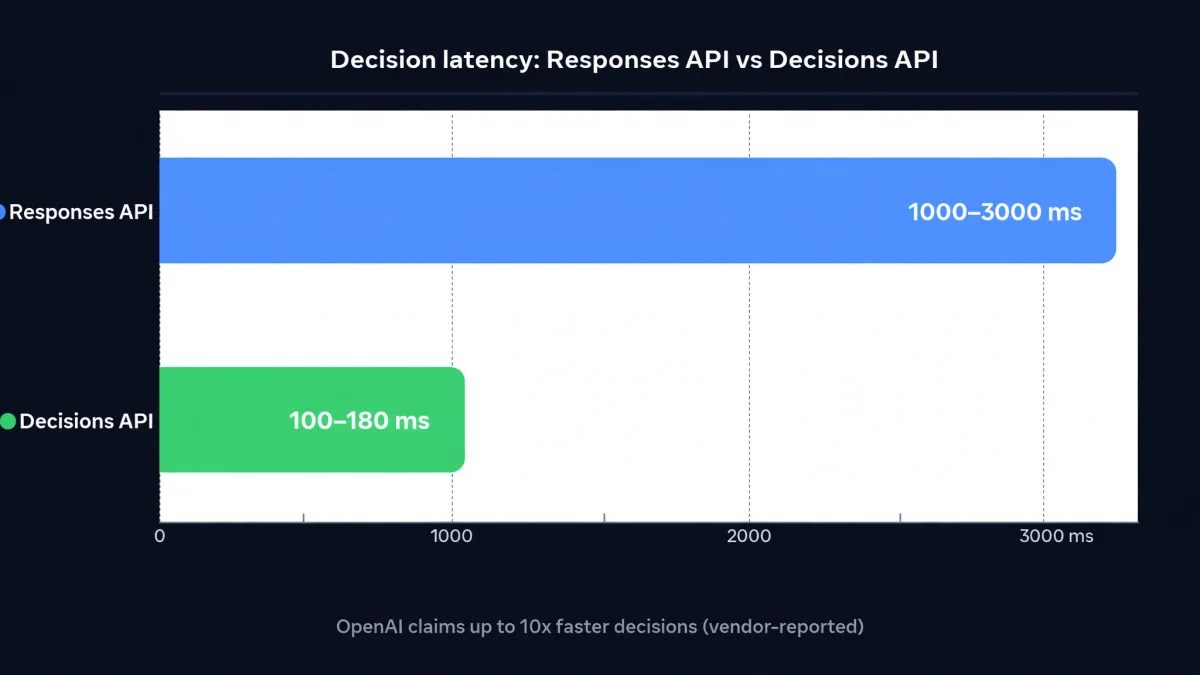
| Typical decision latency | 1 to 3 seconds | 100 to 180 ms (vendor-reported) |
| Input pricing | Standard GPT-6 Luna rates | $0.10 per 1M input tokens |
| Best for | Reasoning, explanation, tool use | High-volume classification, routing, scoring |
What changed in the GA release (October 22, 2026)
The Decisions API had a public beta before the GA announcement, and the generally available version doubles the key limit and adds production features:
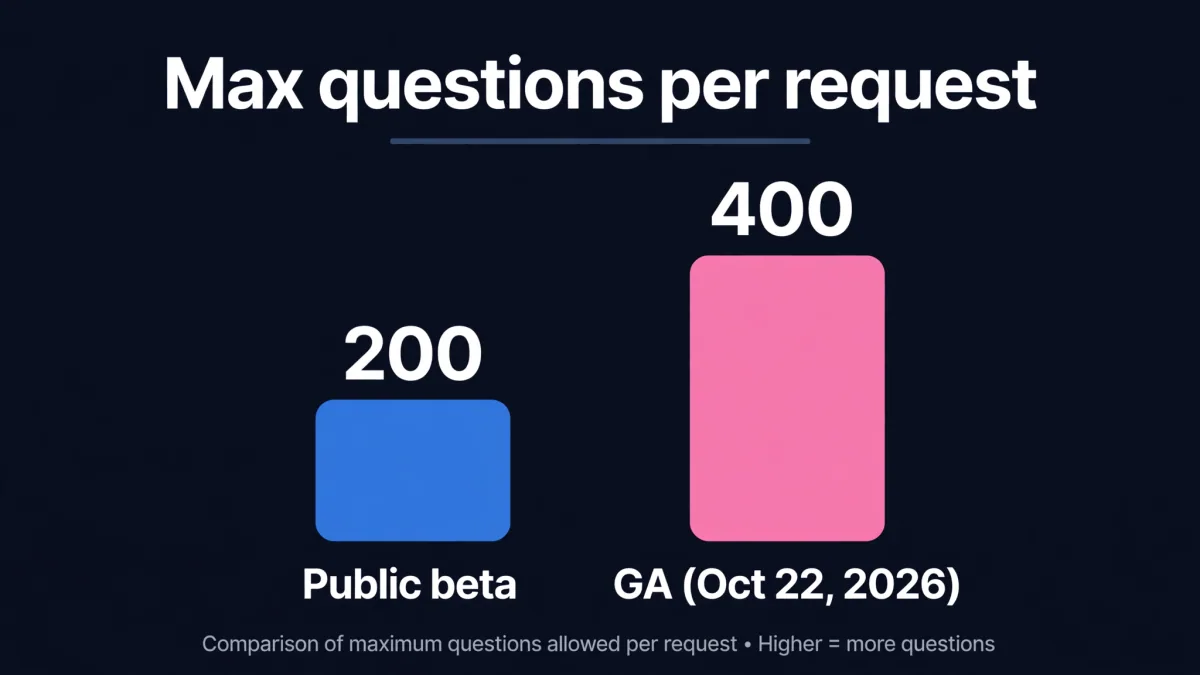
- 400 questions per request, up from 200 in the public beta
- Prompt caching, with cached input priced at $0.01 per 1M tokens
- Native GPT-Live integration, so live voice apps can trigger decisions as transcripts arrive
- Structured JSON input, plus images inside text instructions or individual question instructions
- Inference residency in the US and EU, with Zero Data Retention available for eligible customers
- A dedicated
/v1/decisionsendpoint and a Decisions Playground for experimenting before integration
How it works: the three decision types
Developers supply three things: the information to evaluate, the questions to answer, and the allowed output format. The API supports three decision types.
| Decision type | What it returns | Example |
|---|---|---|
| Predicate | Probability that a condition is true | Estimate whether a package looks damaged |
| Choice | One selection from predefined options | Route a support ticket to billing or technical support |
| Score | Score against ordered levels | Rate an issue as minor, moderate, or severe |
For choice and score questions, the API also returns probability information and a confidence measure, so teams can automate confident cases and send uncertain ones to a human reviewer. A structured response does not guarantee a correct decision: OpenAI and its customers both stress that developers must test their questions, measure accuracy, and set sensible thresholds.
Pricing
| Component | Price |
|---|---|
| Uncached input | $0.10 per 1M tokens |
| Cached input | $0.01 per 1M tokens |
| Output tokens | No separate output-token charge |
Cache writes, regional processing premiums, and long-context pricing rules can affect the final bill, so check the official pricing guide before estimating production costs.
The speed story, in numbers
OpenAI's API product lead, Nikunj Handa, told TechCrunch the company cut decision response times from one to three seconds down to approximately 100 to 180 milliseconds. OpenAI claims the API can be up to 10 times faster than GPT-6 Luna through the Responses API, and believes further optimization could reach around 60 milliseconds.
Early customers have published their own results. Treat these as customer-reported, not independent benchmarks:
| Company | Reported result |
|---|---|
| Box | About 5x faster route selection across 30 certificates of insurance, with accuracy matching the Responses API approach |
| Datadog | 40x faster 95th-percentile latency for a command-risk scoring workflow versus available frontier models |
| Speak | Time between AI actions fell from 1.4 seconds to 0.13 seconds, an improvement of more than 90 percent |
The competition is moving too
OpenAI is not alone in the decision-model race. TypeSafe, the startup behind the Jev decision model, recently reached a valuation of about $7.6 billion and has expanded Jev with image support and conditional decision-making. Liquid (D1 Ultra) and Base Lab (Elephant-1) are also shipping competing models. On two public decision benchmarks reported in the launch coverage, TypeSafe Jev ranked 7th and 3rd while OpenAI's decision model ranked 8th and 14th. Rankings shift as benchmarks update, so treat them as a snapshot, not a final verdict.
Which one should you use?
Use the Decisions API when your workload is high-volume, repeatable, and latency-sensitive: classifying transactions, routing support tickets, scoring risk, or deciding an AI agent's next action. Stick with the Responses API when you need explanations, open-ended generation, reasoning chains, or flexible tool use. Many production systems will use both, with decisions handled by the Decisions API and everything else on the Responses API.
If you are building agent workflows, this is exactly the kind of plumbing that matters. CodeMyPixel builds custom AI agent development solutions and full AI automation systems for teams that need models doing real work, not just generating text. For model context, see our breakdowns of GPT-6 Astra and Claude Opus 5.5.
FAQ
What is OpenAI's Decisions API?
A developer interface that uses GPT-6 Luna to evaluate text, images, and structured data, returning probabilities, predefined choices, or scores that applications can act on directly.
Is the Decisions API really 10 times faster?
OpenAI says it can be up to 10 times faster than GPT-6 Luna through the Responses API. That is a vendor-reported maximum, not a guarantee. Actual latency depends on input size, question complexity, network conditions, and workload. Customer-reported results (Box at 5x, Datadog at 40x p95, Speak cutting 1.4s to 0.13s) are specific to their evaluations.
How much does the Decisions API cost?
Published base pricing is $0.10 per 1M uncached input tokens and $0.01 per 1M cached input tokens, with no separate output-token charge. Cache writes and regional premiums may add cost.
Can the Decisions API replace the Responses API?
Not for every task. It is built for focused classification, selection, and scoring. The Responses API remains the right choice for open-ended text generation, reasoning, and tool-driven workflows.
When did the Decisions API become generally available?
October 22, 2026, after a public beta. The GA release doubled the per-request question limit from 200 to 400 and added prompt caching, native GPT-Live integration, and structured JSON input.
- openai decisions api
- gpt-6 luna
- ai agents
- openai api pricing
- llm latency