ИИ9 мин чтенияАвтор JH Akash
Meta Muse Spark Open Explained: 816B Open-Weight Model, Benchmarks, License, and Mac Studio Setup
Meta released Muse Spark Open on October 15, 2026: an 816 billion parameter open-weight model built for coding and agentic work. It leads JobBench and MCP-Atlas, trails Chinese rivals on pure coding benchmarks, and runs on two Mac Studios.
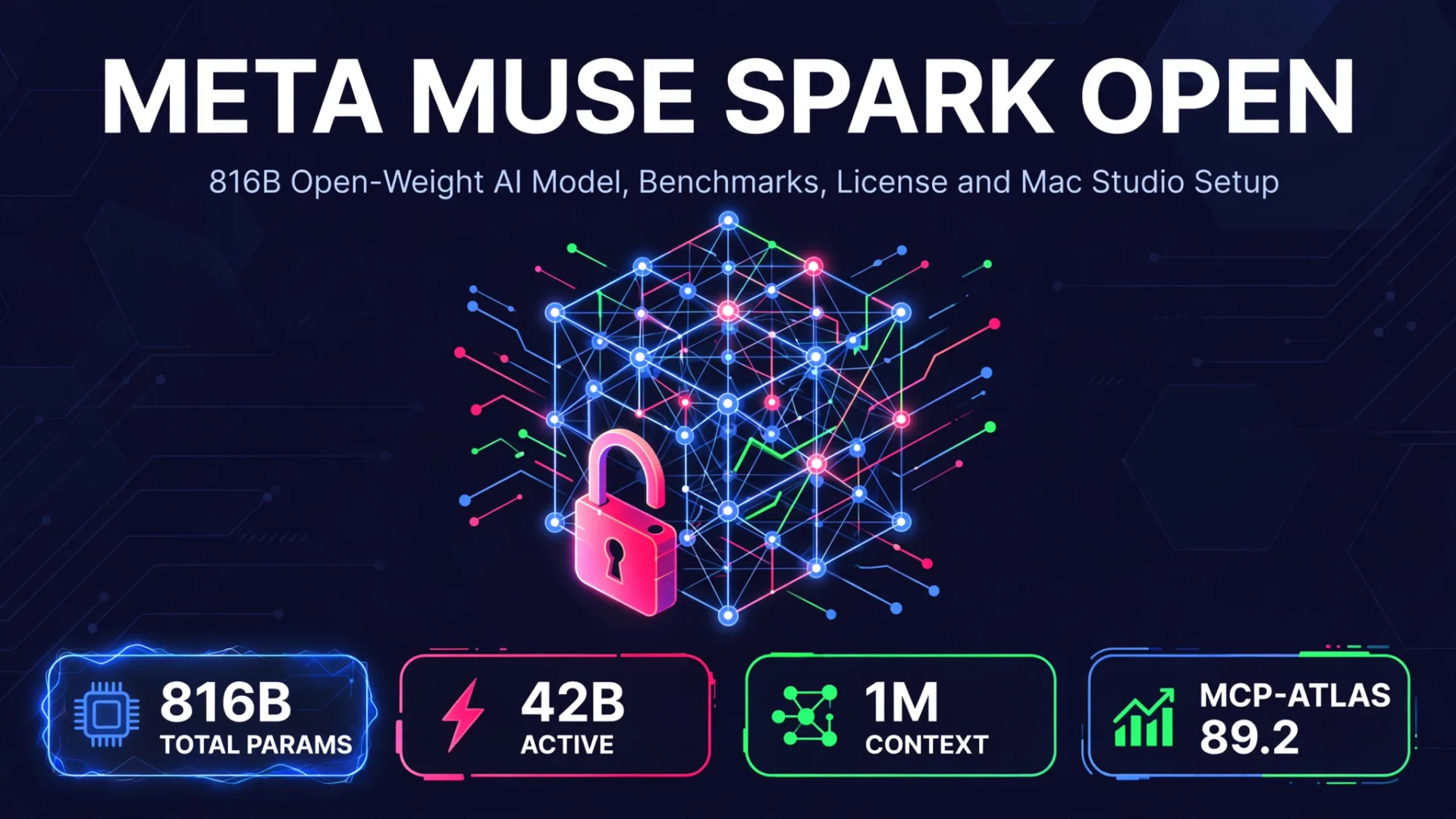
Meta released Muse Spark Open on October 15, 2026, and it is the biggest open-weight release of the year so far. The model has 816 billion total parameters, a 1 million token context window, and native support for text, image, video, and audio. Meta calls it the most capable US open-weight model to date, and it is built for one job above all others: coding and long-running agentic work.
The release matters because the open-weight race has been led by Chinese labs for the past two years. Alibaba's Qwen, Moonshot AI's Kimi, and Z.ai's GLM models set the pace while US labs kept their best models closed. Muse Spark Open is Meta's answer, and its benchmark results tell a split story. It leads on agentic and tool-use tests, but still trails its Chinese rivals on pure coding benchmarks. Here is what the numbers actually say.
Quick verdict
| Question | Answer |
|---|---|
| What is it? | Open-weight AI model for coding and agentic work |
| Released | October 15, 2026 |
| Parameters | 816B total, 42B active per token (mixture-of-experts) |
| Context window | 1 million tokens |
| Inputs | Text, image, video, audio |
| Best at | Agentic workflows, tool use, multi-step tasks |
| Weakest at | Pure coding benchmarks vs Kimi K3, GLM 5.3, Qwen3.8 |
| License | Muse Model License, free for most developers, with conditions |
| Download | Hugging Face, AWS SageMaker, Google Cloud Model Garden, Microsoft Foundry |
What Muse Spark Open is
Muse Spark Open is the open-weight version of Muse Spark, the model behind the Meta AI assistant. The closed flagship, Muse Spark 1.2, shipped in August 2026. Meta took that model, added safety post-training so it holds up without the guardrails of Meta's own services, and released the weights for anyone to download and run.
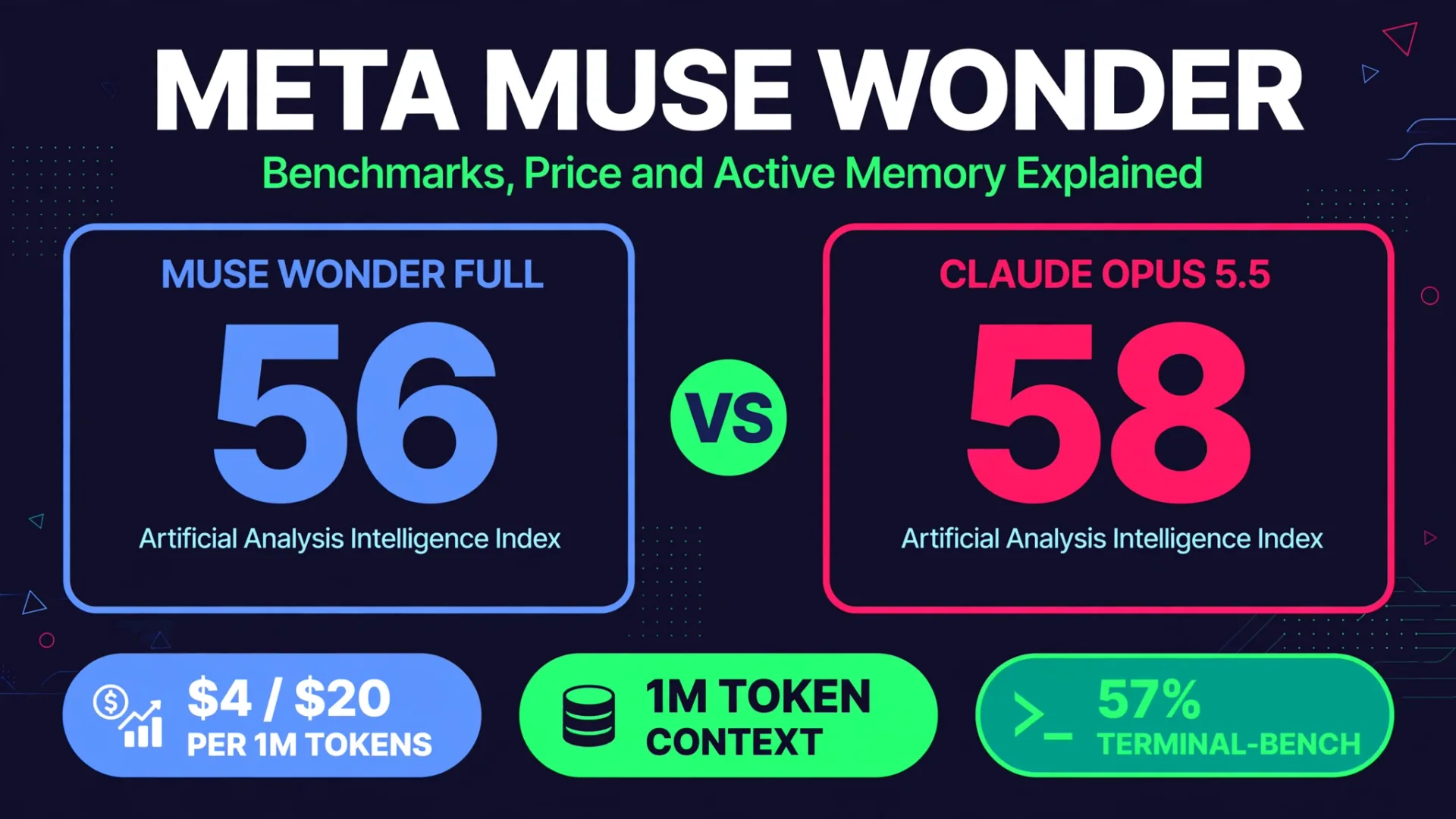
This is a return to open weights for Meta. Its previous open-weight release was Muse Glimmer, a much smaller 30 billion parameter model released in August. Meta's most capable systems remain closed: the Muse Wonder models launched on October 12, 2026 are available only through the Meta Model API and Muse Code. If you want to see how the closed flagship compares, read our breakdown of Meta Muse Wonder.
Open-weight does not mean fully open source. You can download the weights, adapt the model, and host it yourself. Meta does not publish the training data or the full training code. The release also comes under a new Muse Model License, not a permissive license like Apache-2.0. More on that below.
Specifications
| Spec | Muse Spark Open |
|---|---|
| Total parameters | 816 billion |
| Active parameters per token | 42 billion |
| Architecture | Mixture-of-experts (MoE) |
| Context window | Up to 1,000,000 tokens |
| Modalities | Text, image, video, audio in; text out |
| Built for | Coding, long-horizon tasks, multi-step reasoning, tool use |
| Weight formats | Full BF16 (about 1.6 TB), compressed NVFP4 (about 530 GB), smaller community formats |
| Inference engines | SGLang, vLLM, TensorRT-LLM, Transformers, Apple MLX, llama.cpp, Unsloth |
| Hardware support | AMD, Apple, Intel, Nvidia |
Only 42 billion of the 816 billion parameters activate for any given token. That is the point of a mixture-of-experts design: the model stays fast and affordable to run because most of its weights sit idle on each step, while the total capacity stays huge.
Benchmarks: where Muse Spark Open leads
All benchmark scores below are vendor-reported, from Meta's own benchmark table. Independent verification has not yet been published.
| Benchmark | Muse Spark Open | GLM 5.3 | Kimi K3 | Qwen3.8 |
|---|---|---|---|---|
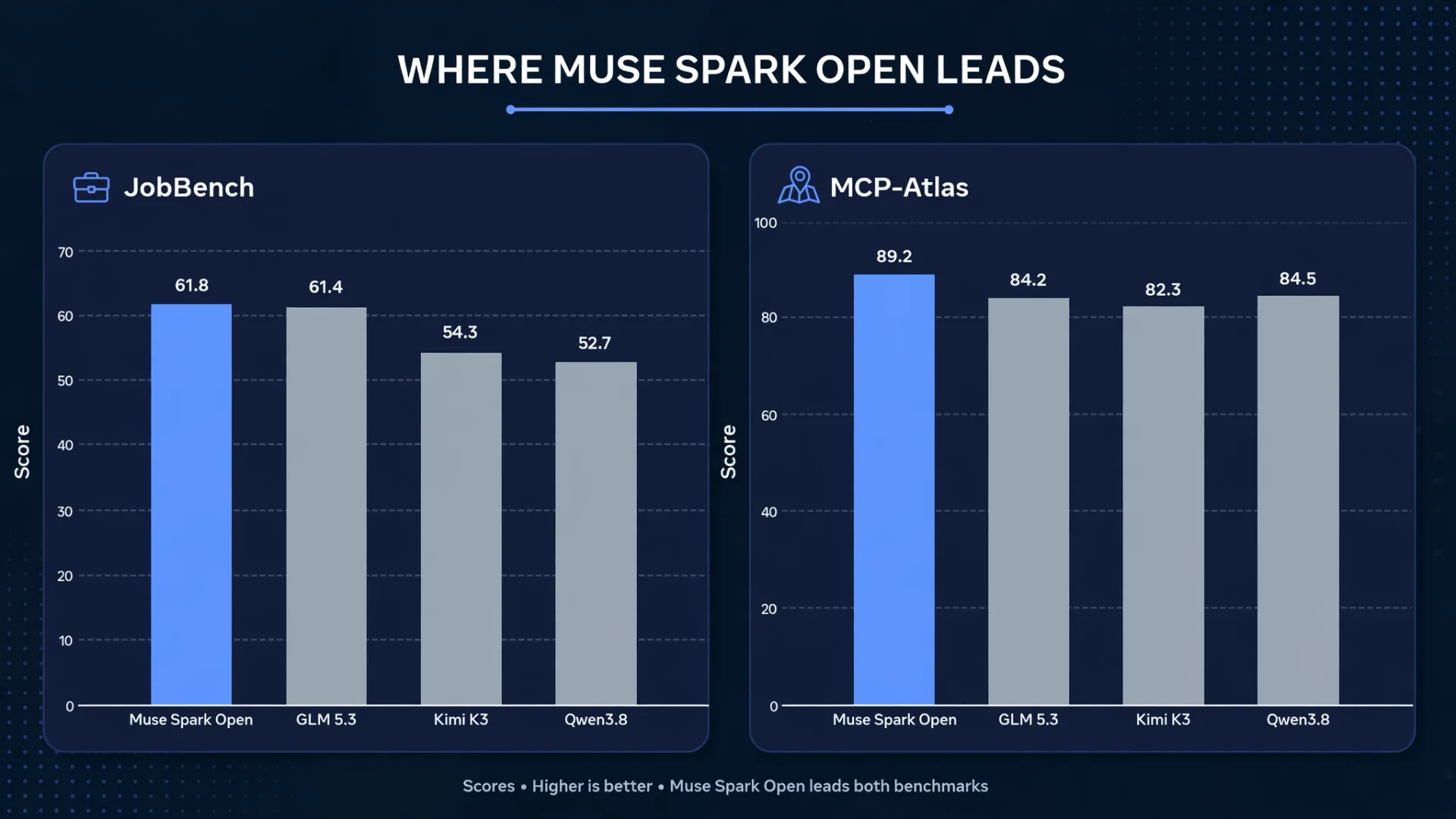
| JobBench (agentic work) | 61.8 | 61.4 | 54.3 | 52.7 |
| MCP-Atlas (tool use) | 89.2 | 84.2 | 82.3 | 84.5 |
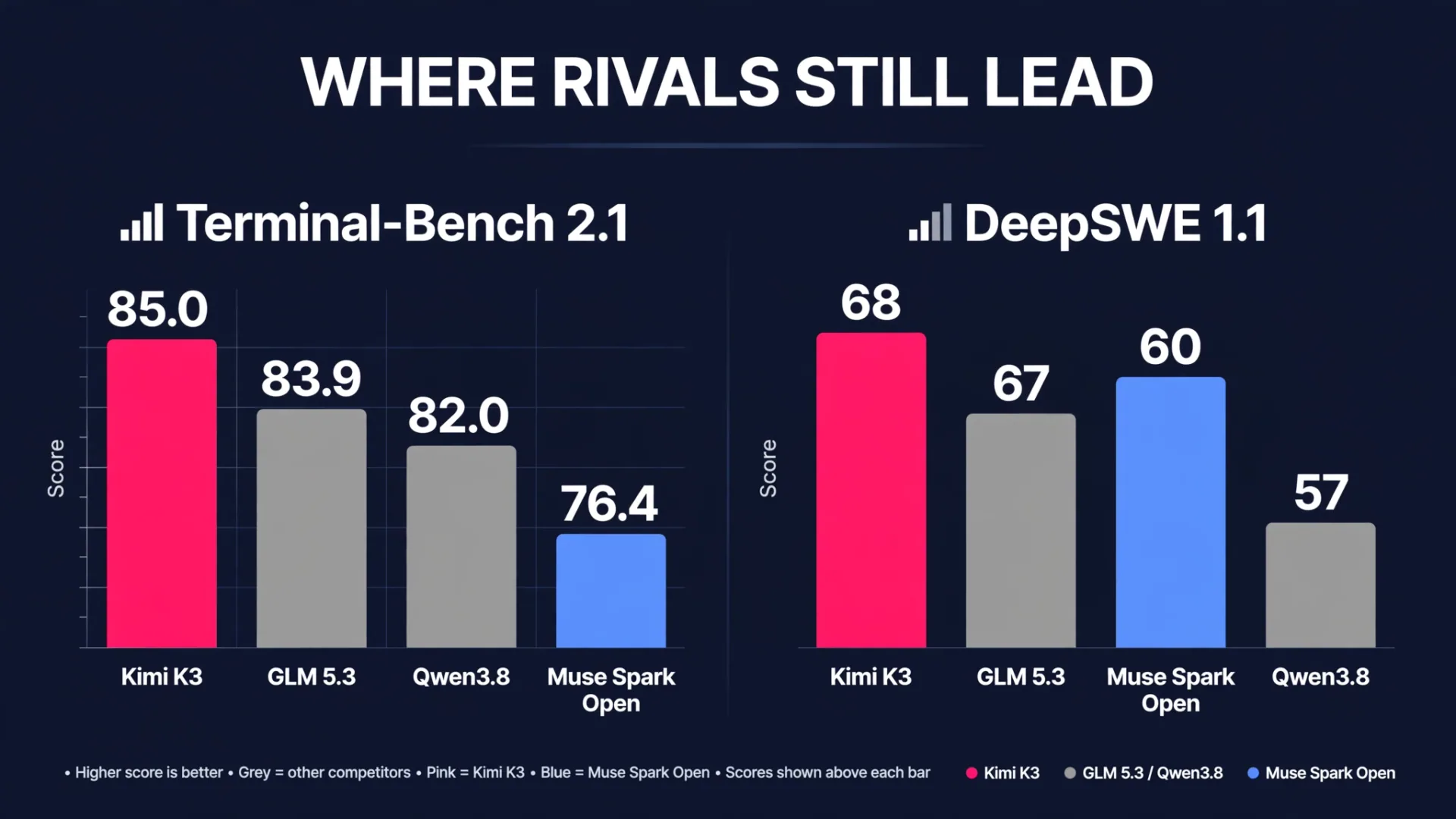
| Terminal-Bench 2.1 (coding) | 76.4 | 83.9 | 85.0 | 82.0 |
| DeepSWE 1.1 (software engineering) | 60 | 67 | 68 | 57 |
| GDPVal-AA v2 | 1,401 | 1,653 | 1,537 | 1,613 |
| Artificial Analysis Intelligence Index | 39 | 45 | 44 | 40 |
The pattern is clear. Muse Spark Open wins the two agentic benchmarks that measure real multi-step work: JobBench, which tests agent-style tasks, and MCP-Atlas, which tests tool use across 220 tools on 36 live Model Context Protocol servers without naming the tools in advance. It also leads on reasoning tests like HLE-Diamond and AA-Omniscience, according to Meta.
But on pure coding, the Chinese models are ahead. Kimi K3 leads Terminal-Bench 2.1 at 85.0, and GLM 5.3 leads GDPVal-AA v2 at 1,653. Muse Spark Open is also well behind Meta's own closed Muse Wonder models on coding, which Meta does not hide.
Cost: what it takes to use Muse Spark Open
| Route | Cost |
|---|---|
| Download the weights | Free (Hugging Face, AWS, Google Cloud, Microsoft Foundry) |
| Hosted API access | Provider pricing, varies (Baseten, Fireworks AI, Groq, Modal, Nebius, OpenRouter, Together AI) |
| Run locally, full fidelity | Two Mac Studio computers with M5 Ultra chips and 512 GB unified memory each, about 1 TB total |
| Cheapest Mac Studio | From $10,799 for a 256 GB unit; a multi-machine setup can pass $40,000 |
| Budget local option | Compressed 2-bit community formats that run on a 256 GB machine with llama.cpp |
The headline cost is zero: the weights are free to download. The real cost is compute. Full-precision BF16 weights are about 1.6 TB, and the compressed NVFP4 version is about 530 GB. Meta's showcase setup runs the model on two Apple Mac Studio desktops with M5 Ultra chips, linked through Apple's MLX framework into one system with about 1 TB of memory.
For most teams, hosted API access through one of the seven launch providers is the practical route. Running it locally makes sense when data privacy, latency, or control over the deployment matters more than raw cost.
The Apple partnership: frontier AI on a desk
The most surprising part of the launch is the hardware story. Meta worked directly with Apple so Muse Spark Open runs on Mac Studio desktops. Zuckerberg announced it on X, noting the model runs great on new Mac Studios thanks to work with Apple and its new CEO John Ternus.
Meta tested the setup on real agentic workflows running entirely on-device. Muse Code ran on the two-Mac setup while the coding terminal worked through bug fixes and new features for the open-source Mastodon client Ice Cubes, including a full build. The model also drove DaVinci Resolve end to end, reviewing raw footage frame by frame to pick out and crop the best shots for vertical video.
This is a genuine shift in where frontier-scale AI can run. The catch is the price: frontier AI now fits on a desk, but the desk setup costs about as much as a car.
License: read the terms before you ship
Muse Spark Open is released under Meta's new Muse Model License. It is free for most developers, but it is not unrestricted open source. Key terms:
- Free to adapt and ship. No fee applies to developers who adapt the model or ship it inside their own software.
- Attribution label required. Products built on it must show a "Built with Muse Spark Open" label.
- Hosted-service threshold. Any company that sells the model as a hosted service and has passed $20 million in gross revenue over a 12-month period needs a separate agreement with Meta.
- Prohibited uses. Military and critical infrastructure uses are off-limits, plus standard acceptable-use restrictions.
- Safety. Meta says the model cleared the release thresholds in its Superintelligence Scaling Framework, with a full evaluation report still to come.
If you are building a commercial product on open weights, have a lawyer review the license. The $20 million hosted-service clause is the one most likely to matter as a product grows.
Which model should you pick?
Pick Muse Spark Open if: you need an open-weight model for agentic coding work, you want to self-host for privacy or control, you need strong tool use and multi-step task handling, or you are building a product and want to avoid per-token API lock-in.
Pick Kimi K3 or GLM 5.3 if: raw coding benchmark performance matters most to you and you are comfortable with a Chinese open-weight model and its license terms.
Pick Qwen3.8 if: you want a balance of strong coding and broad ecosystem support, and Alibaba's licensing fits your use case.
Pick a closed frontier model if: you need the absolute best coding performance and do not need to self-host. Closed models like Muse Wonder, Claude Opus 5.5, and GPT-6.1 Sol still lead on coding benchmarks. For the closed-model picture, see our Claude Opus 5.5 breakdown.
For most businesses, the practical choice is not the weights at all. It is a hosted API or an AI agent built on top of a frontier model, where the model is one component of a system that handles real workflows, tools, and approvals.
What this means for AI development
Muse Spark Open matters for three reasons. First, it gives the US an open-weight model that can credibly compete with the Chinese open models on agentic work, even if coding still lags. Second, it proves frontier-scale models can run on desktop hardware, which changes the economics of self-hosted AI for privacy-sensitive teams. Third, it signals that Meta is back in the open-weights game after the Llama era, and competition in open weights is good for every developer and business building with AI.
The open question is independent verification. Meta's benchmarks are vendor-reported, and the real test will be how the model performs in production coding agents, on real codebases, over weeks of use. Watch for independent evaluations in the coming weeks.
If you want help putting an open-weight model or an AI agent to work in your business, talk to CodeMyPixel. We build AI agents that automate real business workflows, from inbox triage to booking and follow-ups, on the model that fits your needs.
FAQ
Is Muse Spark Open free?
Yes, the weights are free to download from Hugging Face and major cloud model catalogs. You still pay for compute, whether that is cloud GPUs, hosted API access, or your own hardware. Companies earning over $20 million a year that sell the model as a hosted service need a separate agreement with Meta.
Can I run Muse Spark Open on my own computer?
At full fidelity, you need about 1 TB of memory, which Meta demonstrated with two Mac Studio computers with M5 Ultra chips and 512 GB each. Compressed formats are much smaller: NVFP4 is about 530 GB, and community 2-bit formats can run on a 256 GB machine with llama.cpp. For most people, hosted API access is far more practical.
Is Muse Spark Open better than Kimi K3, GLM 5.3, or Qwen3.8?
It depends on the task. Muse Spark Open leads on agentic benchmarks (JobBench 61.8, MCP-Atlas 89.2). Kimi K3 leads on Terminal-Bench 2.1 coding (85.0) and DeepSWE 1.1 (68), and GLM 5.3 leads GDPVal-AA v2 (1,653). There is no single winner across all benchmarks, so pick based on your workload.
What is the difference between Muse Spark Open and Muse Wonder?
Muse Wonder is Meta's closed flagship family, launched October 12, 2026, available only through the Meta Model API and Muse Code. Muse Spark Open is the open-weight release: anyone can download the weights and run them. Muse Wonder scores higher on coding benchmarks, but you cannot self-host it.
Can I use Muse Spark Open in a commercial product?
Yes, for most developers, under the Muse Model License. You must show a "Built with Muse Spark Open" label, and you cannot use it for military or critical infrastructure purposes. If you sell it as a hosted service and pass $20 million in gross revenue over 12 months, you need a separate agreement with Meta.
Where can I download Muse Spark Open?
The weights are available on Hugging Face, Amazon SageMaker AI, Google Cloud Model Garden, and Microsoft Foundry Models. Hosted API access is available from Baseten, Fireworks AI, Groq, Modal, Nebius, OpenRouter, and Together AI.
Benchmark scores in this post are vendor-reported by Meta and have not yet been independently verified. Hardware prices are as reported at launch.
- Muse Spark Open
- Meta AI
- Open-Weight AI
- AI Agents
- Coding AI