ИИ8 мин чтенияАвтор JH Akash
Meta Muse AI Connectors: The Next App Store Moment? (Video Breakdown)
Meta opened Muse to developers via connectors. Greg Isenberg calls it the App Store moment for AI. Here are the four startup ideas, the money math, and how to build and submit one.
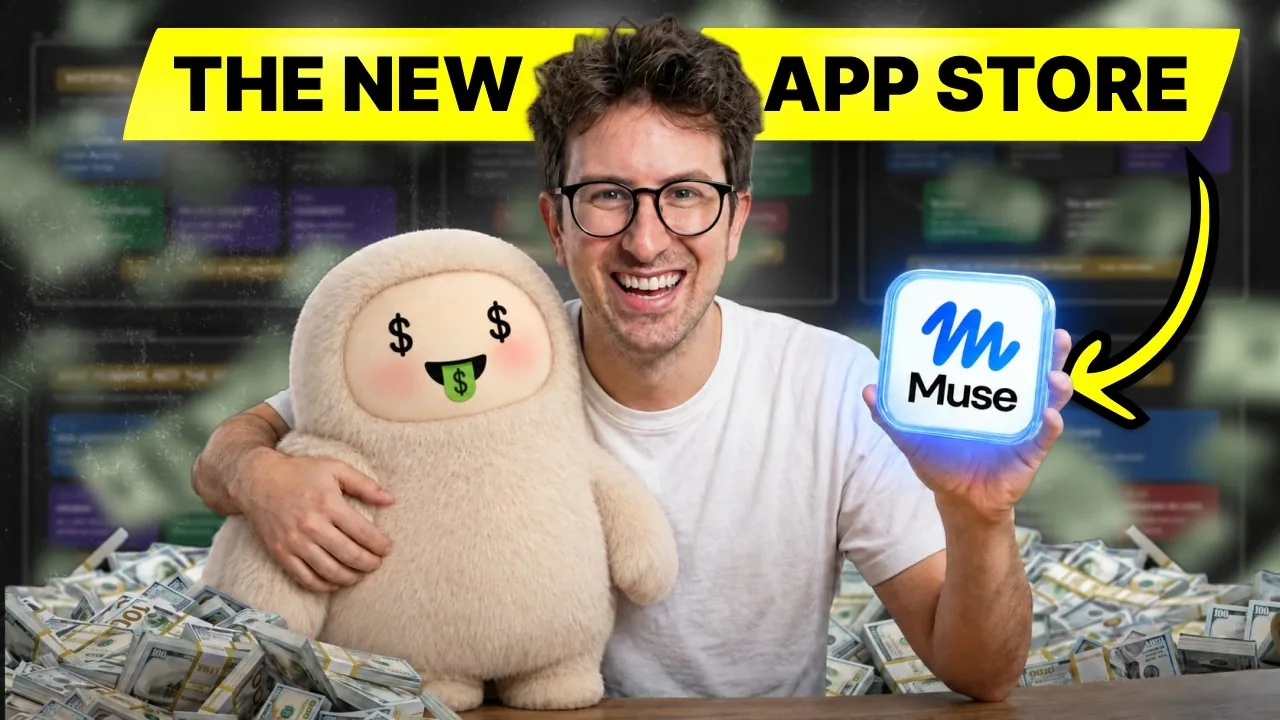
Meta Muse AI Connectors: The Next App Store Moment? (Video Breakdown)
Meta has opened Muse, its personal AI agent, to developers. Now you can submit something called a connector, which lets Muse use your service when someone asks it for help. Startup ideas creator Greg Isenberg (718K subscribers) says this could be the App Store moment for AI, and he just broke the whole opportunity down in a 26 minute video.
This post walks through what he covered: how connectors work, the four startup ideas he gave away for free, how customers would find your connector, and how to build and submit one. Charts below are drawn from the video's own numbers.
<iframe width="560" height="315" src="https://www.youtube.com/embed/84q4WA3kA8Q" title="Meta Muse AI Connectors: The Next App Store Moment?" frameborder="0" allow="accelerometer; autoplay; clipboard-write; encrypted-media; gyroscope; picture-in-picture" allowfullscreen></iframe>
What Is a Muse Connector?
A Muse connector is a submitted integration that gives Muse a way to use your service when someone asks for help. Isenberg's example: you tell Muse you need a podcast studio on a Tuesday afternoon for 2 hours with a $200 budget. Muse figures out your city and recording type, then queries a studio's connector through its API. The studio returns an available room at $160 including equipment. Muse shows you the offer, you approve, and the booking gets made.
Meta runs a submission process and keeps a directory of approved connectors. Big companies are already in there, and Isenberg expects a wave of small and medium businesses to follow. Two important details from the video:
- Meta must approve you to be a connector. There is also a custom connector option for private testing before you pursue a public listing.
- The submission form offers two integration paths: your own API or an existing MCP server. MCP is a standard way to make tools available to an AI application. Stacktree's founder has published a firsthand account of the review form, so the process is already visible.
The App Store Parallel
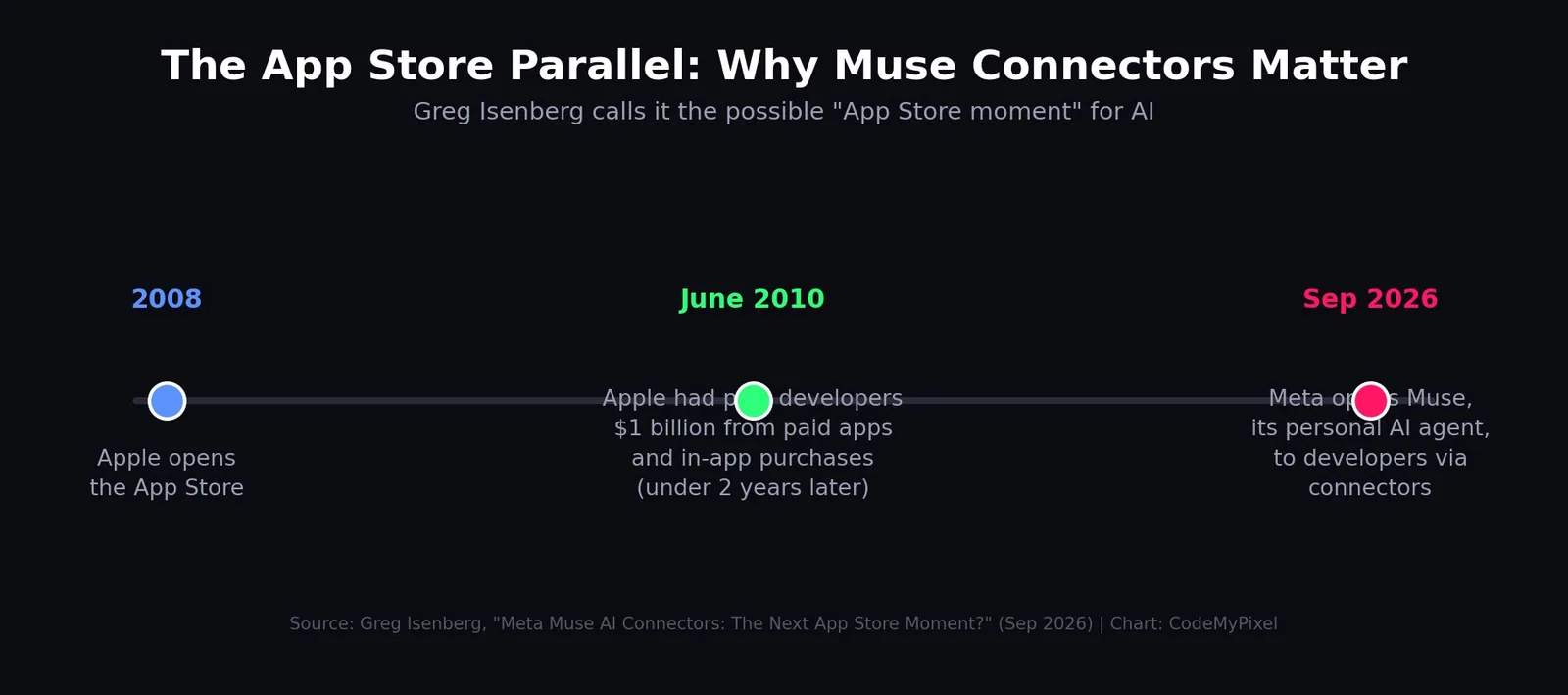
Isenberg's central argument is a history lesson. Apple opened the App Store in 2008. Apple supplied distribution and payment collection, so developers could focus on building things people wanted. By June 2010, less than two years after the store opened, Apple had paid developers a billion dollars from paid apps and in-app purchases. A new market formed around the phone, and outside businesses earned a lot of money from it.
His case: Meta is building the assistant, and other businesses can now supply the services that complete a customer's request. There is one extra wrinkle he likes. Your service can become useful halfway through a bigger request. Someone organizing a small event starts by needing a venue, then realizes they need equipment rental. The equipment company becomes relevant mid conversation, and money changes hands at that moment. As a founder, those are the moments to hunt for.
One honest caveat, straight from the video: how big this market gets depends on whether people actually use Muse for these jobs. Isenberg notes Muse was the number one app in the App Store on the day he recorded. His open questions: will Muse reach 50 million, 100 million, 200 million, or a billion users? And will approval be YC selective (0.01%) or App Store like (most accepted if high quality)? Nobody knows yet.
Four Startup Ideas, Given Away for Free
Isenberg walked through four connector businesses he thinks are worth building. The math below is exactly as he described it.
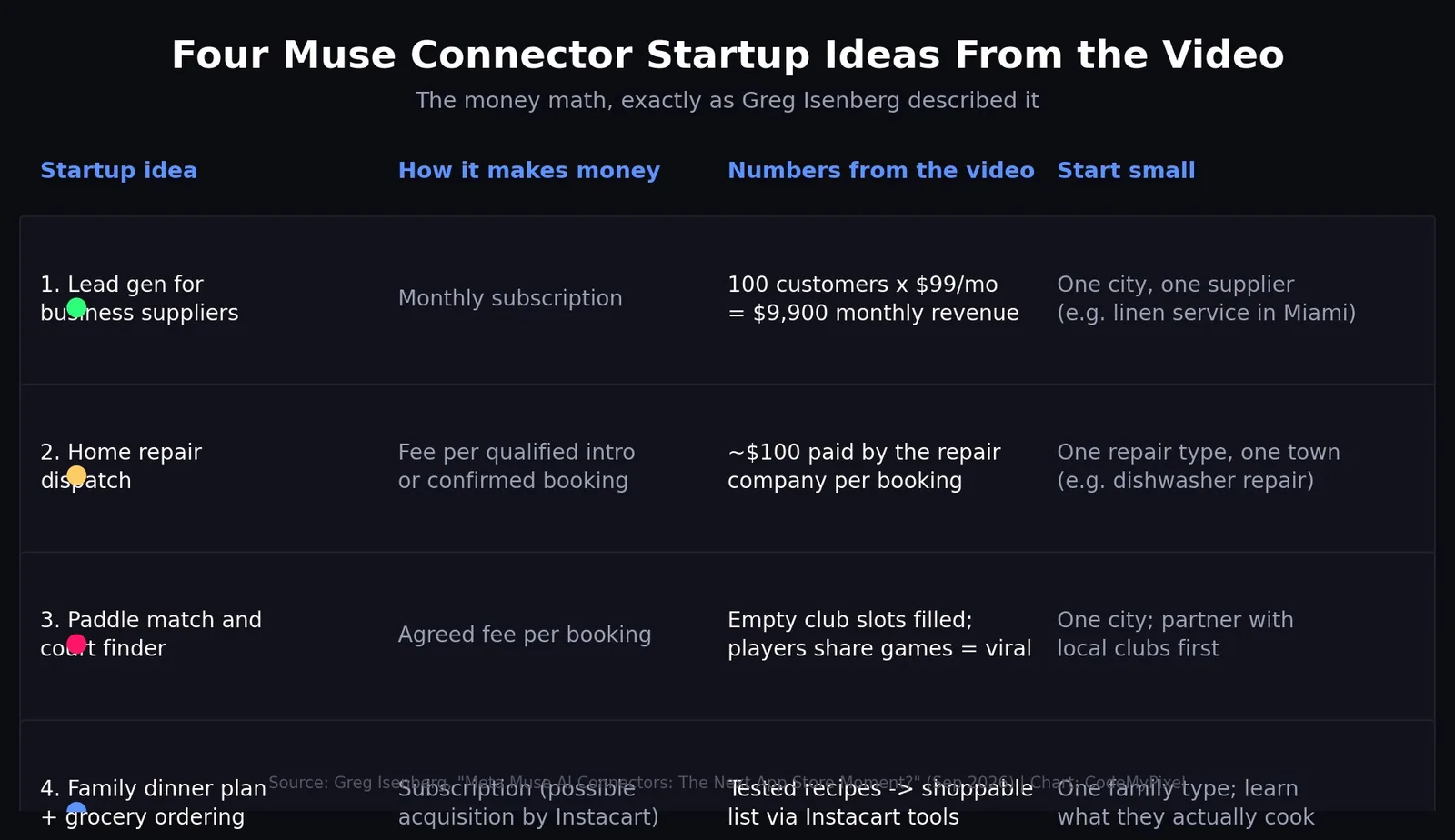
Idea 1: Lead gen for business suppliers. You track new business openings in a city and sell that intelligence to suppliers. His example: a linen service in Miami finds out which restaurants are opening nearby, with sources and public contacts. General contact search already exists (Apollo), but the edge is timely local knowledge. His math: 100 customers paying $99 a month gives $9,900 in monthly revenue before costs. Start with one city and one supplier, verify the data yourself, and sell freshness.
Idea 2: Home repair dispatch. Someone tells Muse their dishwasher broke and they need a Samsung specialist tomorrow. Your service checks participating repair companies with confirmed availability and books the job. You charge the repair company about $100 per qualified intro or confirmed booking. Thumbtack already validated that providers pay for customer leads. Start with one repair type in one town and learn what the providers can actually handle.
Idea 3: Paddle match and court finder. A player asks for a paddle game tonight near them with people around their level. Your service finds open spots at participating clubs, shows prices, and books the game. Clubs fill empty slots; you earn an agreed fee per booking. Playtomic already does court and match booking in some cities, so look for clubs whose availability players still have to check separately. Isenberg says he would personally start here because he loves racket sports, and he expects Muse to get more social over the next 6 to 12 months.
Idea 4: Family dinner planning plus grocery. A parent asks for three nights of dinners, 20 minutes of cooking max, working around what is already in the kitchen. Your service builds the plan from tested recipes, adjusts quantities, and turns missing ingredients into a shoppable list. Instacart's developer tools already support that checkout flow. He speculates that if this category gets big, companies like Instacart could simply acquire these connectors.
If he were starting with a small budget, Isenberg says he would investigate the lead gen idea first, because you can put together a useful sample and show it to a potential customer before writing much software.
How People Find Your Connector
Getting listed in the directory is not a distribution plan by itself. Isenberg is direct about this: whether an unknown service gets recommended during a general conversation still needs evidence. His four growth ideas:
- Partner with creators who have audiences. For the dinner service, find a creator who shares recipes for parents, demonstrate turning meals into a grocery order, and agree on pay per customer they introduce.
- Product-led sharing. One paddle player books a court and shares the time and location with three other players. The recipients get value before they ever sign up, and some become customers. Build this into the product from day one.
- Distribution through connected marketplaces. Ticketmaster says eligible events can now appear through its connector without each organizer doing extra integration work. If your industry has a marketplace, plug into its existing supply.
- Meta directory feature placement. Editors can feature connectors, and Isenberg once got 40,000 downloads a day from an App Store feature. But he calls it unbankable: you are betting a product marketing manager in Menlo Park wakes up liking your app.
How to Build and Submit One
His build advice is simple. Write down one thing the customer should accomplish, like "show me available paddle courts near me tomorrow evening with prices." Take that brief to a coding agent like Claude Code or Codex, hand it the documentation for the system you are connecting to, and describe the request in plain language. Build availability check and quoting first, then booking. The service must be hosted somewhere Muse can reach, and it needs a way to check which customer is using it.
Before submitting, test the awkward requests: a time that is already booked, an expired quote, a repeated request that must not create a duplicate reservation, and moving a booking to another day. That is where you find out how much of the actual job your service can handle, and it is likely what separates approvals from rejections.
He also notes the build cost comparison that frames the whole video. In the App Store era, a quality mobile app needed one or two million dollars and a team of 10 people. Now, he says, anyone watching can ship a connector with a coding agent.
The Honest Take
Isenberg is bullish but clear eyed. The opportunity is real because Meta is opening a distribution channel at the exact moment AI assistants are becoming how people get things done. The risks are equally clear: Muse's user scale is unproven, the approval selectivity is unknown, connector availability may not extend outside the US (one commenter flagged this), and being early means you learn faster but also that the evidence on discovery does not exist yet.
His prescription for this week: pick a customer you can actually talk to, ask about the task they keep dealing with, how the last time went, where they waited, and what it cost. That conversation is a better starting point than a blank editor. Or browse startup-ideas-pod.link and ideabrowser.com for sparks.
FAQ
What is a Meta Muse AI connector? A connector is a submitted integration that lets Meta's personal AI agent Muse use your service when someone asks for help. Meta runs a review process and lists approved connectors in a directory. You can submit via your own API or an existing MCP server, and Meta must approve you before going public.
How much does it cost to build a Muse connector? The video's position: far less than the App Store era, when a quality mobile app took one or two million dollars and a team of 10. Isenberg recommends starting with one customer task, a coding agent like Claude Code or Codex, and clearly labeled sample inventory, then building availability and quoting before booking.
Can anyone submit a connector to Meta? Meta must approve every connector, and the approval selectivity is one of the video's open questions: will it be YC selective or App Store permissive? There is a custom connector option for private testing, and Isenberg advises checking the current submission form since the program is new.
Is Muse available outside the US? One commenter on the video noted that Muse connectors are not available outside the US. Availability may vary by region, so check Meta's current documentation before planning a launch.
Which of the four startup ideas should you build first? Isenberg says to investigate the lead gen idea first on a small budget, because you can demonstrate a useful sample before writing much software. If you know local service providers, home repair is a closer look. He personally likes the paddle idea because it is fun and social.
How do customers find your connector? Do not rely on Meta's directory alone. The video recommends creator partnerships, product-led sharing built into the service, distribution through connected marketplaces like Ticketmaster, and treating a directory feature as a bonus rather than the plan.
Want CodeMyPixel to Build Your Muse Connector?
Reading about the connector economy is fun. Shipping in it is better. If you run a business with a booking flow, a catalog, or a service people ask about, we can turn it into a Muse connector: API design, the connector submission, the hosted service, and the customer facing experience.
Talk to CodeMyPixel about your connector idea
Video credit: "Meta Muse AI Connectors: The Next App Store Moment?" by Greg Isenberg, published September 25, 2026. All figures and ideas above are his, summarized and visualized by CodeMyPixel.
- Meta Muse
- Muse connectors
- Greg Isenberg
- AI agents
- AI startups
- MCP
- AI news