AI9 min leestijdDoor JH Akash
Meta Muse Wonder Explained: Benchmarks, Price, and the Opus Problem
Meta released Muse Wonder and Muse Wonder Full on October 12, 2026. Here is how they score, what they cost, and whether Active Memory is a real advantage.
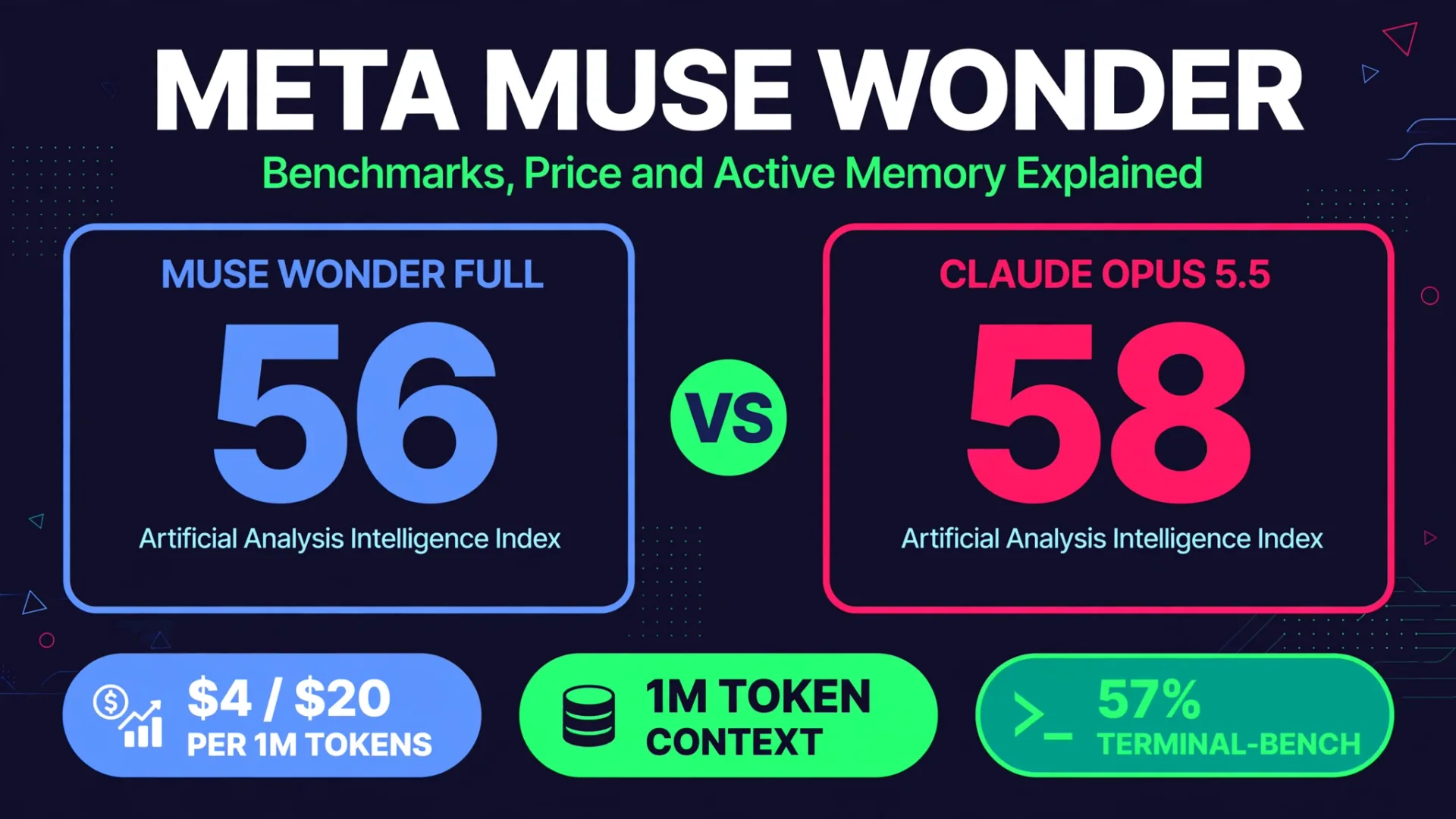
On October 12, 2026, Meta released Muse Wonder and Muse Wonder Full, its most capable AI models so far. Meta calls them its first frontier models, built for agents that do multi-step work instead of answering once and stopping. The pitch rests on two new ideas, Active Memory and Active Focus. The catch is the price: the standard model costs as much as Claude Opus 5.5 while scoring slightly lower on independent tests. Here is what the benchmarks, the pricing, and the fine print actually say.
Quick verdict
| Question | Short answer |
|---|---|
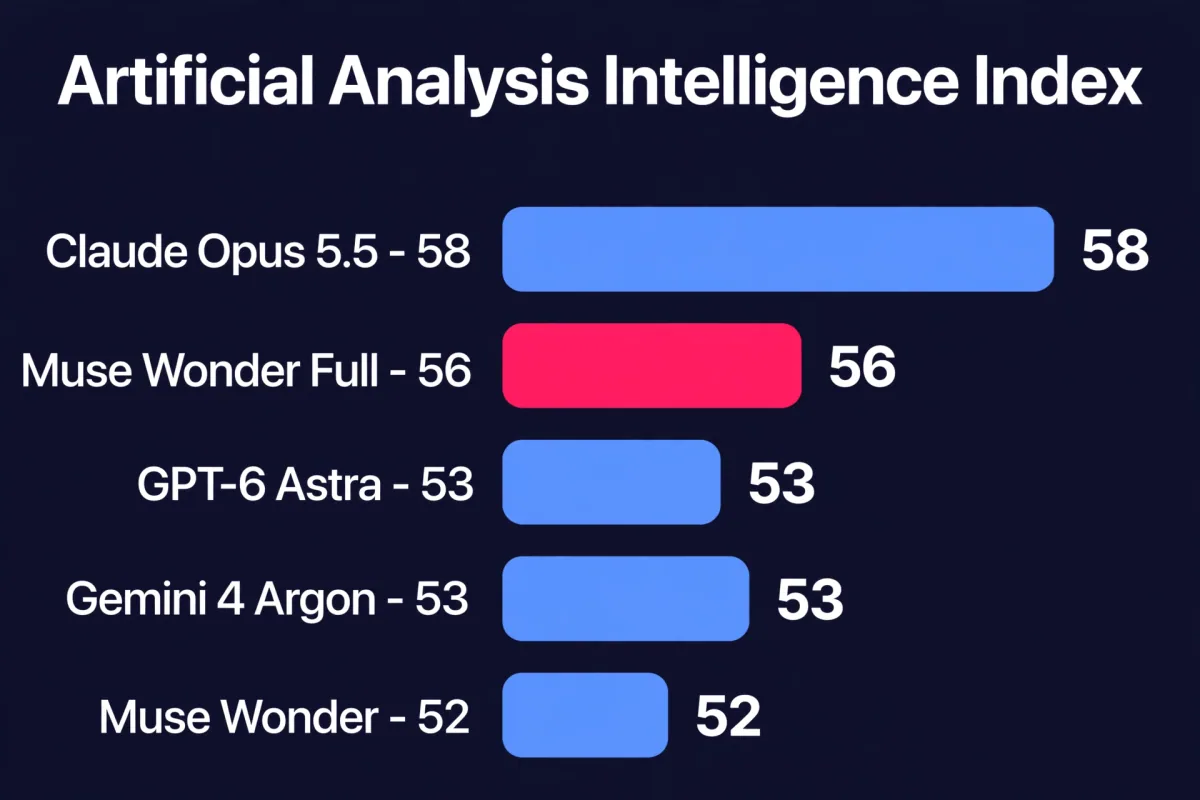
| Is Muse Wonder a real frontier model? | Yes. On the independent Artificial Analysis Intelligence Index, Muse Wonder Full scores 56, close behind Claude Opus 5.5 at 58. |
| What is its best feature? | Active Memory: the model remembers important facts across conversations instead of starting from zero every time. |
| What is the biggest problem? | Price and access. The standard model matches Opus pricing, and the stronger Full version is not sold by the token at all. |
| Should you switch today? | Test it on your own workload first. The independent scores and Meta's own charts point in different directions. |
What is Muse Wonder?
Muse Wonder is a family of two models from Meta Superintelligence Labs, the division led by chief AI officer Alexandr Wang. It follows Muse Spark 1.3, released about six weeks earlier. Both Wonder models share the same basics:
- Context window: about 1 million tokens (1,048,576 to be exact)
- Inputs: text, images, video, audio, and PDF
- Output: text only
- Weights: closed, not open source
- API model ID: muse-wonder-1.0, via the Meta Model API
The two versions differ in capability and access. Muse Wonder is the standard model, available now through the Meta Model API and in Muse Code, Meta's coding tool. Muse Wonder Full is the stronger model, but it is only available to Muse Code subscribers. It is not on the API at launch. Meta also plans to bring Wonder to its Muse personal agent app, starting with paid subscribers.
Active Memory and Active Focus, explained
These are the two features Meta is selling, and they matter more than any single benchmark, because they describe how the model behaves over long work.
Active Memory means the model retains important information across conversations and retrieves it when a task needs it. In practice, that should mean less re-explaining: your preferences, your project details, and earlier decisions carry over instead of resetting every session. Meta tests this with its own internal benchmark called MemoryBench, which hides facts inside long conversations, adds distractions, and changes some facts halfway through. Both Wonder versions score about 85.5 on it, higher than every other model Meta tested. Note that MemoryBench is Meta's own test, not an independent one.
Active Focus means the model keeps working toward a goal when a task gets hard. It tries alternative approaches when something fails, adjusts to new information, and asks for clarification when it is unsure. It is also designed to check with you before taking important actions. In Meta's demos, that looked like building a wedding seating chart with many conflicting requirements, preparing a running plan from a user's preferences, and helping with lease agreements and insurance claims.
One honest warning from Meta's own model card: a model that refuses to give up can also keep trying things you did not ask for. Meta recommends asking for human confirmation before any action that cannot be undone. That is good advice for any agent, not just this one.
Benchmarks: independent scores vs Meta's own charts
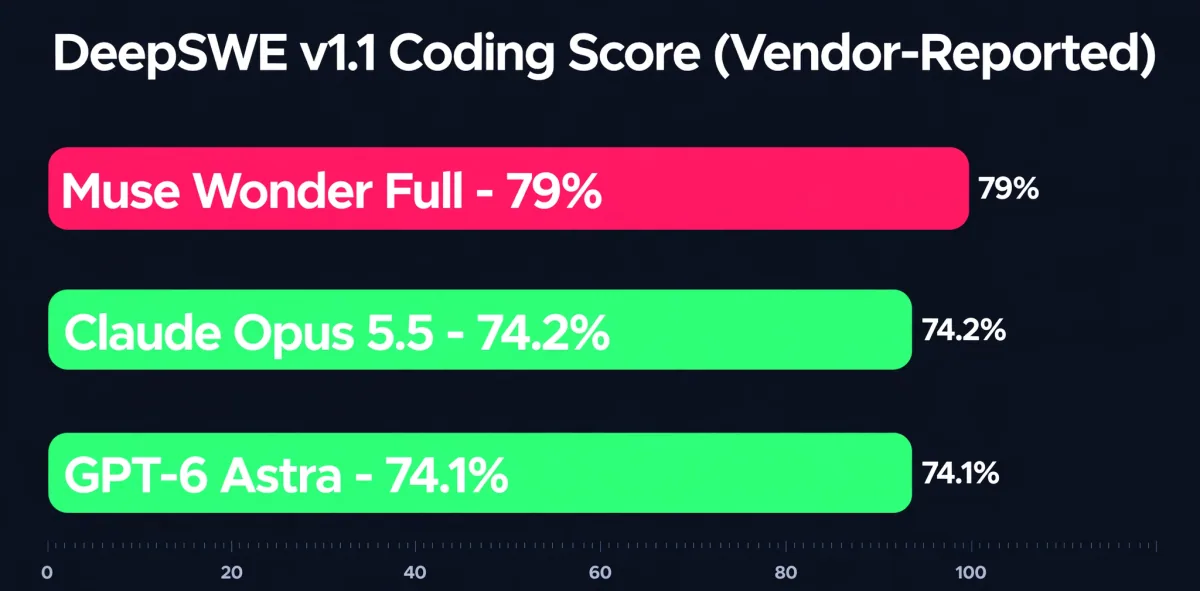
This is where the story splits. Independent tests put Wonder Full slightly behind the leader. Meta's own charts put it ahead on coding and legal work. Both can be true at the same time, because different benchmarks measure different things. Treat vendor-reported numbers as vendor-reported.
| Benchmark | Muse Wonder Full | Claude Opus 5.5 | GPT-6 Astra | Source |
|---|---|---|---|---|
| Artificial Analysis Intelligence Index | 56 | 58 | 53 | Independent (Artificial Analysis) |
| DeepSWE v1.1 coding | 79% | 74.2% | 74.1% | Vendor-reported (Meta) |
| Harvey LAB-AA legal agent tasks | 13.1 | 4.2 | 8.6 | Vendor-reported (Meta) |
| SWE-Marathon | 57.5% | 46.3% | Not reported | Vendor-reported (Meta) |
| Terminal-Bench 4.0 | 57% | Not reported | Not reported | Artificial Analysis |
| MemoryBench | About 85.5 | Not reported | Not reported | Meta internal, not independent |
| AA-Omniscience factual knowledge | 30 | Not reported | Not reported | Artificial Analysis |
Three things stand out:
- The independent gap is small but real. Wonder Full at 56 sits two points behind Opus 5.5 at 58, and ahead of GPT-6 Astra and Gemini 4 Argon at 53. The standard Muse Wonder at 52 is a clear step up from Muse Spark 1.3, which scored 48 six weeks earlier.
- Meta's coding numbers are strong. On DeepSWE v1.1, SWE-Marathon, and legal agent tasks, Meta's charts show Wonder Full ahead of both rivals. If your work is long coding or document-heavy agent tasks, these are the numbers to test yourself.
- Factual knowledge is a weak spot. Wonder Full scores only 30 on the AA-Omniscience test, which measures factual knowledge. And Meta's own model card warns that visual and spatial reasoning, especially 3D tasks, remains a known limitation.
Pricing: Opus-level price, second-place independent scores
| Model | Input per 1M tokens | Output per 1M tokens | How to get it |
|---|---|---|---|
| Muse Wonder | $4 | $20 | Meta Model API, Muse Code |
| Muse Wonder Full | Not sold by token | Not sold by token | Muse Code plans at $50 and $200 per month |
| Claude Opus 5.5 | $4 | $20 | API |
| Claude Sonnet 5.5 | About $2 (reported) | About $10 (reported) | API |
The pricing is the hardest part of this launch to defend. Muse Wonder's headline price is identical to Claude Opus 5.5, the model that outscores it on the independent index. The Neuron reports that Claude Sonnet 5.5 costs about half as much and still scores higher than the standard Wonder on the same index. The better model, Wonder Full, cannot be bought by the token at all: you need a Muse Code subscription at $50 or $200 per month.
Cost per task tells the same story. Artificial Analysis puts the cost of running Muse Wonder at $4.52 per Intelligence Index task, about three times the $1.60 for the previous Muse Spark 1.3. Token pricing jumped from $1.25 input and $4.25 output on the older model to $4 and $20 now. Meta is charging frontier prices, so it will be judged by frontier standards.
The Muse agent app adds another wrinkle. Muse has passed 5 million downloads since its September launch, though reports say growth has slowed. Access to Wonder inside Muse will require a paid subscription, reportedly $20 or $100 a month, but Meta has not confirmed public pricing tiers or a general availability date beyond what is already live for developers.
What is still missing
Two gaps deserve attention before you move real work onto Wonder:
- The safety report is not published yet. Meta says a full safety evaluation report is coming soon, so its safety claims cannot yet be checked against full test results.
- MemoryBench is Meta's own benchmark. Active Memory is the headline feature, and its headline number comes from Meta's own test. Independent memory testing will matter more than the launch-day chart.
Neither gap makes the launch fake. Wonder Full's 56 on an independent index is a real result, and it is fair to call this Meta's strongest model yet. But bold framing plus a "coming soon" safety report plus a paywalled Full version is a pattern worth watching rather than taking at face value.
Which one should you pick?
- Long coding or agent work, and you already use Muse Code: Wonder Full is the version to test. Meta's coding and legal-agent numbers are its strongest case, and the subscription bundles the better model. Verify the coding scores on your own codebase before committing.
- General frontier work by the token: Opus 5.5 leads the independent index at the same $4/$20 price. Wonder is close, not ahead. If you are already on Claude, this launch alone is not a reason to switch. For a deeper comparison of the Claude and OpenAI flagships, see our GPT-6.1 Sol vs Claude Sonnet 5.5 comparison.
- Best value per token: Sonnet 5.5 is reported at about half the price of Wonder and still scores above it on the independent index. Our Claude Haiku 5.5 vs GPT-6 Luna breakdown shows the same value logic playing out in the small-model tier.
- Memory-heavy personal assistant work: Active Memory is the one feature rivals do not package the same way. If your agent work involves long-running projects where context carries across days, Wonder is worth a pilot. Just keep human approval switched on for anything irreversible.
- Google ecosystem teams: Gemini 4 Argon scores 53 on the same independent index, level with GPT-6 Astra. See our Gemini 4 Argon explainer before choosing between ecosystems.
For teams building their own agents rather than renting one model, the model is only one layer. Our work on AIOS, AI agent teams that do real work covers how memory, tools, and human approval fit together into a system that survives contact with real business work.
FAQ
What is Meta Muse Wonder?
Muse Wonder is Meta's frontier AI model family, released October 12, 2026, in two versions: Muse Wonder and the stronger Muse Wonder Full. Both are built for agentic, multi-step work and come with Active Memory and Active Focus. It is Meta's most capable model family so far.
How much does Muse Wonder cost?
Muse Wonder costs $4 per million input tokens and $20 per million output tokens through the Meta Model API, the same headline price as Claude Opus 5.5. Muse Wonder Full is not sold by the token; it is only available through Muse Code subscription plans at $50 and $200 per month.
What is Active Memory in Muse Wonder?
Active Memory lets the model retain important facts, preferences, and context across conversations and retrieve the relevant details when a task needs them. The goal is to stop re-explaining background in every session. Meta's own MemoryBench test scores both Wonder versions at about 85.5, but that number is not independently verified yet.
Is Muse Wonder better than Claude Opus 5.5?
It depends on the test. On the independent Artificial Analysis Intelligence Index, Opus 5.5 scores 58 against 56 for Wonder Full and 52 for standard Wonder. On Meta's own charts for coding and legal agent tasks, Wonder Full leads. Different benchmarks measure different skills, so test on your own workload.
Can I use Muse Wonder Full through the API?
No, not at launch. Muse Wonder Full is only available to Muse Code subscribers. Only the standard Muse Wonder is on the Meta Model API.
Is Muse Wonder open source?
No. Unlike Meta's older Llama models, the Wonder family is closed-weight. You use it through Meta's API, Muse Code, or the upcoming Muse app, not by downloading the weights.
Bottom line
Meta is genuinely back at the frontier. A 56 on the independent index, strong vendor-reported coding scores, and a real memory story make Wonder Full the best model Meta has ever shipped. But Meta priced the standard model like the leader while scoring behind it, and locked the better model behind a subscription. That is not a failed launch. It is a launch that asks you to test before you trust, and to watch what independent testing says about Active Memory once the safety report lands.
- Meta
- Muse Wonder
- AI models
- benchmarks
- AI agents