IA5 min di letturaDi JH Akash
WTF is a Googlebook?
Google unveiled the Googlebook on September 21, 2026: a premium Android-based laptop line from Acer, ASUS, Dell, HP and Lenovo with deep Gemini integration. Here is everything it is, and who should buy one.
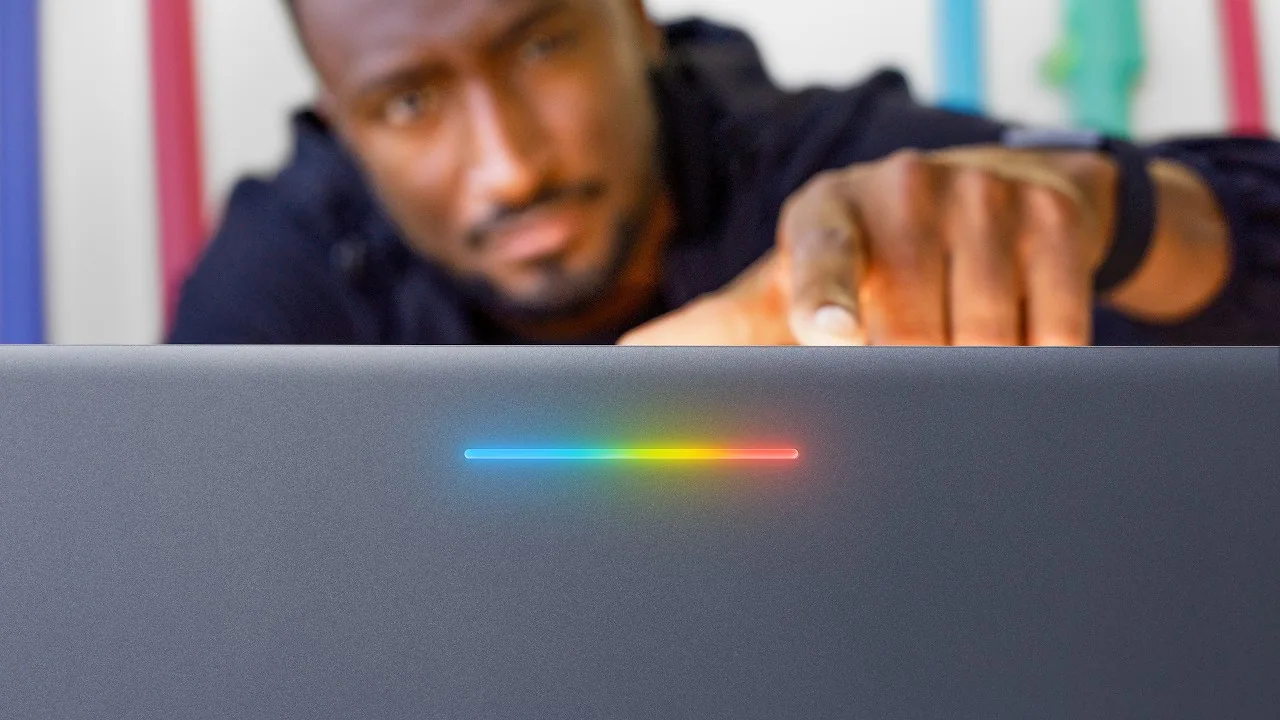
Google just invented a brand-new category of laptop, and it is not a Chromebook. On September 21, 2026, Google unveiled the Googlebook: a premium laptop line running a brand-new Android-based operating system called Googlebook OS, with Gemini AI woven through the whole experience. Marques Brownlee (MKBHD) got his hands on one early and asked the question everyone is asking: WTF is a Googlebook?
Here is the full breakdown.
What is a Googlebook?
A Googlebook is Google's new flagship laptop category. The twist: Google is not building the hardware itself. Five partners make the launch lineup: Acer, ASUS, Dell, HP and Lenovo. Every model shares the same premium baseline: lightweight aluminium or carbon-fibre builds, 16GB RAM minimum (up to 32GB), 512GB storage, high-resolution touch displays up to 3K OLED, and a colorful LED strip on the lid called the Glowbar.
The Glowbar is the signature design touch. It glows red when the battery is low, shows charging progress when plugged in, and pulses purple while you are talking to Gemini.
Googlebook OS: Android grows up
The biggest break from the past is the software. Googlebooks do not run ChromeOS. They run Googlebook OS, a new desktop operating system based on Android 17, blending the Android app stack with a desktop windowing environment borrowed from ChromeOS, including the desktop Chrome browser with extensions.
What that means in practice:
- Native Android apps. The Play Store is built in, and Android apps run natively, not through a virtual machine like on Chromebooks. Photoshop, CapCut, Android games, all install directly.
- Deep phone integration. Pair a Pixel (or any Android phone) and the two devices act as one: notifications on the laptop, texting from the laptop, instant internet sharing, drag-and-drop file access, and one-click handoff when a phone task needs a bigger screen.
- A real file system with semantic search. There is local storage and a files app that finds documents by description, even if you forgot the file name.
- Linux for developers. An isolated Linux environment with full terminal access, plus support for agentic coding tools.
Google is committing to 10 years of software updates for Googlebooks.
Gemini is the whole point
Every Googlebook ships with Gemini deeply integrated:
- Magic Pointer. Wiggle the cursor over anything on screen to ask Gemini about it or act on it. Off by default, genuinely useful once enabled.
- Semantic file search. Describe what you remember about a file, and the files app finds it.
- Rambler. A much smarter speech-to-text engine that strips filler words and formats as you speak, with a dedicated keyboard button.
- Create-my-widget. Describe a widget in natural language and the OS builds it for you.
The bundle sweetens the deal: 12 months of Google AI Pro, 5TB of cloud storage and 3 months of YouTube Premium are included with every Googlebook.
Googlebook vs Chromebook vs MacBook Air
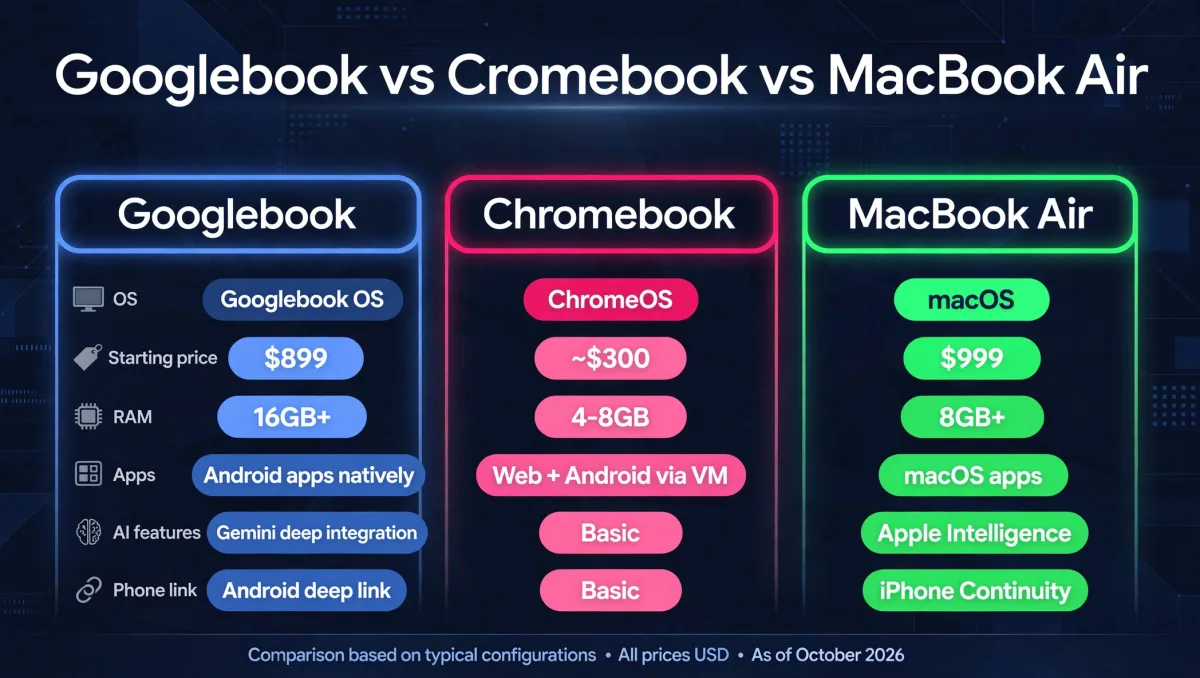
The honest comparison: a Chromebook starts around $300 and lives in the browser. A MacBook Air starts at $999 and owns the premium thin-and-light crown. The Googlebook starts at $899 and sits right between them, betting that deep Android integration plus on-device Gemini is worth the premium over a Chromebook.
| Model | Starting price |
|---|---|
| Acer Googlebook 14 | $899 |
| Lenovo Googlebook 15 | $1,099 |
| Dell XPS Googlebook | $1,199 |
| ASUS Googlebook 14 | $1,299 |
| HP Googlebook 14 | $1,299 |
Launch timeline: pre-orders opened September 21, 2026, with US availability from October 4, followed by Canada, the UK, Ireland, France, Germany and Australia on October 5.
Who should actually buy one?
The Googlebook makes sense for one specific person: a heavy Android and Pixel user who lives in Google's ecosystem and wants the same continuity iPhone plus Mac users enjoy. If your phone is the center of your digital life and you want a laptop that extends it rather than a separate computer you manage, this is built for you.
It makes less sense if you need desktop-grade creative suites beyond what Android apps offer, or if a $750 premium Chromebook covers your needs. Google has confirmed some newer Chromebooks will be able to upgrade to Googlebook OS, which could make those the smarter buy.
The bigger picture
The Googlebook is Google's answer to a decade-old question: what happens when the phone OS grows up into a real computer OS? With NPUs over 45 TOPS, on-device Gemini and a full Android app library, Google is betting the next laptop war is fought on AI integration, not specs. Whether it can steal the MacBook Air's lunch remains to be seen, but the category is real, it ships now, and the software update promise is the longest in the industry.
Curious how AI systems like the ones inside Googlebook OS actually coordinate work behind the scenes? Read our explainer on what an AIOS is, the operating layer for teams of AI agents, and why CodeMyPixel builds on it.
FAQ
What is a Googlebook?
A Googlebook is a new premium laptop category from Google, launched September 2026, running the Android-based Googlebook OS with deep Gemini AI integration. Five partners make them: Acer, ASUS, Dell, HP and Lenovo.
Is a Googlebook the same as a Chromebook?
No. Chromebooks run ChromeOS and start around $300. Googlebooks run the new Googlebook OS (based on Android 17), start at $899, run Android apps natively, and are positioned as premium devices.
How much does a Googlebook cost?
Prices start at $899 for the Acer Googlebook 14 and go up to $1,299 for the ASUS and HP models. The Dell XPS Googlebook starts at $1,199 and the Lenovo Googlebook 15 at $1,099.
What is Googlebook OS?
Googlebook OS is Google's new laptop operating system, based on Android 17 with desktop windowing, the Play Store, desktop Chrome with extensions, deep Pixel phone integration and system-level Gemini features. Internally it was developed under the codename Aluminum OS.
Can a Googlebook run Android apps?
Yes, natively. Unlike Chromebooks, which run Android apps through a virtual machine, Googlebook OS runs them directly from the built-in Play Store.
What is the Glowbar?
The Glowbar is the signature LED light strip on the back of every Googlebook lid. It indicates battery level, charging progress and animates when you interact with Gemini.
When do Googlebooks go on sale?
Pre-orders opened September 21, 2026. Units arrived in the US on October 4, 2026, followed by Canada, the UK, Ireland, France, Germany and Australia on October 5.
Should I buy a Googlebook or a MacBook Air?
If you are deep in the Android and Pixel ecosystem and want laptop-phone continuity with on-device Gemini, the Googlebook is built for you. If you need macOS software or prefer Apple's ecosystem, the MacBook Air remains the safer pick at a similar price.