IA6 min di letturaDi JH Akash
Reflection AI Beam: The Open-Weight Model That Matches China at a Quarter of the Compute
Reflection AI's Beam is a 501B open-weight model that claims GLM-5.2 level reasoning at 3-4x less compute. The specs, the company-published benchmarks, and the AI factory strategy, explained.
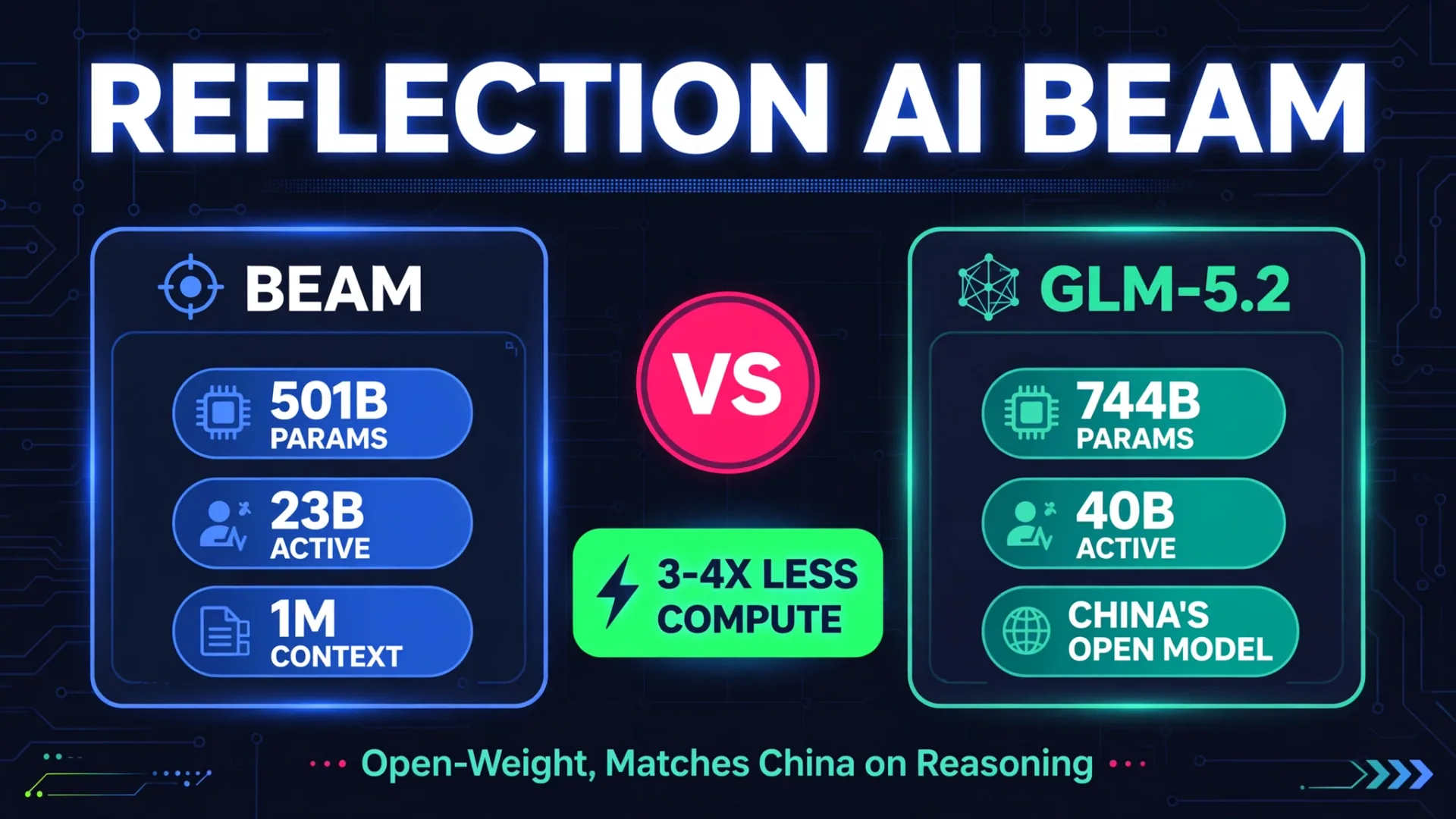
A new contender just walked into the open-weight arena, and it brought a different argument than everyone else. On October 5, 2026, Reflection AI, a two-year-old Brooklyn startup backed by Nvidia, unveiled Beam: a 501-billion-parameter open-weight model whose headline claim is not raw supremacy, but efficiency. Reflection says Beam matches Z.ai's GLM-5.2, one of China's strongest open models, on advanced reasoning benchmarks while using three to four times less inference compute.
If that claim holds up once the weights are public, it matters more than another leaderboard crown. Compute is the cost of every token served, so a model that reasons as well for a quarter of the compute is a model that is dramatically cheaper to run at scale.
Quick verdict
| Model | Beam, by Reflection AI |
| Type | Text-only mixture-of-experts (MoE), open-weight |
| Scale | 501B total parameters, 23B active per token |
| Training data | 23.8 trillion tokens |
| Context window | 1 million tokens |
| Headline claim | GLM-5.2 class reasoning at 3-4x less inference compute (company claim, not yet verified) |
| License | Apache 2.0, weights due later in October 2026 |
| Status | Announced October 5; early access by sign-up; weights not public yet |
Beam vs GLM-5.2: the specs side by side
| Spec | Reflection Beam | Z.ai GLM-5.2 |
|---|---|---|
| Total parameters | 501B | ~744B |
| Active parameters per token | 23B | 40B |
| Training tokens | 23.8T | Not confirmed from our sources |
| Context window | 1M tokens | Not confirmed from our sources |
| Modality | Text only | Multimodal |
| Release model | Apache 2.0 weights, due later in October | Weights available |
Benchmarks: what Reflection published, and what is still unverified
Read this section with one caveat: every score below is company-published by Reflection. The weights are not public yet, so no independent lab has verified these numbers. Treat them as Reflection's opening bid, not settled fact.
| Benchmark | Reflection Beam | Z.ai GLM-5.2 |
|---|---|---|
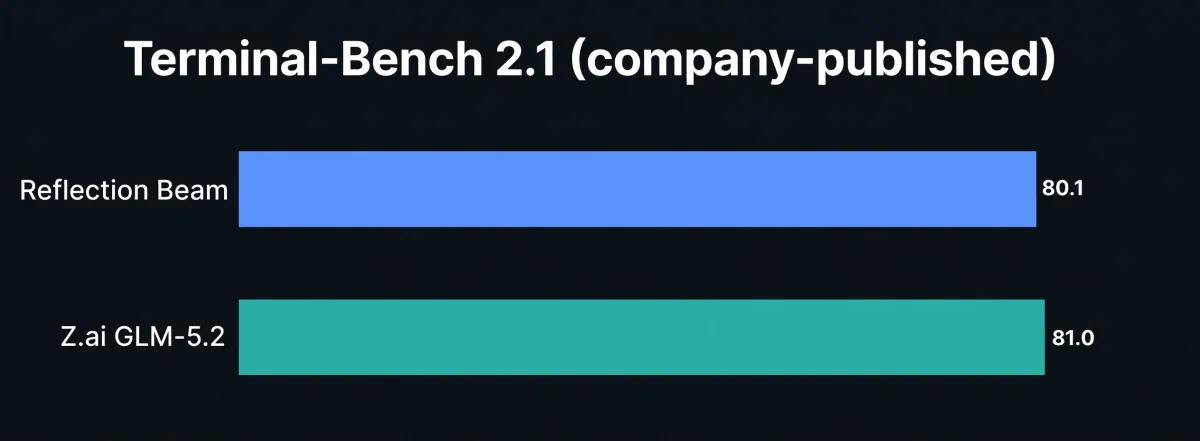
| Terminal-Bench 2.1 | 80.1 | 81.0 |
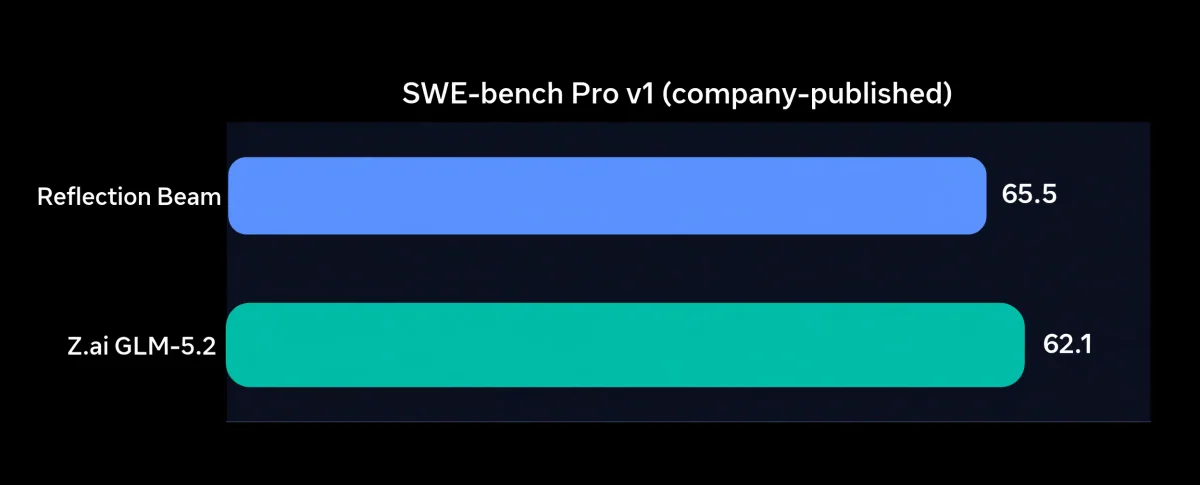
| SWE-bench Pro v1 | 65.5 | 62.1 |
On Terminal-Bench 2.1, an agentic terminal-task benchmark, Beam lands just behind GLM-5.2 (80.1 vs 81.0), and Reflection's own scorecard shows it trailing Kimi K3 and Qwen 3.8-Max on this test too. On SWE-bench Pro v1, a software engineering benchmark, Beam edges ahead of GLM-5.2 (65.5 vs 62.1).
Reflection also claims Beam outscores Inkling, the open model from Mira Murati's Thinking Machines Lab released in July, on four coding tests where both labs report numbers. Note the asymmetry: Inkling is multimodal and Beam is text-only, so this is a coding-only comparison.
And the efficiency headline: Reflection says these reasoning scores come at three to four times less inference compute than rival Western open models. One important footnote from independent coverage: Reflection's estimate is a model-compute comparison built on benchmark data from Artificial Analysis and DataCurve, and it excludes prompt prefill, attention overhead and serving costs. So do not read "3-4x less compute" as "3-4x cheaper for you to run" until real serving benchmarks land.
How Beam got efficient: the training story
Reflection credits high-compute reinforcement learning: instead of just adding parameters, the training was designed to make the model reason in fewer steps. The reported scale is striking: 10,500 Nvidia GB300 GPUs for a four-week reinforcement learning run generating more than 100 million rollouts, per Reflection's technical announcement.
The company has also been locking up the hardware to keep training. This summer Reflection signed compute deals collectively worth more than $7 billion with SpaceX and Nebius, securing access to Nvidia GB300 chips through 2029.
The company behind Beam
Reflection AI was founded in 2024 by two former Google DeepMind researchers and has raised roughly $4.7 billion from backers including Nvidia, Sequoia Capital and Lightspeed Venture Partners, per PitchBook. Its last round valued the company at a $25 billion pre-money valuation. That is an enormous war chest for a two-year-old lab, and it signals how seriously investors take the "Western answer to DeepSeek and Qwen" thesis.
The business model: AI factories, not chatbots
Reflection is not chasing a consumer chatbot. The pitch is "AI factories": selling enterprises and sovereign nations the ability to build their own customized, local AI systems by training Reflection's models on their own proprietary data. Nvidia CEO Jensen Huang, whose company backs Reflection, has long championed the AI factory idea. Reflection has already begun testing a sovereign AI factory partnership with Shinsegae Group in South Korea, and Axios reports hedge funds and trading firms are among the eager early prospects.
This is a smart lane. Reflection knows it cannot out-distribute Anthropic or OpenAI on consumer reach, so it is selling where open weights are a feature, not a compromise: regulated industries and governments that want the model inside their own walls.
Price and availability: what it will cost
There is no public API pricing for Beam yet, and no token price to put in a table. Here is what we know:
- The weights are promised under the Apache 2.0 license later in October, which means you can self-host: your cost is your own compute, and the 3-4x efficiency claim is the pricing story.
- Reflection describes Beam's token cost as "a fraction" of rival models, but has not published dollars per million tokens.
- Distribution is planned through hyperscalers and neoclouds, with open source library integrations at launch, and early access is currently by sign-up.
If you are budgeting today, price it against the models you can actually buy: Google's Gemini 4 Argon lists at $2 per million input tokens and $10 per million output tokens, and Anthropic's Claude Sonnet 5.5 holds at $2/$10. Beam's pitch is to undercut that class of pricing once it is servable. We covered both of those models in detail: Gemini 4 Argon: Google's comeback flagship and Claude Opus 5.5, the most powerful AI model.
Who should care, and what to do now
Enterprises that want open weights without depending on Chinese labs. Beam is the first serious Western attempt at matching GLM-5.2 class reasoning with better efficiency. Wait for the October weights drop and independent verification before planning around it.
Developers and teams running agents at scale. If the 3-4x compute claim survives independent testing, Beam could materially cut serving costs for coding and agentic workloads. Until then, keep your current stack.
Anyone building AI agents for business. Open weights plus strong agentic benchmark scores is exactly the combination that makes self-hosted agents economical. If you are exploring that path, see our AI agent development services and how to hire an AI automation agency.
FAQ
What is Reflection AI Beam?
Beam is the first frontier open-weight AI model from Reflection AI, a Nvidia-backed startup founded in 2024 by two former Google DeepMind researchers. It is a text-only mixture-of-experts model with 501 billion total parameters and 23 billion active per token.
When will Beam's weights be released?
Reflection says the weights, full technical details, a technical report and developer tools will be released later in October 2026 under the Apache 2.0 license. As of the October 5 announcement, they are not public yet.
Is Beam better than Z.ai's GLM-5.2?
On Reflection's own published scorecard, Beam trails GLM-5.2 slightly on Terminal-Bench 2.1 (80.1 vs 81.0) and leads slightly on SWE-bench Pro v1 (65.5 vs 62.1). Reflection's real claim is efficiency: similar reasoning at 3-4x less inference compute. None of this is independently verified yet.
How much does Beam cost to use?
No public pricing has been announced. Because the weights will be Apache 2.0 licensed, organizations can self-host and pay only their own compute costs.
What license is Beam released under?
Apache 2.0, according to Reflection. That is a permissive open license that allows commercial use and modification.
Who founded Reflection AI?
Two former Google DeepMind researchers founded the company in 2024. It has raised about $4.7 billion, with Nvidia, Sequoia Capital and Lightspeed among its backers, per PitchBook.
Is Beam multimodal?
No. Beam is text-only. That is worth remembering when comparing it against multimodal open models like Inkling.
What is Reflection's "AI factory" strategy?
Instead of a consumer product, Reflection plans to sell enterprises and governments complete localized AI systems, "AI factories", built on its models and trained on the customer's proprietary data. A pilot with South Korea's Shinsegae Group is already underway.
- Reflection AI
- Beam
- open-weight AI
- GLM-5.2
- AI benchmarks
- AI news