IA8 min de lecturePar JH Akash
Grok Voice 3.0 vs GPT-Live-1 vs Gemini Live: Benchmarks, Price, and Which Voice AI to Pick
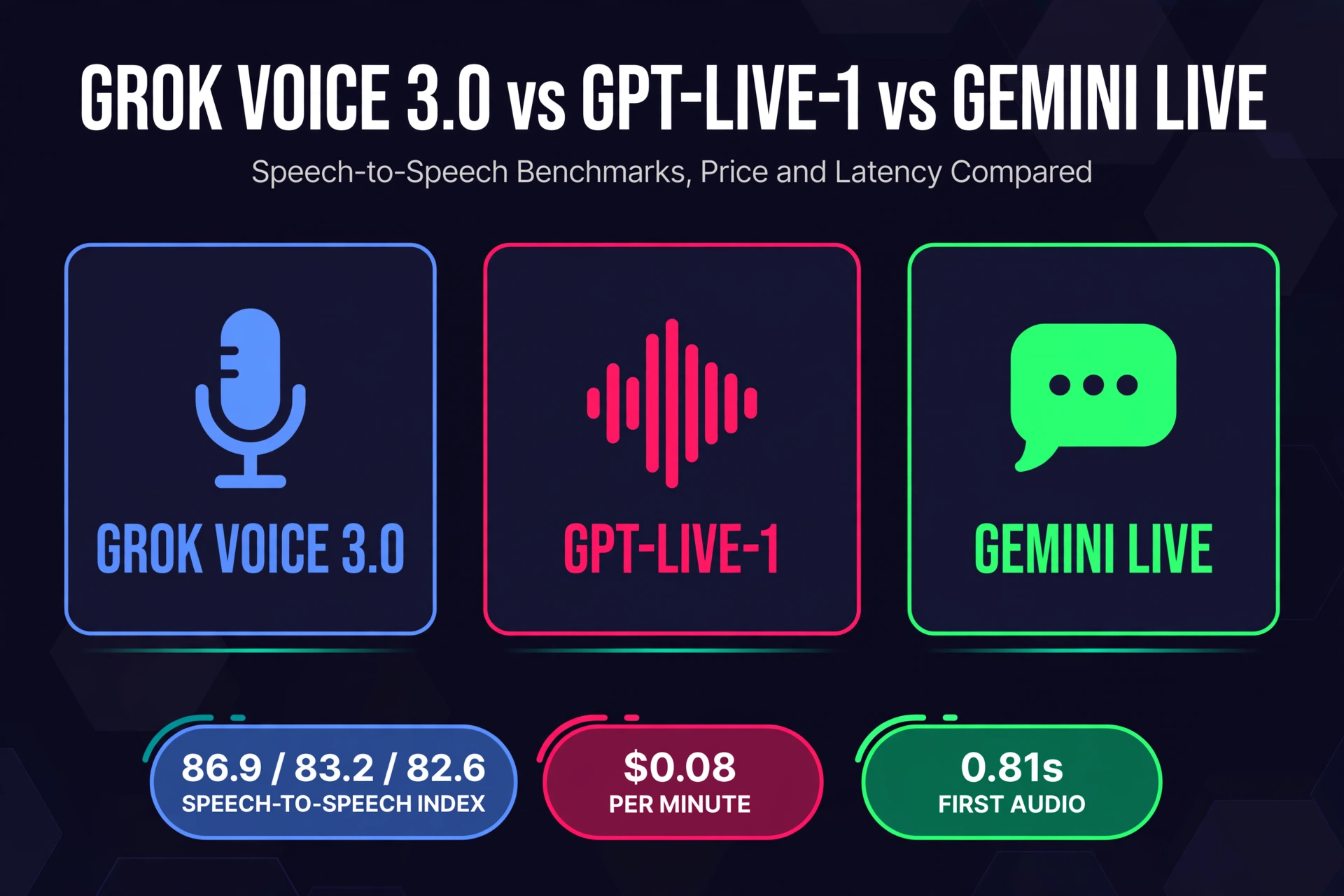
xAI released Grok Voice 3.0 on October 14, 2026. It leads the Artificial Analysis Speech-to-Speech Index at 86.9, costs $0.08 per minute, and answers in 0.81 seconds. Here is how it compares to OpenAI GPT-Live-1 and Google Gemini Live.
What happened on October 14
xAI released Grok Voice 3.0 on October 14, 2026, its newest speech-to-speech model for real-time voice agents. It is available now through the xAI Voice Agent API at the same price as its predecessor, and every agent configured to use the grok-voice-latest alias was upgraded automatically, with no code change required.
The headline claim is big: in independent testing by Artificial Analysis dated October 13, 2026, Grok Voice 3.0 ranks first on the Speech-to-Speech Index with a score of 86.9, ahead of OpenAI GPT-Live-1 at 83.2 and Google Gemini 3.8 Live at 82.6. All benchmark figures in this post are vendor-cited from that Artificial Analysis testing unless noted otherwise, and they have not been independently re-verified by us.
So is Grok Voice 3.0 actually the best voice AI you can build on today? The honest answer is that it depends on what your voice agent has to do. Grok leads the overall index, but OpenAI still wins the one benchmark that most closely resembles a real support call. Here is the full breakdown.
Quick verdict
| Model | Best for | One line summary |
|---|---|---|
| Grok Voice 3.0 | Fast, high-volume support and sales calls | Highest overall index score, lowest latency, flat per-minute price |
| GPT-Live-1 (Astra, Medium) | Complex support calls where task completion matters most | Leads the tau-Voice support-call test at 74.5 percent |
| Gemini 3.8 Live (Ext. Thinking, High) | Teams already deep in Google Cloud | Strong reasoning, but trails on support-call success and conversation flow |
No single benchmark decides this. A model can top an overall index and still lose the test that matches your use case, which is exactly what happens here.
Benchmarks: Grok Voice 3.0 vs GPT-Live-1 vs Gemini Live
The Artificial Analysis Speech-to-Speech Index combines speech reasoning, support-call performance, and preference plus task success from blind head-to-head calls.
| Benchmark | Grok Voice 3.0 | GPT-Live-1 (Astra, Medium) | Gemini 3.8 Live (Ext. Thinking, High) | Grok Voice 2.0 |
|---|---|---|---|---|
| Speech-to-Speech Index (overall) | 86.9 | 83.2 | 82.6 | 81.3 |
| Big Bench Audio (speech reasoning) | 98.5% | 90.1% | 97.7% | 97.2% |
| Speech Agent Arena (human preference Elo) | 1070 | 1048 | 990 | 1011 |
| Task Success Rate | 94.8% | 87.4% | 89.1% | 94.6% |
| Full Duplex Bench (pauses, turn-taking, interruptions) | 97.0% | 94.9% | 91.9% | 95.1% |
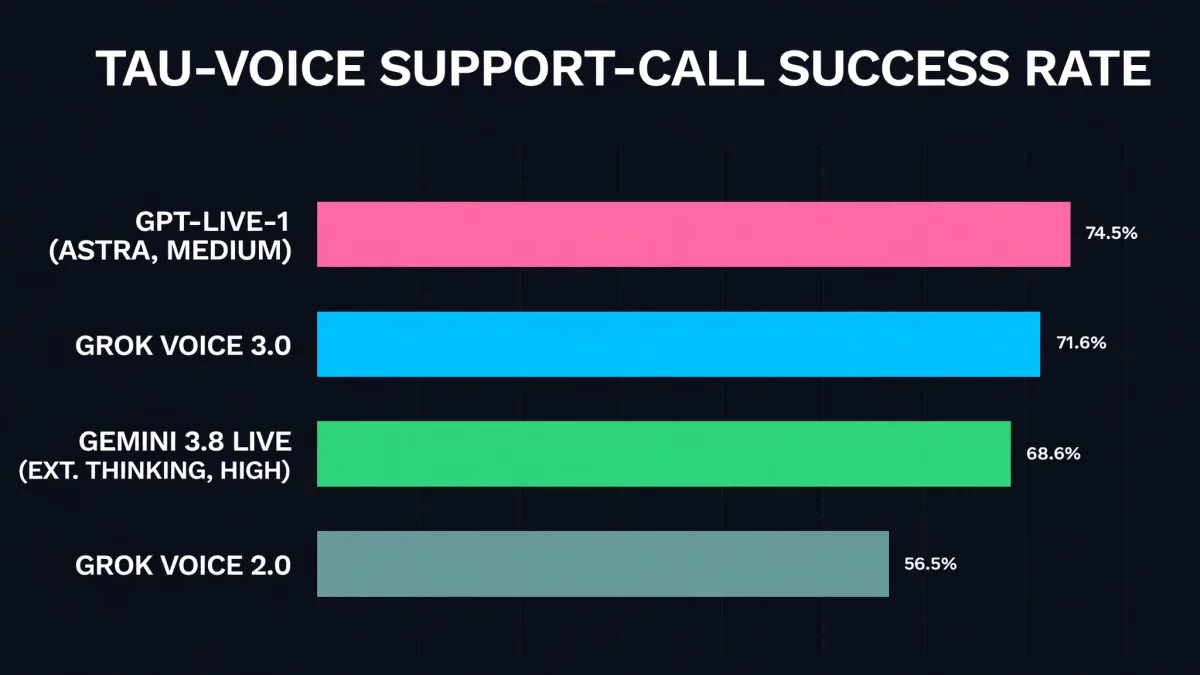
| tau-Voice (support-call task success) | 71.6% | 74.5% | 68.6% | 56.5% |
| Time to first audio | 0.81s | 1.34s | Not published in announcement | 0.70s |
| EVA-Bench accuracy (ServiceNow, 200+ enterprise scenarios) | 74% | Not published in announcement | Not published in announcement | Not published in announcement |
Three things stand out in this table.
First, the generation-over-generation jump is real. Grok Voice 3.0 improves on 2.0 on every index component, and the tau-Voice leap from 56.5 percent to 71.6 percent is the largest single gain. That is the difference between a voice agent that finishes roughly half of support calls and one that finishes nearly three quarters of them.
Second, tau-Voice is the one test Grok does not win. GPT-Live-1 leads it 74.5 percent to 71.6 percent. Tau-Voice simulates support calls with diverse accents, background noise, and interruptions, so if your agent handles messy real-world calls, this is the number to weight most heavily. xAI describes its result as comparable at about 40 percent lower latency, which is a fair framing, but on raw task success OpenAI is still ahead.
Third, latency is Grok's clearest edge. Time to first audio is 0.81 seconds versus 1.34 seconds for GPT-Live-1 in the same test setup, roughly 40 percent lower. Note that this measures when the response starts, not how long a task takes to finish, and Grok Voice 2.0 was actually slightly quicker to start at 0.70 seconds. Still, sub-second first audio is what makes a voice agent feel human instead of robotic, and Grok delivers it.
On ServiceNow's open-source EVA-Bench, which tests enterprise voice agents across more than 200 scenarios, xAI reports 74 percent accuracy for Grok Voice 3.0, the best score when accuracy and customer experience are scored together. This is an xAI-reported figure from launch material, not an independent re-test.
Pricing: what a minute of voice AI costs
| Model | API price | Notes |
|---|---|---|
| Grok Voice 3.0 | $0.08 per minute ($4.80 per hour) | Flat per-minute price through the Voice Agent API, unchanged from Grok Voice 2.0 |
| GPT-Live-1 (Astra, Medium) | Token-based, varies by session | OpenAI prices realtime voice by input and output tokens, so per-minute cost depends on talk time and reasoning effort |
| Gemini 3.8 Live (Ext. Thinking, High) | Token-based, varies by session | Google prices live voice by tokens; extended thinking raises cost per session |
Flat per-minute pricing is a practical advantage for budgeting. With Grok Voice 3.0, a business running 10,000 minutes of calls a month pays $800, with no surprise bill from a long reasoning chain. Token-based pricing can be cheaper for short, simple calls and more expensive for long, reasoning-heavy ones, so compare using your own call lengths, not the headline rate.
Artificial Analysis also measured cost per task on its Big Bench Audio run: $0.025 for Grok Voice 3.0, versus $0.030 for GPT-Live-1 (Astra, Medium) and $0.055 for OpenAI GPT-Realtime-2.1 (High). On that measure, Grok is both the fastest and the cheapest per completed task among the three.
Already proven in production
Unlike many benchmark launches, Grok Voice arrives with production mileage. According to xAI, Grok Voice powers millions of conversations a day across Tesla and SpaceX. Starlink customer support handles roughly 20,000 calls a day with the model, about 70 percent resolved without human intervention, and roughly a quarter of sales calls end in a purchase before hang-up. These are xAI-reported operational figures, not independently verified, but they explain why xAI is pitching this model at support and sales teams first.
In Tesla vehicles, Grok Voice handles in-car conversations, including checking calendars and answering email through Connectors, while longer tasks like ordering coffee or booking dinner go through Grok Bot, whose voice mode also runs on the new model.
The platform supports full-duplex conversations, interruption handling, tool calling, search, multilingual speech in more than 25 languages, expressive voices, and custom voice cloning. Those are platform capabilities of the Grok Voice product line rather than version-specific changes in 3.0.
The catch: the auto-upgrade
There is one operational detail every developer should know. Agents pointed at the grok-voice-latest alias were moved to Grok Voice 3.0 automatically on October 14. That is convenient, and it is also a behavior change: tau-Voice task success jumping from 56.5 percent to 71.6 percent means the model completes calls differently, from when it yields a turn to when it hands off or asks a follow-up question. Prompts tuned against 2.0 may behave differently on 3.0. If your voice agent runs in production, pin the model version explicitly and re-test your prompts before you trust the new behavior on live calls.
Which voice AI should you pick?
Pick Grok Voice 3.0 if you run high-volume support or sales calls, need sub-second first audio, want predictable per-minute pricing, or already use the xAI Voice Agent API. The combination of the highest overall index score, the lowest latency, and flat pricing is hard to beat for call centers and phone-based sales.
Pick GPT-Live-1 if your calls are complex and messy, with heavy accents, noise, and interruptions, and you value task completion over speed. Its tau-Voice lead is small but real, and it is the safer choice when a failed call costs more than a slow one.
Pick Gemini 3.8 Live if your stack is already on Google Cloud and you want one vendor for voice, text, and agents. It trails on support-call success and conversation flow in these tests, but ecosystem fit can outweigh a few benchmark points.
If you already run Grok Voice 2.0, upgrade, but do it deliberately: pin the version, re-run your test calls, and watch handoff rates for the first week. The improvement is large enough to justify the migration, and the auto-upgrade means you may already be on 3.0.
For most businesses building their first AI voice agent, Grok Voice 3.0 is now the default starting point: cheapest per task, fastest to respond, and proven at Starlink-scale call volume. Just validate it against your own calls before you declare it the winner for your business, because your callers are not a benchmark.
Want to build a voice agent on one of these models? CodeMyPixel builds AI agent development services for businesses, from voice receptionists to full support automation. See also our breakdown of Grok Bot and the AI bots worth stealing ideas from and our small-model comparison of Claude Haiku 5.5 vs GPT-6 Luna.
FAQ
What is Grok Voice 3.0?
Grok Voice 3.0 is xAI's speech-to-speech AI model for real-time voice agents, released on October 14, 2026. It listens and speaks directly, without a separate speech-to-text and text-to-speech pipeline, which is what keeps its latency under one second.
How much does Grok Voice 3.0 cost?
Grok Voice 3.0 costs $0.08 per minute, or $4.80 per hour, through the xAI Voice Agent API. The price is unchanged from Grok Voice 2.0.
Is Grok Voice 3.0 better than GPT-Live-1?
On the overall Artificial Analysis Speech-to-Speech Index, yes: 86.9 versus 83.2. On the tau-Voice support-call test, no: GPT-Live-1 leads 74.5 percent to 71.6 percent. Grok is faster and cheaper per task; GPT-Live-1 completes slightly more messy support calls.
What is the latency of Grok Voice 3.0?
xAI reports class-leading latency under one second. In Artificial Analysis testing, time to first audio was 0.81 seconds for Grok Voice 3.0 versus 1.34 seconds for GPT-Live-1 (Astra, Medium), roughly 40 percent lower.
Does Grok Voice 3.0 replace Grok Voice 2.0 automatically?
Yes, for agents configured to use the grok-voice-latest alias. They were upgraded to 3.0 automatically on October 14, 2026, with no code change. Pin an explicit model version if you want to control upgrades yourself.
Which voice AI should a business pick for support calls?
For high-volume, speed-sensitive support and sales calls, Grok Voice 3.0 is the strongest starting point on these numbers. For complex calls where completion rate matters more than speed, GPT-Live-1 is the safer choice. Always test with your own real calls before committing.
What languages does Grok Voice support?
The Grok Voice platform supports multilingual speech in more than 25 languages, along with full-duplex conversation, interruption handling, tool calling, and voice cloning.
- Grok Voice 3.0
- xAI
- Voice AI
- GPT-Live-1
- Gemini Live
- AI agents