IA8 min de lecturePar JH Akash
DeepSeek V4.1-Flash-1017 Explained: Benchmarks, Price, and Search API
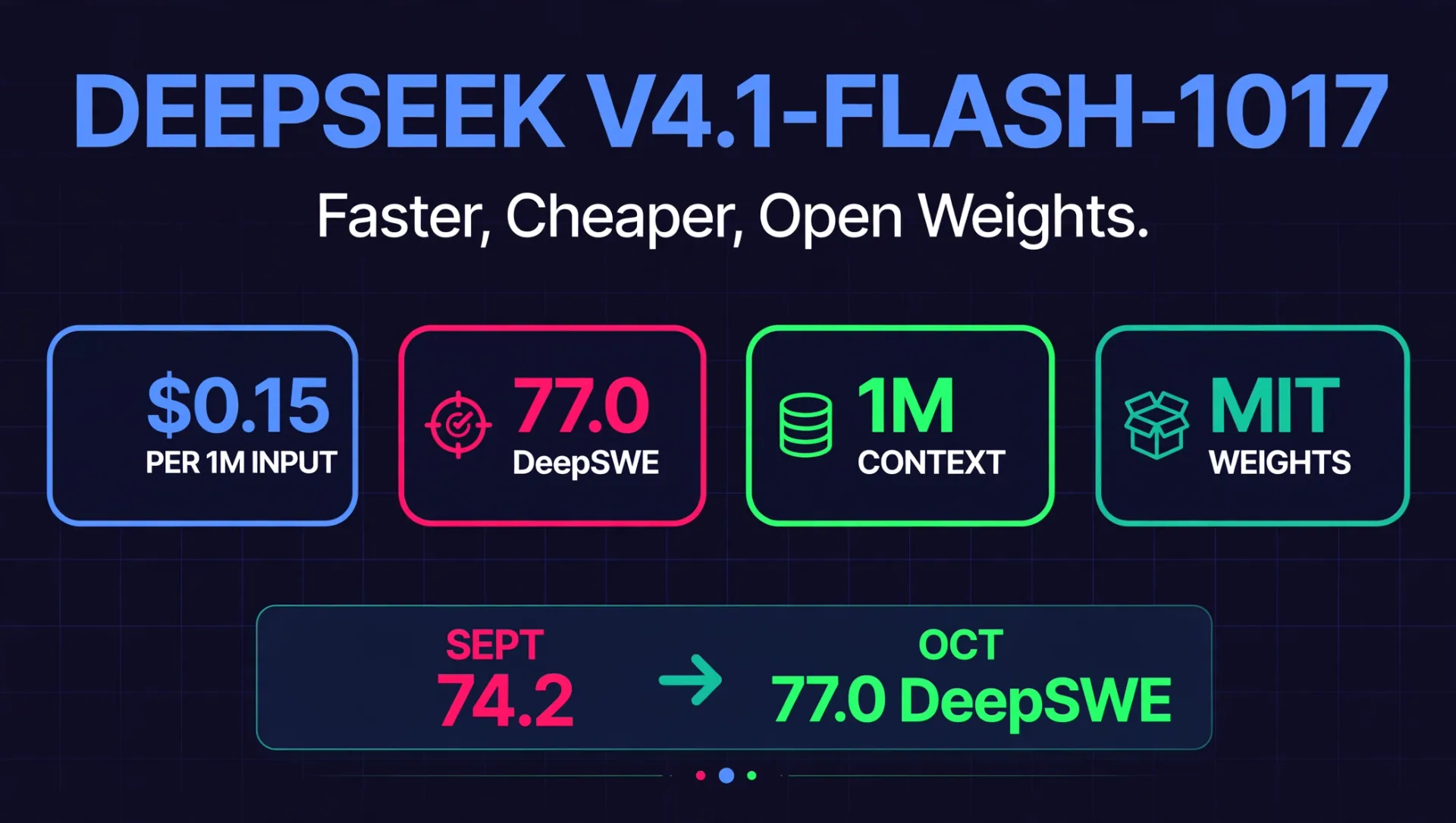
DeepSeek released V4.1-Flash-1017 on October 17, 2026: higher scores on all 11 reported benchmarks, the same low API price, 1M context, MIT-licensed weights, and a new Search and Fetch API. Here is what changed and who should use it.
What happened
DeepSeek released DeepSeek-V4.1-Flash-1017 on October 17, 2026, a post-training refresh of the V4.1-Flash model it launched on September 10. It is live on DeepSeek's website, app, and API under the deepseek-flash model name. DeepSeek calls it a Pareto improvement: stronger scores, faster task completion, and shorter outputs, at the same price.
This is a launch breakdown with verified numbers. Every benchmark score below is DeepSeek's own figure, from its model card and API change log, and none has been independently reproduced yet. Prices come from DeepSeek's published pricing page. Where the evidence is thin, this post says so.
Quick verdict
| Question | Answer |
|---|---|
| What is it? | An updated checkpoint of DeepSeek V4.1-Flash, tuned for coding and agentic work |
| Released | October 17, 2026 |
| Biggest gain | All 11 reported benchmarks improved, led by Terminal-Bench 4.0, up 11.1 points |
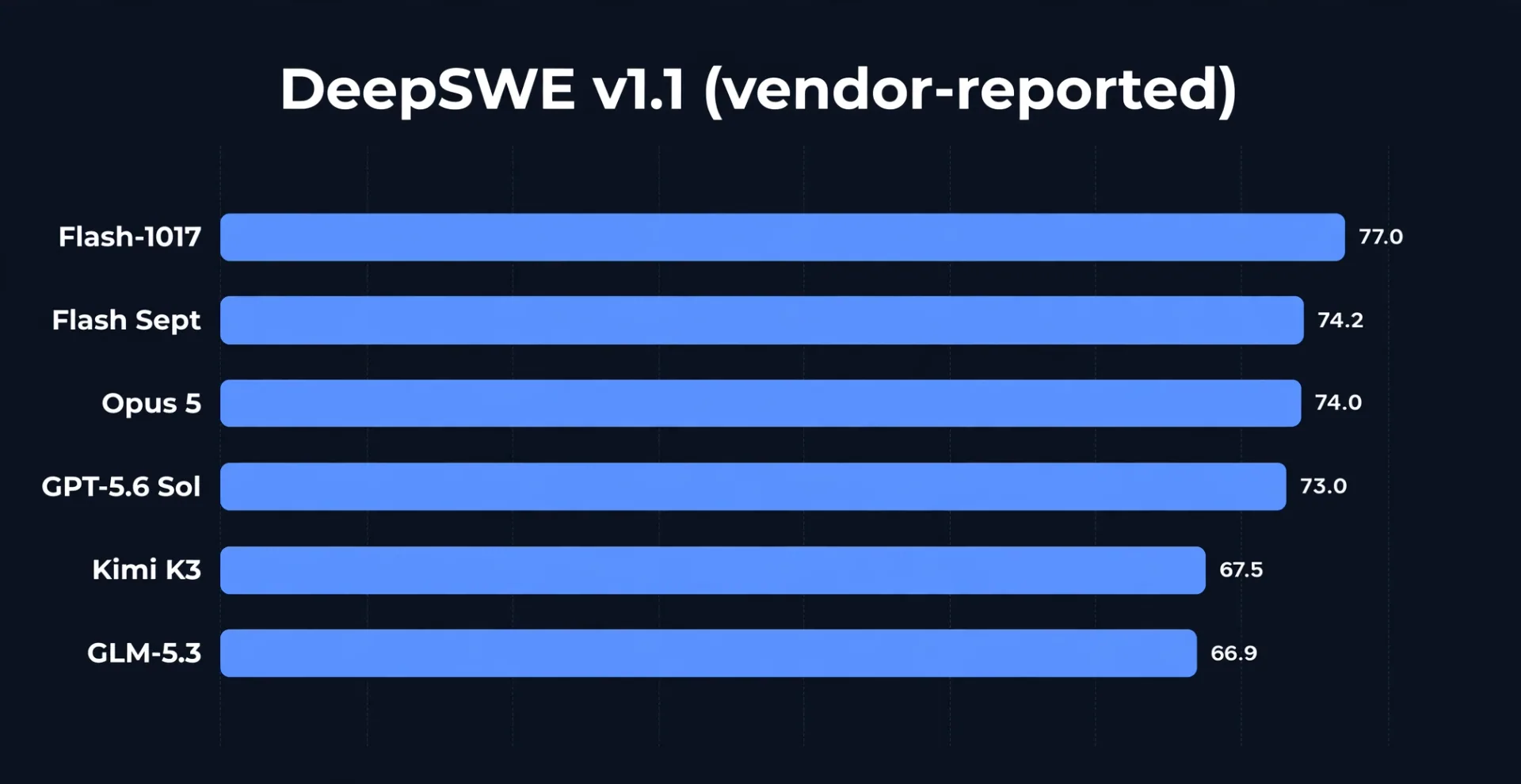
| Headline score | 77.0 on DeepSWE v1.1, ahead of Claude Opus 5 at 74.0 in DeepSeek's own table |
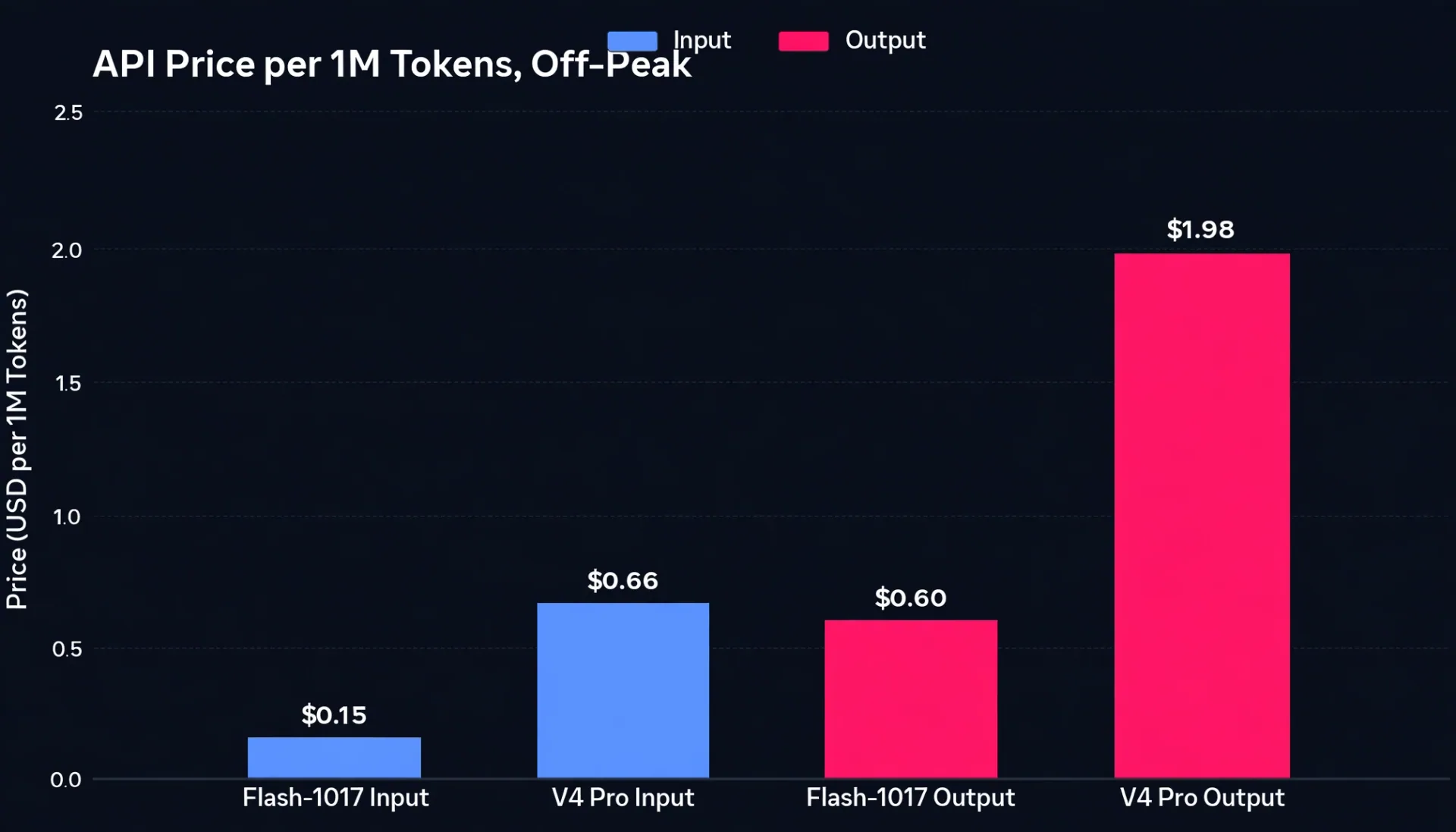
| Price change | None. Off-peak API price is still $0.15 per 1M input tokens and $0.60 per 1M output tokens |
| Context | 1,048,576 tokens, with up to 384,000 output tokens |
| Weights | Published on Hugging Face, reported as MIT-licensed, 510.3 GB across 48 files |
| New besides the model | Search and Fetch APIs, $0.75 per 1,000 successful requests each |
| Skip it if | You need the strongest reasoning on every benchmark, or you need independently verified scores before you switch |
What changed in V4.1-Flash-1017
The update is a post-training refresh, not a new architecture. The architecture comes from the V4.1-Flash technical report: a multimodal mixture-of-experts model with a 552 billion parameter backbone plus 196 billion Engram parameters. It activates only 8 billion parameters per token when reading a prompt and 16 billion when generating text, which is why it is cheap to serve despite its size.
Three engineering details explain the cost story:
- Causal Encoder-Decoder (CED): 40 Transformer layers split into a 20-layer causal encoder and a 20-layer decoder. Projecting decoder KV from encoder states nearly halves prefill compute.
- Compressed KV cache: Global KV drops to 890 bytes per token, about one quarter of the previous Flash generation. At the full 1,048,576-token window, that is about 0.93 GB of GPU cache.
- Native image understanding: Visual and text embeddings are trained jointly from the start of pre-training, so the model takes text and image input and returns text.
DeepSeek says the model finishes tasks faster and produces shorter outputs, which would lower bills even at an unchanged price per token. The model card does not publish the task-time or output-length figures, so that saving cannot be sized yet.
Benchmarks: September vs October
All scores are DeepSeek's own. Benchmarks have different scales and are not averaged.
| Benchmark | V4.1-Flash (Sept 10) | V4.1-Flash-1017 (Oct 17) | Change |
|---|---|---|---|
| Terminal-Bench 4.0 | 31.2 | 42.3 | +11.1 |
| ProgramBench | 20.3 | 29.1 | +8.8 |
| Apex Bench v1.1 | 64.6 | 72.1 | +7.5 |
| HLE, no tools (text-only subset) | 36.8 (39.1) | 42.6 (44.0) | +5.8 |
| Automation-Bench v1.0.6 | 54.8 | 60.5 | +5.7 |
| Chartography, with tools | 78.9 | 83.0 | +4.1 |
| Agents' Last Exam | 31.8 | 35.4 | +3.6 |
| BabyVision, with tools | 89.6 | 92.5 | +2.9 |
| DeepSWE v1.1 | 74.2 | 77.0 | +2.8 |
| NL2Repo-Bench | 65.4 | 68.2 | +2.8 |
| ZeroBench-main, with tools | 49.0 | 51.0 | +2.0 |
The largest gains are in agentic coding and automation. Terminal-Bench 4.0 rose 36 percent and ProgramBench 43 percent. The smallest gains are on the image tests and on DeepSWE, where the model was already strong.
Against rivals: what DeepSeek's own table shows
DeepSeek's model card lines the new checkpoint up against four rivals. Treat this as a claim to test, not a ranking, because DeepSeek chose the comparisons and the settings.
| Benchmark | Flash-1017 | Kimi K3 | GLM-5.3 | GPT-5.6 Sol | Claude Opus 5 |
|---|---|---|---|---|---|
| DeepSWE v1.1 | 77.0 | 67.5 | 66.9 | 73.0 | 74.0 |
| Terminal-Bench 4.0 | 42.3 | 12.6 | 37.9 | 39.9 | 51.8 |
| Automation-Bench v1.0.6 | 60.5 | 46.7 | 48.8 | 45.8 | 50.3 |
| Agents' Last Exam | 35.4 | 27.6 | 28.5 | 26.7 | 28.6 |
| Apex Bench v1.1 | 72.1 | 47.8 | 56.6 | 54.3 | 65.8 |
| ProgramBench | 29.1 | 17.5 | 19.0 | 23.0 | 37.0 |
| NL2Repo-Bench | 68.2 | 58.0 | 58.0 | 56.8 | 75.3 |
| HLE, no tools | 42.6 | 43.5 | 42.0 | 44.5 | 56.3 |
Read it honestly: Flash-1017 leads on DeepSWE, Automation-Bench, Agents' Last Exam, and Apex Bench. Claude Opus 5 still leads on Terminal-Bench 4.0, ProgramBench, NL2Repo-Bench, and HLE, with the widest gaps on HLE (56.3 vs 42.6) and Terminal-Bench (51.8 vs 42.3). In DeepSeek's table, the new model beats Kimi K3 on 10 of 11 tests and GPT-5.6 Sol on 9 of 11, while trailing Opus 5 on 7 of 11. No cross-benchmark winner can be declared from this, because different benchmarks measure different skills.
Harness choices matter too. DeepSeek says it ran Terminal-Bench 4.0 in the Claude Code harness and DeepSWE in the Mini-SWE-V2 harness, and that ZeroBench allowed five attempts (Pass@5). A different harness or attempt limit can move a score, and several of these gains are only two to three points.
Pricing: unchanged, and that is the point
| DeepSeek API price, per 1M tokens | Off-peak | Peak |
|---|---|---|
| Flash-1017, input, cache miss | $0.15 | $0.30 |
| Flash-1017, input, cache hit | $0.003 | $0.006 |
| Flash-1017, output | $0.60 | $1.20 |
| V4 Pro 0813, input, cache miss | $0.66 | $1.32 |
| V4 Pro 0813, input, cache hit | $0.022 | $0.044 |
| V4 Pro 0813, output | $1.98 | $3.96 |
Peak hours are 01:00 to 04:00 and 06:00 to 10:00 UTC, Monday to Friday, excluding Chinese public holidays. Weekends are off-peak all day.
What this means in practice:
- One 1M-token prompt with no cache hit costs $0.15 off-peak or $0.30 at peak.
- The same prompt re-read from cache costs $0.003 off-peak or $0.006 at peak.
- 100,000 tokens of output cost $0.06 off-peak or $0.12 at peak.
- A hypothetical agent run of 2M input tokens with 80 percent cache hits plus 100,000 output tokens costs about $0.12 off-peak or $0.25 at peak.
Against DeepSeek's own larger model, Flash charges about one quarter of V4 Pro for uncached input and about one third for output. Pro is the stronger model on DeepSeek's feature table, and it is text-only, while Flash accepts images. Pick on capability first, price second.
New: DeepSeek Search and Fetch APIs
Alongside the model, DeepSeek opened its in-house search engine to every developer through two new endpoints on api.deepseek.com: POST /v1/tools/search and POST /v1/tools/fetch. The Search API returns ranked web results for a query. The Fetch API returns a single page as Markdown. DeepSeek says its engine serves hundreds of millions of requests daily.
- Price: $0.75 per 1,000 successful requests for each endpoint. Empty results and failures are free.
- Search options: 1 to 50 results, optional page content, and operators like
site:,lang:,after:, andbefore:. - Result fields: Each result carries a 0 to 3 rerank score and a 0 to 4 authority tier.
- Rate limit: 5 queries per second per account for each API.
- Free window: Server-side calls via DeepSeek Harness, Claude Code, or Codex stay free until November 1, 2026.
For agent builders, the combination matters: a cheaper coding model plus a first-party web layer behind one API key. For comparison, Brave lists its search API at $5 per 1,000 requests and Exa's search starts at $4 per 1,000, though features differ, so this is not a like-for-like comparison.
What to watch before you trust the numbers
- No independent reproduction yet. The weights are public, so outside labs can rerun the tests. Until they do, the benchmark gains remain DeepSeek's claims.
- Robustness limits. DeepSeek's own report says the new design creates robustness limits that are not yet fully characterized, and that selection errors in sparse attention and approximate state reconstruction in the cache-replay system may degrade capability in untested edge cases. It also says internal tests found no systematic degradation.
- Reliability. Earlier in the same week, DeepSeek suffered an outage of about five hours, leaving its servers unreachable. Some experts attributed it to insufficient computing resources. Aggressively priced models draw heavy demand, and that pressure shows up in service stability.
- License check. Multiple launch reports describe the weights as MIT-licensed on Hugging Face. One launch-day roundup noted the 1017 checkpoint's own license line was not clearly disclosed. Check the model card before commercial use.
Which to pick
- Pick Flash-1017 for high-volume coding agents, long-context repository work, and cost-sensitive production, or if you want to self-host open weights.
- Pick V4 Pro when you need DeepSeek's strongest model and can pay roughly 4.4 times more for uncached input and 3.3 times more for output.
- Pick Claude Opus 5 when Terminal-Bench and HLE-style reasoning matter most and price is secondary. In DeepSeek's own table, it still leads where reasoning depth counts.
- Pick GPT-5.6 Sol only after testing it on your own workload. In DeepSeek's table, Flash-1017 beats it on 9 of 11 tests, but vendor tables are not a substitute for your own evals.
The practical move for most teams: run Flash-1017 on a real slice of your own agent workload, measure task completion and cost per completed task, and compare against whatever you run today. Benchmark tables tell you where to look. Your own evals tell you what to buy.
FAQ
What is DeepSeek V4.1-Flash-1017?
It is an updated post-training checkpoint of DeepSeek V4.1-Flash, released October 17, 2026. It is served through the deepseek-flash API name and is tuned for coding, agentic, and long-context work, with text and image input and text output.
How much does DeepSeek V4.1-Flash-1017 cost?
Off-peak, $0.15 per 1M uncached input tokens, $0.003 per 1M cached input tokens, and $0.60 per 1M output tokens. Peak rates are double. The October 17 update did not change API prices.
Is DeepSeek V4.1-Flash-1017 open source?
The weights are published on Hugging Face and reported as MIT-licensed, which makes it an open-weight model. One launch-day roundup flagged that the 1017 checkpoint's own license line was not clearly disclosed, so verify the model card before commercial use.
How does V4.1-Flash-1017 compare to Claude Opus 5?
In DeepSeek's own table, Flash-1017 leads on DeepSWE (77.0 vs 74.0), Automation-Bench, Agents' Last Exam, and Apex Bench. Opus 5 leads on Terminal-Bench 4.0 (51.8 vs 42.3), ProgramBench, NL2Repo-Bench, and HLE (56.3 vs 42.6). Neither model wins everywhere.
What is the DeepSeek Search API?
A first-party web search and page-fetch layer at api.deepseek.com, priced at $0.75 per 1,000 successful requests per endpoint. Server-side calls via DeepSeek Harness, Claude Code, or Codex are free until November 1, 2026.
Should I switch my coding agent to V4.1-Flash-1017?
Test it first on your own workload. The price is hard to beat, the DeepSWE and Automation-Bench scores are strong, and the open weights make self-hosting possible. But the scores are vendor-reported, the robustness limits are not fully characterized, and Opus 5 still leads on several reasoning-heavy tests. Measure cost per completed task, not cost per token.
Related reading
- Meta Muse Spark Open Explained: Benchmarks, License, and Mac Studio Setup
- Reflection AI Beam: Open-Weight Model Explained
- GPT-6.1 Sol vs Claude Sonnet 5.5 Comparison
- Claude Haiku 5.5 vs GPT-6 Luna
CodeMyPixel builds AI agents that do real work, from coding assistants to inbox triage and booking automation. If you want a Flash-1017 powered agent scoped to your own workflow, start with a free AI Opportunity Review.
- DeepSeek V4.1-Flash-1017
- DeepSeek
- AI Coding
- Open-Weight AI
- AI Agents