IA11 min de lecturaPor JH Akash
Custom Software Development: Cost, Process, 2026 Rates
Most custom software projects cost $30,000-$100,000 and take 3-6 months, according to GoodFirms' 2026 survey. Here is the real cost breakdown, the process step by step, and when custom beats off-the-shelf.
Every business reaches the same fork in the road. The off-the-shelf tool that got you this far starts bending your process out of shape, or it cannot do the one thing your team actually needs. That is the moment custom software development enters the conversation, and the first question is always the same: what will it cost, and how long will it take?
This guide answers both, with real 2026 numbers. The most useful anchors come from two public datasets: the GoodFirms 2026 Custom Software Development Cost Survey of more than 100 development firms, and Clutch's 2026 pricing data from verified client reviews. Where a number comes from one of those sources, we say so. Where it is a typical range rather than a quote, we say that too.
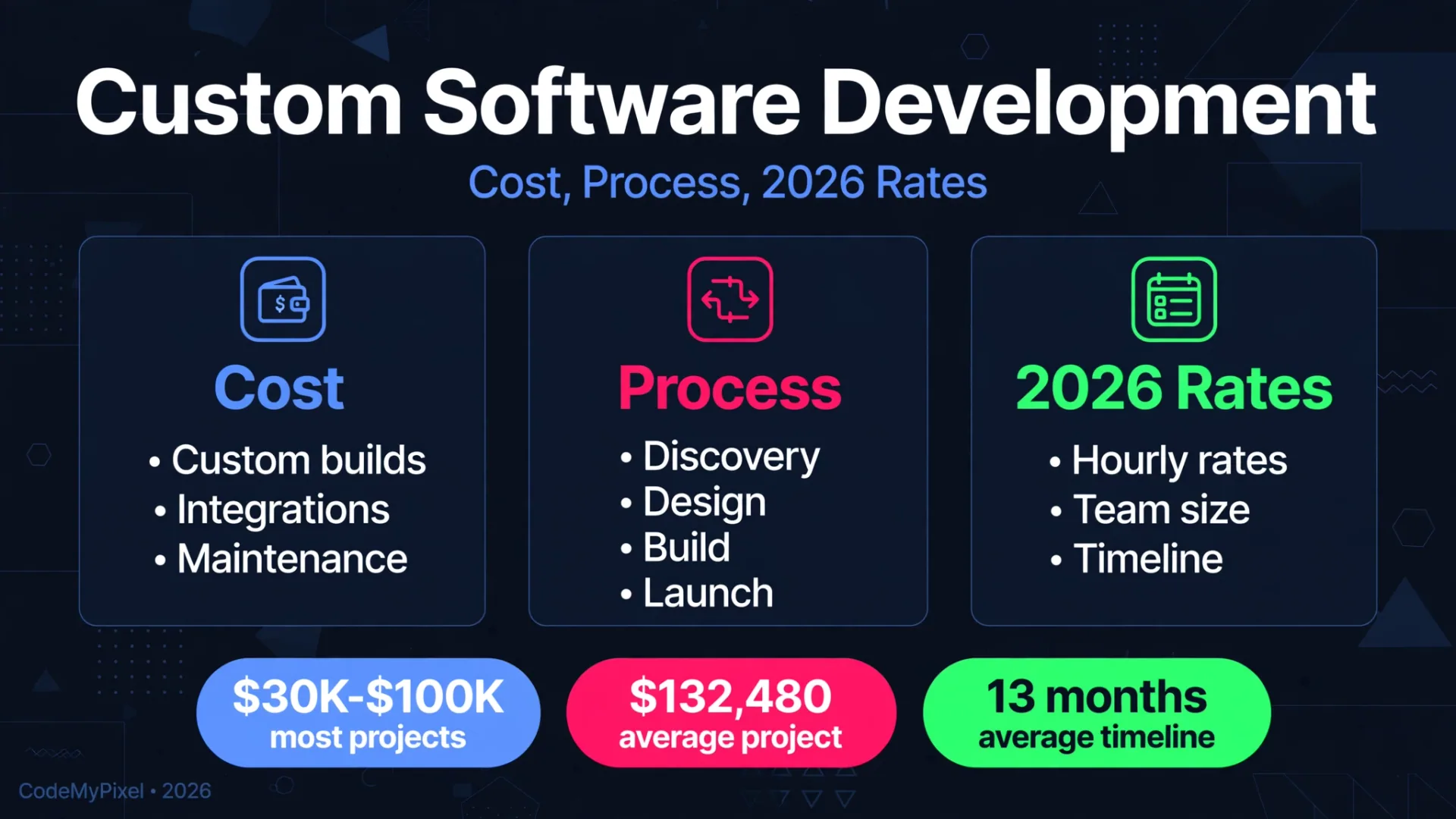
The short answer first. Most small to mid-size custom software projects land between $30,000 and $100,000 and take three to six months, according to GoodFirms' 2026 survey. Clutch's 2026 data puts the average project at $132,480 over about 13 months, though the most common range in its reviews is $10,000 to $49,999, which tells you the average is pulled up by a few very large builds. The keyword "custom software development" draws about 1,900 searches a month in the US, and advertisers pay roughly $98 per click for it, which tells you how competitive this market is.
When custom software wins, and when it does not
Custom software wins when your process is the advantage. If your team handles orders, quotes, scheduling, or client work in a way no generic tool supports, software built around that process saves hours every day. It wins when you need systems to talk to each other, when you handle regulated data, and when the tool you need does not exist yet.
It does not win when a $50-a-month SaaS product already does 90% of the job. It does not win when the problem is a one-off task, or when the process itself is broken and nobody has written it down yet. Building software on top of a messy process just makes the mess faster.
A useful test: if you can describe the exact workflow, who does each step, and what "done" looks like, custom software is worth pricing. If you cannot, spend the discovery phase on the process first. Many teams find that an AI agent that automates one repeated workflow is the cheaper first step, and a full custom build comes later once the workflow is proven.
The custom software development process, step by step
A good build follows the same six steps whether the team is two people or twenty. Skipping a step is the most common reason budgets blow out.
1. Discovery
The team maps your current process, interviews the people who will use the software, and writes down what success looks like. Expect two to four weeks. This is where the scope gets honest: what is in, what is out, and what can wait for version two.
2. Scope and design
Discovery turns into a written scope, wireframes, and a technical plan: which systems it connects to, where the data lives, and how it will be hosted. A fixed scope at this stage is what makes a fixed price possible later.
3. Build
Developers work in short cycles, usually one to two weeks each, showing you working software at the end of every cycle. This is the longest phase, and its length depends entirely on scope. A small tool takes weeks; a platform takes months.
4. Test
Testing is not a phase at the end, it runs through the whole build, but there is a dedicated pass before launch: real users, real data, edge cases, and the integrations that always break first. Budget two to four weeks for a mid-size build.
5. Launch
The software goes live, usually to a small group first, then to everyone. Data gets migrated, users get trained, and the old tool gets switched off only after the new one proves itself.
6. Support and improve
Software is never finished. GoodFirms' 2026 survey suggests budgeting 10% to 20% of the build cost per year for maintenance, hosting, and small improvements. The first three months after launch are when the most useful changes surface, because real users finally touch it every day.
How much does custom software development cost in 2026?
The table below uses GoodFirms' 2026 survey bands, cross-checked against Clutch's 2026 pricing data. These are market ranges, not quotes. Every vendor defines its tiers a little differently, and your exact price depends on scope, integrations, and where the team sits.
| Project size | Typical cost | Typical timeline | What it usually includes |
|---|---|---|---|
| Small tool or MVP | Under $30,000 | 1 to 3 months | One core workflow, basic admin, one integration, a small team of 2 to 3 people |
| Medium business system | $30,000 to $100,000 | 3 to 6 months | Several modules, user roles, 3 to 5 integrations, a team of 5 to 7 people |
| Large platform | $100,000 to $200,000 | 6 to 12 months | Multi-tenant architecture, reporting, compliance basics, several integrations |
| Enterprise system | $200,000 and up | 12 to 24 months | Legacy migration, complex permissions, high availability, phased rollout |
Two thirds of projects in the GoodFirms survey sit in that middle band, $30,000 to $100,000 over three to six months. Clutch's average of $132,480 over about 13 months sits higher because it includes enterprise builds that pull the average up.
Hourly rates explain much of the spread. Clutch's 2026 data shows most listed firms charging $25 to $49 an hour, with US firms clustering at $50 to $99 and Canadian firms at $100 to $149. The same scope can cost three times as much from a US team as from an offshore team, which is why so many buyers now mix a local lead with a distributed build team.
Timeline: how long each phase usually takes
| Phase | Small tool | Medium system | Large platform |
|---|---|---|---|
| Discovery | 1 to 2 weeks | 2 to 4 weeks | 4 to 8 weeks |
| Scope and design | 1 to 2 weeks | 2 to 4 weeks | 4 to 6 weeks |
| Build | 4 to 8 weeks | 3 to 5 months | 6 to 12 months |
| Test and launch | 1 to 2 weeks | 2 to 4 weeks | 1 to 2 months |
| Total | 1 to 3 months | 3 to 6 months | 6 to 12 months |
These are typical durations, not promises. The single biggest timeline risk is not coding speed, it is late decisions. Every week a key approval waits, the launch moves a week.
What drives the price up, and down
Seven factors move the number more than anything else.
Integrations. Every system the software must talk to adds work, and old systems add the most. An API that is documented and modern is cheap to connect. A legacy system with no API can double a module's cost.
Compliance. Healthcare, finance, and anything handling personal data needs audit trails, access controls, and evidence. GoodFirms' data puts regulated builds at 25% to 40% more time than the same build without compliance.
Team location. As the rate bands above show, geography is the largest single cost lever. A blended team, local discovery and a distributed build team, is how many mid-size buyers land in the $30,000 to $100,000 band.
Scope creep. GoodFirms' 2026 survey found that two thirds of firms say scope creep adds 10% to 25% to a project. A written scope with a change process is the cheapest insurance you can buy.
AI features. Adding an AI agent, a chatbot, or document automation to a build typically adds $40,000 to $200,000 on top, depending on whether it uses existing models or needs custom training. The GoodFirms 2026 survey found 90.6% of development teams now use AI tools across coding, testing, and planning, which has shifted where hours go rather than cutting total cost dramatically. Our own take: start with one automated workflow, prove the return, then expand. That is the same reuse-first approach we use at CodeMyPixel, and it is why we write about hiring an AI automation agency as a separate decision from commissioning a full custom build.
Design quality. A clean interface is not a luxury. If your team will use the tool eight hours a day, bad design costs more in lost time than good design costs to build.
Maintenance. Budget 10% to 20% of the build cost per year. Hosting, security updates, and small fixes never stop, and a system nobody maintains quietly becomes a security risk.
Build vs buy: a quick checklist
Answer these before you commit to a custom build.
- Does an off-the-shelf tool do at least 90% of what you need, with no workarounds that eat hours? If yes, buy it.
- Is your process genuinely different from your competitors, in a way customers pay for? If yes, build it.
- Do you need three or more systems to share data in real time? That usually means build, or at least a custom integration layer.
- Will the software still matter in three years? Custom builds pay off over years, not months.
- Can you name one person on your team who owns the project and can approve decisions weekly? Without that person, no build, custom or not, ships on time.
- Is there a smaller first version that proves the value in eight weeks? If yes, build that first. A working small system beats a promised big one.
If the checklist points to buying, buy, and spend the saved budget on automating the workflow around the tool. If it points to building, the cost tables above are your starting budget.
Risks, and how to avoid them
The never-ending project. Fix the scope in writing, agree on what "version one" means, and put every addition through a change request with a price. Scope creep is not a surprise, it is a process failure.
The vendor disappears. Ask for the source code in your repository from day one, not at the end. If a vendor will not agree to that, walk away.
Nobody uses it. The people who will use the software daily should see it every two weeks during the build, not at the launch party. Their feedback in week four is cheap. Their feedback in month nine is a rebuild.
Security as an afterthought. Ask how data is encrypted, who can access production data, and how backups are tested. These are basic questions, and a good vendor answers them before you ask.
The wrong team. Check shipped work you can verify, not slides. Our guide to choosing an AI consulting company covers the same seven checks, and they apply here word for word.
FAQ
How much does custom software development cost in 2026?
Most small to mid-size projects cost $30,000 to $100,000 and take three to six months, according to GoodFirms' 2026 survey of more than 100 development firms. Small tools and MVPs start under $30,000. Large platforms run $100,000 to $200,000, and enterprise systems start at $200,000. Clutch's 2026 average is $132,480 over about 13 months, pulled up by large enterprise builds.
How long does custom software development take?
A small tool takes one to three months. A medium business system takes three to six months. A large platform takes six to twelve months, and an enterprise system takes twelve to twenty-four months. Discovery, design, and testing are part of those timelines, not extra.
Is custom software worth it for a small business?
It is worth it when the software removes a real bottleneck every day, or when no off-the-shelf tool fits your process. It is not worth it when a $50-a-month tool does 90% of the job. For many small businesses, the smarter first step is automating one repeated workflow, such as missed-call follow-up or inbox triage, and building custom software only after that proves its value.
What is the difference between custom software and off-the-shelf software?
Off-the-shelf software is built for many businesses and you adapt your process to it. Custom software is built for one business and adapts to your process. Off-the-shelf is cheaper and faster to start, but you pay rent forever and you cannot change how it works. Custom costs more upfront, but you own it, and it fits exactly.
How do I choose a custom software development company?
Look for shipped work you can verify, a team that automates a real workflow instead of showing a demo, clear pricing, and support after launch. Ask who owns the source code, how they handle scope changes, and what happens when something breaks at 2 a.m. The cheapest quote is rarely the cheapest project.
What does custom software development cost per hour?
Clutch's 2026 data shows most firms charging $25 to $49 an hour, with US firms at $50 to $99 and Canadian firms at $100 to $149. Fixed-price projects are usually quoted from those rates, so the hourly band matters even when you are not paying by the hour.
The bottom line
Custom software development is not a purchase, it is a decision about how your business will work for the next five years. The 2026 numbers are clear enough to budget with: under $30,000 for a small tool, $30,000 to $100,000 for most business systems, $100,000 to $200,000 for a large platform, and $200,000 and up for enterprise. The process takes one to three months at the small end and a year or more at the large end, and maintenance runs 10% to 20% of the build cost every year.
The teams that get the best return do three things. They fix the scope before they fix the price. They ship a small first version and prove it. And they choose a partner that reuses proven pieces instead of building everything from scratch. That reuse-first approach is how we work at CodeMyPixel: reuse what exists, configure it to your process, customize only where it matters, and build new only when nothing else fits.
If you are weighing a custom build, the cheapest useful first step is not a quote, it is a look at one workflow. Our free 15-minute missed-call audit shows how much business leaks through unanswered calls, and it is a good test of whether automation, custom software, or both will pay for themselves. Bring the numbers from this guide to the call, and we will tell you honestly whether a custom build is the right next step, or whether a smaller automation wins first.
- custom software development
- custom software development cost
- custom software development process
- software development company
- custom software