Engineering8 min read
4 Reasons Bangladesh Lacks Global Tech Firms
With 180M people and thousands of engineers, why so few global tech companies from Bangladesh? Four problems nobody talks about.

Ask a room of Bangladeshi founders to name ten globally recognized tech companies built from Dhaka, and the room goes quiet after two or three. ShopUp. Maybe Pathao. Then the thinking starts.
That is the uncomfortable question a recent Bangla-language video essay puts on the table: India produced Zoho, Freshworks, Flipkart, and Razorpay — companies that used their home country as a launchpad to build massive regional and global businesses. Bangladesh has 180+ million people, hundreds of thousands of talented engineers, and a steady stream of new startups. So why are globally recognized Bangladeshi tech companies still exceptions instead of a pattern?
The honest answer is uncomfortable too — because it is not talent, ambition, or impossibility. Bangladesh already has companies earning real global revenue. The problem is that it has not turned that into a repeatable habit.
Key Takeaways
- Bangladesh already produces global-revenue companies — Dorik (100k+ users), Apploye (60+ countries), YearWork (45 countries), GoZayaan, Pathao, and ShopUp's $110M SILQ Group merger prove it is possible.
- The real question is why it does not happen regularly. The video's diagnosis: four problems — mindset, distribution, corporate structure, and capital.
- Local-first product design quietly becomes a liability: a product tuned for the Bangladeshi market often needs a rebuild before it can go global.
- In global markets, your biggest competitor is often that nobody knows you exist. Distribution is a product skill, not a post-launch task.
- Startup investment in Bangladesh was ~0.03% of GDP in 2025, and H1 2026 funding was effectively 100% foreign — domestic participation was zero.
- The twist: the 70–85% engineering cost gap versus the US is the ecosystem's sharpest weapon — if founders spend the margin on distribution instead of cheapness.
The proof that it is not impossible
Before diagnosing the problem, the video points at the counter-evidence — Bangladeshi companies that already generate global revenue:
- Dorik — a website-building platform built in Bangladesh with 100,000+ users worldwide.
- Apploye — a workforce-management SaaS serving customers in 60+ countries.
- YearWork — serving 300+ clients across 45 countries.
- GoZayaan — the travel-tech company that expanded into Pakistan's market.
- Pathao — running operations in Nepal beyond its home market.
- ShopUp — merged with Saudi Arabia's Sary to form SILQ Group and raised $110 million.
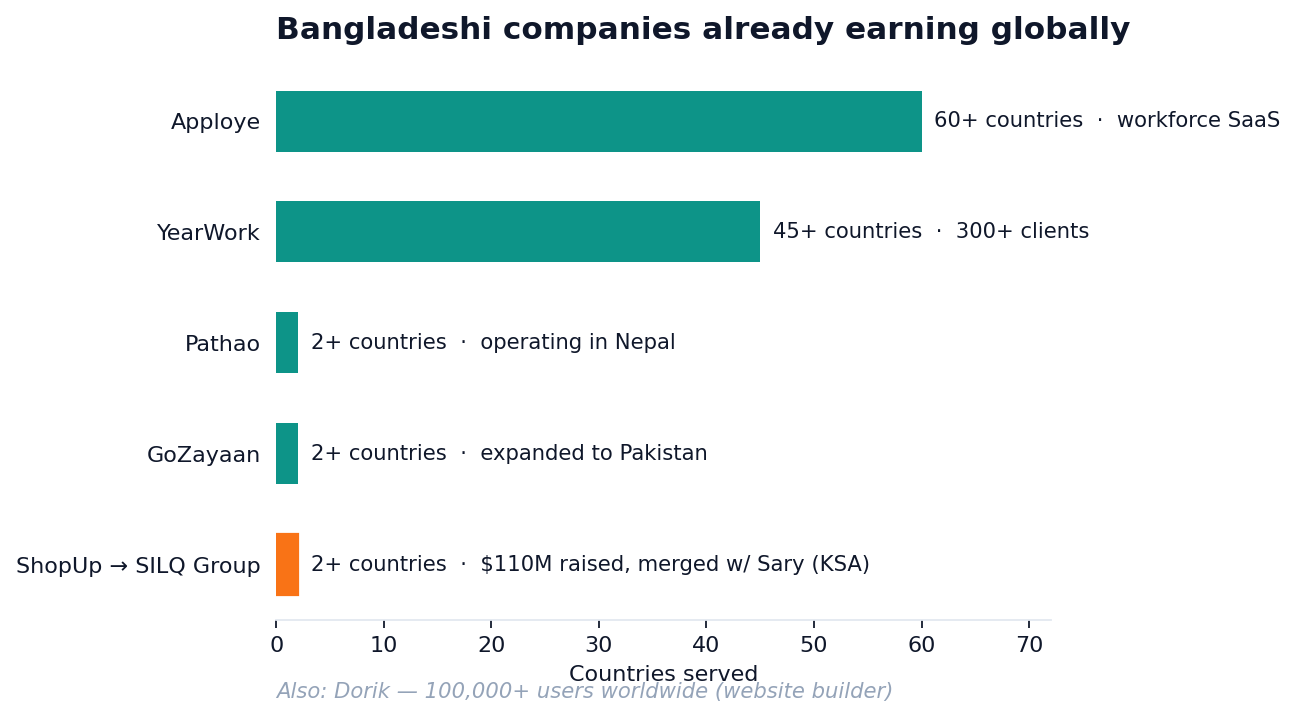 Chart: Countries served by Bangladeshi companies already earning global revenue. Source: video essay, September 2026.
So building a global company from Bangladesh is demonstrably possible. The real question is narrower and more useful: why doesn't it happen on a regular basis? The answer splits into four problems — and none of them are "our engineers aren't good enough."
Problem 1: The local-market mindset
Most Bangladeshi founders start by asking local questions: What do Bangladeshi customers want? What price works in Bangladesh? How do we run Facebook ads here? Those are not wrong questions — understanding your local market matters. The problem starts when Bangladesh stops being the starting point and becomes the whole map.
The video illustrates the trap: you build software, price it for the local market ($30 feels too much, so you drop to $5), and design payments and support around Bangladeshi customers. Two years later you decide to go global — and discover your product is now so Bangladesh-specific that half of it needs to be rebuilt. Local success quietly became a liability instead of an advantage.
"Bangladesh can be your market — but never make Bangladesh your boundary."
The companies earning global revenue share a common pattern: they treated international markets as the core objective from day one. Global expansion was not a feature to add later — it was the design constraint.
Problem 2: Distribution, not product
There is a recognizable founder tendency: spend the first six months perfecting the product — beautiful UI, fast servers — launch, and only then ask where customers will come from. In global markets, that is a brutal mistake, because of a simple reality:
Nobody cares that you built the best software in Bangladesh if nobody in the world can discover it.
Building the product is an engineering problem. Getting it in front of people is a distribution problem — and often the harder of the two. Dorik did not reach 100,000+ users just by being a great website builder; from the start it used Product Hunt, SEO, and community-led growth. Apploye used global discovery platforms like Capterra to build a customer base across 60+ countries. They did not just build software — they built a machine for being discovered.
For a Bangladeshi startup going global, the biggest competitor often is not a rival product. It is that nobody knows you exist. This is where many strong local products die: real technology, no distribution skill.
Problem 3: Corporate architecture
Say you fix the mindset and learn distribution. Customers start arriving from the US, Dubai, and Europe. Now a set of very practical questions hits: How do you collect their money? How does a foreign investor invest in you? Which entity signs enterprise contracts? How do ESOPs work? What does an exit look like?
These are frictions a Silicon Valley founder may never think about — and they are a big reason so many globally competitive Bangladeshi startups maintain international corporate structures in Singapore or Delaware. Global payment rails, investor confidence, and enterprise sales all get easier with the right structure.
Bangladesh's regulatory framework was historically designed for conventional business, and friction remains around cross-border investment, foreign exchange, employee share ownership, and exits. The FY2026–27 budget brought startup-friendly tax and VAT relief proposals — a positive signal — but implementation and regulatory certainty remain critical. The result: founders are not only fighting competitors. Many are also fighting the structure itself.
Problem 4: The capital gap
And then there is money. In 2025, total startup investment in Bangladesh was roughly 0.03% of GDP. In the first half of 2026, essentially all startup funding came from foreign investors — domestic investor participation was effectively zero.
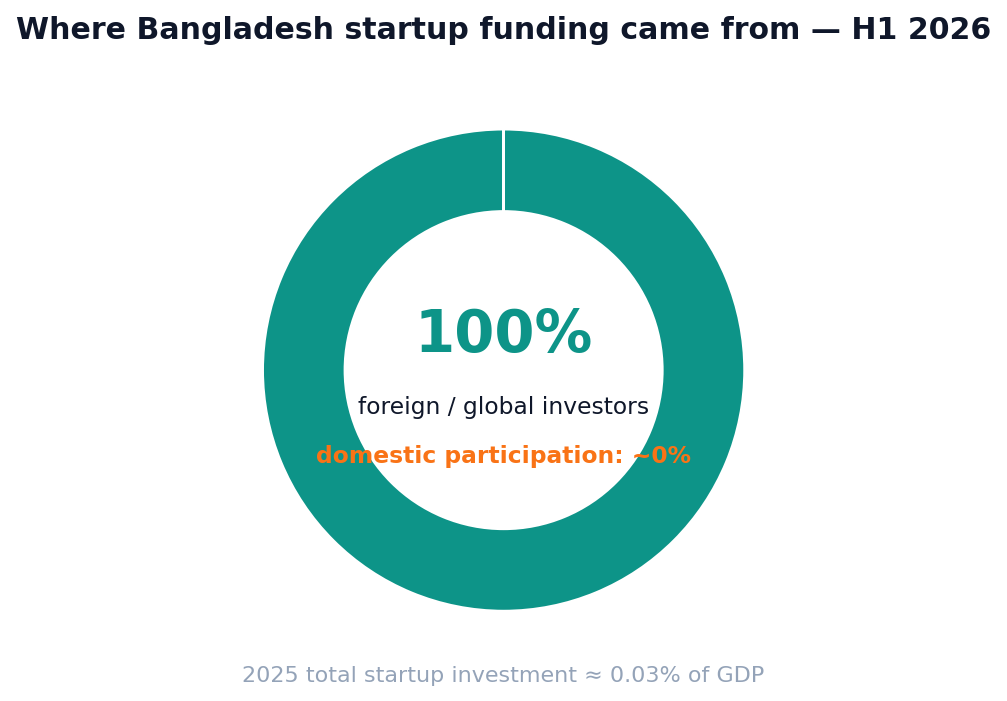 Chart: Startup funding sources for Bangladesh, first half of 2026. Domestic participation: ~0%.
Bangladeshi founders compete against startups raising millions while local risk capital is extremely limited. Foreign investors price in "Bangladesh risk": political uncertainty slows funding rounds, dollar swings make investors nervous, and unclear exit routes make them more nervous. Founders start the game with a capital disadvantage built in.
The twist: the weakness is also the edge
Here is where the video turns. That same cost structure that signals a weak ecosystem is also Bangladesh's sharpest competitive weapon. The engineering team you can build in Dhaka would cost multiples more in San Francisco or London — recent analysis puts the senior engineering talent cost gap between Bangladesh and the US at roughly 70–85%.
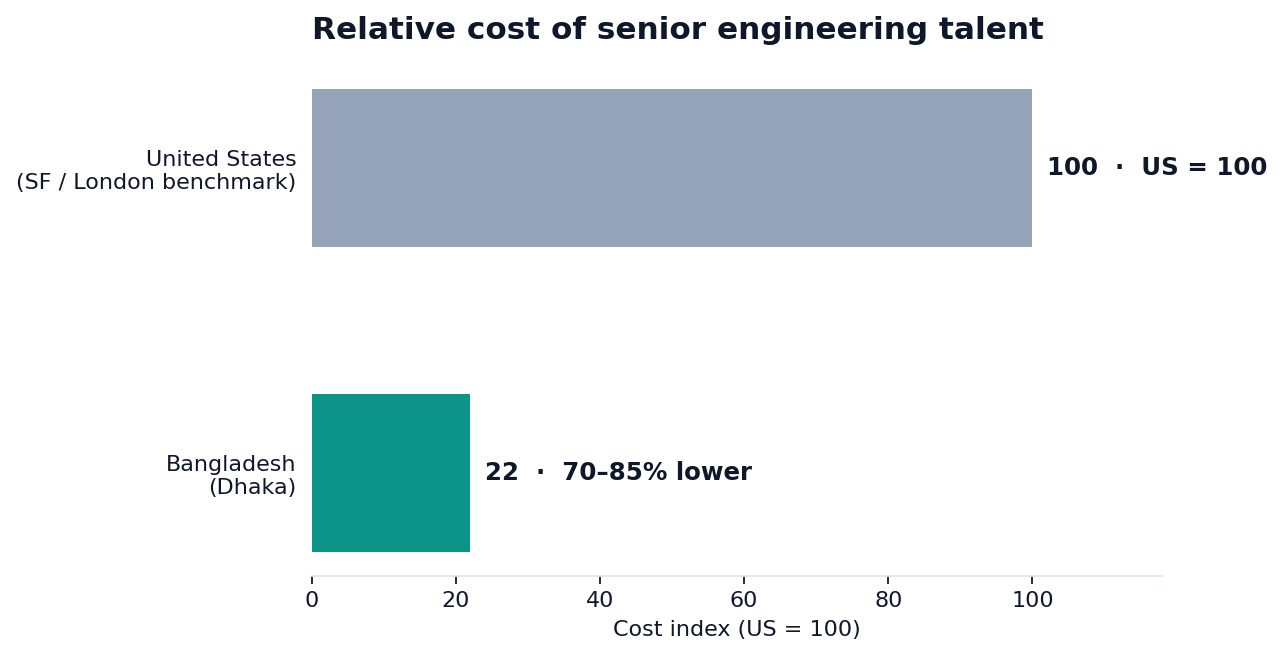 Chart: Relative cost of senior engineering talent, US = 100. Bangladesh runs roughly 70–85% lower.
Pair that with market dynamics: a $20 SaaS product feels expensive in the Bangladeshi market but is trivially cheap for a US target customer. Spend in taka, earn in dollars — and suddenly your unit economics can be dramatically better than the global competitor you are up against.
The catch the video ends on: founders who win the cost advantage often waste it — competing on cheapness instead of reinvesting the margin into distribution, brand, and global reach.
What this means for founders
The argument compresses into a practical checklist:
- Design global-first. Treat Bangladesh as a market, not a boundary. Pricing, payments, and support should work for international customers from day one — not after a rebuild.
- Build distribution like a product. SEO, Product Hunt, communities, and discovery platforms like Capterra are part of the product, not a post-launch task.
- Structure for the game you are playing. If the ambition is global revenue and global investors, the corporate architecture needs to support cross-border payments, investment, ESOPs, and exits.
- Use the cost advantage as fuel, not as the pitch. The 70–85% engineering cost gap buys runway and margin — spend it on being discovered.
The bottom line
Bangladesh does not lack talent, ambition, or proof. Dorik, Apploye, YearWork, GoZayaan, Pathao, and ShopUp all exist. What is missing is regularity — an ecosystem where global companies emerge as a pattern rather than exceptions. Mindset, distribution, structure, and capital are the four levers. Three of them are founder-controllable, and the fourth is slowly moving in the right direction.
Frequently Asked Questions
Can a global tech company really be built from Bangladesh?
Yes — and it already has been. Dorik serves 100,000+ users worldwide, Apploye sells in 60+ countries, YearWork works with 300+ clients in 45 countries, and ShopUp's merger with Saudi Arabia's Sary created SILQ Group with $110 million in funding. The gap is that these remain exceptions rather than a repeatable pattern.
What is the biggest reason Bangladeshi startups fail to go global?
The video argues it is distribution, not product. Founders perfect the product for months, then look for customers — while global buyers never discover them. "Nobody knows you exist" beats more startups than any rival does.
Why do Bangladeshi startups incorporate in Singapore or Delaware?
Global payment rails, foreign investor confidence, enterprise contracts, ESOPs, and clean exit routes are all easier under an international corporate structure. Bangladesh's regulatory framework was designed for conventional business, so founders who play the global game usually need global architecture.
How big is the engineering cost advantage?
Recent analysis cited in the video puts the senior engineering talent cost gap between Bangladesh and the US at roughly 70–85%. A team that would cost multiples more in San Francisco or London can be built in Dhaka — while revenue comes in dollars.
What should a Bangladeshi founder do differently?
Design for international customers from day one, treat distribution as part of the product, set up a corporate structure that can take global payments and investment, and reinvest the cost advantage into being discovered — not into being the cheapest option.
Sources and further reading
- Video essay: বাংলাদেশ থেকে Global Company এত কম তৈরি হয় কেন? আসল সমস্যা কোথায়?
- Dorik — website builder
- Apploye — workforce management SaaS
- [SILQ Group (ShopUp × Sary)](https://silq.com)
Building for a global market?
The lesson applies to any product meant to earn beyond its home country: global-first design, a distribution engine, and a structure that can take the money. CodeMyPixel builds SaaS platforms, AI systems, and conversion-focused websites for companies across the US and Europe — designed for international customers from day one. Contact us to discuss your project.
- Bangladesh startups
- global tech companies
- Bangladeshi SaaS
- startup ecosystem
- Dorik
- Apploye
- ShopUp
- Pathao
- engineering talent
- startup funding
- business automation