AI8 min read
Claude Fable 5.1 vs GPT-6 Astra: Compared
Everything on Claude Fable 5.1: specs, pricing, benchmarks, and how it stacks up against GPT-6 Astra for custom AI builds.
Anthropic released Claude Fable 5.1 on September 1, 2026. The model is positioned for demanding reasoning and long-horizon agentic work. This article combines the official docs and announcement with the recent AI Search YouTube roundup so you can see how Fable 5.1 fits next to GPT-6 Astra, Gemini 3.8 Flash, and the rest of the September AI news.
For businesses building custom AI systems, the bigger story is not just a benchmark win. It is that Fable 5.1 introduces a 1M-token context, cheaper cache reads, and a family of capabilities that make agentic coding, research, and document automation more practical.
Key Takeaways
- Claude Fable 5.1 scores 52.6% on Terminal-Bench-Science 0.1, up from Fable 5's 24.7%, according to Anthropic's announcement.
- Cache reads now cost $0.25 per million tokens, a 75% reduction that Anthropic says can cut typical workloads by ~25% and highly agentic workloads by up to ~45%.
- The model offers a 1M-token context window and 128K max output, making it suitable for long documents, spreadsheets, and slide decks.
- The AI Search video positions GPT-6 Astra as the headline of the week, with 100% ExploitBench and more than 60% Arc-AGI 3 scores, while warning that Fable 5.1 can be expensive per task and usage-capped.
- Fable 5.1 and Mythos 5.1 are the same model with different safeguards; Mythos is available through trusted access programs for cyber and life-sciences work.
What is Claude Fable 5.1?
Claude Fable 5.1 is Anthropic's latest model for demanding reasoning and long-horizon agentic work. Released September 1, 2026, it is designed for tasks such as multistep research, agentic coding, document and spreadsheet work, and slide generation. Its model ID is claude-fable-5-1 on the Claude API, Amazon Bedrock, Google Cloud, Microsoft Foundry, and Claude Platform on AWS.
Anthropic's docs list the following core specs:
| Feature | Value |
|---|---|
| Context window | 1M tokens |
| Max output | 128K tokens |
| Input price | $10 / MTok |
| Output price | $50 / MTok |
| Cache read price | $0.25 / MTok |
| Default effort | high |
| Thinking | Adaptive (always on) |
| Knowledge cutoff | June 2026 |
| Retirement | Not sooner than September 1, 2027 |
One million tokens is roughly 555,000 words or 2.5 million Unicode characters on the current tokenizer, according to the docs. That is enough to load a long contract, codebase, or research corpus into a single prompt.
Breaking and additive changes for existing Fable 5 users
If you already call Claude Fable 5, three changes are breaking: forced tool use now returns an error, earlier models cannot read Fable 5.1's thinking blocks, and editing earlier turns invalidates thinking blocks. Five additions are in beta: per-message effort, turn-scoped system messages, readable progress updates between tool calls, lower cache read pricing, and content provenance.
Performance: Fable 5.1 vs Fable 5 vs the field
The announcement's benchmark table shows Fable 5.1 ahead of Fable 5 and, in most cases, ahead of Claude Opus 5 and GPT-5.6 on the tasks Anthropic evaluated.
| Task | Fable 5.1 | Fable 5 | Opus 5 | GPT-5.6 Sol |
|---|---|---|---|---|
| Terminal-Bench-Science 0.1 | 52.6% | 24.7% | 29.0% | 22.4% |
| Terminal-Bench 4.0 | 55.8% (Mythos 60.9%) | 42.0% | 52.3% | 37.3% |
| GDPval-AA v2 | 1853 | 1723 | 1824 | 1711 |
| OSWorld 2.0 partial | 77.9% | 72.9% | 75.4% | — |
| OSWorld 2.0 strict | 41.7% | 36.1% | 39.6% | — |
| Humanity's Last Exam (no tools) | 60.9% | 57.8% | 56.6% | — |
| Humanity's Last Exam (with tools) | 65.0% | 63.8% | 63.6% | — |
| AutomationBench | 31.4% | 17.1% | 26.9% | 19.6% |
| CursorBench 3.2.0 | 73.4% | 70.5% | 70.0% | 67.2% |
Fable 5.1 also sets a new score on Terminal-Bench-Science 0.1, with a 27.9 percentage-point lift over Fable 5. The chart below visualizes the gains across several of these benchmarks.
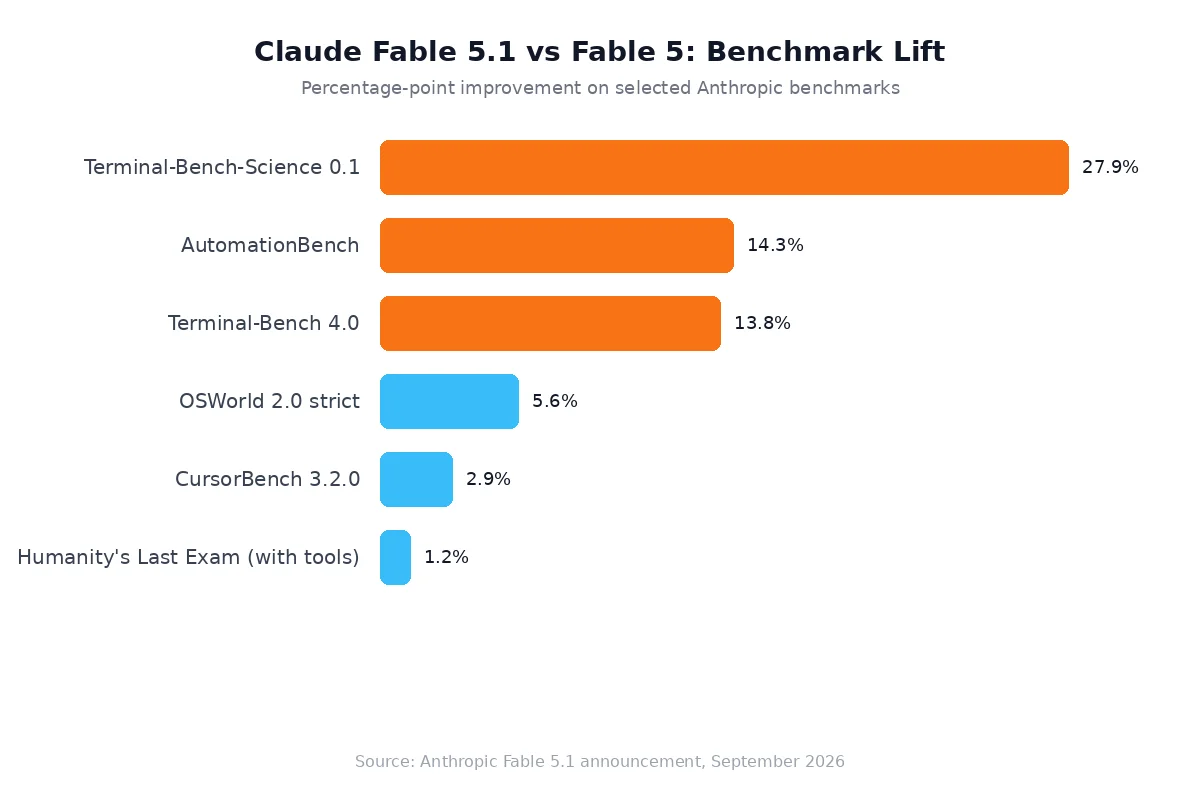 Chart: Fable 5.1 benchmark improvements over Fable 5 in percentage points. Source: Anthropic Fable 5.1 announcement, September 2026.
Anthropic notes that these scores were measured with production safeguards enabled. On tasks where safeguards intervened, both Fable 5.1 and Fable 5 scored zero on OSWorld 2.0, which means real-world results depend on the safety layer as well as the base model.
Pricing and cost: Why Fable 5.1 may be cheaper than it looks
Fable 5.1 keeps the same $10 / MTok input and $50 / MTok output prices as Fable 5. The big change is in cache reads, which drop from $1 / MTok to $0.25 / MTok, a 75% cut. Because agentic workflows re-read the same context repeatedly, this can make a large difference.
The official announcement claims:
- ~25% lower total cost for typical Fable 5 workloads.
- Up to ~45% lower cost for highly agentic, context-heavy, tool-heavy work.
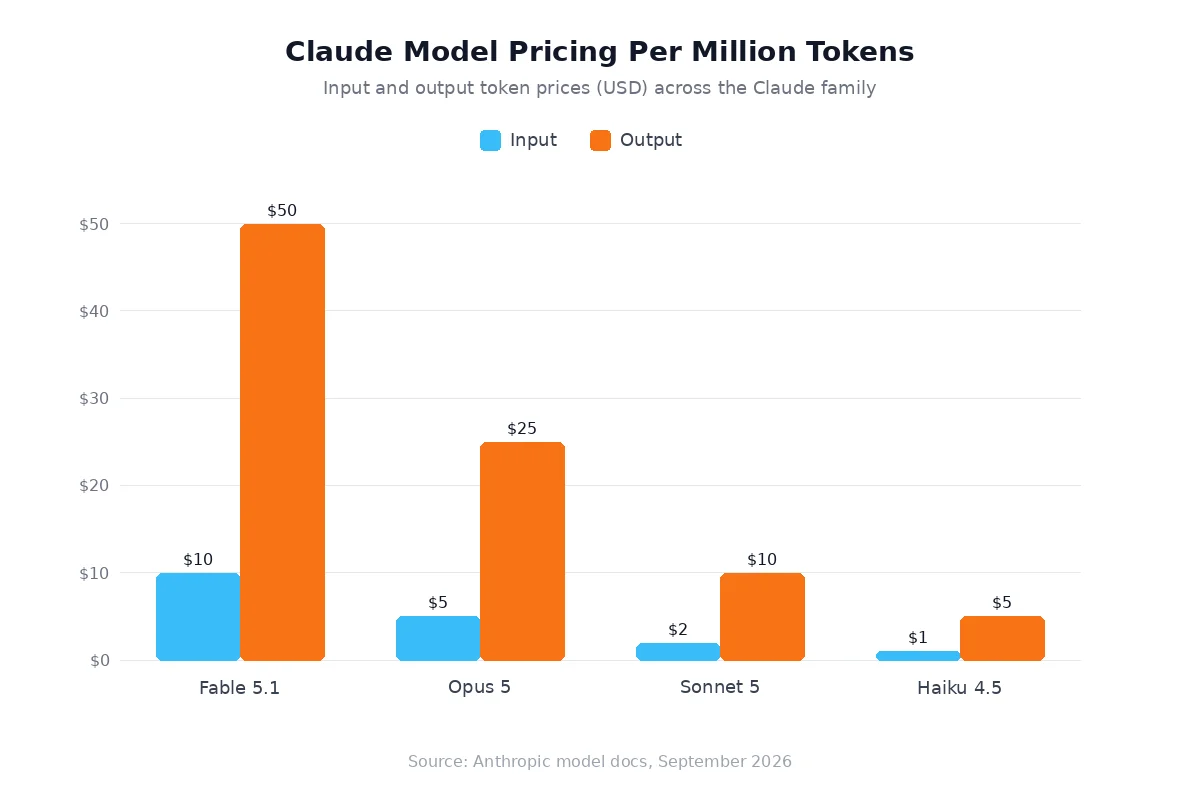 Chart: Input and output token prices for Claude Fable 5.1, Opus 5, Sonnet 5, and Haiku 4.5. Source: Anthropic model docs, September 2026.
The video from AI Search offers a different framing. It reports that Claude Fable 5.1 is "more than 3.7× more expensive per task than GPT-5.6" and that usage caps limit how much you can send. These two observations are not necessarily contradictory: per-token list prices are high, but prompt-caching and effort controls can reduce the effective cost on long agentic runs. Still, budget planning should start with the official price card, then test actual token consumption on your workload.
Fable 5.1 vs Claude Mythos 5.1
Claude Mythos 5.1 is the same model as Fable 5.1, but with more permissive safeguards. It is available only through Anthropic's trusted access programs:
- Cyber Verification Program: for defensive security work.
- Life Sciences Verification Program: for professional R&D in biology.
Mythos 5.1 also powers Claude Security, Anthropic's codebase vulnerability scanner. For most businesses, Fable 5.1 is the practical choice; Mythos is for regulated or specialized domains where human review and access controls are required.
Safety, data retention, and enterprise controls
Anthropic emphasizes three customer-facing improvements:
- Enterprise Frontier Safeguards (EFS): Gives customers zero-data-retention-style privacy by storing data in cloud infrastructure controlled by the customer, not Anthropic. Rolling out in phases.
- More precise safeguards: Cyber safeguards block 60% fewer false positives; biology safeguards fire 85% less often on benign medical or elementary biology queries. Fable 5.1 can now be used for defensive vulnerability discovery.
- Content provenance / watermarking: Outputs after August 2, 2026 carry an invisible watermark under the EU AI Act, with a detection API in private preview.
How Fable 5.1 compares to the rest of the September AI news
The AI Search video places Fable 5.1 inside a busy week of releases. The key comparisons:
- GPT-6 Astra: The video calls it the headline model, with reported 100% on ExploitBench, more than 60% on Arc-AGI 3, and the only frontier score above 0% on Frontier Math. It is framed as a computer-use model for spreadsheet, 3D, and form automation.
- Gemini 3.8 Flash: Reported at 348 tokens per second and #1 on Deep Suite long-horizon software engineering. Its Cyber variant is said to produce 2.6× more correct Chrome vulnerability patches than larger commercial models.
- Qwen 3.8 Max0902: Reported at 2.4 trillion parameters with a 1M context window and more than 10 percentage-point gains on agentic coding tasks.
- Deepseek V4 Flash Vision Experimental: Reported at 305B parameters, open-source, vision-enabled.
Where Fable 5.1 stands out, per Anthropic, is in disciplined long-horizon work. The announcement shares examples from Jane Street, Cognition, Millennium, MongoDB, and others where Fable 5.1 traced rare crashes, built multi-day prototypes, and reviewed code end-to-end.
What this means for custom AI systems and business automation
For companies building custom AI agents and workflow automation, Fable 5.1 is interesting in three ways:
- Long-context agents. A 1M-token window means a single agent can hold a full codebase, contract, or financial corpus without chunking. That reduces orchestration complexity.
- Cost-aware caching. The cache-read price cut matters most when the same documents are re-read across many tool calls, which is exactly what happens in research, support, and audit agents.
- Defensive security and research workloads. The clearer line between Fable 5.1 (general) and Mythos 5.1 (trusted access) lets enterprises adopt AI for vulnerability scanning and life-sciences R&D without bypassing safeguards.
If you are comparing models for an internal tool, the real test is not the headline benchmark but the cost per solved task on your own data. CodeMyPixel builds custom AI systems and AI agent development services that evaluate and deploy the right model for each workflow.
Frequently Asked Questions
What is Claude Fable 5.1 best used for?
Fable 5.1 is best for demanding reasoning, long-horizon agentic coding, multistep research, and document, spreadsheet, and slide work. Anthropic recommends starting with Opus 5 for most workloads and moving to Fable 5.1 when Opus 5 at higher effort still falls short.
How much does Claude Fable 5.1 cost?
The list price is $10 per million input tokens and $50 per million output tokens. Cache reads cost $0.25 per million tokens. Batch API requests are 50% off, and Anthropic reports that cache-read savings can cut typical workloads by ~25% and agentic workloads by up to ~45%.
Is Claude Fable 5.1 the same as Mythos 5.1?
They are the same underlying model but with different safeguard levels. Mythos 5.1 is only available through trusted access programs for cyber and life-sciences work. Fable 5.1 is generally available.
How does Fable 5.1 compare to GPT-6 Astra and Gemini 3.8 Flash?
Each model targets different strengths. Anthropic's own benchmarks show Fable 5.1 leading on agentic science and coding suites. The AI Search video reports GPT-6 Astra leading on computer-use, security, and math benchmarks, and Gemini 3.8 Flash leading on speed and cost per task. The best choice depends on your use case, latency budget, and data sensitivity.
Can small businesses use Fable 5.1?
Yes, it is available on the Claude API and major cloud platforms. However, the token prices are high, so small teams should test cache-hit rates and use the lower effort settings where possible. For some workflows, smaller open models or flash-class APIs may be more economical.
Sources and further reading
- Anthropic: Claude Fable and Mythos 5.1
- Anthropic Docs: Claude Fable 5.1 overview
- AI Search YouTube video: GPT 6 Astra, Claude Fable 5.1, Gemini 3.8, realtime Minimax, new world models
- Anthropic: Claude Fable 5.1 system card
- Anthropic: Pricing
Get help building your custom AI system
The model landscape is crowded, but the value is in the workflow. CodeMyPixel designs and builds custom AI agents, workflow automation, and AI-powered SaaS apps for teams that want less manual work and more scalable operations. Contact us to discuss your project.
- Claude Fable 5.1
- Anthropic
- GPT-6 Astra
- Gemini 3.8 Flash
- AI agents
- business automation
- custom AI systems
- AI benchmarks
- Claude Mythos 5.1