AI8 min readBy JH Akash
Tencent Hy4 Explained: Vision, Computer Use, and the Open-Weight Catch
Tencent released full Hy4 on Nov 4, 2026: vision and computer use for the first time, 770B parameters, 1M context, at $0.834/$2.501 per million tokens. Weights are still promised, not published.
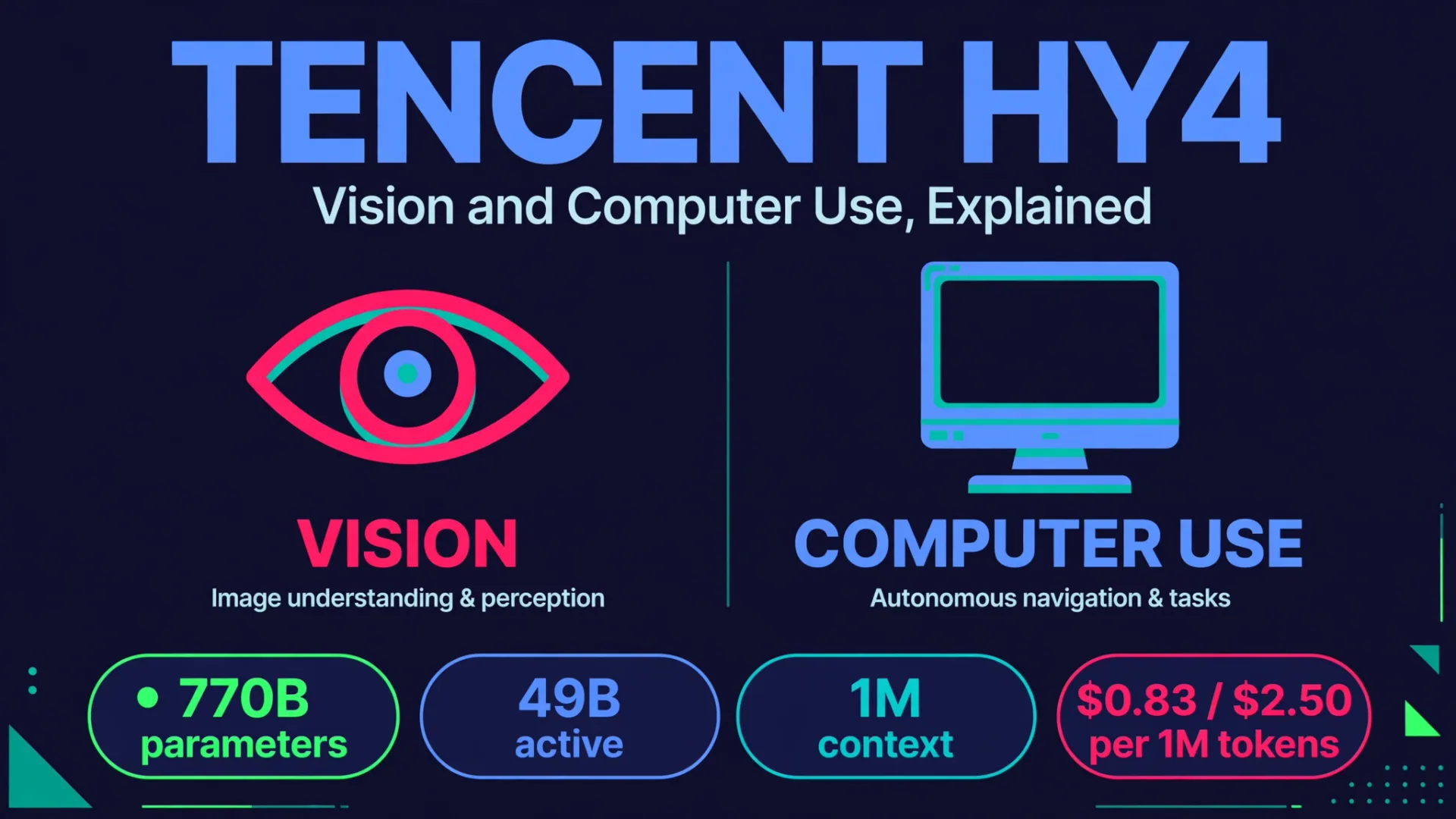
Tencent released the full version of Hy4 on November 4, 2026, and the headline change is simple: for the first time in the Hy line, the model can see images and use a computer. The August preview was text only. The full release adds visual understanding and computer use, plus better instruction following, long-context comprehension, and long-horizon agent work.
There is a catch that matters more than the headline. The preview shipped with open weights and a model card on day one. The full release does not. Tencent says it plans to release model weights and system cards in the coming days, but the licence for the full release has not been stated yet. So today, Hy4 is a hosted model you can call through an API, not yet a model you can download and run yourself.
Quick verdict
| Question | Short answer |
|---|---|
| What is actually new? | Vision and computer use, for the first time in the Hy line |
| What can you use today? | Hosted API through Tencent Cloud and OpenRouter, plus Tencent products |
| What can you not do yet? | Download the full model weights, or read its full system card |
| Listed price | $0.834 input and $2.501 output per 1 million tokens, unchanged from the preview |
| Biggest reason to wait | No public coding benchmarks and no independent tests yet for the full model |
What changed from the Hy4 Preview
The preview, released in August 2026, was a text-only model. The full Hy4 adds three things, according to Tencent:
- Visual reasoning. It handles fine-grained image details, complex charts, and mathematical reasoning over visuals, combining perception with tool calls. Tencent's demo example uses a 2.8-gigapixel aerial photograph, in which the model finds a two-metre roof component. Treat that as a vendor illustration, not a published visual benchmark, because no visual benchmark is attached to it.
- Computer use. It can work across command-line and graphical interfaces. Tencent says it received specialised training on professional software such as Blender and CAD, and on frontend and game development workflows covering Unreal Engine, Unity, and Godot.
- Better core behaviour. Tencent reports gains over the preview in instruction following, long-context understanding, long-horizon tasks, and deep research, plus a shorter chain of thought. The preview's own model card admitted two problems, excessive reasoning and over-verification, and no before-and-after token counts have been published, so the efficiency gain is still unmeasured.
Hy4 also powers a broad update to WorkBuddy, Tencent's workplace AI tool, with integration across WeCom chats, emails, documents, calendars, and meetings. A team collaboration feature called Projects is promised as an upcoming WorkBuddy addition.
Pricing
| Token type | Listed price per 1 million tokens |
|---|---|
| Input | $0.834 |
| Output | $2.501 |
| Cached input | $0.042 |
The listed prices are unchanged from the preview, according to both Unite.AI and API listings. Some summaries round these to about $0.90 input and $2.70 output, but the listed figures above are the ones to budget against. OpenRouter's deployment listing specifies a 1,048,576-token context window and a 65,536-token completion limit, with text and image inputs and text output. Availability is through Tencent Cloud and OpenRouter, and inside CodeBuddy, WorkBuddy, Yuanbao, and ima.
Benchmarks, all vendor-reported
This is the section to read carefully. The full release has no benchmark appendix and publishes no Terminal-Bench or SWE-bench results, two widely used public coding tests. Almost everything below comes from Tencent's own task suites and expert panels, so treat it as a vendor claim until independent testers publish results.
| Test | Hy4 result | What to know |
|---|---|---|
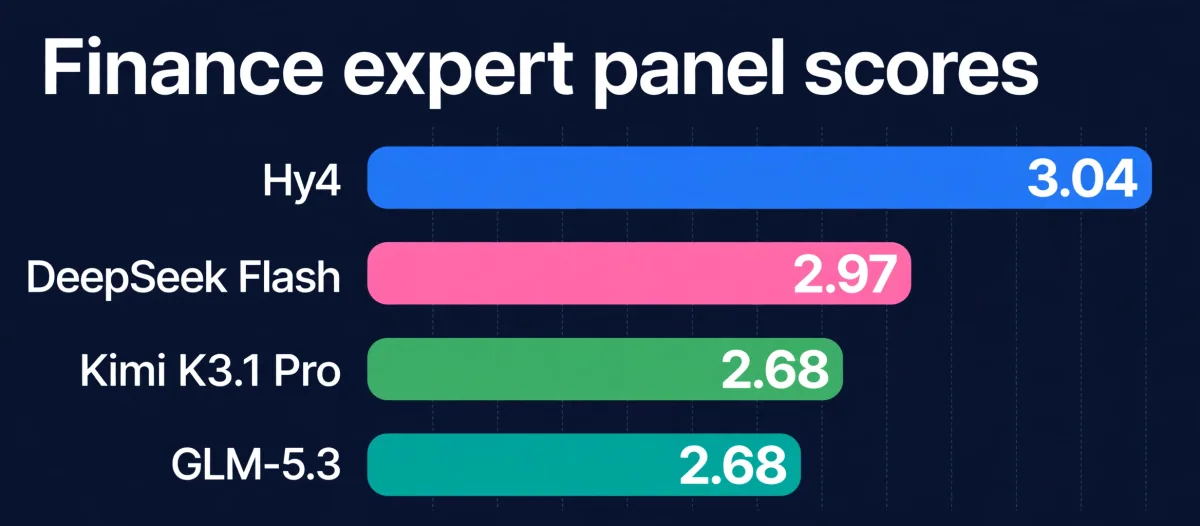
| Finance expert panel, 579 real-world tasks | 3.04 | Vendor-run, blind evaluation with 213 finance professionals, including 153 from external institutions |
| DeepSeek-V4.1-Flash-1017, same finance panel | 2.97 | Same vendor-run panel |
| Kimi K3.1 Pro, same finance panel | 2.68 | Same vendor-run panel |
| GLM-5.3, same finance panel | 2.68 | Same vendor-run panel |
| GameDev vs preview | Up 19.1% | Internal suite, no published item count |
| GameLogic vs preview | Up 9.8% | Internal suite, no published item count |
| Investment research benchmark (iRaB) vs preview | Up 12.03 percentage points | Internal benchmark run by financial AI company Rabyte |
| WorkBuddy evaluation | 83.18 average, 96.15% pass rate | Tencent's own evaluation, first in nine of twelve scenarios in the mainland Chinese market |
| TenureTrail, 123 research tasks across seven disciplines | First among open-weight models | Vendor-reported, internal set |
| Hy-BioExperimentBench | 30.4 out of 100 | Tencent's own biosafety check, with reviewers finding limited ability to turn biological knowledge into actionable protocols |
One number needs a warning label. Sources disagree on Tencent's headline hallucination claim. One summary reports a fall from 12.95% in the preview to 7.2%, while another reports 15.76% to 5.45%. Both agree that errors from unsupported assumptions fell from 23.1% to 5.6%, but the methodology is unpublished, so do not quote a single hallucination figure as settled.
Tencent itself also states the gaps plainly: Hy4 still lags the leading closed-source systems in research-level mathematics, long-horizon coding, model self-improvement, and advanced visual question answering. That honesty is useful, because it tells you where not to bet on Hy4 yet.
Size, and why the numbers need care
The figures in circulation are 770 billion total parameters, 49 billion active per token, and about 1 million tokens of context. Those are the preview's figures, and one review notes that Tencent did not restate the parameter count or context length in the full launch announcement. One outlet does report 770 billion for the full model, and the OpenRouter listing confirms the 1,048,576-token context, but until the promised system card arrives, treat 770B and 49B as carried-over preview figures, not newly confirmed full-model specs. The architecture is mixture-of-experts, which is why only 49 billion of the 770 billion parameters do work on any given token, while hosting still requires storing the full checkpoint.
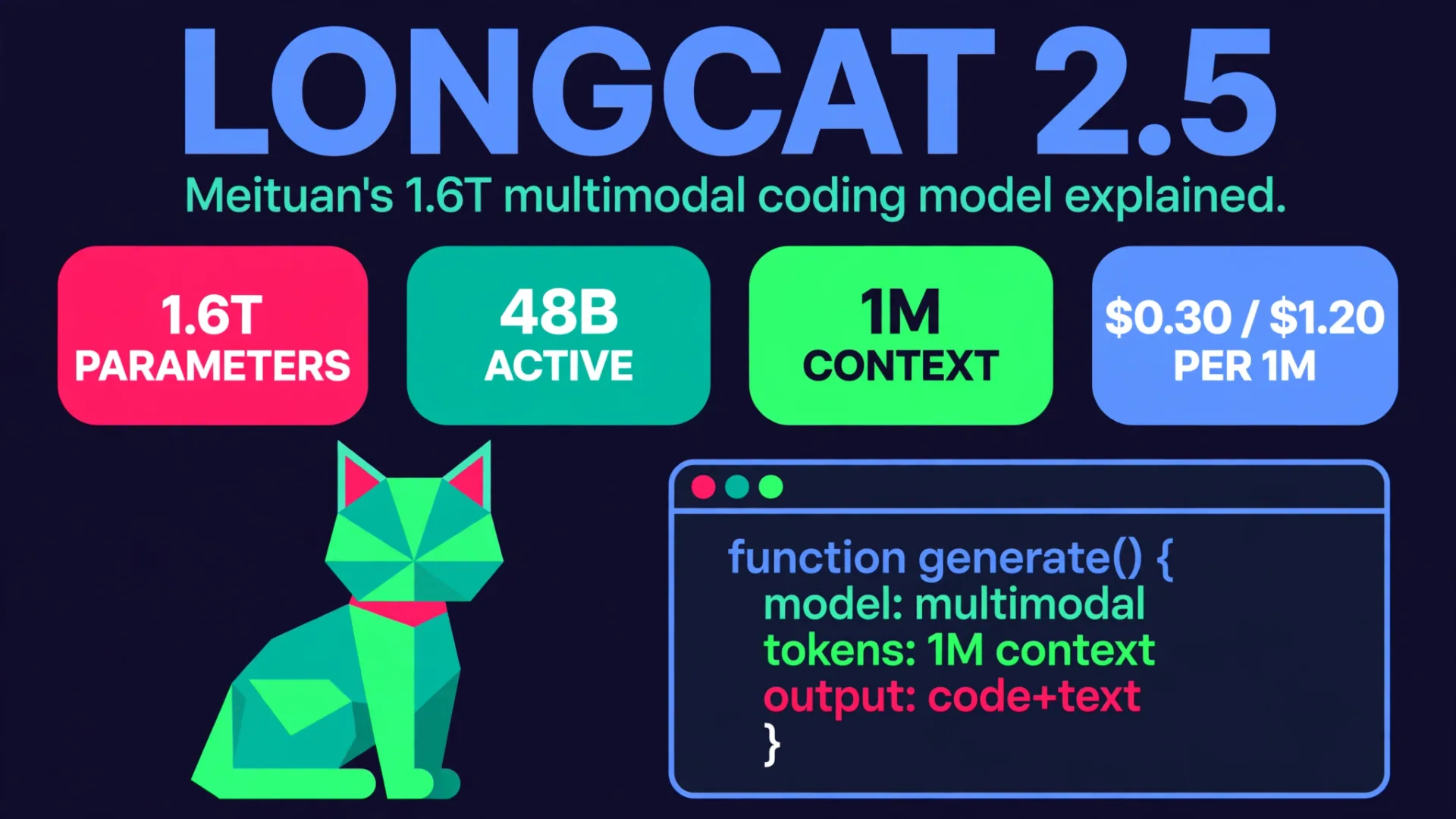
For comparison, the open-model field moved fast in the same week: Meituan's LongCat 2.5, covered in our LongCat 2.5 explained post, also pairs a huge total size with a much smaller active size. If you are tracking the open-weight race, also read our Kimi K3.1 Pro explained post and our DeepSeek V4.1 Flash benchmarks and price post, since both models appear in Hy4's own finance panel above.
Safety choices
Tencent says it filtered exploit development, reverse engineering, and penetration-testing material out of Hy4's training, focusing instead on defensive cybersecurity uses such as proof-of-concept generation and vulnerability patching. Tencent Xuanwu Lab and Tencent Keen Security Lab conducted red-team audits, and the company reports no elevated risk in reversing cryptographic algorithms, defeating binary obfuscation, or exploiting vulnerabilities. On biosafety, the 30.4 out of 100 Hy-BioExperimentBench score above is presented as evidence that the model does not meaningfully lower the barrier to biological harm.
For builders, the practical safety point is sharper with computer use than with chat. Before giving any agent shell or desktop access, define tool permissions, timeouts, retry limits, and the points where a human must approve an action. Computer use turns a wrong tool call into a real action on a real machine, so sandboxing and approval gates are not optional extras.
Which to pick
Try Hy4 through the API now if: you already test the preview, you need vision plus desktop control in one hosted model, and you can test on your own workloads at the unchanged listed price. Finance workflows are the strongest vendor-backed case, given the 579-task expert panel, but verify on your own documents before trusting it with real money decisions.
Wait to self-host if: your plan depends on downloading weights. The preview is downloadable under Apache 2.0, but the full model has no published weights, licence, or model card yet. Do not promise a self-hosted Hy4 deployment until those arrive.
Wait for independent tests if: you need public coding, vision, or computer-use benchmarks, or a settled hallucination figure. The full release publishes none of those yet, and the broader self-benchmarking is reported as mixed against Kimi K3.1 Pro.
Watch next: the weights and system card in the coming days and their licence, whether the system card confirms the 770B and 49B architecture and describes the vision encoder, independent third-party results, and Hy4 Flash, the lighter, more cost-efficient variant Tencent says is coming, followed by Hy5.
FAQ
Is Tencent Hy4 open source yet?
Not yet in practice. Tencent says it plans to release model weights and system cards in the coming days. The licence for the full release has not been stated. The August preview was released under Apache 2.0, but that does not automatically cover the full model.
What is new in Hy4 compared with Hy4 Preview?
Tencent says the full Hy4 adds visual understanding and computer use for the first time, plus better instruction following, long-context comprehension, and long-horizon agent tasks. The preview was text only.
How big is Tencent Hy4?
The figures in circulation are 770 billion total parameters with 49 billion active per token and a context of about 1 million tokens. Those are the preview's figures, and Tencent did not restate them at the full launch, so treat them as carried over until the system card confirms them.
How much does Hy4 cost?
Listed API pricing is $0.834 per million input tokens, $2.501 per million output tokens, and $0.042 per million cached input tokens, unchanged from the preview. It is available through Tencent Cloud and OpenRouter, and inside CodeBuddy, WorkBuddy, Yuanbao, and ima.
Does Hy4 beat DeepSeek, Kimi, and GLM?
In Tencent's own finance expert panel, Hy4 scored 3.04 against 2.97 for DeepSeek-V4.1-Flash-1017 and 2.68 each for Kimi K3.1 Pro and GLM-5.3. That is a vendor-run panel, and reports of Tencent's broader self-benchmarking describe mixed results against Kimi K3.1 Pro. No independent tests exist yet for the full model.
Should I switch from the Hy4 Preview?
If you use the hosted API, the upgrade is straightforward: vision and computer use at the same listed price. If you self-host the preview weights, do not switch yet, because the full model weights are not published. Test the shorter reasoning and the new vision features on your own workloads first, since the efficiency gain is unmeasured.
Sources
- Unite.AI, Tencent Releases Full Hy4 Model With Vision and Computer Use: https://www.unite.ai/tencent-releases-full-hy4-model-with-vision-and-computer-use/
- PYMNTS, Tencent Targets Financial Analysis With Hy4 AI Model: https://www.pymnts.com/news/artificial-intelligence/2026/tencent-targets-financial-analysis-with-hy4-ai-model/
- Unicorn API, Tencent releases full Hy4 AI model that can see images and use a computer: https://unicornapi.net/blog/tencent-releases-full-hy4-ai-model-see-images-use-computer
- Tencent Hy4
- Hunyuan
- computer use
- vision model
- open-weight AI
- AI benchmarks