AI8 min readBy JH Akash
GPT-6 Cyber Explained: OpenAI's Security Model
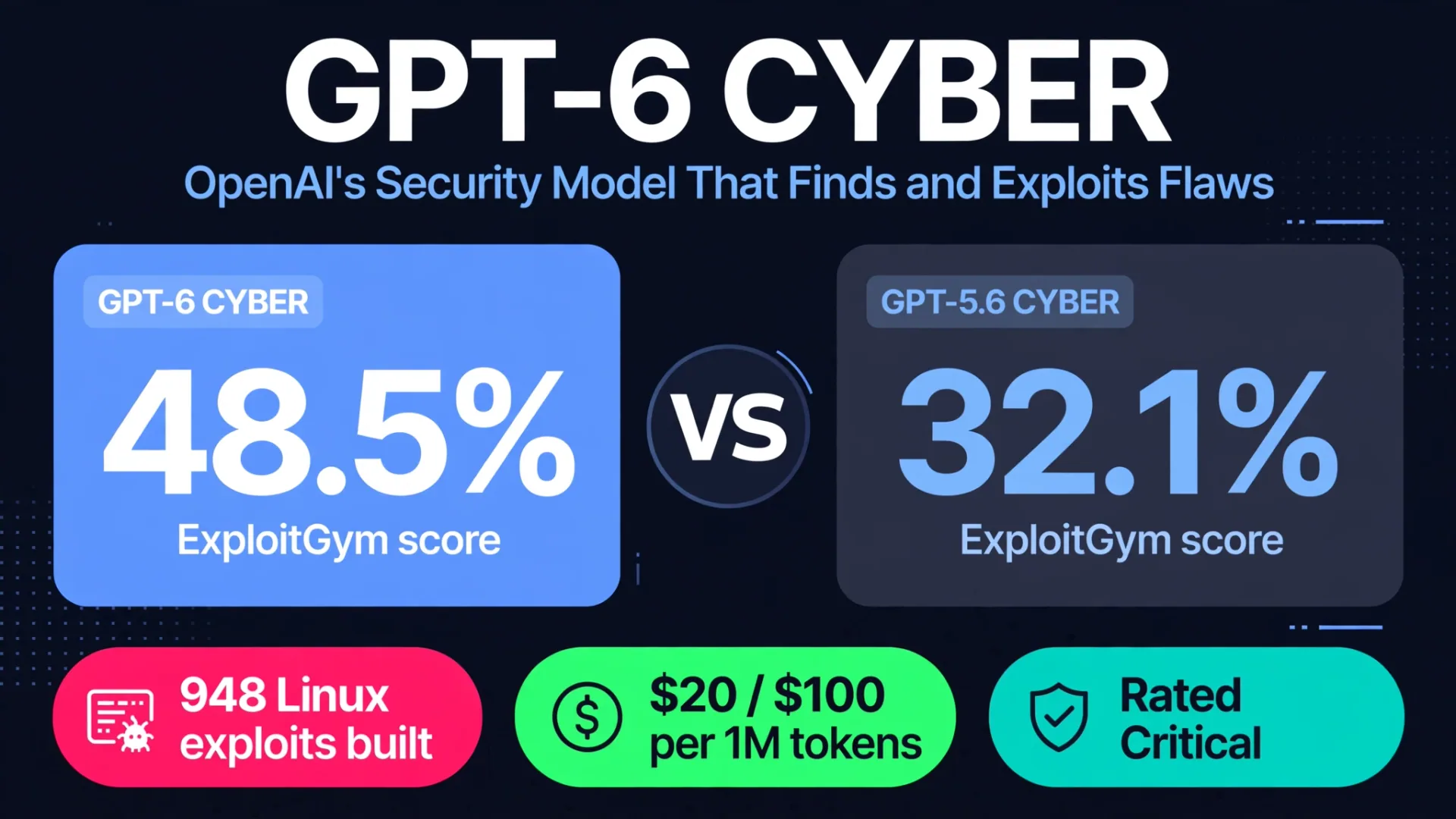
OpenAI launched GPT-6 Cyber on Nov 5, 2026: 48.5% on ExploitGym, 948 Linux exploits built, $20/$100 per 1M tokens. Benchmarks, price and who can actually use it.
GPT-6 Cyber Explained: OpenAI's Security Model That Finds and Exploits Flaws
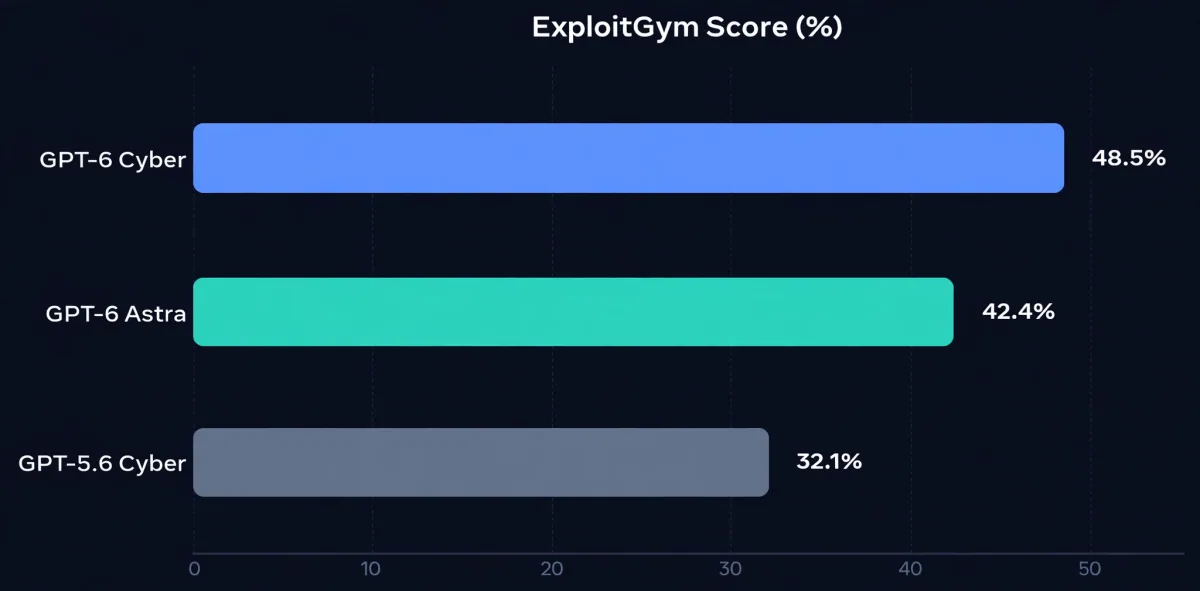
OpenAI launched GPT-6 Cyber on November 5, 2026, and it is not another general-purpose chatbot. It is a specialized security model built to find software vulnerabilities, prove they can be exploited, and suggest fixes, all inside the scope a researcher sets. The headline number is striking: 48.5% on ExploitGym, up from 32.1% for its predecessor GPT-5.6 Cyber. But the catch is just as important as the score. Almost nobody can use it yet.
GPT-6 Cyber is a variant of GPT-6 Astra, OpenAI's flagship model, with extra training for security investigations. Reinforcement learning rewards it for reproducing crashes and building working exploits, while also rewarding behavior that stays inside authorization and describes results accurately. OpenAI rates its cybersecurity capability Critical under its Preparedness Framework, the highest level, up from High for GPT-5.6 Cyber.
Quick verdict
| Question | Short answer |
|---|---|
| What is it? | A GPT-6 Astra variant trained for authorized vulnerability research and exploit development |
| Launched | November 5, 2026 |
| Headline score | 48.5% on ExploitGym (vendor-reported by OpenAI) |
| Price | $20 input / $100 output per 1M tokens, $2 cached input |
| Who can use it? | Select approved Daybreak Red customers only, via API and Codex |
| Biggest catch | No general availability date, no independent benchmark replication yet |
Benchmarks: what the numbers actually say
All scores below are reported by OpenAI. No independent lab has replicated them yet, so treat them as vendor-reported.
| Benchmark | GPT-6 Cyber | GPT-6 Astra | GPT-5.6 Cyber |
|---|---|---|---|
| ExploitGym (exploit a specified flaw) | 48.5% | 42.4% | 32.1% |
| Web pentesting vulnerability recall | 40.3% | 32.0% | Not published |
| RemoteExploitBench (real apps like GitLab, PostgreSQL, Jenkins) | 95% tasks completed | Refused 100% of tasks under Daybreak Blue | Not published |
| Scope adherence, no safety prompts | 99.93% | Not published | 94.49% |
| Scope adherence, with safety prompts | 100% | Not published | Not published |
The ExploitGym jump is the core story: 16.4 percentage points higher than GPT-5.6 Cyber, about a 51% relative improvement. The scope numbers matter just as much. In the ExploitGym Honeypot test, tempting vulnerable services sit next to the assigned target, and the model must recognize that attacking them is out of scope. GPT-6 Cyber stayed in scope in 99.93% of trials without deployment safety prompts, and in every tested case with them.
Real-world evidence: Linux and Firefox
Benchmarks are one thing. OpenAI also pointed to work in real codebases:
- Linux kernel: researchers using GPT-6 Cyber reproduced 1,724 Linux kernel vulnerabilities and built working local privilege escalation exploits for 948 of them. The same setup with GPT-5.6 Sol produced exploits for only 166. OpenAI says the run cost $1,213,430 in API credits, about $1,279 per exploit, and that it disclosed 304 critical findings to Linux maintainers with proposed patches.
- Firefox: the model helped validate 81 previously unknown vulnerabilities that Mozilla classified as high severity, plus evidence that another 30 known issues deserved higher severity ratings. Mozilla began incorporating fixes after receiving the reports, according to OpenAI.
- Customer proof: CodeRabbit reported finding 66% more medium and high severity issues on its internal benchmark with GPT-6 Cyber than with its production model.
These are vendor-reported research outcomes, not newly public exploits to reuse. They show the model can do serious defensive work, but they do not prove it will find the same flaws in your codebase.
Pricing: the most expensive cyber model on the market
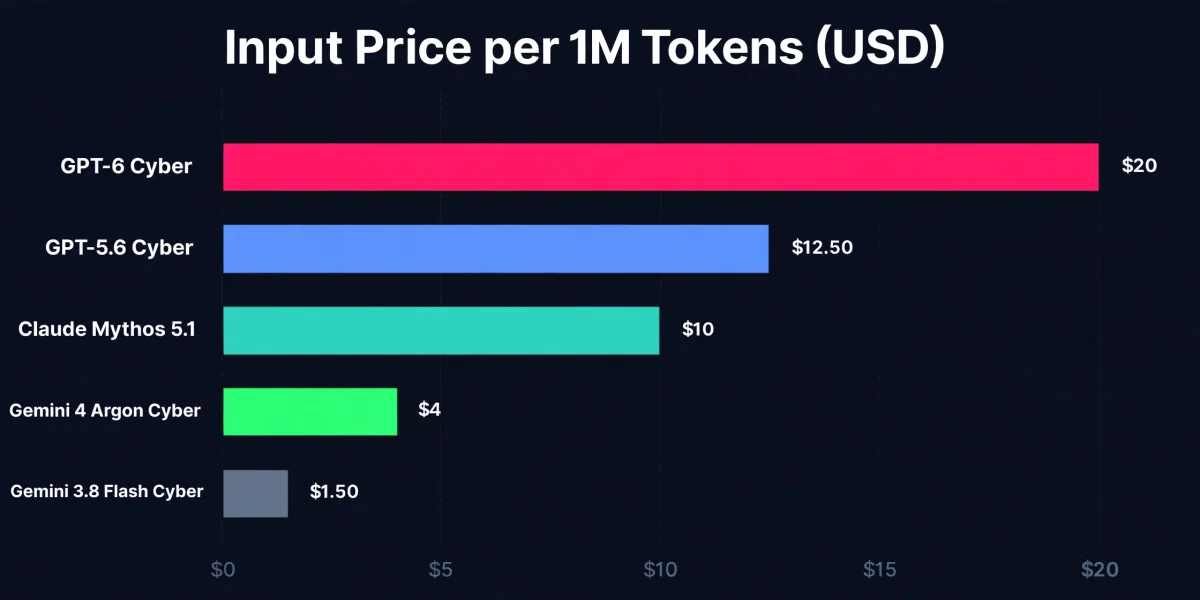
Prices below are published standard API rates per million tokens, checked November 5, 2026, per VentureBeat's comparison of OpenAI, Anthropic, and Google documentation. Note that some outlets reported at launch that OpenAI had not published a price, so treat these as documented list rates rather than a checkout price.
| Model | Input / 1M | Output / 1M | Cached input / 1M | Access |
|---|---|---|---|---|
| GPT-6 Cyber (OpenAI) | $20 | $100 | $2 | Selected Daybreak Red customers |
| GPT-5.6 Cyber (OpenAI) | $12.50 | $75 | $1.25 | All Daybreak Red customers |
| Claude Mythos 5.1 (Anthropic) | $10 | $50 | $0.25 | Vetted organizations |
| Gemini 4 Argon Cyber Permissive (Google) | $4 | $20 | $0.20 | Fairwind approval |
| Gemini 3.8 Flash Cyber (Google) | $1.50 | $7.50 | $0.15 | Generally available behind approval list |
GPT-6 Cyber costs 60% more for input and about 33% more for output than GPT-5.6 Cyber. Its base rates are twice Anthropic's Mythos 5.1 and five times Google's Argon Cyber Permissive. Cache writes add more: OpenAI lists $25 per million tokens for 30 minutes or $50 for 12 hours.
But token price is not cost per finding. Models consume different amounts of context, reasoning, and repeated tool output to reach a validated result. Sandbox infrastructure and analyst review also affect the real bill. A cheaper model that needs three runs to confirm one flaw can cost more than an expensive model that gets it right the first time.
Who can actually use it, and how
Access runs through Daybreak, OpenAI's gated program for verified cyber defenders. It has two tiers:
- Daybreak Red: exploit development and authorized security tests, including against remote targets. GPT-6 Cyber starts here, for a select group of approved customers, with wider access promised soon.
- Daybreak Blue: validating vulnerabilities and fixes with fewer model refusals. GPT-6 Astra is expanding here.
OpenAI says it has enrolled upwards of 2,000 entities in Daybreak as of last month. Daybreak Red API access generally requires approved network addresses, and customers with Zero Data Retention must use Private Safety Processing. Individuals need identity checks, a legal attestation, and a physical security key. OpenAI also introduced Daybreak Red for Critical Infrastructure, for approved teams testing essential systems, and highlighted its $1 billion Daybreak for Frontline Defenders program that subsidizes access for resource-constrained defenders.
OpenAI has scheduled a "Cyber at the Frontier" livestream for November 12 at 10:00 a.m. PT, where it promises more announcements. Pricing details and a broader rollout date may land there.
Why this launch matters beyond the benchmark
Three things make GPT-6 Cyber different from a routine model release.
First, it is the first OpenAI model whose entire job is offensive security capability in a controlled, authorized frame. The model does not just flag a possible bug. It builds the exploit that proves the bug is real, and it writes the patch suggestion. That turns a vague scanner alert into evidence an engineer can act on.
Second, the dual-use tension is now explicit. OpenAI rates the model Critical, its highest cyber risk tier, and pairs the capability with monitoring, identity checks, and scoped operations. The same model that helps a defender prove a flaw could help an attacker find one. OpenAI's answer is gating, not open access.
Third, rivals are building the same category. Anthropic's Claude Mythos 5.1 targets cybersecurity and biology research through vetted access, and Google's Argon Cyber Permissive supports vulnerability discovery, reverse engineering, and patch generation through Fairwind approval. The frontier cyber model is now a product category, not a one-off experiment.
Which one should you pick?
- Pick GPT-6 Cyber if: you are an approved Daybreak Red customer doing authorized exploit research, and you need the strongest available exploit validation with strict scope control. The price is the highest in the category, so the finding rate has to justify it.
- Pick GPT-5.6 Cyber if: you are already inside Daybreak Red and want a proven cyber model at a lower price. It is now open to all Daybreak Red customers.
- Pick Claude Mythos 5.1 if: your team works across cybersecurity and biology research and you prefer Anthropic's vetted-access route at half the input price of GPT-6 Cyber.
- Pick Gemini 4 Argon Cyber Permissive if: you want the lowest list price among frontier cyber models and you can work through Google's Fairwind approval.
- Pick none yet if: you are a small team without a Daybreak or Fairwind approval. None of these models is generally available, and a standard scanner plus a human pentester still covers most real-world needs.
For most teams, the practical move is to watch the Daybreak program and the November 12 livestream. GPT-6 Cyber is not something you can sign up for today.
What this means for AI agents in security work
GPT-6 Cyber shows where AI agents are heading: specialized models that do one high-stakes job end to end, from finding a flaw to proving it to proposing the fix. That pattern applies far beyond security. The same agent loop, investigate, validate, report, is what good business automation looks like in support, sales, and operations.
If your team spends hours on repeated security reviews, triage, or report writing, an AI agent can take the repetitive part while your people keep the judgment calls. That is what we build at CodeMyPixel: AI agents that automate business work, and teams that want one can hire an AI automation agency to scope it.
For more on the base model behind GPT-6 Cyber, read our breakdown of GPT-6 Astra, and for how the other frontier labs compare, see our guide to Claude Opus 5.5.
FAQ
What is GPT-6 Cyber?
GPT-6 Cyber is OpenAI's cybersecurity model, launched November 5, 2026. It is a variant of GPT-6 Astra trained to find software vulnerabilities, build working exploits in authorized tests, and suggest fixes, while staying inside the scope researchers set.
How much does GPT-6 Cyber cost?
OpenAI's developer documentation lists $20 per million input tokens and $100 per million output tokens, with cached input at $2 per million tokens, per VentureBeat. That makes it more expensive than GPT-5.6 Cyber ($12.50 / $75), Claude Mythos 5.1 ($10 / $50), and Gemini 4 Argon Cyber Permissive ($4 / $20).
Can anyone use GPT-6 Cyber?
No. It is available only to a select group of approved Daybreak Red customers through the API and Codex. Access requires OpenAI approval, identity checks, and for individuals a legal attestation and a physical security key. OpenAI says access will expand to all Daybreak Red customers over time.
What is GPT-6 Cyber's ExploitGym score?
GPT-6 Cyber scores 48.5% on ExploitGym, according to OpenAI, versus 32.1% for GPT-5.6 Cyber and 42.4% for GPT-6 Astra. That is a 16.4 percentage point gain over its predecessor, about a 51% relative improvement. The score is vendor-reported and has not been independently replicated yet.
Is GPT-6 Cyber dangerous?
OpenAI rates it Critical under its Preparedness Framework, the highest cybersecurity tier, up from High for GPT-5.6 Cyber. The model is built for authorized defensive research, and OpenAI gates it behind Daybreak Red approval, monitoring, and scoped operations. Its capability is dual-use, which is exactly why access is restricted.
When will GPT-6 Cyber be generally available?
OpenAI has not announced a general availability date. The next milestone is the "Cyber at the Frontier" livestream on November 12, 2026, where OpenAI promises more announcements about the model and the Daybreak program.
- GPT-6 Cyber
- OpenAI
- ExploitGym
- Daybreak
- AI security
- AI benchmarks