AI8 min readBy JH Akash
UK AI Biosecurity Lab Explained: £100M, OpenAI, Anthropic
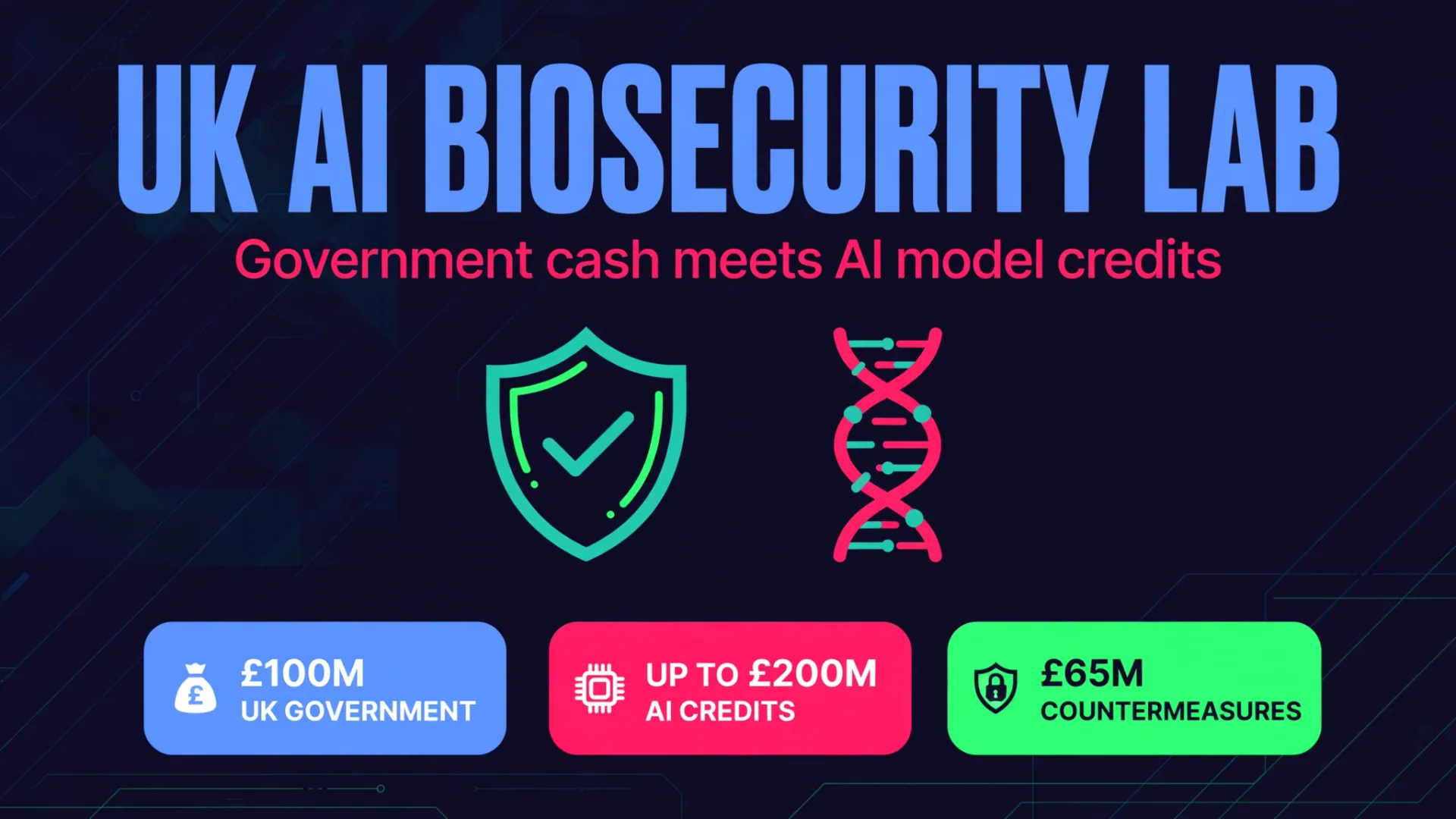
The UK announced the AI Biosecurity Lab on Oct 24, 2026: £100M in government cash, up to £200M in OpenAI and Anthropic model credits, and £65M for countermeasures.
The UK government has created a new institution for one of the sharpest questions in AI safety: what happens when the same models that accelerate biology could also lower the barrier to harmful biological work. On October 24, 2026, the government announced the AI Biosecurity Lab, or AIBL, described as the world's first dedicated AI biosecurity organisation. It is not a lab that is already running. It is a funded institution still to be built, with named partners, a clear mission, and several big details still missing.
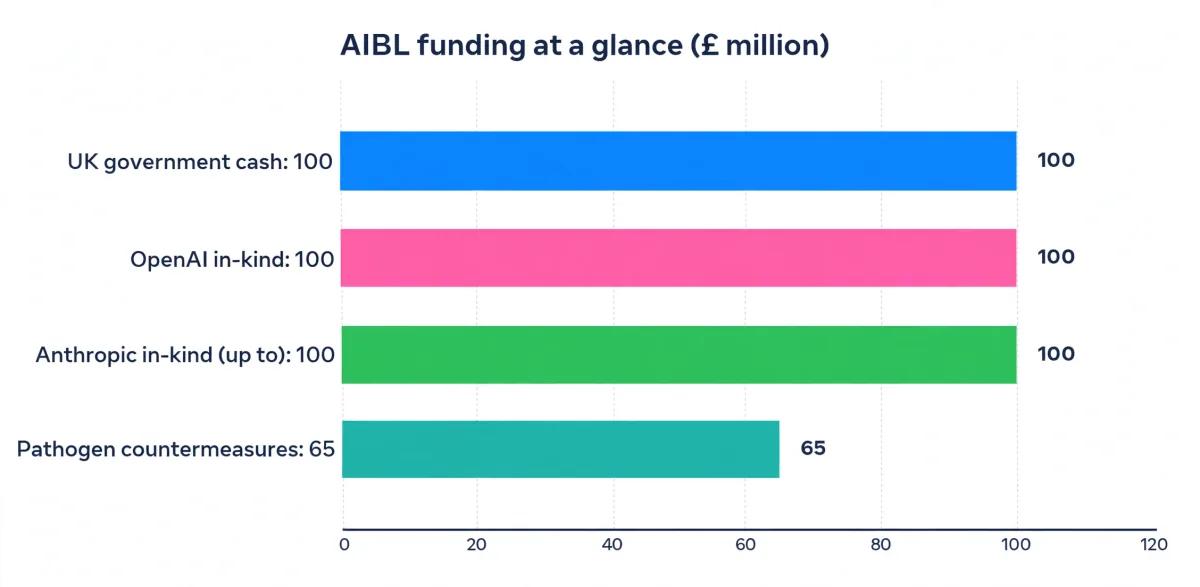
The headline numbers need careful reading, because cash and credits are not the same thing. The UK government is putting in £100 million in cash to establish the lab. OpenAI and Anthropic are adding up to £200 million combined, but that support comes as compute, model credits, trusted model access, and technical help, not as cash the lab can spend on staff, equipment, or lab space. A separate £65 million government line will fund pathogen countermeasures. Together, the biosecurity lines total £165 million in government cash, plus the in-kind company support.
The quick verdict: who is putting what into AIBL
| Participant | Role | Amount | Form |
|---|---|---|---|
| UK government | Funder and sponsor | £100 million | Cash to establish AIBL |
| OpenAI | Company supporter | £100 million | Compute and model credits, trusted access via the Rosalind Biodefense programme |
| Anthropic | Company supporter | Up to £100 million | Model credits, trusted access, dedicated technical support |
| Google DeepMind | Research partner | Not quantified | Frontier Gemini and specialised science models |
| Basecamp Research | Research partner | Not quantified | AI-biology models and expertise |
| UK government, separate line | Countermeasures | £65 million | Cash for developing pathogen countermeasures |
The distinction between OpenAI and Anthropic matters. OpenAI's commitment is stated as £100 million, while Anthropic's is stated as up to £100 million. A ceiling is not a payment, and no drawdown schedule has been published, so nobody outside the deals can yet say how much of the Anthropic figure will actually be used, or over how many years.
What the lab is meant to do
AIBL sits inside a wider National AI Biosecurity Initiative. Its mission, in the government's own four verbs, is to understand, prevent, detect, and respond to biological threats. In practice, the announcement puts the first emphasis on two capabilities: earlier detection of emerging biological threats, and faster development of vaccines, treatments, and other countermeasures.
Understand points to research on pathogens and on how AI systems interact with biological knowledge. Prevent covers testing whether advanced models could help a bad actor, and building safeguards against that. Detect implies surveillance and early-warning tools, such as spotting unusual signals in sequence or health data. Respond covers speeding up the path from a detected threat to a usable countermeasure.
The lab will operate as an independent non-profit, modelled on the UK AI Security Institute, with a scientific advisory committee drawn from academia, industry, and the third sector. It will work alongside the UK Health Security Agency, the Animal and Plant Health Agency, and the Defence Science and Technology Laboratory, and it will work with the medicines regulator MHRA to prepare for health emergencies and to inform future regulation of AI-designed medicines.
AI minister Kanishka Narayan said the aim is for the lab to become a major global institution "bringing together world-leading scientific expertise to protect people from emerging biological threats." That is an ambition, not a result, and the lab will need international talent, credible independence from its sponsors, and published results to earn that standing.
Why credits are not cash, and why that still matters
Model credits are valuable, and they are not a trick. A new lab could never train frontier models itself, and day-one access to OpenAI, Anthropic, DeepMind, and Basecamp Research models gives it capability it could not buy quickly through normal procurement. For biosecurity research, heavy model access is a real input.
But credits also steer the lab. Credits only work on the donor's models, they cost the donor less than face value if models run on spare capacity, and researchers who build workflows around a model tend to keep using it once credits run out. That is why the honest headline is not "£300 million for a lab." It is £100 million in government cash, plus up to £200 million in company in-kind support, plus £65 million for countermeasures. Conflating those lines overstates what the lab can spend, and understates how much of its work will run on two companies' systems.
The same tension runs through the whole announcement. The government says increasingly capable AI systems "also create new biological risks and could lower barriers to harmful activity." The companies whose systems create that risk are now contracted contributors to the institution meant to guard against it. That does not make the lab pointless. It makes independence, transparent evaluation, and published methods more important than the launch announcement.
The wider £600 million AI security package
AIBL is the largest single biosecurity line, but it sits inside a wider package that Reuters put at around £600 million, about $800 million. As reported, the package also includes:
| Line | Reported amount |
|---|---|
| AI Security Institute, extra funding | £120 million |
| Cyber defence: National Cyber Shield and National Exposure and Real-Time Vulnerability Centre | £130 million |
| Fund for British companies using AI in robotics, autonomous systems, and manufacturing | £60 million |
| AI research and procurement contracts | £60 million |
| Regional mayors, local AI work | £30 million |
| Research on the economic impact of AI | £23 million |
| Chip design academy | £18 million |
| Prize for AI solutions to public policy problems, starting with healthcare | £15 million |
Treat these as reported lines in an approximate package total, not as a spreadsheet that must sum exactly to £600 million, because some items in the package were left unspecified in reporting. The pattern is clear either way: biosecurity first, cyber defence second, and a long tail of smaller capability funds.
What is still missing
A first announcement always leaves gaps, and this one leaves important ones. There is no opening date, no location, no staffing target, and no named leadership for AIBL. The scientific advisory committee is promised in due course, with no names yet. There is no published delivery plan, no metric for what counts as a biological threat detected, and no detail on how the £65 million countermeasure line will be spent or whether AIBL will steer it. The MHRA role on AI-designed medicines is an intention, not yet a framework.
None of that cancels the announcement. The £100 million is real government funding, the partnerships are named, and the bureaucratic wiring is specified. But until those missing pieces appear, AIBL is best described as a funded intention becoming an institution, not as a working lab with results to judge.
Who should care, and what to watch
If you build AI products, this announcement is a signal about where government trust is heading. Governments are sorting AI suppliers by trust, and a national lab built on named Western developers raises the bar for any model maker that wants a seat in sensitive public programmes. If you run a biosecurity or life-sciences startup, AIBL is both a possible customer and a possible competitor: published tools and datasets could help you build, while the best-funded work in the country could make hiring harder.
Watch three things next. First, whether a follow-up statement firms up Anthropic's up to £100 million figure and names the scientific advisory committee chair. Second, what the MHRA does first on AI-designed medicines, because that line is the earliest signal of a regulatory framework for drugs designed by AI. Third, whether other governments answer with their own institutions, after Poland's AI-safety research framework earlier the same week. The race to institutionalise AI biosecurity has now formally started.
For teams building AI systems today, the practical lesson is closer to home than a government lab. Agent and model choices still need human confirmation on write actions, tool calls, and anything that touches real records or money. CodeMyPixel builds custom AI agent development solutions and full AI automation systems with those controls built in. For model context, see our breakdowns of GPT-6 Astra and Claude Opus 5.5.
FAQ
What is the UK AI Biosecurity Lab?
The AI Biosecurity Lab, or AIBL, is a new UK institution announced on October 24, 2026, described by the government as the world's first dedicated AI biosecurity organisation. It will operate as an independent non-profit inside a National AI Biosecurity Initiative, with a mission to understand, prevent, detect, and respond to biological threats.
How much funding does the AI Biosecurity Lab get?
The UK government is providing £100 million in cash to establish the lab. OpenAI is providing £100 million in in-kind support and Anthropic up to £100 million in in-kind support, in compute, model credits, trusted access, and technical help. A separate £65 million government line funds pathogen countermeasures. Only the government money is cash.
Who are the partners in the AI Biosecurity Lab?
OpenAI and Anthropic are company supporters. Google DeepMind and Basecamp Research are research partners, contributing frontier and AI-biology models. The lab also works with the UK Health Security Agency, the Animal and Plant Health Agency, the Defence Science and Technology Laboratory, and the medicines regulator MHRA.
Is the AI Biosecurity Lab already operating?
No. The announcement establishes the lab, but no opening date, location, staffing target, or named leadership has been published yet. Treat any claim that AIBL is live today as wrong until the government publishes a delivery plan.
What is the wider UK AI security package worth?
Reuters put the wider package at around £600 million, about $800 million. It includes the £100 million lab, £65 million for countermeasures, £120 million extra for the AI Security Institute, £130 million for cyber defence, and smaller funds for robotics, research, regional AI work, chip design, and public-policy prizes.
Why does AI biosecurity matter for businesses?
Because the same AI capabilities that accelerate drug discovery and biological research could also lower the barrier to harmful biological work. Governments are now building institutions, funding lines, and eventually rules around that dual-use risk, and suppliers will increasingly be judged on trust, safety controls, and auditability, not just on model capability.
- uk ai biosecurity lab
- aibl
- openai
- anthropic
- google deepmind
- ai safety
- ai policy