AI6 min read
4 AI Agents Tested: Muse, Grok Bot, Hermes
Which AI agent fits your workflow? Muse vs Instinct vs Grok Bot vs Hermes compared on real business tasks, with workflow-fit grades.
The most useful question is no longer “Which AI agent is best?” It is “Which agent should own this workflow?”
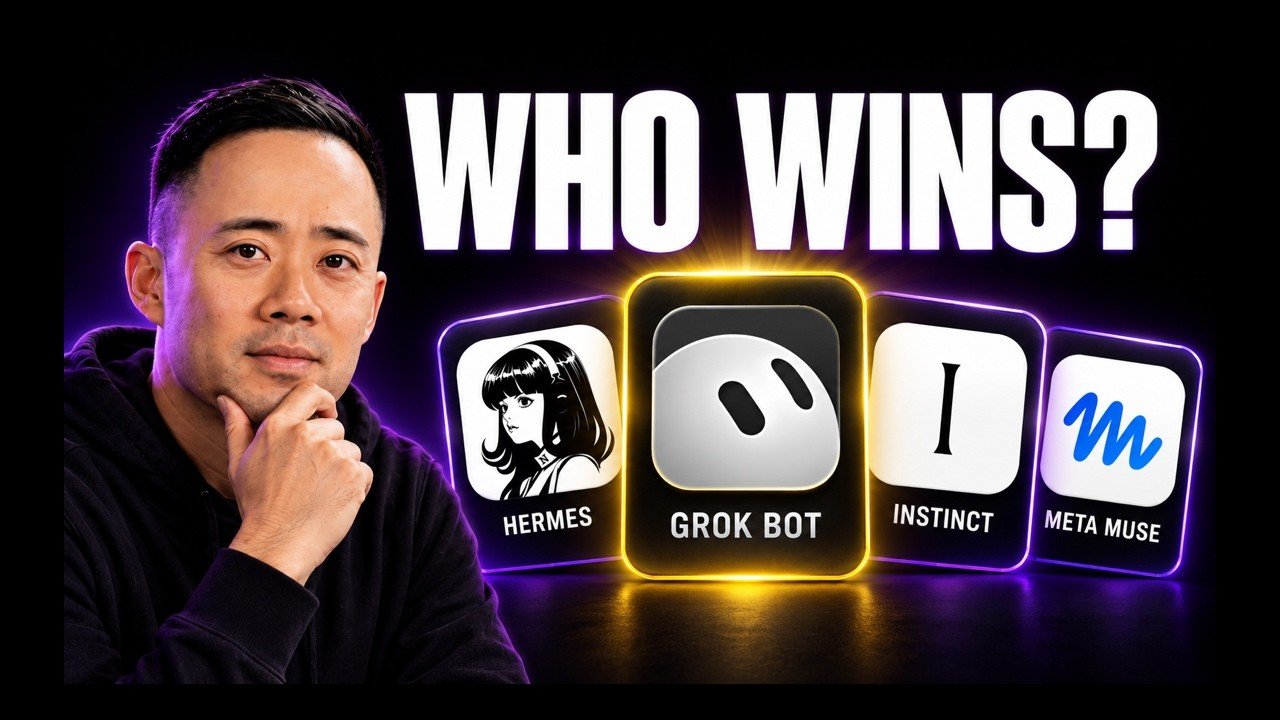
That distinction matters because the four agents tested in Eric Siu’s “I Tried The 4 Hottest Agents Right Now” are not really trying to do the same job. Muse behaves like a strategist. Instinct behaves like a browser operator. Grok Bot is built around conversations and operational follow-up. Hermes is the customizable context layer.
The fast answer: match the agent to the job
| Agent | Best fit from the video | Example workflow |
|---|---|---|
| Muse | Strategy, content and competitive research | Reworking content, generating ideas and mining ad-library patterns |
| Instinct | Multi-step browser work | Travel research, points accounts, applications and outreach |
| Grok Bot | Calls, qualification and CRM operations | Phone bookings, speed-to-lead and candidate evaluation |
| Hermes | Custom context and analytical thinking | Analytics investigation, model switching and personalized agent workflows |
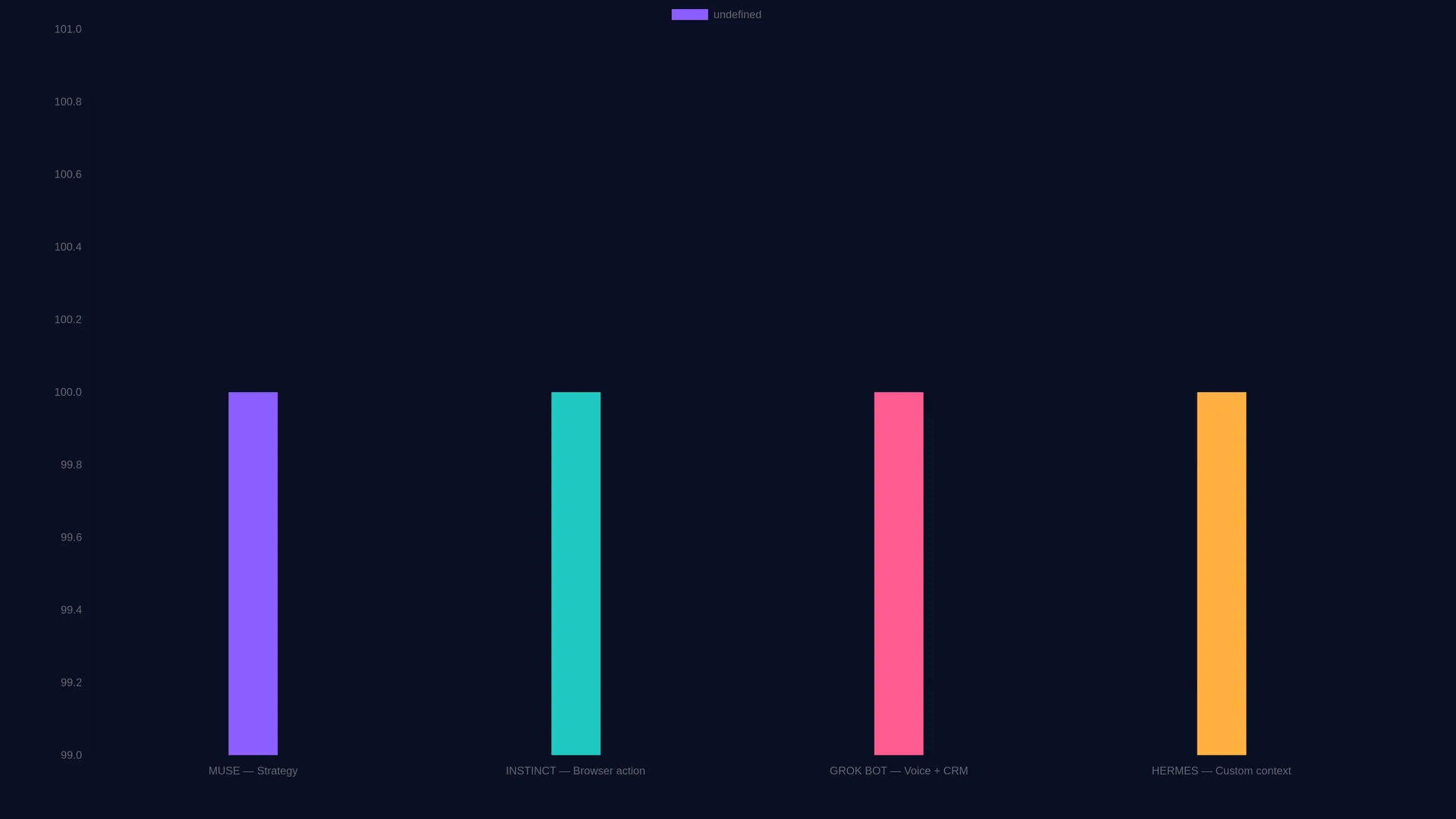
A workflow-fit graph, not a fake benchmark
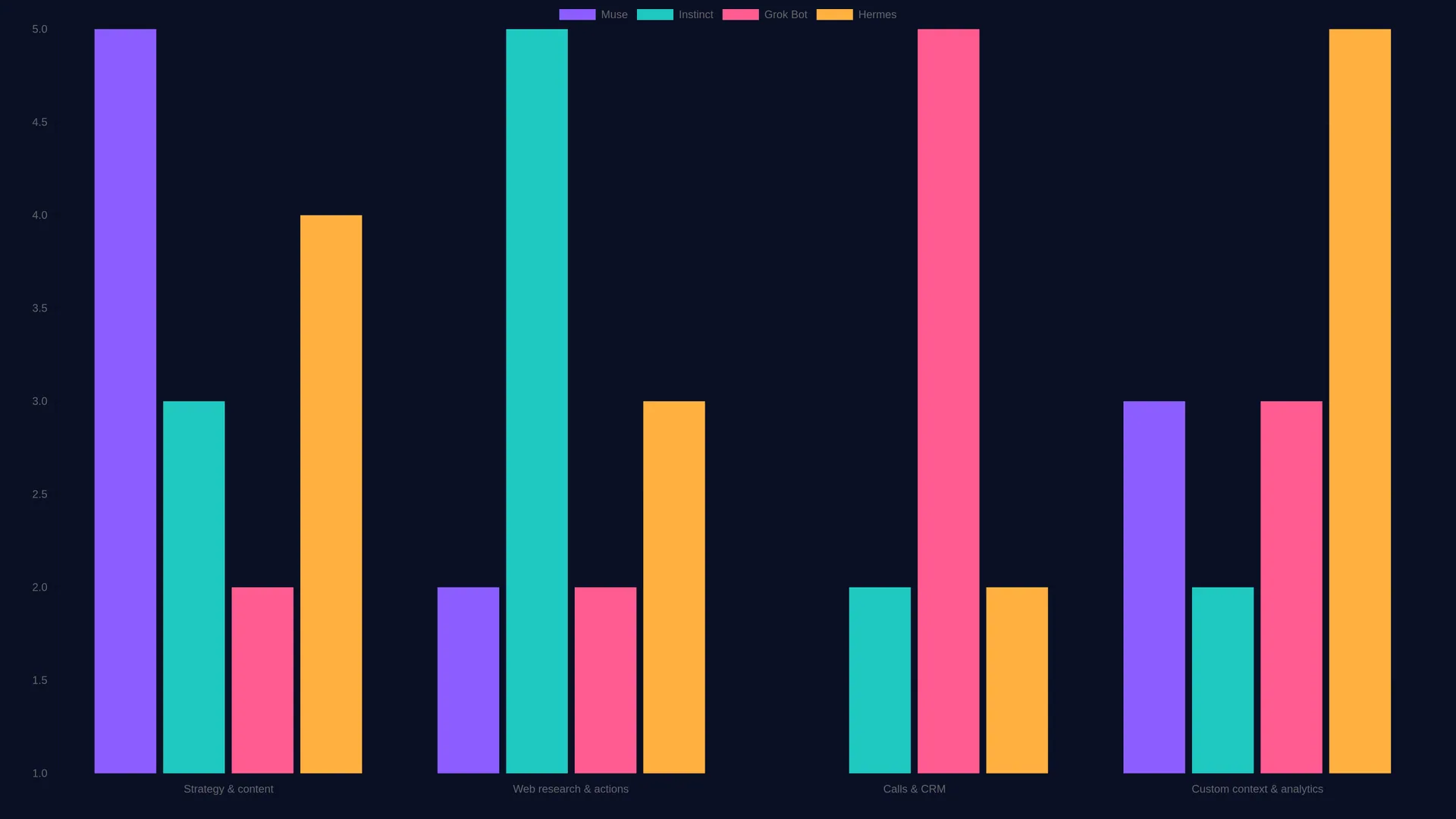
The scores above are CodeMyPixel’s editorial synthesis of the use cases demonstrated in the video, not independent benchmark results. The point is to visualize specialization: an agent can be excellent for one business loop and only a light fit for another.
1. Muse: the strategy and content layer
Muse stands out when the job begins with thinking, interpreting performance, or generating a direction rather than simply clicking through a fixed process.
In the video, Muse is connected to Eric’s Instagram, X and YouTube context. It is used to inspect an underperforming Instagram reel, rethink the opening visual hook, and generate long-form content ideas from live channel information. It also pulls patterns from the Meta ad library to help reverse-engineer how competitors structure their offers.
That makes Muse interesting for founders, marketers and content teams because its value is not just “write me a caption.” The more important use case is turning first-party business and audience context into a recommendation.
Where Muse fits:
- Content strategy and ideation
- Social and channel analysis
- Competitor and offer research
- Creative iteration
- A long-running AI thought partner that learns the operator’s context
In the video, Eric describes Muse as the strongest thought partner of the group. That is a very different job from a browser agent or a phone agent — and it is why comparing all four on one generic “intelligence” score would miss the point.
2. Instinct: the browser operator
Instinct is the most obvious fit for work that normally creates too many tabs, too many forms and too many tiny steps.
The video shows it researching cherry-blossom travel to Japan against points balances, signing into rewards accounts, and handling speaking applications for conferences. Eric also describes using it for recruiting and podcast outreach.
This is the type of work where traditional chatbots hit a wall. The answer itself is not the problem. The problem is navigating websites, gathering details, comparing options, moving information between pages and completing a sequence of actions.
Where Instinct fits:
- Deep web research
- Travel and rewards workflows
- Form filling and applications
- Recruiting operations
- Outreach and repetitive browser tasks
- Multi-step jobs where the path is not fully predictable in advance
The important takeaway is that browser-use agents change the unit of automation. Instead of automating one API call, you can automate a messy human workflow that spans several websites.
3. Grok Bot: the operations and conversation layer
Grok Bot becomes compelling when the workflow requires an AI agent to pick up the phone, speak to someone, qualify information, or trigger the next CRM action.
One of the simplest examples in the video is a phone call to confirm a couples massage booking. The business example is more valuable: a speed-to-lead bot can call a new inbound lead quickly, qualify the prospect and log the outcome into HubSpot. Eric also shows recruiting-oriented bots that run candidates through evaluations.
These are not “AI assistant” workflows. They are closer to small operational systems with a conversation interface.
Where Grok Bot fits:
- Inbound lead qualification
- Speed-to-lead follow-up
- Phone confirmations and bookings
- Recruiting screens
- CRM updates after conversations
- Repeatable customer or prospect communication
Eric’s personal conclusion in the video is that Grok Bot is the one he is most comfortable treating as a daily driver. That should not be read as an objective win over the others. It reflects the fact that his recurring operational workflows line up well with what Grok Bot does reliably.
4. Hermes: the customizable context layer
Hermes is the most interesting option when the team wants a system that can be shaped around its own data, tools, models and communication surfaces.
In the video, Hermes is used as an analytical partner against Google Analytics. It identifies a suspicious traffic spike from China that had distorted August conversion numbers. Eric also highlights its availability across desktop, iMessage, Telegram and a dedicated app, plus the ability to switch models quickly.
He says Hermes has replaced OpenClaw in his own stack. Again, that is a personal workflow decision, but it illustrates the underlying advantage: Hermes is valuable when customization and persistent context matter more than having one tightly defined vertical workflow.
Where Hermes fits:
- Analytical investigation
- Custom agent stacks
- Deep business context
- Multi-interface access
- Model experimentation
- Teams that want more control over how the agent behaves
Why “one AI agent for everything” is probably the wrong architecture
The clearest lesson from the comparison is that the four tools become more useful when you stop treating them as substitutes.
A realistic company might use an agent like Muse to develop a campaign angle, Instinct to research and collect information, Grok Bot to contact and qualify prospects, and Hermes to analyze the resulting business data or act as a deeply customized internal assistant.
That creates a more practical mental model:
Think → Research → Operate → Learn
- Muse helps the team think.
- Instinct helps the team navigate and act on the web.
- Grok Bot helps the team run conversations and operational follow-up.
- Hermes helps the team adapt the agent layer around its own context.
The advantage comes from connecting specialized agents to clear business loops — not from asking one general-purpose bot to impersonate an entire company.
How to choose an AI agent for a real business workflow
Before choosing a tool, define the workflow in plain English. Ask four questions:
- Does the task mainly require judgment and strategy? Start by evaluating a strategy-oriented agent.
- Does it require navigating websites and completing steps? Look at browser-use agents.
- Does it require phone calls, qualification or CRM updates? Evaluate conversational operations agents.
- Does it need deep customization around your own systems and context? Prioritize an extensible agent framework.
Then test the agent on one real process with a measurable result: response time, completion rate, hours saved, qualified leads, applications completed, or another operational metric. That is far more useful than judging an agent by a polished demo.
What this means for teams building custom AI systems
Off-the-shelf agents are getting better quickly, but the highest-leverage business systems usually sit between these tools: they connect the company’s CRM, internal data, approval rules, communications and domain-specific logic into one controlled workflow.
That is the difference between “using an AI agent” and building an AI-enabled operation.
Our guide to custom AI agent development services explains what buyers should expect from a development partner, from architecture and security to maintenance.
At CodeMyPixel, this is the type of problem we focus on with AI-Powered Business Automation: deciding what should be automated, which agent or model should own each step, where a human should approve an action, and how the whole system should connect to the tools the company already uses.
Final takeaway
There is no meaningful single winner here because the agents are strongest at different jobs.
Muse is the strategist. Instinct is the browser operator. Grok Bot is the conversation-and-operations layer. Hermes is the customizable context layer.
If your company is evaluating AI agents, start with the workflow you want to improve and work backward to the tool. The best agent is the one that can reliably own that specific business loop — with the right data, permissions and human checkpoints around it.
- AI agents
- Muse
- Instinct
- Grok Bot
- Hermes
- AI automation
- business automation
- AI agent comparison