الذكاء الاصطناعي9 دقيقة قراءةبقلم JH Akash
FLUX 3 Image Klein Explained: 5.6B Open-Weights Model, 4K, 8GB GPU
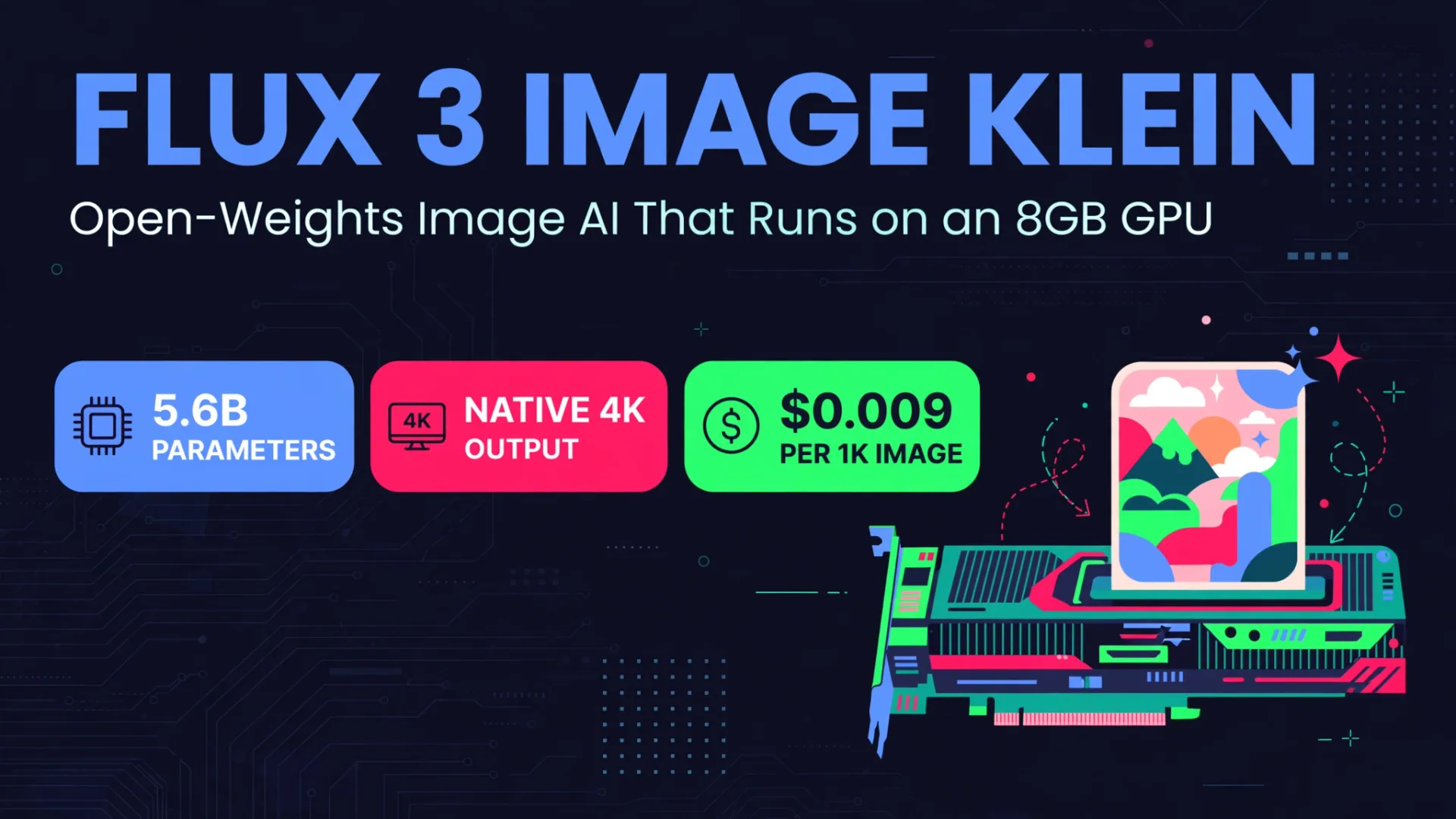
Black Forest Labs released FLUX 3 Image Klein on Oct 15, 2026: a 5.6B open-weights image model with native 4K, 10 reference images, API from $0.009/image, and local runs on 8GB VRAM.
What happened
Black Forest Labs released FLUX 3 Image Klein on October 15, 2026: a 5.6-billion-parameter open-weights image model that generates images, edits images, and works with up to 10 reference images at once. It is the second open-weights release from the FLUX 3 family, after the FLUX 3 Action robot model, and Black Forest Labs calls it its most capable open-weights image model to date.
The headline is not the parameter count. It is the size of the machine you need. The INT8 build runs on NVIDIA GeForce RTX GPUs with as little as 8 GB of VRAM, which means a standard gaming laptop can run it locally instead of sending every image to an API. At the same time, the hosted API starts at about $0.009 per 1K image.
This is a launch breakdown with verified numbers. Every benchmark score below is Black Forest Labs' own figure from its internal evaluations, unless it is explicitly labeled as a third-party test. None of the vendor scores have been independently reproduced yet.
Quick verdict
| Question | Answer |
|---|---|
| What is it? | Open-weights text-to-image, image editing, and multi-reference generation model |
| Released | October 15, 2026 |
| Maker | Black Forest Labs, Freiburg, Germany, the lab founded by researchers behind Stable Diffusion |
| Parameters | 5.6B (image generator only; the Qwen3-VL-4B-Instruct text encoder is separate) |
| Max output | Native 4K |
| Reference images | Up to 10 per request |
| Minimum local GPU | 8 GB VRAM (INT8 build) |
| API price | From $0.008 per image at 768px, $0.009 at 1K, $0.036 at 4K |
| License | FLUX Kommunity License, free commercial use under $5M annual revenue |
| Skip it if | You need the best pose or viewpoint edits, or you earn over $5M and want free self-hosted commercial use |
What FLUX 3 Image Klein actually does
One set of weights covers three jobs: text-to-image generation, single-image editing, and multi-reference generation. Multi-reference means you can feed it up to 10 source images to guide one output, for example a product, a character, and a background style in the same request.
Two features matter for real work:
- Bounding-box layout control. You draw boxes to say where an element belongs, or to confine an edit to one region of the image instead of regenerating the whole frame.
- Pixel-accurate editing. On the API, a feature called pixel restoration preserves unedited regions exactly, so a small fix does not quietly change the rest of the picture.
The model builds on the shared FLUX 3 backbone, which learns jointly across images, video, and audio. Images contribute spatial detail, video adds motion and physical dynamics, and audio adds information about events and interactions. Black Forest Labs says this shared learning helps the model understand how the visual world behaves.
Two checkpoints: Base and Distilled
| Checkpoint | Built for | How it runs |
|---|---|---|
| Klein Base | Fine-tuning and research | Undistilled, 50 steps, CFG 3.5 |
| Klein (Distilled) | Low-latency generation | 16 steps, no guidance, powers the BFL API |
The Distilled checkpoint is what the BFL API serves as flux-3-image-klein, with prompt upsampling and pixel restoration added on top. The Base checkpoint is the one to pick if you want to fine-tune on your own data.
Quantized builds were developed with NVIDIA in NVFP4, FP8, and INT8. Generator weights occupy 5.6 GB in FP8, compared with 11.2 GB in BF16, which is what makes the 8 GB VRAM claim possible.
Pricing: API and self-hosted
The BFL API charges per image by output resolution, with text-to-image and editing priced the same:
| Output resolution | Price per image |
|---|---|
| 768 x 768 | $0.008 |
| 1K | $0.009 |
| 1.5K | $0.011 |
| 2K | $0.014 |
| 4K | $0.036 |
For comparison, the full FLUX 3 Image model on the same API costs $0.048 per 1K image and $0.607 per 4K image. Klein at 4K is roughly one-seventeenth the price of the full model at 4K, which is the gap that makes Klein interesting for high-volume work.
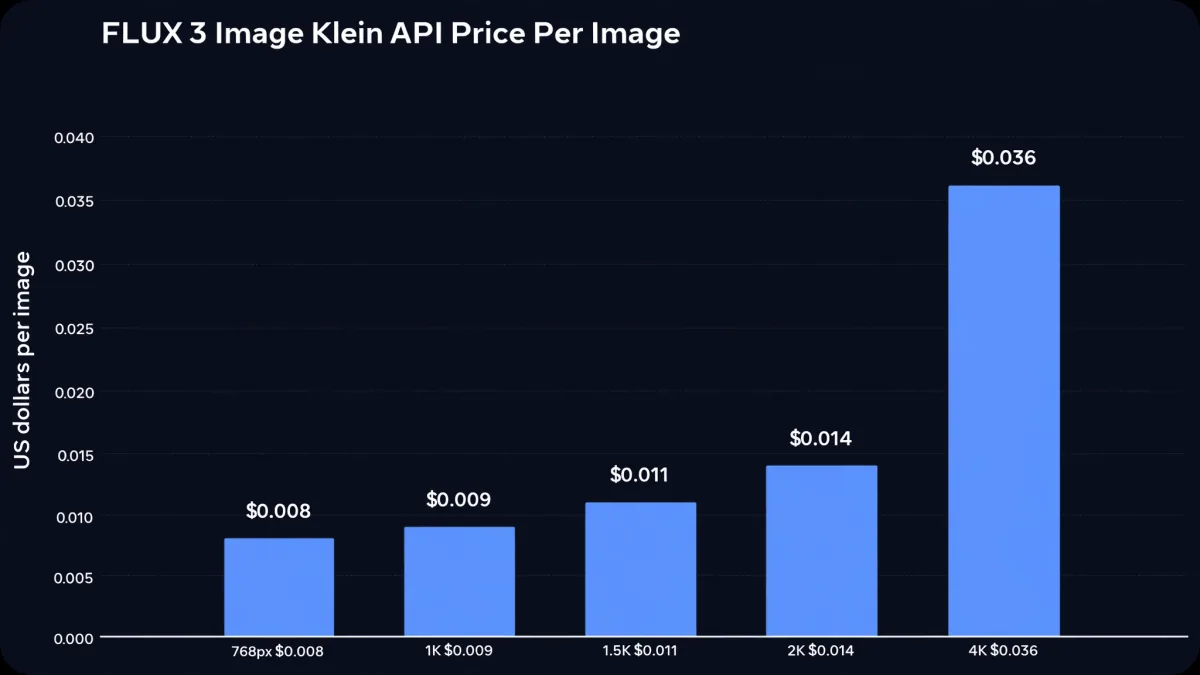
Budgeting note: price the resolutions you will actually order. A campaign of 10,000 images costs about $90 at 1K but about $360 at 4K. The 1K rate is not the campaign rate if your hero images are 4K.
Self-hosting is a different deal. The weights are free under the FLUX Kommunity License for individuals and companies with under $5 million in annual revenue, plus research and non-commercial use. Above that revenue line, commercial deployment needs a self-hosted license or the API. "Open weights" does not mean "free for everyone at any scale." Check the license against your revenue before you ship a product on it.
Benchmarks: vendor-reported
All scores below are Black Forest Labs' internal evaluations. Treat them as company claims until independent testing lands.
| Test | Result |
|---|---|
| Text-to-image Elo vs FLUX.2 klein (9B) | +91 Elo, with 38% fewer parameters |
| Editing Elo vs FLUX.2 klein (9B) | +70 Elo |
| Open-model ranking (BFL internal evals) | 1st in text-to-image, multi-reference generation, and editing |
| Rivals beaten in BFL internal evals | Qwen-Image 2.1 (7B), Krea 2 (12.9B), closed Ideogram V4.5, BFL's own FLUX.2 [pro] |
The +91 and +70 Elo gains are the strongest vendor numbers in the release, and the "38% fewer parameters" framing is the point: Klein beats its 9B predecessor while being smaller.
The one public third-party result so far is a single blind test of 200 text-to-image and editing tasks, judged by Claude, Gemini, and GPT, relayed by a community source. In that test, Nano Banana 2.1 scored 7.20 and Klein scored 6.93, with Klein at about one-fifth of Nano Banana 2.1's cost per image. One test with 200 tasks is a signal, not a verdict, and no official Nano Banana 2.1 specs or prices are public to compare against.
Speed: local GPU and API
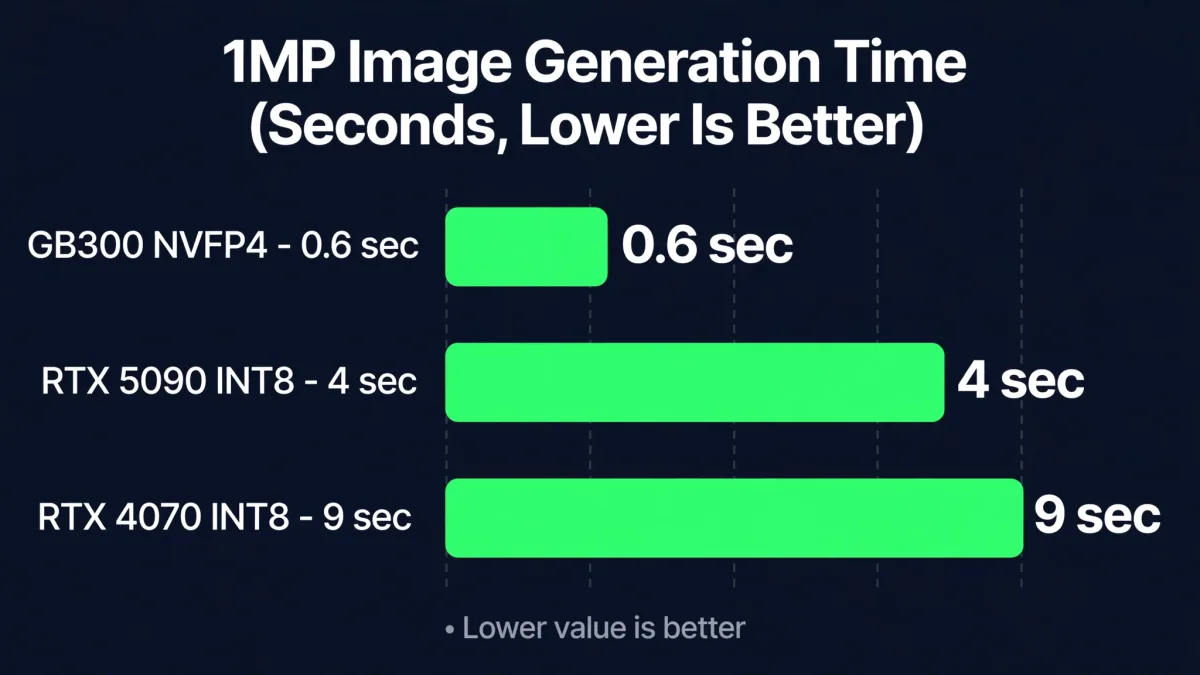
Vendor-reported timings for a 1MP image, measured on the GPU with 16 steps and one image per run, excluding network and queueing time:
| Hardware and build | 1MP image time |
|---|---|
| NVIDIA GB300, NVFP4 | Under 0.6 seconds |
| RTX 5090, INT8 | About 4 seconds |
| RTX 4070, INT8 | Under 9 seconds |
| BFL API median, text-to-image, 1MP | 4.54 seconds end to end |
| BFL API median, editing, 1MP | 7.18 seconds end to end |
The local numbers and the API numbers measure different things. Local GPU time excludes network and queueing; API latency includes them. Do not compare the 4 seconds on an RTX 5090 directly against the 4.54 second API median.
Comparison: Klein vs the alternatives
| Feature | FLUX 3 Image Klein | Full FLUX 3 Image | Qwen-Image 2.1 |
|---|---|---|---|
| Open weights | Yes | No, API only in reported pricing | Yes |
| Parameters | 5.6B generator | Not disclosed in sources used | 7B |
| Max output | Native 4K | Native 4K class (priced to 4K) | Not compared here |
| Reference images | Up to 10 | Up to 10 class features | Not compared here |
| Minimum local GPU | 8 GB VRAM (INT8) | Not self-hostable per sources used | Higher (not compared here) |
| API price, 1K image | $0.009 | $0.048 | Not compared here |
| API price, 4K image | $0.036 | $0.607 | Not compared here |
The honest read: Klein is the budget and self-hosting option. The full FLUX 3 Image model costs roughly 5 times more at 1K and roughly 17 times more at 4K. Qwen-Image 2.1 is the closest open rival on paper at 7B parameters, and BFL's internal evals rank Klein above it, but that is still a vendor claim.
For video work, the image model is only half the pipeline. See our breakdown of Kling 4.0, which handles 30-second AI video with keyframes and reference assets. For the open-weight trend on the language side, see DeepSeek V4.1-Flash-1017, another small, cheap, open model punching above its size.
Which to pick
Pick Klein if you want to run image generation on your own hardware. The 8 GB VRAM floor, the FP8/INT8/NVFP4 builds, and the ComfyUI and Diffusers support make it the most practical self-hosted frontier-class image model available right now. LoRA training works from day one through Diffusers, the Ostris AI Toolkit, and NVIDIA NeMo AutoModel recipes, and serving a LoRA adds only around 5% to generation time.
Pick the Klein API if you want cheap, fast images without managing GPUs. At $0.009 per 1K image, variant-heavy work like product backgrounds, ad creatives, and mockups becomes nearly free at the model layer. Your real cost becomes review time, not generation.
Pick the full FLUX 3 Image model if Klein's quality ceiling shows in your tests. Klein's early weak spots, reported by hands-on testers, are pose changes, viewpoint shifts, multi-reference compositing, people generation, and fine text rendering in some cases. If your use case lives in those weak spots, test both and compare on your own prompts before committing.
Skip Klein if you are over the $5M revenue line and want free self-hosted commercial use. The Kommunity License does not cover that. Use the API or get a self-hosted license instead.
If you are building image generation into a product, an agent workflow, or an internal tool rather than generating one-off pictures, that is where a partner helps. CodeMyPixel builds AI agent development services that put models like this inside real business workflows, with the guardrails, cost controls, and review steps a production system needs.
Safety and limits
Black Forest Labs says it applies dataset filters during pre-training to limit exposure to harmful content, plus targeted fine-tuning during post-training to suppress harmful behaviors. The Klein checkpoints were red teamed internally and evaluated by external safety partner Cinder, and the company reports substantially fewer vulnerabilities than other popular open-weights models.
Still, open weights mean the model can be fine-tuned by anyone, including for uses the lab did not intend. If you deploy Klein in a customer-facing product, add your own content filters, logging, and human review. The lab's safety work covers the released checkpoint, not what someone else fine-tunes it into.
FAQ
What is FLUX 3 Image Klein?
FLUX 3 Image Klein is a 5.6-billion-parameter open-weights image model from Black Forest Labs, released October 15, 2026. It handles text-to-image generation, image editing, and multi-reference generation with up to 10 reference images, with native 4K output.
Can FLUX 3 Image Klein run on 8 GB of VRAM?
Yes, with the INT8 build. Black Forest Labs says the INT8 version runs on NVIDIA GeForce RTX GPUs with as little as 8 GB of VRAM through ComfyUI or Diffusers. Generator weights are 5.6 GB in FP8, compared with 11.2 GB in BF16.
How much does the FLUX 3 Image Klein API cost?
The BFL API charges per image by resolution: $0.008 at 768px, $0.009 at 1K, $0.011 at 1.5K, $0.014 at 2K, and $0.036 at 4K. Text-to-image and editing cost the same.
Is FLUX 3 Image Klein free for commercial use?
Free commercial use applies to individuals and companies with under $5 million in annual revenue, under the FLUX Kommunity License, plus research and non-commercial use. Companies above that line need a self-hosted license or the API.
What is the difference between Klein Base and Klein Distilled?
Klein Base is the undistilled checkpoint for fine-tuning and research, running 50 steps at CFG 3.5. Klein Distilled is the step-distilled checkpoint for low-latency generation, running 16 steps without guidance, and it powers the BFL API.
How good is FLUX 3 Image Klein compared to Qwen-Image 2.1?
In Black Forest Labs' internal evaluations, Klein ranks first among open models in text-to-image, multi-reference generation, and editing, ahead of Qwen-Image 2.1 (7B) and Krea 2 (12.9B). Those are vendor-reported results. The only public third-party test so far, a 200-task blind comparison against Nano Banana 2.1, scored Klein 6.93 against 7.20.
What are FLUX 3 Image Klein's weaknesses?
Early hands-on reports flag weak pose and viewpoint edits, multi-reference compositing, people generation, and fine text rendering in some cases. Test it on your own prompts before committing to it for those use cases.
Where can I try FLUX 3 Image Klein?
The weights are on Hugging Face, reference inference code and a Gradio demo are on GitHub, there is a demo on Hugging Face Spaces, and the distilled model is available through the BFL API as flux-3-image-klein. Day-one tooling support includes ComfyUI, Diffusers, TensorRT-LLM, SGLang Diffusion, and vLLM-Omni.
- FLUX 3 Image Klein
- Black Forest Labs
- Open-Weight AI
- Image Generation
- AI Models