A score you can audit
The risk number comes from a fixed formula over the flagged clauses. The same contract gets the same score, and every point traces back to a quoted line.
Lex Claro · AI legal-tech case study
An AI workspace for legal documents, built for LexClaro. Upload a contract and every clause is read, scored for risk by a fixed formula and checked against market terms. Then it is negotiated, signed and locked.
LexClaro is a workspace for legal documents, founded by Roy van Hemert. CodeMyPixel is the technology team behind it. We designed and built the whole system, and we keep it running in production.
A contract goes in as a file and comes back as a marked-up document. Every clause is found and quoted. Every risk is flagged next to the words that caused it. One risk score sits on top, calculated by a fixed formula rather than a model's opinion. Then each term is measured against what the market treats as fair, so the reader knows what is risky and what to ask for instead.
The same workspace carries the contract the rest of the way: an editor laid out like the printed page, an assistant that can explain a clause or rewrite it, links for the other side to suggest changes, and a lifecycle that ends with the signed version locked on the server.
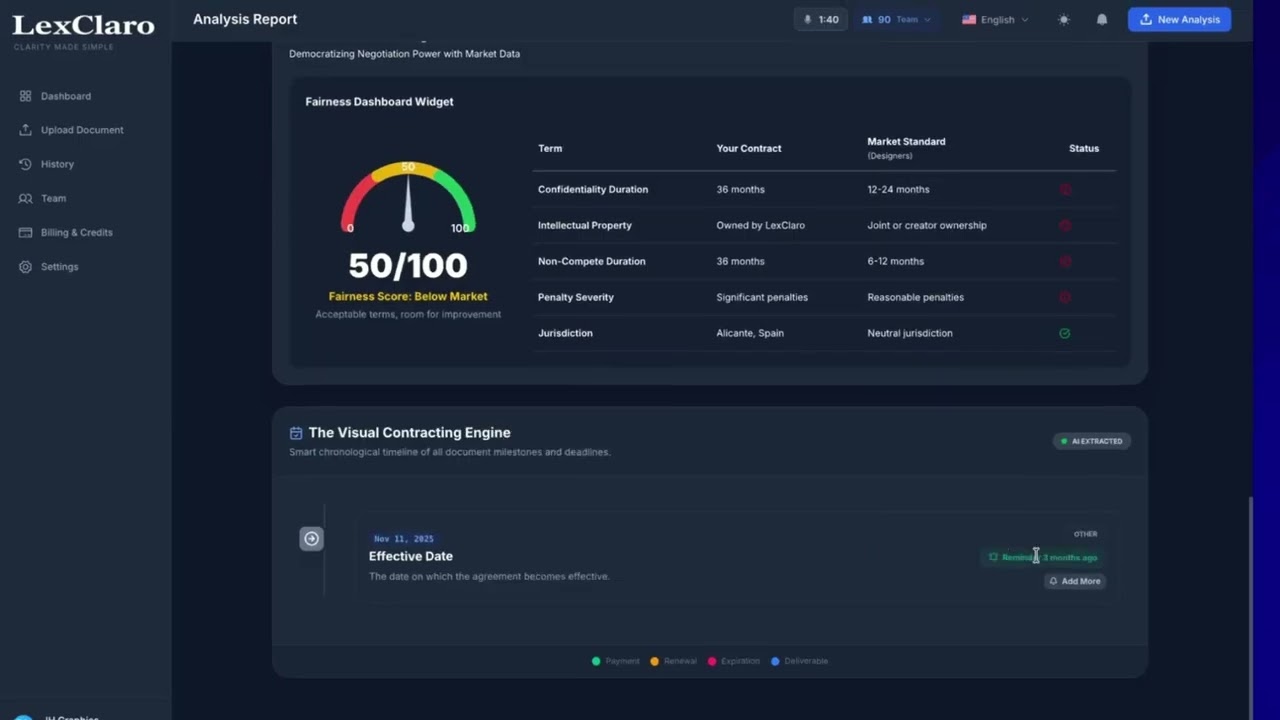
LexClaro's own tutorial: uploading a contract, reading the risk report and working in the document.
The risk number comes from a fixed formula over the flagged clauses. The same contract gets the same score, and every point traces back to a quoted line.
Each term is compared with market standard. The reader sees a line like "payment terms 50% below market" and gets a drafted reply asking for better.
Once a contract reaches Executed, the server makes it read-only. Every earlier version is kept, encrypted and hash-chained, so a later edit cannot hide.
Personal data is scrubbed from the text before it is sent for analysis, and an upload can be set to delete itself an hour later.
Ask about a clause, have the assistant rewrite it in place, or open a live voice conversation with the contract itself.
Contracts are written to be signed, not read. A founder with a supplier's terms, a freelancer with a client's NDA, a lawyer with a stack of leases: each has the same problem. The clause that matters is buried. Nobody can say whether the terms are normal for the market. And the conversation with the other side starts with nothing firmer than a feeling. A full legal review fixes that, at a price and a pace most documents never get. An AI summary is quicker, but a summary that cannot show its working is one more thing to trust blindly.
A careful read of a long contract costs hours, and the queue of documents waiting for one never gets shorter.
Liability caps, renewals and payment terms sit deep in the document, phrased to be read past.
Without knowing what the market accepts, a hard bargain looks the same as a bad one, and there is nothing concrete to push back with.
We built LexClaro as two applications behind one sign-in. LexClaro owns the account: who you are, which plan you are on and how many credits are left, with payments through Stripe. LawClaro is where the documents live, and it re-reads the account on every page load, so a plan change or a top-up counts the moment it happens. Every contract goes through the same pipeline in the same order, and comes out with a report that shows its evidence.
Billing and identity live in one app and the legal work in the other, so either can change without putting the other at risk.
OCR, credit check, duplicate check, privacy scrub, two analysis passes, then the score. In that order, for every document.
Roles and invitations, clients with their aliases, numbered matters, and a conflict check that must be waived on the record before work goes ahead.
LexClaro's commercial numbers are LexClaro's to publish. What we can show is what the system does to every contract that goes into it: the clauses it finds and quotes, the languages it works in, how it protects what it reads, and how briefly it needs to keep it.
Know before you sign
The LexClaro app: the source of truth for every account.
The same steps, in the same order, for every upload.
Solution:Ask a model for a number twice and it can give two. So the models only find and classify the clauses. The score is computed afterwards by our own formula, weighting each finding by severity and normalising the total, so identical findings always produce an identical score.
Solution:A lawyer cannot send a client's name to a model they do not control. The text is scrubbed of personal data before it goes for analysis, reports and snapshots are encrypted with AES-256-GCM, and each upload can be set to delete itself on a timer.
Solution:A locked flag is only as good as whoever can unset it. Executed contracts are read-only on the server, and every version is an encrypted snapshot chained to the one before it by SHA-256. A verification pass walks the chain and names the first version that does not match.
Solution:Plans and credits live in LexClaro, documents in LawClaro. Rather than syncing on a schedule and hoping, LawClaro re-reads the account on every page load, and every credit spent, from a team pool or a personal balance, is mirrored back to LexClaro as it happens.
Let's build the AI that reads them first.