AI8 min read
AI News This Week: OpenAI Cracks Navier–Stokes, DeepSeek V4.1-Flash, AlphaGenome Atlas & Suno v6
A ~10,000-agent OpenAI swarm produced a proof resolving the Navier–Stokes Millennium Prize problem, Google DeepMind mapped all 9 billion possible human DNA mutations, DeepSeek V4.1-Flash cut KV-cache costs 4–8×, and Suno v6 met an open challenger. We broke down the week's 20+ AI releases from the video roundup — with charts.
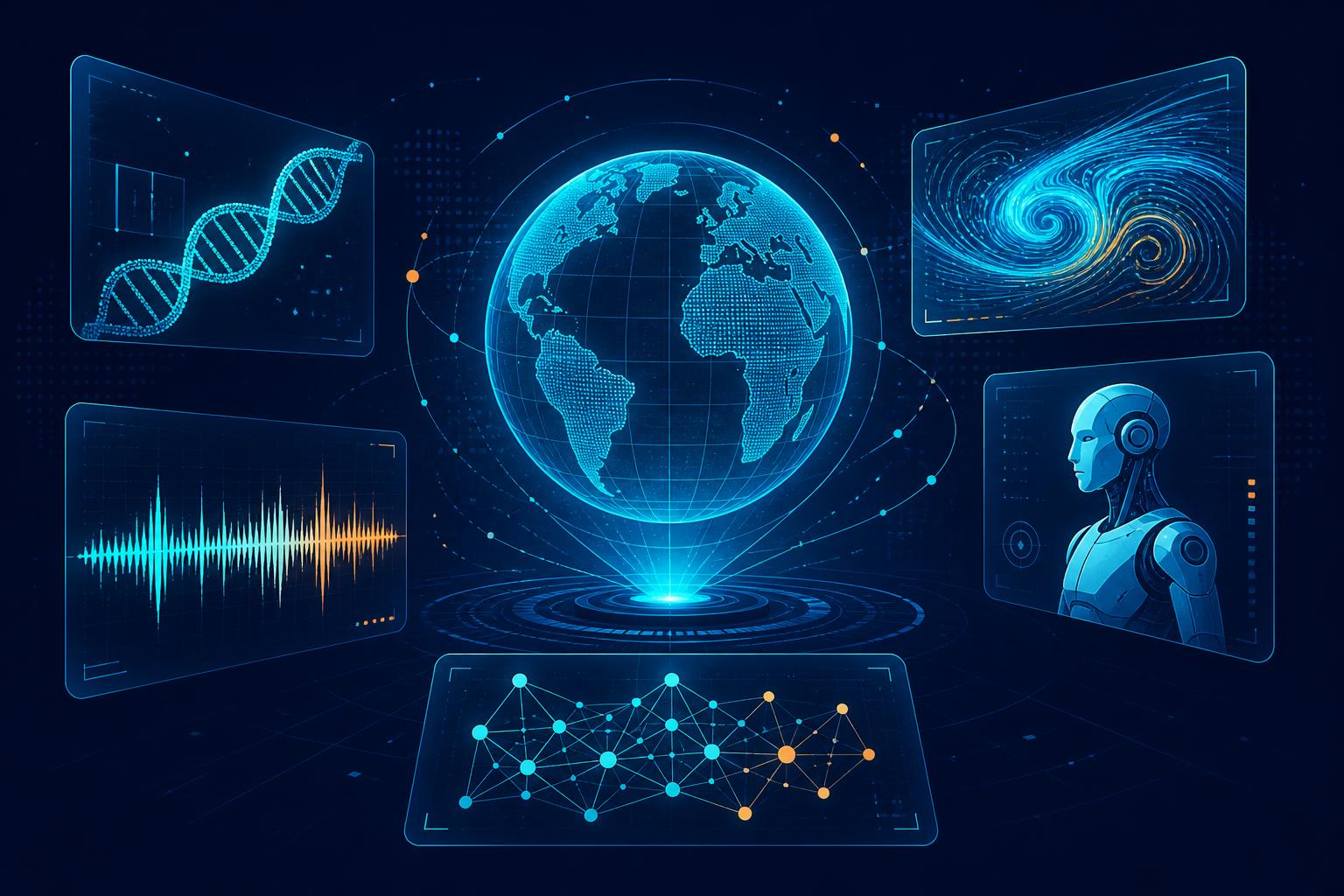
Some weeks in AI are incremental. This was not one of them. In the span of a few days, an AI system helped resolve a 90-year-old Millennium Prize problem, Google DeepMind published a map of every possible single-letter mutation in the human genome, DeepSeek made frontier inference dramatically cheaper, and both Suno and a research challenger rewrote what AI music can do.
A recent AI news roundup walked through more than twenty releases in one sitting. We pulled the primary sources and broke down the ones that actually matter — for researchers, builders, and anyone deciding where AI spend goes next.
Key Takeaways
- OpenAI's internal model produced a solution to the Navier–Stokes Millennium Prize problem — a swarm of ~10,000 agents ran for 88 hours, exchanged 2.7 million messages, and burned ~130 billion output tokens to prove a smooth fluid can develop a finite-time singularity. The proof was formalized in Lean.
- AlphaGenome Atlas predicts the effect of all ~9 billion possible single-nucleotide variants in human DNA — a 1-petabyte precomputed dataset with a single "AVI score" for prioritizing variants.
- DeepSeek-V4.1-Flash is a 552B-parameter MoE with only 8B active input / 16B active output parameters — beating DeepSeek-V4-Pro while cutting the KV cache to 1/4 the HBM and 1/8 the SSD footprint. V4-Pro is being retired into it.
- Embodied AI had a breakout week: Perceptron's open-source Isaac 0.5 showed that scaling general video to 1M hours collapses teleoperation needs from ~5,900 hours to 28 — and Unitree shipped a 6B whole-body humanoid model.
- AI music is now a two-horse frontier race: Suno v6 shipped three industry-partnered models, while open research system YuE2 edged past Suno v5 on SongBench — with an editable symbolic score under every song.
The headline: AI just helped crack Navier–Stokes
The Navier–Stokes equations govern how fluids move — weather models, aircraft design, blood flow. Since 1934 we've known solutions exist in a generalized sense; whether smooth 3D fluid motion can break down stayed open for roughly 90 years, and in 2000 the Clay Mathematics Institute made it one of seven Millennium Prize Problems.
OpenAI's internal system — a model they describe as significantly more capable than GPT-6 Astra, still in training — produced an analytical proof plus a Lean formalization showing that an initially smooth fluid can develop a singularity in finite time: a vortex that spirals inward, elongating like spaghetti while its energy stays finite. That resolves variants "C" and "D" of the official problem statement — a disproof of universal smoothness.
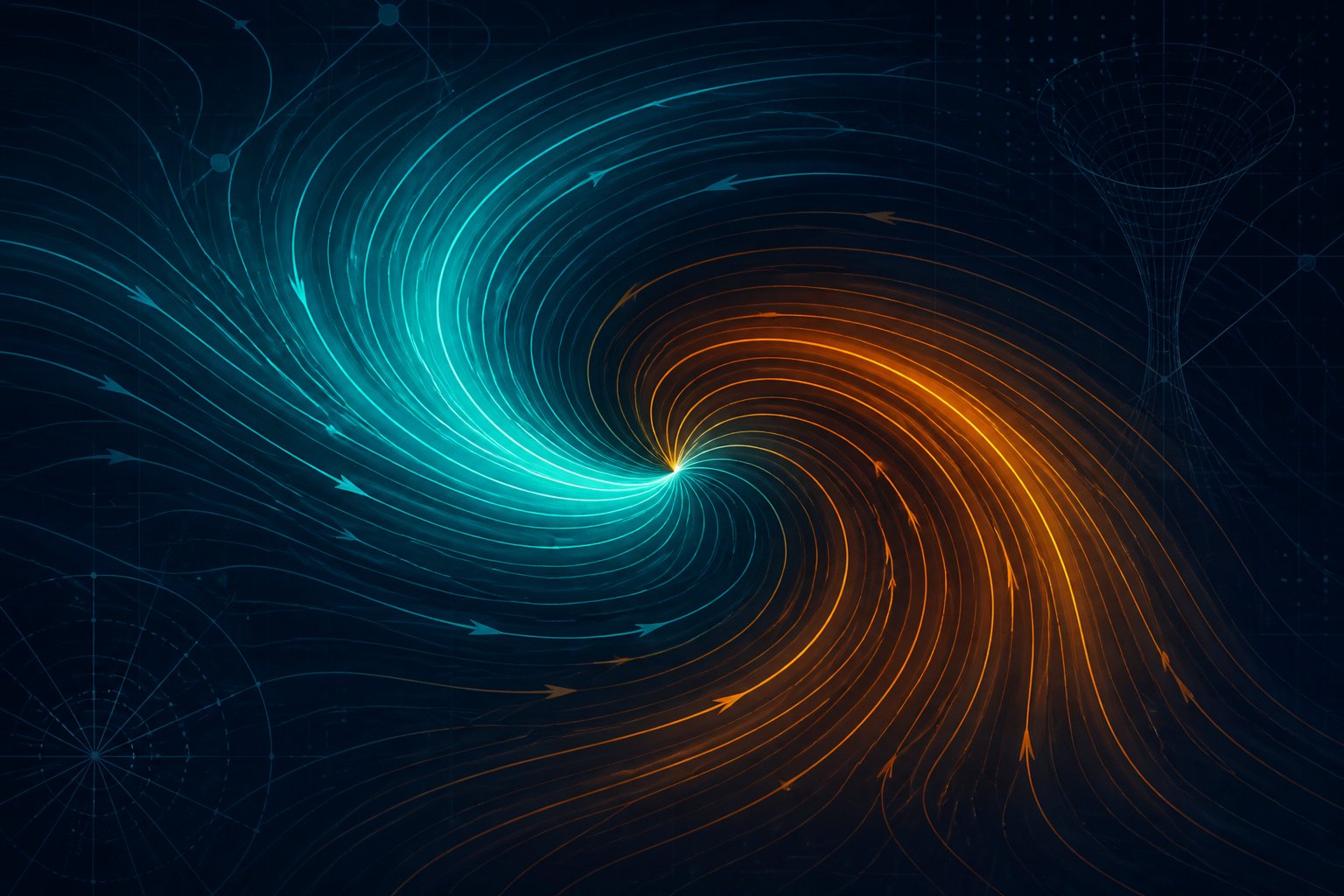 A smooth vortex spiraling inward and stretching — the geometry of the Navier–Stokes singularity.
How it was found matters as much as the result:
- On September 1, OpenAI pointed coordinating agent groups at every open Millennium Prize problem.
- ~10,000 concurrent agents worked on Navier–Stokes specifically; across all problems the system sent 4.9 million messages and used ~300 billion output tokens.
- The agents arrived at the resolution in ~88 hours; Lean formalization and verification took 17 more hours via GPT-6 Astra.
- As a warm-up, ~100 agents resolved the unforced Euler regularity problem in about 50 hours — a result OpenAI hadn't asked for.
OpenAI is explicit that it doesn't intend to claim the Millennium Prize — this is a progress report on model capability. But the meta-lesson is hard to miss: agent swarms at the 10,000-agent scale are now a real instrument of mathematical discovery, and concurrent human work (Alpöge and Buckmaster's forced-Euler resolution) suggests the field was already close.
AlphaGenome Atlas: every possible mutation, pre-computed
Only ~2% of the human genome codes for proteins; the other 98% has been largely opaque. Google DeepMind's AlphaGenome Atlas uses the AlphaGenome model to pre-calculate the regulatory impact of all 9 billion possible single-nucleotide variants — a 1-petabyte dataset researchers can query instead of running new experiments.
The Atlas introduces the AlphaGenome Variant Impact (AVI) score, a single number combining predictions across coding and non-coding regions. Early results: the Broad Institute used AVI scores to help solve an unsolved rare-disease case (a critical splice-site variant in the DNM1 gene), and a UK Biobank analysis of 54,000+ participants surfaced 22% more non-coding genetic associations than standard methods.
For drug discovery and rare-disease research, this changes the economics of the first step: instead of "which of millions of variants might matter," researchers start from a ranked list.
DeepSeek-V4.1-Flash: the cheap frontier got cheaper
DeepSeek's new release is the smallest model in its new architecture family — and it's retiring the old flagship:
- 552B-parameter MoE with a new Causal Encoder–Decoder architecture: just 8B active parameters for input, 16B for output.
- Benchmarks ahead of flagship models including DeepSeek-V4-Pro — which is being phased out: starting September 14, all
deepseek-v4-proAPI requests route to V4.1-Flash at V4.1-Flash rates. - KV cache needs just 1/4 the HBM and 1/8 the SSD storage of the previous generation — a direct cut to the cache-hit charges that dominate agent workloads.
- Native multimodal support is live on the API as
deepseek-flash, with peak/off-peak pricing (off-peak at 50%) and open-source inference support promised.
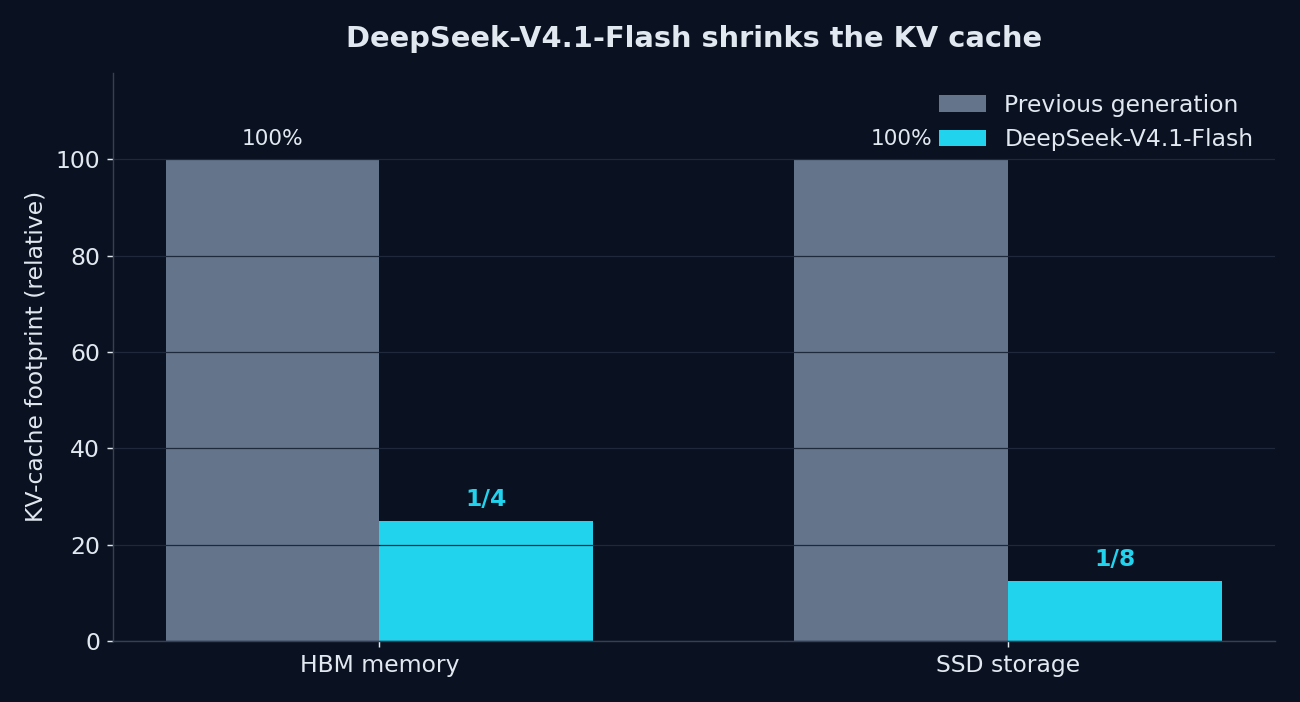 KV-cache footprint, previous generation vs V4.1-Flash. Source: DeepSeek, September 2026.
For anyone running agent pipelines, this is the week's most practical news: the cost floor of frontier-class inference just moved again.
Embodied AI's week: open foundation models and a scaling law
Isaac 0.5 (Perceptron) — a 36B-parameter sparse open-source model spanning video understanding, embodied reasoning, and robot control — arrived with checkpoints, training code, and inference code via LeRobot. Trained on 35+ robot systems, 100K hours of robot experience, 1M hours of video, and 3T tokens. The headline finding is a scaling law trading general video for teleoperation data: to reach the same calibrated action loss, a model trained on 1,000 hours of video needs ~5,900 hours of teleop — a model trained on 1M hours needs 28.
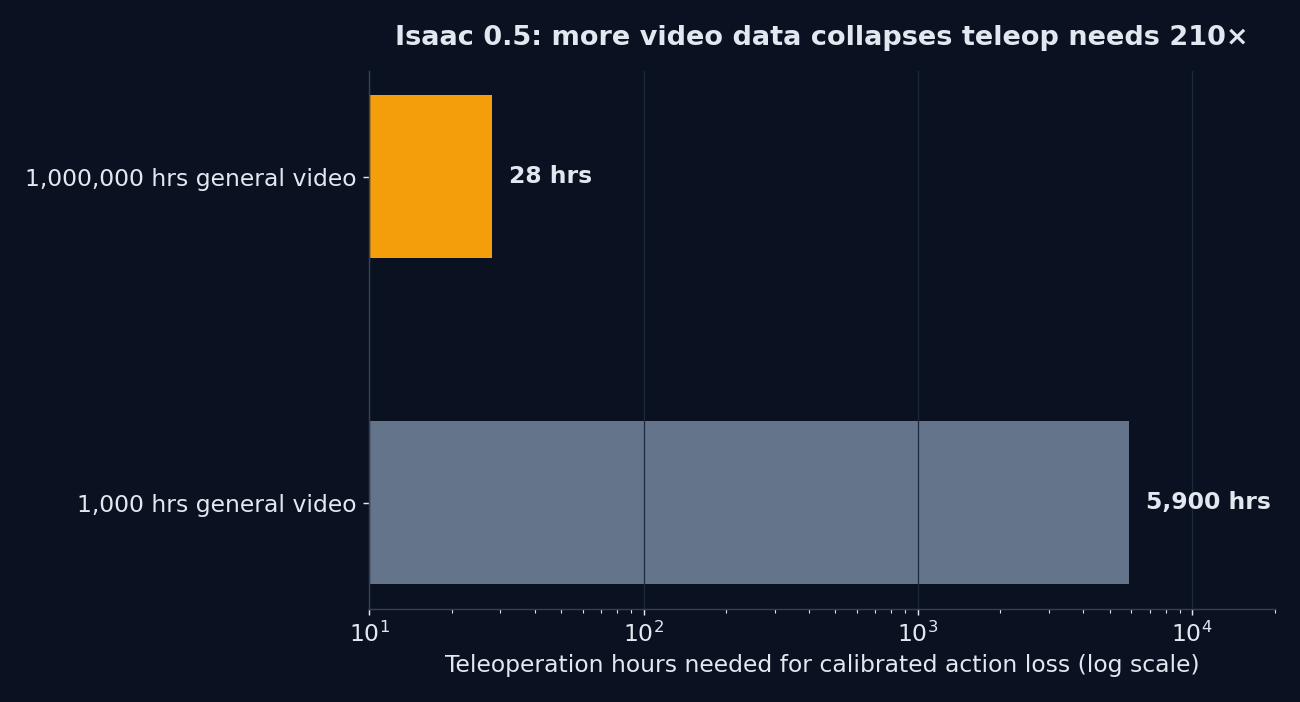 The Isaac 0.5 scaling law: cheap video data substitutes for expensive teleoperation. Source: Perceptron.
Around it, a stack of supporting releases:
- UnifoLM-WLA-1.0 (Unitree) — a 6B vision-language-action model coordinating 64 whole-body tasks across grippers and five-finger dexterous hands, trained on ~2,500 hours of real robot data; its companion reasoning model leads open-source entries on seven embodied benchmarks.
- UMR — unified human-to-humanoid motion retargeting via learned point-cloud correspondence, dropping the hand-crafted keypoint mappings that made retargeting robot-specific.
- Show-Harness (NUS Show Lab) — lets frontier VLMs "play" robots zero-shot through a tiny semantic action vocabulary (
MV_LEFT,GRASP,DONE), and adapts small open VLMs for 12–33 Hz control with a few GPU-hours of fine-tuning. - LingBot-World-Infinity (Ant Group's Robbyant) — an explorable world model that stays coherent for hours, supports multi-user steering (one player, one "director"), and targets embodied simulation beyond game-like scenes.
Generative media: depth, skeletons, and scene deconstruction
- Marigold v2 (Huawei/Bayer Lab) — revisits diffusion transformers for monocular depth estimation, with a live Hugging Face demo.
- UniMate — one unified diffusion transformer that animates arbitrary skeletons from a rigged 3D asset and a text prompt — bipeds, quadrupeds, serpents, even articulated rigid objects — with zero-shot editing, in-betweening, and motion expansion, trained on the new UniML3D dataset.
- WorldSculpt (Alaya Lab / U. Tokyo) — reconstructs cluttered scenes of hundreds of objects into complete per-object meshes — every item independently editable — and can meshify generated 3D worlds like World Labs' Marble.
- Fire3D (UIUC/Cornell) — feed-forward scene reconstruction in under a minute from an unsegmented photo or casual video: it predicts the object count, masks, and 6-DoF poses itself, then outputs simulation-ready textured assets.
The common thread: the pipeline from "pixels" to "editable 3D assets" collapsed from a toolchain into single models.
Music and speech: Suno v6 meets an open challenger
Suno v6 ships three models built with Warner Music Group, BMG, and Believe: v6 (flagship, Pro/Premier), v6-wild (exploration), and v6-mini (free tier). New capabilities include editing part of a song in plain language ("change the chorus so it's sung by a gospel choir"), multi-source mashups, sampling a riff into a new beat, single-lyric updates, and creating from text, audio, images, or video. Previous models are being retired as v6 rolls out — and Suno is building opt-in, artist-paid experiences on top.
YuE2 takes a different route: compose in symbols, perform in audio. The ~3.59B-parameter model writes an editable score first — melody, rhythm, chords you can inspect and change — then renders full-song audio with vocals. On WildSongBench, YuE2 (best-of-8) scored 6.9632 vs Suno v5's 6.8721 on SongBench. It supports creation, covers, and conversational agentic editing — and it's a research release, not a walled garden.
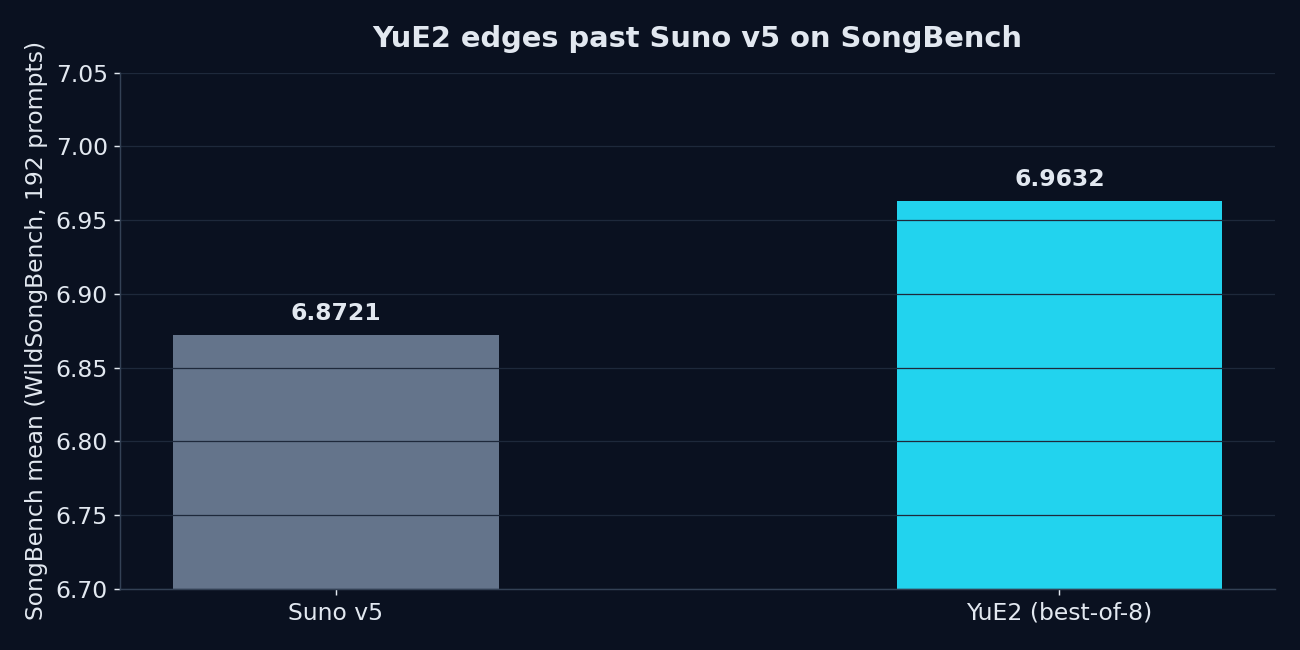 SongBench means on WildSongBench (192 prompts). Source: YuE2 project page, September 2026 evaluation.
AuK rounds out audio: an open-source 1.5B foundation model where one natural-language instruction drives speech generation and editing — trained on ~1.95M hours of supervision across five task families. Its distilled sibling AuK-Flash runs 4-step inference at a 4.5× wall-clock speedup. Code and weights are released.
Also on the radar
- ChatGPT for Financial Services (OpenAI) — a tailored ChatGPT Work experience built with Morgan Stanley and Evercore: GPT-6 Astra plus built-in Daloopa, PitchBook, LSEG News, and Crunchbase data with granular citations back to source tables.
- MiniCPM5-2B (OpenBMB) — a dense 2B on-device model hitting 2B-class open-source SOTA (LiveCodeBench v6: 69.1) with a 131K context window and its full UltraData training datasets released.
- Edge0 — an open-source streaming MoE inference framework (SSD expert offload, Recover-LoRA, prerouter prediction) plus a 35B-A3B preview model — another push to run big MoEs on modest hardware.
- RealSWE (Specific) — a benchmark of frontier models on private, licensed production codebases with native harnesses: 8 model/harness configs, 10 tasks, 640 scored rollouts. A necessary correction to benchmarks built on public GitHub issues.
What it means
Two patterns tie this week together. First, the agent era is eating research itself: the Navier–Stokes result wasn't a model answering a prompt — it was ~10,000 coordinated agents doing 88 hours of mathematics. Second, efficiency is compounding: DeepSeek cutting KV cache 4–8×, Edge0 streaming MoE experts off SSDs, Isaac trading teleop for video, MiniCPM5 hitting SOTA at 2B — the cost of frontier capability is falling on every axis at once.
For teams building products on this stack, the window between "research result" and "API feature" is now measured in days. The practical question isn't whether these capabilities reach production — it's whether your architecture can absorb them when they do.
Sources
- AI news roundup video — AI Search
- OpenAI: On the Navier–Stokes Millennium Prize Problem
- Google DeepMind: Introducing AlphaGenome Atlas
- DeepSeek: Introducing DeepSeek-V4.1-Flash
- Perceptron: Introducing Isaac 0.5
- Suno: Introducing v6
- YuE2: Frontier Music with Symbolic Planning
- AuK: Open-Source Foundational Model for Speech Generation and Editing
- OpenAI: ChatGPT for Financial Services
- MiniCPM5-2B on Hugging Face
- UniMate · WorldSculpt · Fire3D · Show-Harness · UMR · UnifoLM-WLA-1.0 · LingBot World 2 · Edge0 · RealSWE · Marigold v2 demo
- AI news
- DeepSeek V4.1-Flash
- AlphaGenome Atlas
- Navier-Stokes
- OpenAI
- Suno v6
- YuE2
- Isaac 0.5
- humanoid robots
- AI music
- AI automation
- business automation