AI8 min readBy JH Akash
What is AISEO? The Complete Guide to AI Search Engine Optimization in 2026
AISEO (AI Search Engine Optimization) is how you rank on Google AND get cited by ChatGPT, Perplexity, and AI Overviews. The complete 2026 guide.
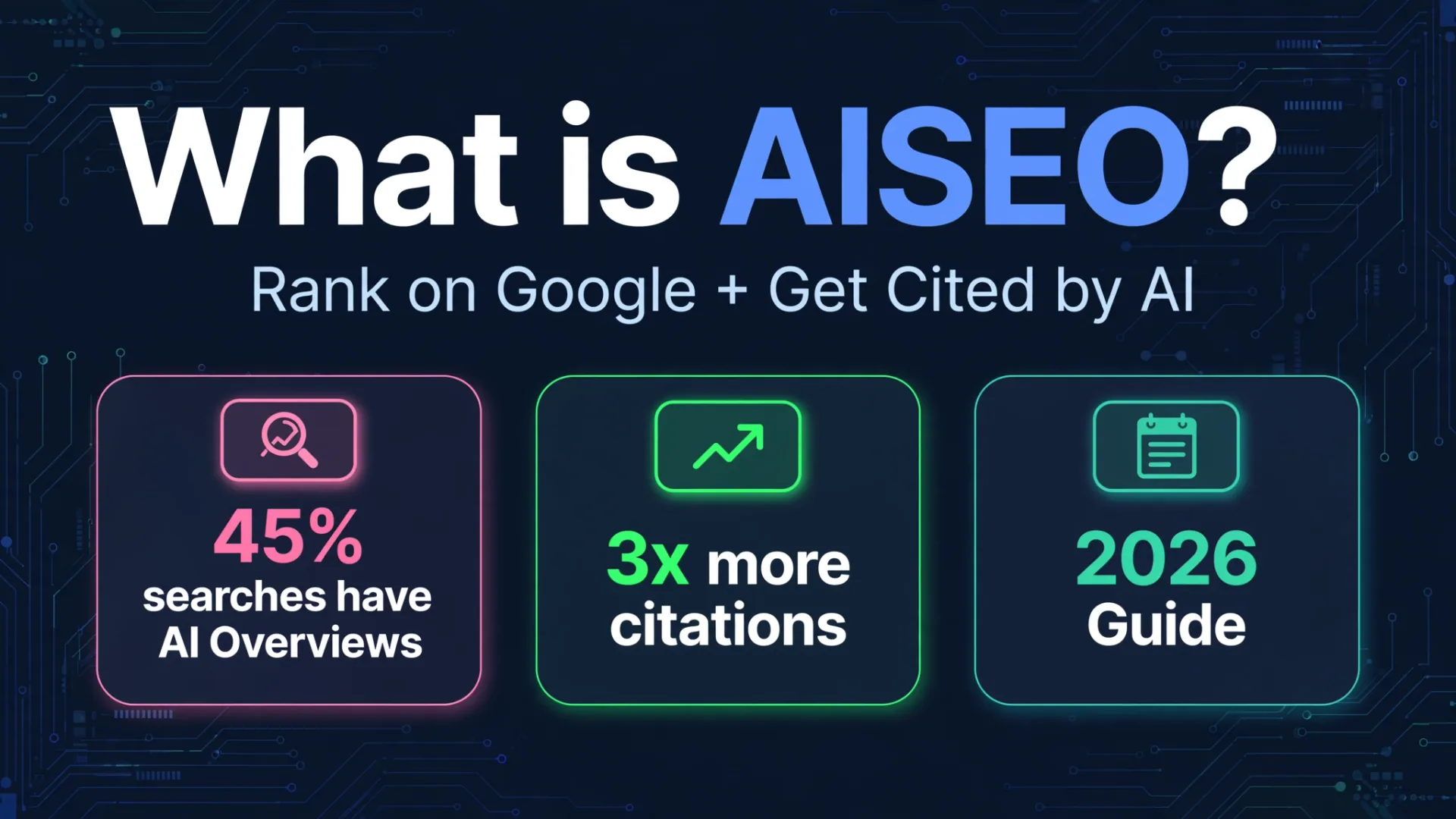
AISEO (AI Search Engine Optimization) is the practice of optimizing your content and website so it ranks on Google and gets cited by AI answer engines like ChatGPT, Perplexity, Google AI Overviews, and Gemini. While traditional SEO fights for a click from a list of blue links, AISEO fights for something more valuable in 2026: inclusion inside the AI-generated answer itself. This guide explains what AISEO is, how it differs from traditional SEO, and the exact steps to make your content visible in both worlds.
What Is AISEO? (Simple Definition)
AISEO stands for Artificial Intelligence Search Engine Optimization. It has two meanings that work together:
- Using AI tools to do SEO better. Keyword research, content briefs, technical audits, and meta tags, all accelerated by machine learning.
- Optimizing content for AI-powered search. Structuring your pages so that ChatGPT, Perplexity, Gemini, Claude, and Google's AI Overviews can find, understand, extract, and cite your content in their answers.
The second meaning is the one reshaping the industry. For twenty years, the goal of SEO was simple: rank in the top 10 blue links and earn the click. In 2026, that model no longer defines visibility. AI answer engines now summarize, interpret, and respond directly to users, often without sending a single click to any website. AISEO is the discipline of making sure your brand is part of the answer, not just a link below it.
Think of it this way: traditional SEO gets you ranked. AISEO gets you cited.
Why AISEO Matters More Than Ever in 2026
The numbers tell the story of a permanent shift:
- AI Overviews appear in roughly 45% of Google searches, and that share keeps growing.
- Pages with AI Overviews see up to 58% fewer clicks than pages without them, according to industry measurements.
- 37% of consumers now start searches with AI assistants, not traditional search engines.
- AI search traffic converts up to 4.4x higher than traditional organic search, because the visitor arrives pre-qualified by the AI's answer.
- Optimized content gets cited 3x more often than non-optimized content across AI platforms.
- 84% of links cited by ChatGPT, Claude, and Gemini point to domains the brand does not own, which means third-party mentions and entity authority matter enormously.
The takeaway is blunt: if your content is not structured to be retrieved and cited by AI systems, you are invisible to a fast-growing share of your market. And unlike traditional rankings, where page 2 means obscurity, a well-structured page can get cited by an AI answer even if it ranks on page 2 or 3 of Google. AI systems select sources based on content quality, structure, and relevance, not just rank position.
AISEO vs Traditional SEO: The Real Differences
| Aspect | Traditional SEO | AISEO |
|---|---|---|
| Primary goal | Rank in top 10 results | Get cited inside AI-generated answers |
| Success metric | Rankings, organic traffic, CTR | Citation rate, brand mentions in AI answers |
| Content style | Keyword-optimized, built for skimming | Answer-first, fact-dense, conversational |
| Key signals | Backlinks, keywords, domain authority | Entity authority, structure, freshness, third-party mentions |
| Query behavior | Short queries, ~4 words average | Long conversational queries, ~23 words average |
| User action | Clicks through to your site | Accepts the summarized answer (zero-click) |
| Trust building | Backlinks and domain authority | Consistent entity info, structured data, expert quotes, statistics |
Neither works in isolation. A page with strong traditional SEO but no clear answer structure often gets ignored by AI Overviews. A page written purely for AI extraction but with poor technical SEO may never get crawled or indexed in the first place. The winning strategy in 2026 is both: rank well and be citable.
How AISEO Works: The AI Search Pipeline
To optimize for AI search, it helps to understand how these systems actually process your content:
- Crawling. AI bots (like GPTBot) crawl your site alongside Googlebot. If your content is blocked or hard to crawl, you are out before you start.
- Indexing. Content is processed and stored, increasingly in vector databases that understand meaning, not just keywords.
- Retrieval. When a user asks a question, the AI retrieves the most relevant content chunks. Clear headings, concise paragraphs, and Q&A formats win here.
- Synthesis. The AI combines information from multiple sources into one answer. Fact-dense, well-structured content gets picked apart and reused.
- Citation. The AI cites the sources it found most authoritative. Statistics, original data, expert quotes, and clear definitions dramatically raise your odds.
Every step rewards the same things: clarity, structure, factual density, and trust signals.
AISEO, AEO, GEO: Clearing Up the Alphabet Soup
The terminology around AI search is confusing. Here is the breakdown:
- AISEO (AI Search Engine Optimization): The umbrella term. Making your content retrievable, extractable, and citation-worthy in AI-powered answer systems. It spans content structure, technical access, topical authority, and measurement.
- AEO (Answer Engine Optimization): A core component of AISEO. Structuring content so AI tools can easily extract and cite it as a direct answer. The goal is to be the answer, not just an option.
- GEO (Generative Engine Optimization): Often used interchangeably with AEO. Specifically about optimizing for visibility inside generative AI experiences like ChatGPT and Google AI Overviews.
You do not need to pick one. In practice, doing AISEO well means you are doing AEO and GEO at the same time.
The 5 Pillars of AISEO
1. Answer-First Content Structure
Put the direct answer in the first 100 words. Use clear H2/H3 headings framed as questions. Keep paragraphs short and scannable. AI systems extract clean chunks, so write in chunks: one idea per paragraph, definitions up front, steps in lists.
2. Entity Authority and Consistency
AI models build a picture of your brand from everything written about you across the web. Keep your business name, description, location, and offerings consistent everywhere: your site, directories, social profiles, and press mentions. Inconsistent entity information confuses the model and costs you citations.
3. Structured Data and Schema
Schema markup (FAQ, Article, HowTo, Organization) tells machines exactly what your content means. It is one of the highest-ROI technical moves in AISEO because it directly improves extractability.
4. Factual Density: Stats, Quotes, Original Data
Content with statistics and citations sees 40%+ higher visibility across AI queries. Original research, benchmarks, and expert quotes are citation magnets. Generic advice gets summarized without credit; specific data gets cited with your name on it.
5. Topical Authority Through Content Clusters
Cover your topic comprehensively with interlinked pillar pages and supporting articles. AI systems favor sources that demonstrate depth on a subject, not one-off pages. Build the hub, then build the spokes.
How to Do AISEO: 7 Practical Steps
- Audit your AI visibility. Test 10 to 20 of your most important queries across Google AI Overviews, ChatGPT, and Perplexity. Note where you are cited and where competitors appear instead.
- Fix the technical foundation. Fast pages, clean crawlability, mobile-friendly design, and schema markup. AISEO builds on technical SEO, it does not replace it.
- Rewrite key pages answer-first. Lead with the direct answer, add an FAQ section, break content into extractable chunks with descriptive headings.
- Add factual density. Insert statistics, original data, expert quotes, and clear definitions. Every claim worth citing should be easy to lift as a quote.
- Build topical clusters. Create a pillar guide (like this one) and link supporting articles to it with descriptive anchor text.
- Earn third-party mentions. Remember: 84% of AI citations point to domains the brand does not own. Reviews, directories, press, podcasts, and community discussions all feed the AI's picture of you.
- Measure citations, not just rankings. Track how often your brand appears in AI answers for target queries by sampling prompts repeatedly. Rankings still matter, but citation share is the new KPI.
Businesses already using AI agents to handle repetitive work, like the AI workers described in our Gemini agent breakdown, are finding that the same structured, well-documented processes that make automation work also make content AI-friendly. Clarity compounds.
AISEO Tools Worth Knowing
- Surfer SEO: Combines NLP and SERP data for real-time optimization suggestions.
- Frase: Structures content around real user questions, strong for answer-first briefs.
- MarketMuse: Audits topical authority and finds content gaps.
- Clearscope / Surfer-style graders: Score content against top-ranking pages for semantic coverage.
- Perplexity and ChatGPT themselves: The fastest way to test whether your content gets cited. Ask the question your customers ask and see who shows up.
Tools accelerate the work, but the strategy is human. As with AI decision models, the model is only as good as the judgment guiding it.
Frequently Asked Questions
What is AISEO in simple words?
AISEO means optimizing your website so it shows up in Google search results AND gets mentioned or cited inside AI answers from tools like ChatGPT, Perplexity, and Google AI Overviews.
Is AISEO replacing traditional SEO?
No. AISEO builds on top of traditional SEO. You still need crawlability, good content, and authority to rank. AISEO adds the layer that makes your content extractable and citable by AI systems. Doing one without the other leaves visibility on the table.
How is AISEO different from AEO and GEO?
AISEO is the umbrella term covering all optimization for AI-powered search. AEO (Answer Engine Optimization) focuses on being extracted as a direct answer, and GEO (Generative Engine Optimization) focuses on visibility inside generative AI tools. In practice, good AISEO covers both.
How long does AISEO take to show results?
Technical and structural changes can improve AI citation rates within weeks, especially for niche queries. Building the topical authority and third-party mentions that drive consistent citations typically takes 3 to 6 months of sustained effort.
Do I need AISEO if I already rank #1 on Google?
Yes, arguably more than anyone. AI Overviews sit above the #1 result on nearly half of searches and can cut your clicks by more than half. Ranking first without being cited in the AI answer means watching your traffic get summarized away.
What content format works best for AISEO?
Clear definitions up front, Q&A and FAQ sections, step-by-step lists, comparison tables, statistics with sources, and concise paragraphs under descriptive headings. Anything an AI can cleanly extract and quote.
The Bottom Line
Search has split into two games: the ranking game and the citation game. Traditional SEO still wins the first. AISEO wins the second, and the second is growing faster. The businesses that structure their content for both, answer-first pages, factual density, schema, topical authority, and consistent entity signals, will own visibility in 2026 and beyond.
At CodeMyPixel, we build AI systems that automate real business work, and we apply the same thinking to content: structure it so both humans and machines can use it instantly. If you want your brand cited instead of summarized away, talk to our team about an AI visibility audit.
- AISEO
- AI SEO
- AI search optimization
- AEO
- GEO
- Google AI Overviews