AI6 min readBy JH Akash
Broadcom's $60B Chip Debt: How AI's Compute Boom Is Financed
Broadcom is gathering $60B in chip financing while lending Anthropic $42B against a $125.2B TPU lease. The numbers, the structure, and what it means for AI builders.
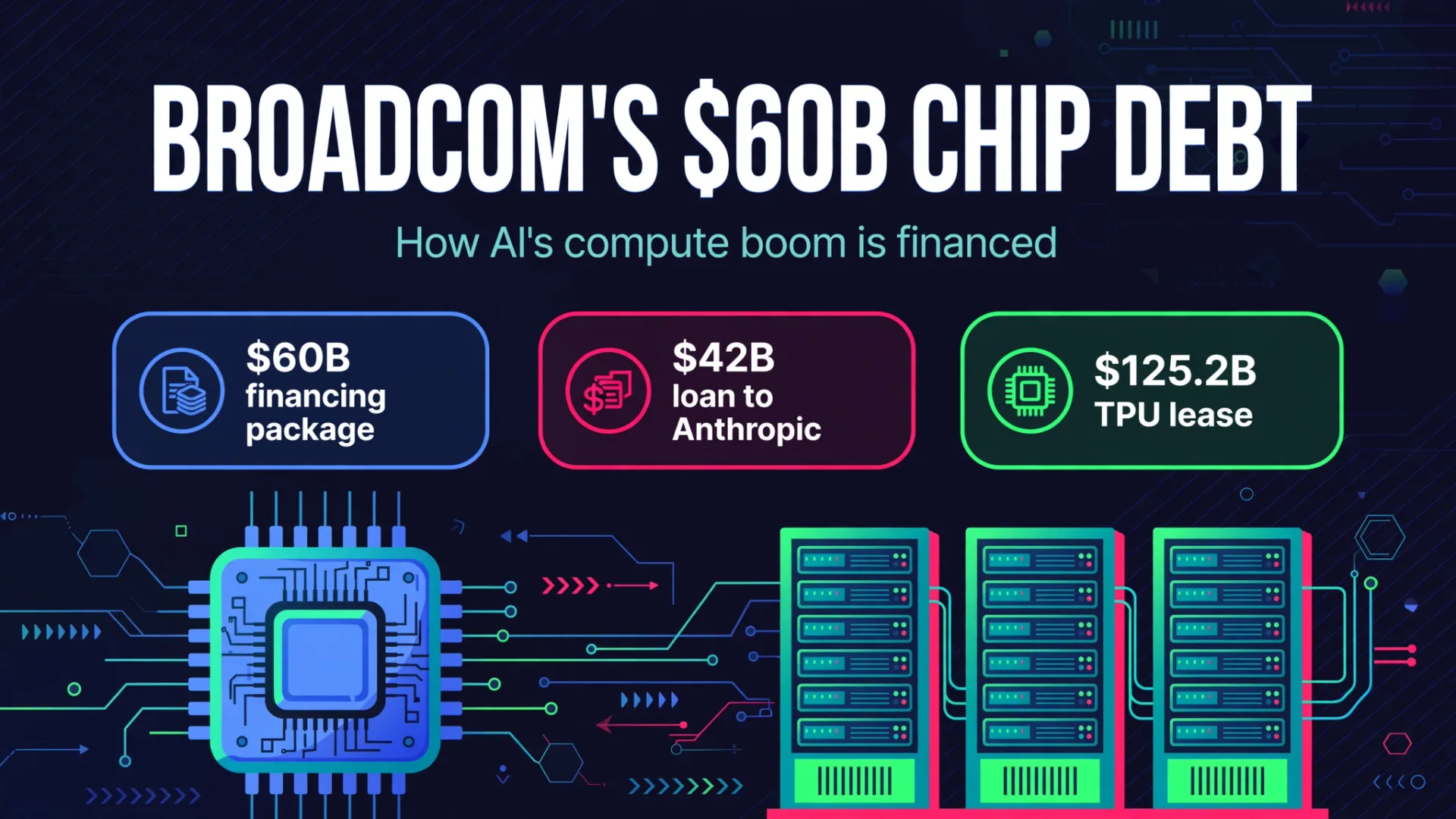
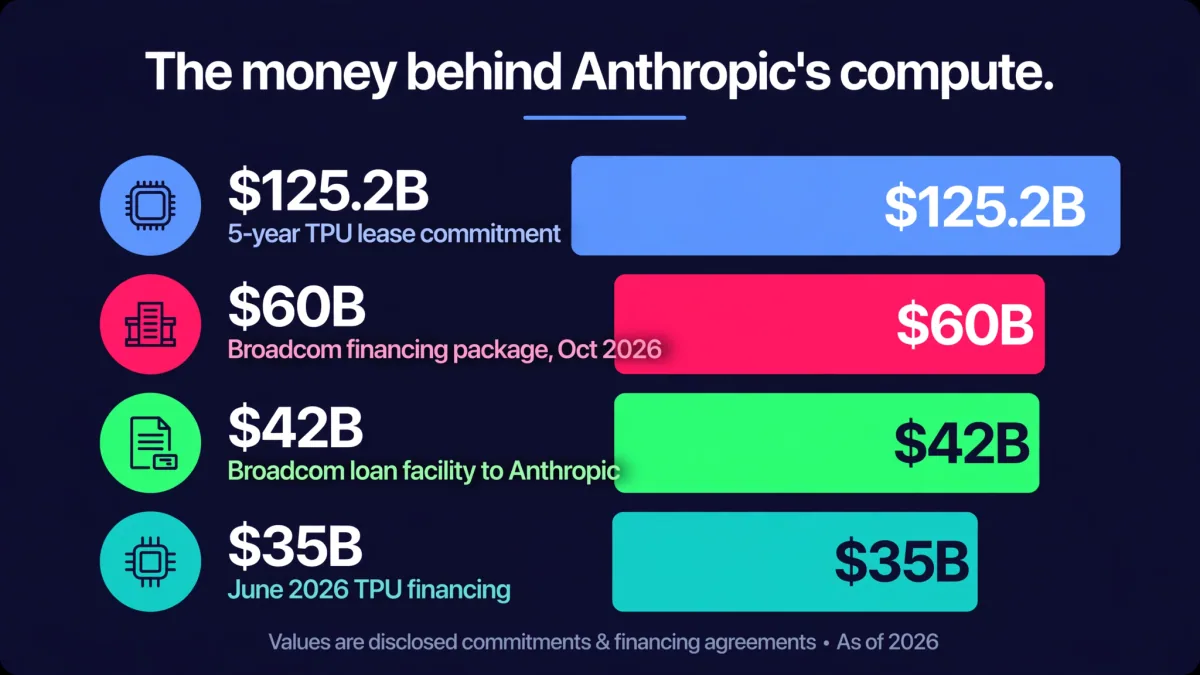
The biggest story in AI this week is not a new model. It is the debt behind the models. On October 1, Anthropic's IPO prospectus revealed that Broadcom agreed to lend the AI lab up to $42 billion to finance its compute. On October 2, Bloomberg reported that Broadcom's banking syndicate is gathering an even bigger $60 billion financing package for AI chips and infrastructure.
Taken together, these two moves show how the AI compute boom is now funded: not with cash on hand, but with layers of debt, lease commitments, and vendor financing that keep getting bigger.
The two deals, side by side
| The $42B loan facility | The $60B financing package | |
|---|---|---|
| Revealed | October 1, in Anthropic's IPO prospectus (via Reuters) | October 2, via Bloomberg |
| Size | Up to $42 billion | $60 billion total |
| Form | Convertible notes tied to TPU lease obligations | $42B Class A senior-secured debt plus $18B Class B junior debt |
| Who leads it | Broadcom itself, with the option to bring a financing partner | Blackstone leads the junior tranche with $9B of its own money |
| What it funds | About one third of Anthropic's five-year, $125.2 billion TPU lease commitment | Chips and infrastructure for Anthropic and other AI companies |
| Status | No notes expected to be sold before the IPO | Banks are preparing syndication letters; not formally announced |
What changed
October 1: the filing. Anthropic's IPO prospectus, reviewed by Reuters, documents a relationship with Broadcom that goes far beyond a supplier contract. It spans compute supply, equipment leasing, and now financing. Broadcom agreed to lend Anthropic up to $42 billion, and in turn Anthropic is expected to become the largest customer in Broadcom's chip design business next year.
The filing itself flags the tension: Broadcom is simultaneously the chip designer, the lessor of the compute, and the lender. Anthropic's prospectus warns of "potential conflicts of interest" and says Broadcom's pricing and hardware decisions could affect its ability to secure computing infrastructure.
October 2: the bigger package. Bloomberg reported that Broadcom's Wall Street syndicate has started gathering $60 billion of fresh financing for AI chips. Banks are preparing syndication letters for a $42 billion senior-secured tranche, while Blackstone leads an $18 billion junior-debt tranche, committing $9 billion through its own funds and syndicating the rest.
Important detail: no reporting connects the two $42 billion figures. The loan facility and the senior-secured tranche are separate arrangements that happen to share a number.
The context: Anthropic's 2025 finances
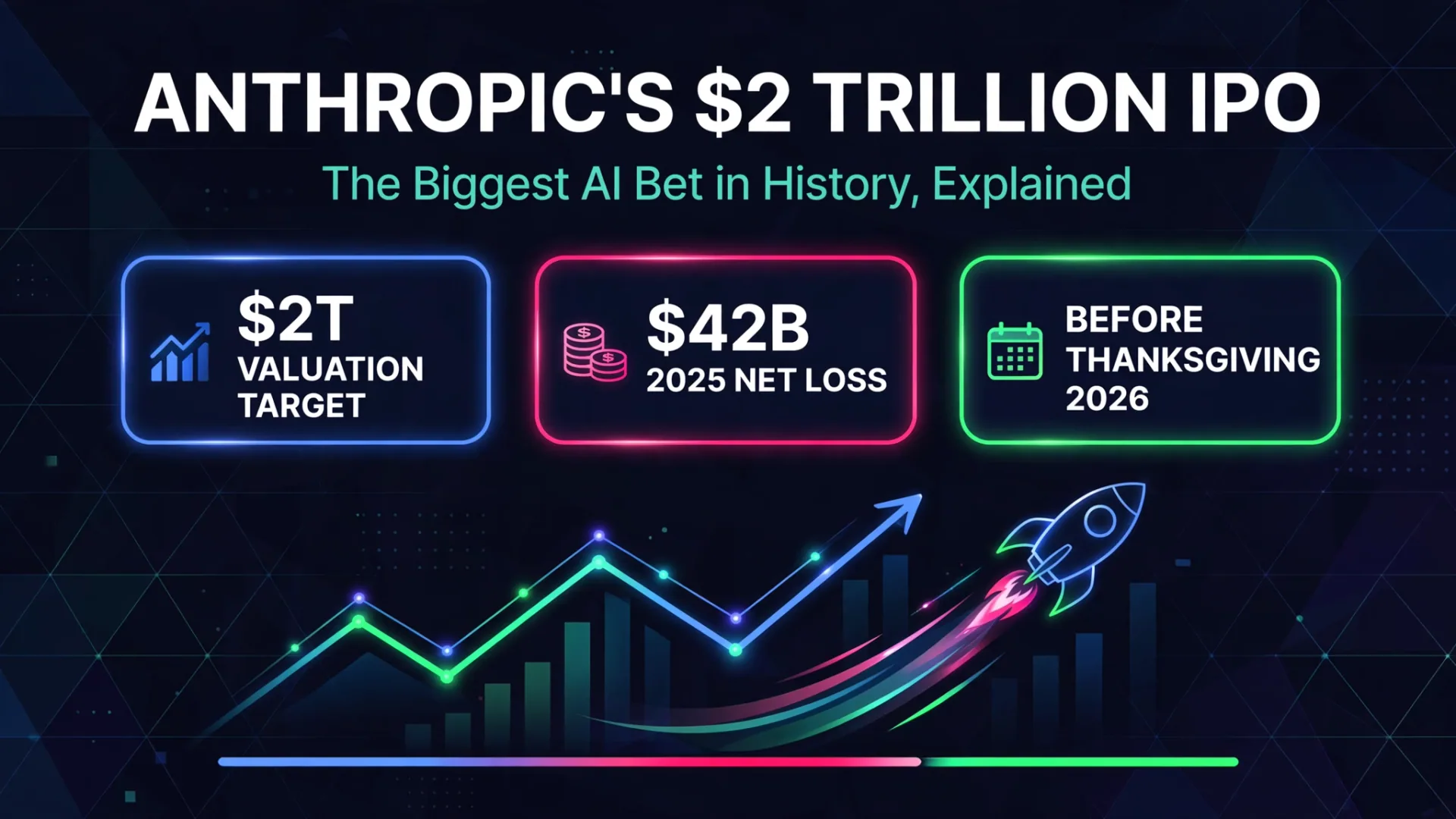
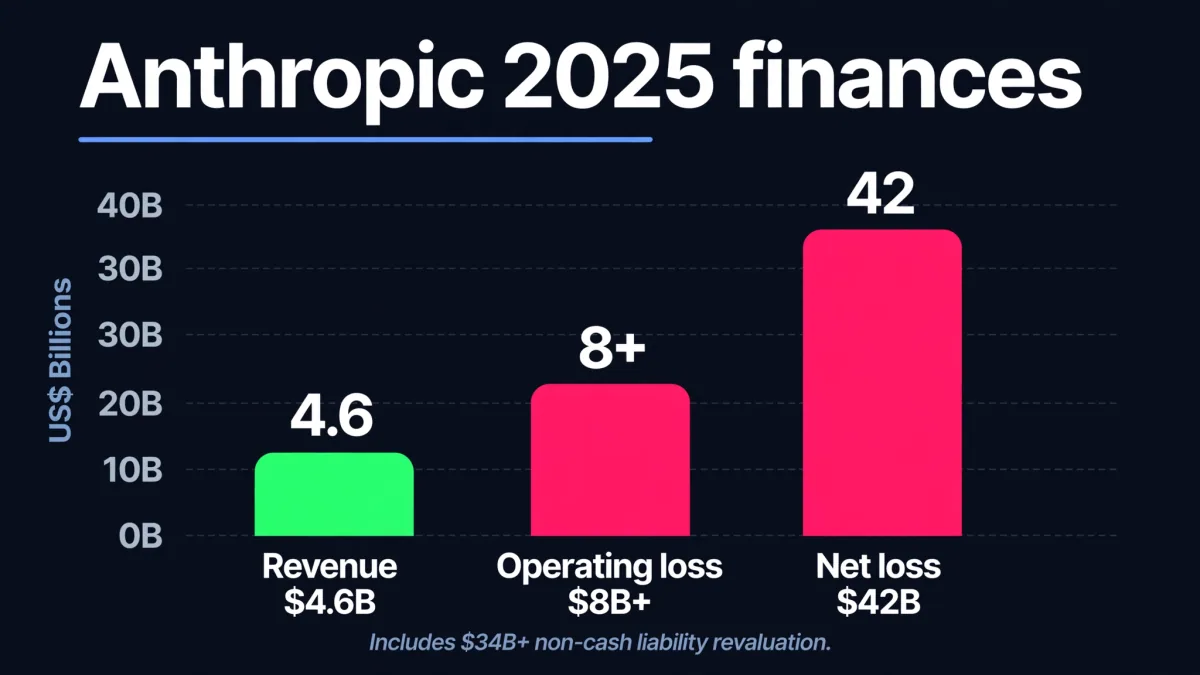
The prospectus numbers explain why the financing layers matter. In 2025, Anthropic's revenue grew about twelvefold to roughly $4.6 billion, while its operating loss exceeded $8 billion and its net loss reached about $42 billion. More than $34 billion of that net loss comes from a non-cash change in the fair value of liabilities, so it is not cash going out the door, but the cash burn is still real.
This is a company heading toward a mid-November IPO at a $1.8 to $2 trillion valuation, with investor marketing possibly starting the week of November 9. It needs compute secured years in advance, and compute at this scale only clears the market when someone finances it.
Why Wall Street is uneasy
Robert Leitao, managing partner at Rothschild and Co., told Reuters: "It feels that there's quite a concentrated bet right now on two companies being able to generate enough revenues to support all the financing that's happened."
He has a point. The circular structure is now explicit: the seller finances the buyer. Broadcom co-designs TPUs with Google, leases Anthropic the capacity through a five-year $125.2 billion commitment, and lends Anthropic the money to pay for it, with the debt convertible into Anthropic shares. Google and Broadcom announced an expanded partnership in April giving Anthropic access to multiple gigawatts of next-generation TPU capacity beginning in 2027.
Investor Michael Burry reportedly compared the pattern to the computer-leasing boom of the late 1960s, arguing that GPU-backed debt and private credit echo that era's leasing models. Whether or not the parallel holds, the concern is the same: valuations and financing commitments built on the assumption that hardware keeps paying for itself.
The pattern is spreading. AI Weekly notes Nvidia announced a $500 billion partnership with six finance firms in August to help customers fund chip purchases. In June, private lenders led by Apollo and Blackstone closed roughly $35 billion to buy Anthropic's initial TPU leases, with Broadcom acting as a contingent guarantor. Debt financing has expanded from data centers into chips and servers, with hundreds of billions raised for the broader buildout.
What it means for AI builders
Three practical takeaways:
- Compute is the real product now. Model announcements like Claude Opus 5.5 and GPT-6 Astra get the headlines, but the competition is decided by who secures multi-gigawatt capacity years ahead. The $125.2 billion lease commitment is the headline number behind every Claude release you ship on.
- Pricing power sits with whoever owns the financing. When your chip supplier is also your lender and your equity is the collateral, pricing and capacity decisions are never fully independent. Builders depending on a single model provider should watch these conflicts of interest, not just the API prices.
- The boom's weakest link is revenue. $4.6 billion in revenue against $8 billion-plus in operating losses is the reality under the $2 trillion valuation. Every financing layer assumes revenue eventually catches up. For teams building AI agents and products on top of these models, the healthy move is the same one investors use: diversify across providers and keep architectures portable.
FAQ
What is Broadcom's $60 billion financing package?
Per Bloomberg's October 2 reporting, Broadcom's banking syndicate is gathering $60 billion in debt to fund AI chips and infrastructure for Anthropic and other companies: a $42 billion senior-secured tranche that banks will syndicate, plus an $18 billion junior-debt tranche led by Blackstone, which is committing $9 billion of its own funds.
Is the $60 billion package the same as the $42 billion Broadcom loan?
No. The $42 billion loan is a convertible-note facility Broadcom agreed to extend to Anthropic, disclosed in Anthropic's IPO prospectus on October 1, covering about a third of its $125.2 billion five-year TPU lease. The $60 billion package reported October 2 is a separate, broader financing for chips and infrastructure. Reporting does not connect them.
Why did Anthropic flag a conflict of interest?
Its prospectus says Broadcom's roles as hardware supplier, equipment lessor, and financing partner create "potential conflicts of interest," because Broadcom's decisions on pricing and hardware could affect Anthropic's access to computing power.
What happens if Anthropic defaults on the TPU leases?
The convertible notes can be converted into Anthropic shares, and Anthropic's own filing warns that a default could see the money demanded and the credit cut off at the same time. Broadcom can also bring in a financing partner, spreading but not removing the risk.
When is the Anthropic IPO?
Bloomberg reported Anthropic is aiming for a mid-November 2026 debut, with formal marketing possibly starting the week of November 9 and an investor day at its San Francisco headquarters on October 14. The target valuation is $1.8 to $2 trillion.
Sources: Reuters reporting on Anthropic's IPO prospectus (October 1, 2026); Bloomberg reporting on the $60 billion financing package (October 2, 2026), as covered by Stocktwits, AI Affairs, AI Weekly, and AI Stock Wire. The Burry comparison was reported by AI Stock Wire. Figures are as disclosed in the reporting cited.
- Broadcom
- Anthropic
- AI infrastructure
- AI chips
- TPU
- AI news