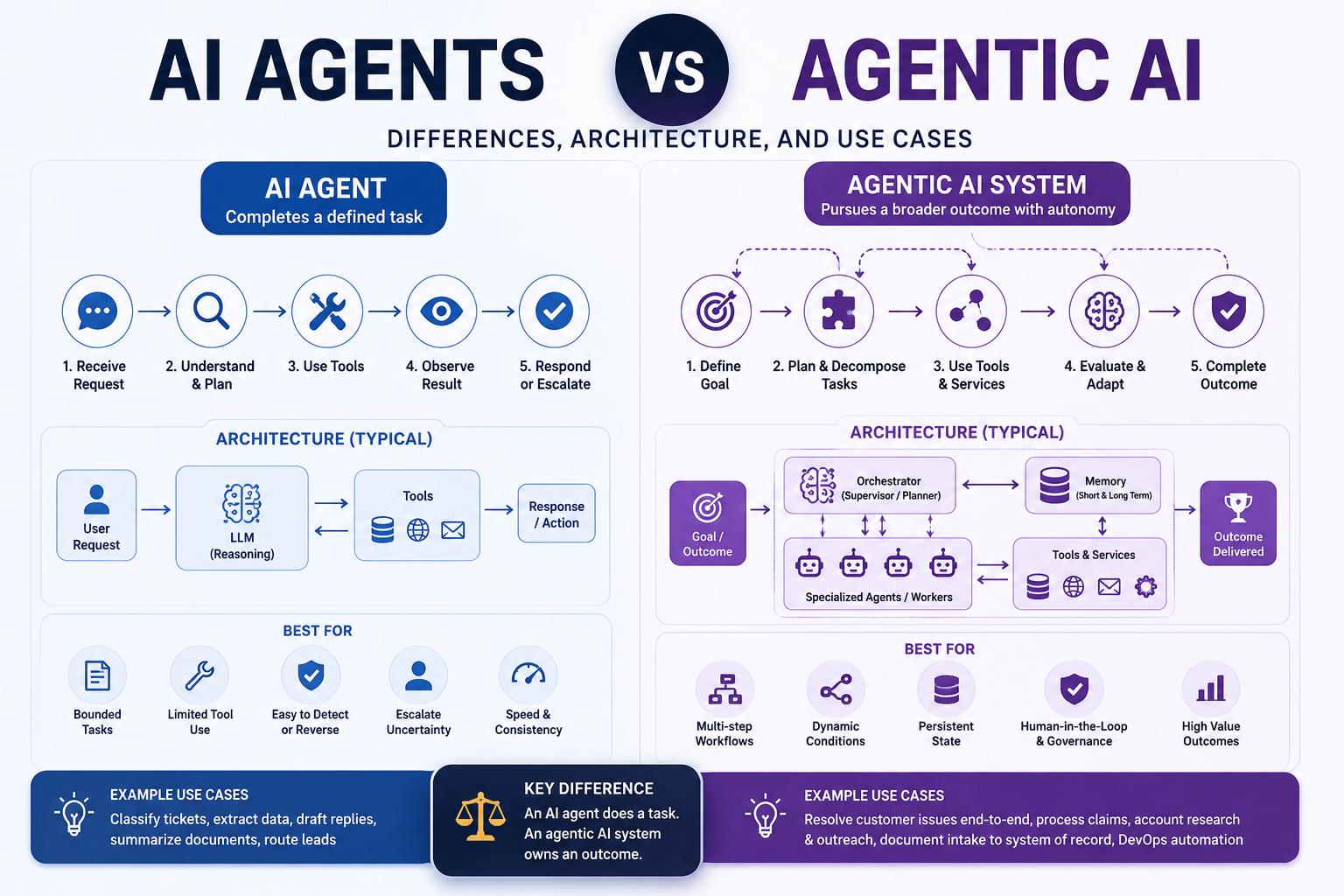
AI agents and agentic AI are related, but they are not interchangeable terms. An AI agent is usually a software component that can interpret a goal, use tools, and take actions. Agentic AI describes a broader system behavior: the ability to plan, adapt, coordinate multiple steps, recover from failure, and pursue an outcome with limited supervision.
The practical difference is scope. A support bot that checks an order status is an AI agent. A system that diagnoses the customer’s issue, checks account history, selects a resolution policy, requests approval for a refund, updates the CRM, and monitors whether the customer replies is closer to agentic AI.
This guide explains the difference, where each approach fits, what the architecture looks like, and how to avoid building more autonomy than the business actually needs.
AI agents vs agentic AI at a glance
| Dimension | AI agent | Agentic AI system |
|---|---|---|
| Primary job | Complete a defined task | Pursue a broader outcome |
| Workflow | Usually bounded | Dynamic and multi-step |
| Tool use | One or several tools | Multiple tools and services |
| Planning | Short-horizon | Multi-stage planning and replanning |
| Memory | Optional session context | Often short- and long-term state |
| Human approval | At selected actions | Built into risk checkpoints |
| Failure handling | Retry or escalate | Diagnose, replan, retry, or hand off |
| Best fit | Repetitive, narrow tasks | Complex workflows with changing conditions |
The distinction is not binary. Systems exist on a spectrum from a single prompt, to a tool-using agent, to a workflow with deterministic branches, to a highly adaptive agentic system.
What is an AI agent?
An AI agent combines a model with instructions, context, and tools. The model interprets the request and decides what to do next. Tools let it retrieve data or take an action, such as searching a knowledge base, querying a database, creating a ticket, or sending a message.
A basic agent loop is:
- Receive a goal or request.
- Inspect available context.
- Choose a tool or produce an answer.
- Observe the result.
- Stop, retry, or escalate.
This pattern is valuable when requests vary enough that rigid rules become expensive, but the outcome is still bounded. Examples include classifying support tickets, extracting fields from documents, drafting account summaries, and routing sales leads.
What is agentic AI?
Agentic AI adds broader autonomy and orchestration. The system may decompose a goal into tasks, maintain state across steps, delegate work to specialized agents, evaluate intermediate results, and change its plan when conditions change.
Agentic behavior commonly includes:
- Goal decomposition into smaller tasks.
- Tool selection based on the current state.
- Memory that persists beyond one model response.
- Reflection or evaluation before committing an action.
- Human approval for high-impact decisions.
- Recovery logic for timeouts, invalid data, and failed tools.
- Observability that records decisions, tool calls, latency, cost, and outcomes.
The 2026 Stanford AI Index describes rapid growth in AI capability and investment, while also warning that evaluation and governance are not keeping pace. That gap matters most in agentic systems because errors can propagate across several actions instead of remaining inside one answer.
Five architecture differences that matter
1. A task boundary vs an outcome boundary
An agent should have a clear task boundary: summarize this record, verify this invoice, or draft a response. An agentic system may be responsible for an outcome such as resolving a customer issue or preparing a sales opportunity for a human closer.
Outcome ownership creates more value, but it also creates more ways to fail. Define what the system is allowed to decide, what it can recommend, and what always requires approval.
2. Short context vs persistent state
A simple agent may only need the current conversation. Agentic systems often need durable state: which steps are complete, which tool outputs are trusted, what approvals are pending, and how to resume after interruption.
Persistent state should be explicit and auditable. Do not treat a long chat transcript as a reliable database.
3. Tool use vs tool governance
Giving a model access to a tool is easy. Governing that access is the real engineering work. Every tool should have a narrow schema, permission checks, input validation, timeouts, idempotency rules, and a clear audit trail.
OWASP guidance for generative AI applications highlights risks such as prompt injection, insecure output handling, excessive agency, and sensitive information disclosure. These risks become more serious when a model can write to production systems.
4. One decision loop vs orchestration
Agentic AI may use a supervisor agent, a graph workflow, or deterministic code to coordinate specialized components. A good design keeps predictable business rules in code and uses a model where interpretation or flexible reasoning is genuinely useful.
More agents do not automatically create a better system. Multi-agent designs add latency, token cost, coordination errors, and more difficult debugging. Start with one agent and split responsibilities only when the boundaries are measurable.
5. Answer quality vs system reliability
For a chatbot, teams often evaluate response quality. For an agentic system, evaluation must include the full trajectory:
- Task completion rate.
- Correct tool selection rate.
- Invalid action rate.
- Human escalation rate.
- Average steps per successful run.
- Cost per completed outcome.
- P50 and P95 completion time.
- Recovery rate after tool failure.
These metrics reveal whether the system is useful in production, not just impressive in a demo.
Real examples of AI agents and agentic AI
Customer support
AI Agent: Answers a question from approved documentation.
Agentic AI: Identifies the issue, retrieves account data, proposes a remedy, gets approval when required, updates the ticket, and schedules follow-up.
Sales operations
AI Agent: Enriches one lead.
Agentic AI: Researches the account, scores fit, drafts personalized outreach, updates the CRM, waits for engagement, and changes the next step based on the response.
Document operations
AI Agent: Extracts fields from a document.
Agentic AI: Checks document quality, requests missing pages, validates extracted data against business rules, sends exceptions to a reviewer, and posts approved records to another system.
Software delivery
AI Agent: Writes or reviews a function.
Agentic AI: Investigates an issue, changes code, runs tests, analyzes failures, requests approval, and prepares a release artifact.
When should you use a basic AI agent?
Choose a bounded agent when:
- The task has a clear start and finish.
- The permitted tools are limited.
- A mistake is easy to detect or reverse.
- The system can escalate uncertainty to a person.
- The value comes from speed and consistency, not long-horizon autonomy.
This is the right default for most first deployments. A narrow agent produces cleaner evaluation data and exposes integration problems before autonomy expands.
When is agentic AI justified?
Agentic AI is justified when the workflow has multiple dependent steps, conditions change during execution, and the economic value is large enough to support stronger engineering and governance.
Use this decision test:
- Does the workflow require interpretation at several stages?
- Can success be measured automatically?
- Are actions reversible or approval-gated?
- Is the source data reliable and permissioned?
- Will the system save enough time or improve enough outcomes to cover monitoring and maintenance?
If several answers are “no”, automate a smaller part of the process first.
A safe implementation path
Phase 1: Assist
The system recommends actions but cannot execute them. Measure accuracy, usefulness, and adoption.
Phase 2: Act with approval
The system prepares tool calls or transactions and waits for a person to approve them. Record rejection reasons as evaluation data.
Phase 3: Limited autonomy
Allow low-risk actions within defined limits. Add rate limits, budgets, policy checks, and automatic rollback where possible.
Phase 4: Outcome automation
Expand autonomy only after the system meets reliability targets over representative traffic. Continue sampling completed runs for human review.
NIST’s AI Risk Management Framework organizes this work around governance, mapping risk, measuring system behavior, and managing identified risks. That is a useful operating model for any team moving from a chatbot to an autonomous workflow.
Frequently asked questions
Is every AI agent agentic AI?
No. An agent can use tools and make a limited decision without having broad planning, persistent state, or adaptive multi-step behavior.
Are agentic AI systems always multi-agent?
No. A single agent with a state machine, tools, memory, evaluation, and recovery logic can behave agentically. Multi-agent architecture is one option, not a requirement.
What is the biggest risk of agentic AI?
The biggest operational risk is uncontrolled action: the system makes a plausible but incorrect decision and then propagates it through tools. Narrow permissions, approvals, validation, and traceable logs reduce that risk.
How should an agentic AI project be measured?
Measure completed business outcomes, not only answer quality. Track task success, action accuracy, escalation, latency, cost, recovery, and downstream business metrics.
Final takeaway
The useful question is not whether AI agents or agentic AI is more advanced. It is how much autonomy the workflow can support safely and profitably.
Start with the smallest agent that can create measurable value. Add planning, memory, orchestration, and autonomy only when the data shows that each layer improves the outcome. If you need help designing a production architecture, CodeMyPixel can map the workflow, integration boundaries, evaluation plan, and approval controls before development begins.
Sources
- Stanford HAI, 2026 AI Index Report: https://hai.stanford.edu/ai-index/2026-ai-index-report
- NIST AI Risk Management Framework: https://www.nist.gov/itl/ai-risk-management-framework
- OWASP GenAI Security Project: https://owasp.org/www-project-top-10-for-large-language-model-applications/
- LangGraph workflows and agents: https://docs.langchain.com/oss/python/langgraph/workflows-agents